
• Skip to main content
Daily Citizen
  • Subscribe
  • Categories
    • Culture
    • Life
    • Religious Freedom
    • Sexuality
  • Parenting Resources
    • LGBT Pride
    • Homosexuality
    • Sexuality/Marriage
    • Transgender
  • About
    • Contributors
    • Contact
  • Donate

education

Jan 08 2025

Parents Support Core Subjects, Keep Males out of Female Sports

A new poll from Parents Defending Education (PDE) shows what parents support – and oppose – in key education areas such as boys in girls sports and private spaces, educational freedom, and the need for schools to focus on core subjects.

The poll also looked at parents’ views about gender ideology, “grading for equity” to “address racial disparities in grading,” and schools withholding information from parents.

PDE, founded in 2021, describes itself as “a national grassroots organization working to reclaim our schools from activists promoting harmful agendas.”

The organization publishes an online “IndoctriNation Map,” where parents and concerned citizens publish information about radical activism in public schools. PDE also identifies parent organizations in each state that oppose extreme ideologies and fight for parental rights in education and students’ privacy and safety.

The survey of 1,000 parents across the country with children 18 years old or younger was conducted for PDE by CRC Research.

Almost three-fourths of the parents (73%) were young, between the ages of 18 and 44, and their responses were generally conservative. It’s clear that parents want quality education for their children, free from ideologies that sexualize and confuse them.

Here are some key findings from the survey:

  • 96% of the parents supported educational freedom, agreeing “that parents should be able to choose the best educational option for their child.”
  • While 60% said they would keep their children in their current school, 19% of parents said that, given the option, they would move their children to a different school. Another 16% said they would homeschool their children, given the option.
  • In terms of what schools should teach, 90% of those surveyed said schools should focus “core subject areas, such as math, reading, writing, science and social studies.”
  • 72% of parents somewhat or strongly oppose “‘grading for equity’ to address racial disparities in grading.”
  • Only 14% of parents thought schools were “good” at “enforcing student behavior policies,” while 58% said schools were “fair” and 36% said they were “poor.” 96% of parents want “clearly stated and enforced expectations when it comes to maintaining order in classrooms.”
  • 80% of the parents surveyed disagreed with schools helping children change their “gender identity” without notifying parents, and 75% oppose school employees “withholding information about a child’s gender identity from parents.” 77% want parents to be informed “if their child wants to use a different name or pronoun at school.”
  • Parents want sex-segregated sports and private spaces, with 78% opposing males on girls teams and 77% opposing males who “identify as females” in “female bathrooms and locker rooms and vice versa.”

In a statement about the results, PDE president Nicole Neily commented:

These results highlight that parents are dissatisfied with a number of elements of the modern American education system – and that there is broad-based consensus that it’s time for schools to get back to basics.
For far too long, federal bureaucrats have sacrificed the needs of students and families in order to appease unions’ and activists’ insatiable demands for money and power.

PDE’s director of Outreach, Erika Sanzi, concluded that parents want to be informed when their child struggles with mental health issues like gender identity:

This poll shows overwhelming opposition to school personnel withholding information from parents about their child’s gender identity at school. …
It’s refreshing to see even more confirmation that people think this ubiquitous trend of facilitating gender transitions behind the backs of parents is complete madness and needs to stop.

If you’re concerned about what your child is being taught in school, check out this updated, free resource from Focus on the Family and Family Policy Alliance: Equipping Parents for Back-to-School.

We want parents to feel confident and equipped to manage issues affecting public – and private and online – schooling. The FREE downloadable resource helps you be aware of what’s going on in your child’s classroom and offers guidance for how to advocate for your child in the school year ahead.

Related articles:

Focus on the Family: Putting Children First in Education

Focus on the Family Parenting: Thriving Student

Is ‘Critical Race Theory’ Being Taught in Public Schools? CRT Deniers Claim it Isn’t

Is it ‘Book Banning’ to Keep Sexually Explicit Books out of Schools?

Reading and Math Scores Plummeted During Pandemic, New Report Finds

Sexualizing Schoolchildren: Classroom and Library Books

Students’ Test Scores Tank After School Consults ‘Woke Kindergarten’

Image from Shutterstock.
Written by Jeff Johnston · Categorized: Education · Tagged: education, transgender

Dec 13 2024

Boise State Closes DEI Centers, Follows National Trend

Another one bites the dust.

Boise State University quietly closed its Student Equity and Gender Equity Centers over Thanksgiving Break, students found out this week. The closure reportedly anticipates a state education resolution banning diversity, equity and inclusion (DEI) programs in public colleges and universities.

The Idaho State Board of Education drafted the “Resolution on Diversity, Equity and Inclusion in Higher Education” to “establish and maintain equality of opportunity so that all students may succeed regardless of personal identity characteristics.”

The document would prevent public colleges from:

  • Dedicating a central office, policy, procedure or initiative to DEI, outside those required for getting degrees, scholarships or grants.
  • Using “personal identity characteristics” to determine hiring or admissions decisions.
  • Requiring students and employees to declare their “gender identity” or “preferred pronouns” in “any form of communication.”

BSU isn’t the only school to back away from DEI in the past month. Idaho State University got rid of its Office of Equity and Inclusion on November 14, vowing to “restructure and rename” it the Office of Equal Opportunity and Title IX.

The University of Idaho also signaled intentions to close its Equity and Diversity Unit , including the Office of Multicultural Affairs, Women’s Center, Black and African American Cultural Center and the LGBTQ+ Office. No changes have yet been implemented.

Idaho’s declining acceptance of DEI reflects national discontent with the ideologies taught on college campuses. Once a bastion of DEI in higher education, the University of Michigan announced last week it would no longer require prospective employees to make commitments to further the school’s DEI goals.

Idaho already prevents public institutions from requiring such “diversity statements.”

DEI programs assume relationships between social identity groups are inherently oppressive. They aim to equalize social and economic disparities between social identity groups by isolating, uplifting and changing rules for “oppressed” groups.

The University of Michigan spent eight years and $250,000,000 buying into this dogma — with little to no benefit. More than half of the money went to hire DEI administrators and teachers, rather than helping students pay tuition. In a 2022 survey of students and faculty, most reported a less positive campus climate and a decreased “feeling of belonging” on campus than before DEI.

Investigative reporter Nicholas Confessore writes of the survey:

Students were less likely to interact with people of a different race or religion or with different politics—the exact kind of engagement DEI programs, in theory, are meant to foster.

Good on Idaho’s higher education system for confronting an ideology that fosters polarization rather than learning.

Additional Articles and Resources

Diversity Statements Booted From University of Michigan Hiring Process

Luigi Mangione: Alleged Killer Apprehended with All-Too-Familiar Manifesto

Hurray for Walmart Abandoning DEI Programs and Policies: ‘Biggest Win Yet’

Oklahoma Bans DEI in Universities and Government Agencies

Despite Supreme Court Ruling on Affirmative Actions, Race Will Continue to Influence Who Gets in College, ‘Wall Street Journal’ Reports.

Indoctrination Station: New York State Education Department Pushes Critical Theory on Students

Written by Emily Washburn · Categorized: Education · Tagged: DEI, education

Dec 06 2024

Diversity Statements Booted From University of Michigan Hiring Process

The University of Michigan (U-M) will no longer require prospective employees to make commitments to further the school’s “Diversity, Equity and Inclusion” (DEI) goals, or diversity statements, Provost Laurie McCauley announced Thursday. Until now, U-M’s affiliates could choose to solicit these statements from applicants, people up for promotion and professors seeking tenure.

The decision comes months after McCauley convened a faculty committee to consider the merits of diversity statements. The group initially recommended keeping such hiring methods — but later changed its mind.

The committee made its first recommendation in deference to “U-M’s commitment to DEI.” By that, it means “the massive amounts of time and money U-M spends on DEI.” The university has poured approximately $250,000,000 into DEI since 2016, according to internal metrics reviewed by investigative reporter Nicholas Confessore, more than half of which has gone toward hiring DEI personnel.

In 2021, the Heritage Foundation found U-M had six DEI officials for every 100 faculty members — the highest ratio of any of the 65 large public universities studied. U-M’s DEI hires continue to outpace its overall faculty growth.

After the school debuted its second DEI program in 2023, the number of employees in the university’s central DEI office, and employees with “diversity,” “equity” or “inclusion” in their title, increased by 70%, finance professor Mark J. Perry told The New York Times Magazine. In contrast, U-M’s faculty has only grown 10% since 2021.

U-M affiliates use diversity statements to maintain the ideological homogeneity the school has worked so hard to achieve. Its Collegiate Fellowship program, for instance, reportedly asks applicants whether they would contribute to DEI by researching “race, gender, diversity, equity and inclusion,” accomplishing a “significant academic achievement in the face of barriers,” or demonstrating “commitment to allyhood through learning about structural inequities.”

But institutional investments don’t always match the opinions of the rank and file. McCauley’s committee changed its recommendation when a survey of more than 2,000 U-M faculty members showed most disliked diversity statements.

The University of Michigan Record reports of the survey:

Most responding faculty agreed that diversity statements put pressure on faculty to express specific positions on moral political or social issues. Slightly more disagreed than agreed that diversity statements allow an institution to demonstrate a commitment to diversity, equity and inclusion by cultivating DEI in the faculty.

The committee eventually recommended to remove diversity statements from the hiring process and, instead, embed DEI principles in their teaching and research standards. McCauley and the school’s Board of Regents elected to ignore the second half of this recommendation, deciding to do away with diversity statements all together.

It’s a big decision, signaling U-M’s willingness to evaluate the effectiveness of DEI on campus. By most available metrics, it’s a bad investment.

In his October exposé on DEI at U-M, Confessore noted such policies, including diversity statements, help U-M pursue racial diversity without breaking the law.

Michigan doesn’t allow public schools or employers to hire based on racial preferences and, in June 2023, the Supreme Court ruled colleges could no longer use race as a determining factor in which students get admitted. U-M subsequently discovered it could use diversity statements to legally identify candidates from marginalized groups. In a federal funding request for the Collegiate Fellows program, U-M noted that “a high percentage of fellows [with] demonstrated commitments to DEI are likely to come from traditionally marginalized groups.”

But screening students this way isn’t entirely successful. U-M has a more racially diverse faculty now than when DEI started, as well as higher rates of Asian, Hispanic and first-generation student enrollment. But enrollment among black students, which U-M has been trying to increase since the 1960s, has remained relatively steady between 4% and 5%. Michigan has a total black population of 14%.

Nor have DEI policies made the school a better place to learn. In a 2022 survey of students and faculty, most reported a less positive campus climate and a decreased “feeling of belonging” than before DEI. Confessore writes:

Students were less likely to interact with people of a different race or religion or with different politics — the exact kind of engagement DEI programs, in theory, are meant to foster.

Nor have DEI policies protected marginalized students from racism and hatred. Between February 2023 and June 2024, U-M received 67 student complaints of harassment and discrimination. “An overwhelming majority involved allegations of antisemitism,” according to Confessore.

U-M only investigated one of these complaints — an error so egregious that the Civil Rights Office at the Department of Education found the university had failed to comply with its Title VI obligations.

U-M bet the farm on DEI. Now, it must reckon with the consequences of its bad investment. Let’s pray other schools find the courage to do the same.

Additional Articles and Resources

Hurray for Walmart Abandoning DEI Programs and Policies: ‘Biggest Win Yet’

Oklahoma Bans DEI in Universities and Government Agencies

Despite Supreme Court Ruling on Affirmative Actions, race Will Continue to Influence Who Gets in College, ‘Wall Street Journal’ Reports.

Written by Emily Washburn · Categorized: Culture, Education · Tagged: college, DEI, education

Dec 03 2024

Indoctrination Station: New York State Education Department Pushes Critical Theory on Students

This is Part 2 of a two-part series examining the New York State Education Department’s (NYSED) systematic indoctrination of its students. Part 1 reveals a New York school district’s adoption of gender ideology. Part 2 explores the NYSED’s intentional perpetuation of Critical Theory.

The American public school system relies on an unspoken agreement between taxpayers, parents and the government. Citizens fund schools and, in exchange, schools teach kids to become productive, well-educated members of society.

The New York State Education Department (NYSED) has abandoned this age-old partnership in favor of indoctrinating students into Critical Theory, the philosophical root of “Diversity, Equity and Inclusion,” gender ideology and intersectionality.

According to the department, schools have only two responsibilities:

New York State understands that the responsibility of education is not only to prevent the exclusion of historically silenced, erased, and disenfranchised groups, but also to assist in the promotion and perpetuation of cultures, languages and ways of knowing that have been devalued, suppressed, and imperiled by years of educational, social, political, economic neglect and other forms of oppression.

You read that right. The government institution responsible for the education of more than 2.4 million children believes educators aren’t responsible for teaching or fostering character development. Instead, they exist to lead a social revolution.

This is just one of the critical positions articulated in the “Culturally Responsive-Sustaining Education Framework” (CR-S), a document that influences curriculum taught in the department’s more than 4,400 public schools. Hastings-on-Hudson district Superintendent William S. McKersie claimed his district’s “gender lessons” were “created in alignment” with CR-S after the curriculum drew criticism online.

Critical Theory is a philosophical derivative of Marxism. It argues that relationships between social identity groups are inherently oppressive, and that all social and economic inequalities stem from these unjust relationships. To achieve justice, critical theorists believe citizens must actively equalize and dismantle unfair power dynamics.

In CR-S, NYSED uncritically accepts the idea that “structural inequities” in American society prevent people of marginalized classes from succeeding:

A complex system of biases and structural inequities is at play [in students’ lives], deeply rooted in our country’s history, culture and institutions. This system of inequity … routinely confers advantage and disadvantage based on linguistic background, gender skin color, and other characteristics.

The department holds educators responsible for upending this system. CR-S suggests teachers can achieve this goal by “empowering students as agents of social change.”

Most parents don’t send their kids to school so they can become a cog in a niche social movement. NYSED doesn’t appear to care. Instead, it aspires to educate students who:

  • “Experience academic success.”
  • “Are sociopolitically conscious and socioculturally responsive.”
  • “Have a critical lens through which they challenge inequitable systems of access, power and privilege.”

Two of these goals are explicitly ideological; they advance the “integrated assertions, theories and aims” of Critical Theory. Students are graded based on their adherence to these controversial concepts.

A “sociopolitically conscious” student, according to CS-R, must believe that American society inherently and unfairly benefits some identity groups over others.

[Students will] recognize that personal, cultural and institutionalized discrimination creates and sustains privileges for some while creating and sustaining disadvantage for others.

Students can “demonstrate excellence” in sociopolitical consciousness by being “inclusive-minded” and focused on “expressions of diversity” including race, social class, gender, language, sexual orientation, nationality, religion and ability.

“Socioculturally responsive” students must demonstrate respect for people of different backgrounds and understanding of culturally diverse education. They must also:

Build alliances across differences to eradicate all forms of discrimination [and] act as agents of social change to redress historical and contemporary oppression.

Whatever that means.

In the “Culturally Responsive-Sustaining Education Framework,” the NYSED has published its intention to indoctrinate and mobilize students in pursuit of a problematic, controversial creed. This agenda taints every public school in one of America’s most populous states.

Students and parents deserve better. NYSED shouldn’t receive a dime of government money until it recommits to its fundamental teaching responsibilities.

Additional Articles and Resources

Kindergarteners Taught Gender Ideology in New York School District

To Understand Cancel Culture, You Must Know Philosopher Herbert Marcuse

Critical Abortion Theory

Written by Emily Washburn · Categorized: Culture, Education · Tagged: education

Dec 02 2024

Kindergarteners Taught Gender Ideology in New York School District

This is the first in a two-part series examining the New York State Education Department’s (NYSED) systematic indoctrination of its students. Part 1 reveals a New York school district’s adoption of gender ideology. Part 2 explores the NYSED’s intentional perpetuation of Critical Theory.

A New York elementary school found itself in hot water shortly before Thanksgiving after it allegedly introduced a new “gender curriculum” for kindergartners. But Superintendent William S. McKersie says it’s nothing new — the whole school district has been teaching gender ideology for years.

The popular X account @LibsofTikTok outed Hillside Elementary School for teaching gender ideology after it obtained a copy of its kindergarten “gender curriculum.” The program synopsis, which Hillside reportedly emailed to parents, endeavors to “center [kindergarten students’] discussions on gender identity” by introducing concepts like:

  • “Identity is who you are.”
  • “Identity includes your gender and the pronouns that you use.”
  • “There is no right or wrong way to be any gender.”

The curriculum teaches that gender isn’t linked to biological sex. The five- and six-year-olds learn to use “cisgender,” “transgender” and “non-binary” to describe a person whose internal sense of being male or female matches their biological sex, a person whose feeling of being male or female doesn’t match their biological sex, and a person who doesn’t feel male or female, respectively.

Unlike the alphabet or addition, Hillside’s kindergarten gender lessons don’t teach students how to perceive or navigate reality. Instead, it perpetuates a philosophical belief system that denies the importance and, in some cases, the existence of biological sex.

But don’t worry, parents — educators will introduce this vocabulary in a “developmentally appropriate way.”

@LibsofTikTok’s original post suggested that Hillside hadn’t yet implemented the curriculum. Superintendent McKersie’s internal response to the backlash claims gender ideology has been a district-wide mainstay for years.

“The gender lessons have been in place for several years and are rooted in Hillside’s core values of respect and fostering dignity for all students,” he wrote.

McKersie claims the brouhaha began when his district, Hastings-on-Hudson, “notified elementary families that Curriculum Synopses for all subjects were available on the website.” By his reckoning, parents should not have been surprised:

The gender lessons have been well received by the vast majority of students and families. We have made annual presentations to families about the lessons. I also have made a point to meet with parents regarding the gender lessons.

A third-grade gender curriculum obtained by @LibsofTikTok supports McKersie’s claim that gender ideology is an established part of the district’s teaching material. The synopsis suggests the school’s 8- and 9-year-olds learn to use people’s “preferred pronouns” as soon as they learn what a pronoun is.

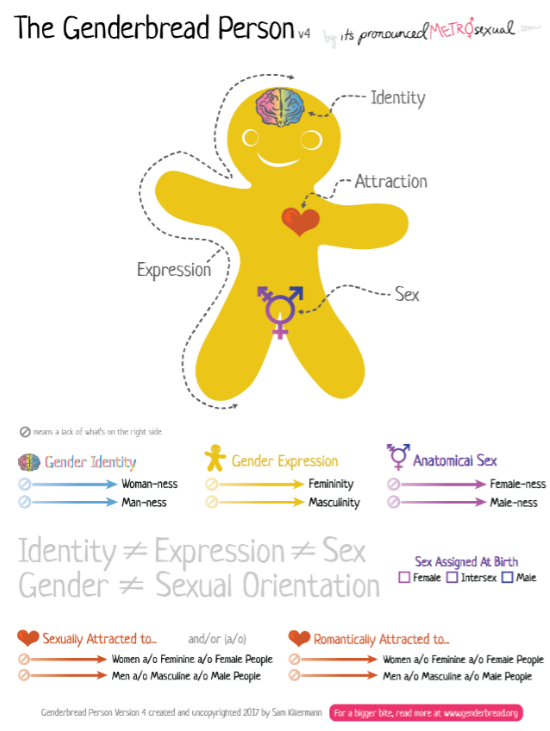
McKersie promises HOH’s gender lessons “do not address sex education or sexuality.” But gender ideology is intimately tied to sexual expression and behavior. Consider this “resource” design to help students determine their “gender identity”:

Regardless, teaching gender ideology defeats the purpose of sending children to school. Taxpayers pay for public schools so kids can become productive members of society. Perpetuating gender ideology diminishes their creative potential.

Teaching children they can “choose” their gender exponentially increases their likelihood of experiencing gender confusion. Natural bodily discomforts become indications a child was “born in the wrong body.” Gender-confused children learn to interpret their bodies as worthless errors, rather than intentional gifts.

Though research shows gender confusion is a socially sensitive, often temporary phenomenon, some of these children will undergo irreversible opposite-sex hormone treatments and surgeries to “affirm” their “gender identity.” These interventions occur before the legal age of consent but consign the recipient to a lifetime of medical complications. “Gender affirming treatments” do not demonstrably improve mental health, but frequently result in sterilization.

Prioritizing “gender identity” over biological sex effectively eliminates sex-based protections for women. Men who “identify” as women can access women’s sports, bathrooms, locker rooms and other private spaces. Biological differences that can make women vulnerable to men, like men’s greater strength and bone density, are minimized or ignored.

In other words, gender ideology has the educational benefit of a beginner’s course in Klingon and the social benefit of “Armed Robbery 101.”  The fact that a New York school district has been hawking gender ideology for years — apparently without some parents’ knowledge — is unconscionable.

Even worse? The tax-funded body responsible for more than 2.4 million public school students explicitly endorses it.

Stay tuned for Part 2.

Additional Articles and Resources

Court Sides With parents Over Teaching First Graders ‘Transgender Ideology’

The Shifting Ground of ‘Gender-Affirming Care’

‘Transgender’ Means Many Different Things — and Nothing

Here’s What Happens When Good People Don’t Connect Gay and Trans Ideology

U.K.’s Review of Child Gender Policy Reveals Profound Failures that U.S. Still Defends

The WPATH Files Exposes ‘Surgical and Hormonal Experiments on Children’

England’s NHS Stops Dispensing Puberty Blockers for Children — Not Safe or Effective

Former ‘Transgender Clinic’ Worker Blows the Whistle, Becomes First to Speak Out Against ‘Transitioning’ Minors

Gaines, Women’s Rights Groups Support Women Appealing Case of man Joining Sorority

New Research Confirms Gender Dysphoria Usually Temporary in Children and Young Adults

Written by Emily Washburn · Categorized: Culture · Tagged: education, LGBT, transgender

  • « Go to Previous Page
  • Page 1
  • Interim pages omitted …
  • Page 4
  • Page 5
  • Page 6
  • Page 7
  • Go to Next Page »

Privacy Policy and Terms of Use | Privacy Policy and Terms of Use | © 2026 Focus on the Family. All rights reserved.

  • Cookie Policy