• Skip to main content
Daily Citizen
  • Subscribe
  • Categories
    • Culture
    • Life
    • Religious Freedom
    • Sexuality
  • Parenting Resources
    • LGBT Pride
    • Homosexuality
    • Sexuality/Marriage
    • Transgender
  • About
    • Contributors
    • Contact
  • Donate

IFS

Jul 07 2025

Married Fatherhood is Key to Recovering Thriving Masculinity

It has been well documented that men are increasingly falling behind women in important measures of life attainment like workforce participation, college enrollment and graduation, general health, hopefulness in life, life expectancy, and overall well-being.

The Institute for Family Studies has an important new article by a professor at the Yale School of Medicine explaining how married fatherhood plays a massive and irreplaceable role in improving the growing masculinity crisis. Dr. Samuel Wilkinson believes the power of married fatherhood is central to reviving healthy manhood because it is essential to what gives life meaning for men. He asks, “What is it about human connection that gives life meaning and purpose?” Wilkinson explains that leading research projects from the world’s most prestigious universities regularly demonstrate meaning comes from intimate connectedness with other humans. He adds, “Why relationships are rewarding has to do with the way nature shaped our family relationships.”

Of course, it cannot be missed that marriage and fatherhood are central to the family and human thriving. Every new person that nature and nature’s God gives us issues directly from one man and one woman. This process is obviously more intimate and direct for the female than the male. Wilkinson notes,

“While women carry and nourish life within their bodies for months, a man’s biological contribution is relatively brief. It’s even possible for a man to conceive a child and not even know it. For a woman, such a scenario is absurd.

He adds, “This biological difference often translates into a more tenuous emotional connection between men and their children.” Therefore, fatherhood must be enforced as a necessary and expected personal and social value. Why? Because the man is naturally less tied to his offspring than is the child’s mother. It is why anthropologist Margaret Mead, in her book Male & Female, described fatherhood as a “social invention.” If the society does not insist on it and actively train young males for it, it is far less likely to happen.

She explains the humanly universal nature of this fact:

When we survey all known human societies, we find everywhere some form of the family, some set of permanent arrangements by which males assist females in caring for children while they are young. … Its distinctiveness lies … in the nurturing behavior of the male, who among human beings everywhere helps provide food for women and children.

Mead notes this practice does not come naturally to men. It must be taught by older men, encouraged and expected by women, and enforced by society. She adds,

“In every known human society, everywhere in the world, the young man learns that when he grows up, one of the things he must do in order to be a full member of society is to provide food for some female and her young.”

It is a sociological fact that it works out best for the man, the woman, and the child, if that child is the offspring of their marital union because “every known human society rests firmly on the learned nurturing behavior of men” Mead explains. And thus, Professor Wilkinson adds, “In short, the quality of a man’s marriage is a strong predictor of the quality of his fathering.” That is how dad remains tied to and encouraged to provide daily for his child and his children’s mother.

Nothing else can change a man into the pro-social contributor like marriage and fatherhood. Wilkinson explains, “Becoming a father can be transformative” as it “can awaken a man to his deepest capacities for love, sacrifice, and responsibility.” This is because, “Fatherhood – when linked to marriage – acts as a catalyst for healthy masculine development.”

Professor Wilkinson is precisely right.

No society has ever discovered how to build healthy manhood apart from its connection to marriage and fatherhood. Military service can come certainly transform men but ultimately fails because its mission is different. The discipline of sports cannot do it, because it does not and cannot tame the male sexual drive, nor does it nurture selflessness. Neither of these trains and encourages men to deny themselves and work to provide for their children and the children’s mother. Only marriage brings that out of men in any effective fashion.

As Nobel prize winning economist George Akerlof explained in a celebrated academic paper, men do better in nearly every measure of male well-being when they marry and become fathers.

Akerlof’s scholarship demonstrates, “Married men are more attached to the labour force; they have less substance abuse, they commit less crime, are less likely to become victims of crime, have better health, and are less accident prone.” This is because, as Akerlof puts it, “With marriage, men take on new identities that change their behaviour.” These new identities are “husband” and “father.” In short, he concludes, “Men settle down when they get married; if they fail to get married, they fail to settle down.”

We must remember these truths in every effort our society undertakes to reclaim essential and healthy manhood.

Related articles and resources:

Are Government Policy and Culture Making Men Weak?

Andrew Tate’s Counterfeit Masculinity

Superman and a Culture in Need of Masculinity

Why manhood doesn’t happen naturally

The Important Parenting Differences Between Moms and Dads

Married Fatherhood Makes Men Better

Important New Research on How Married Parents Improve Child Well-Being

New Research Shows Married Families Matter More Than Ever

Why Men Matter

The Unique Matter of Manhood

How the Left’s Gender War Backfired — Tremendously

The War on Masculinity is Toxic: Exclusive Interview with Prof. Nancy Pearcey
Written by Glenn T. Stanton · Categorized: Culture · Tagged: IFS, Random

Apr 24 2025

New Research Shows How Important Family Strength is for Academic Performance

Important new research published by the Institute for Family Studies (IFS) from highly respected family scholar Nicholas Zill explains, “When it comes to student achievement and adjustment, the advantage of being raised by married birth parents has actually increased over the last quarter century.”

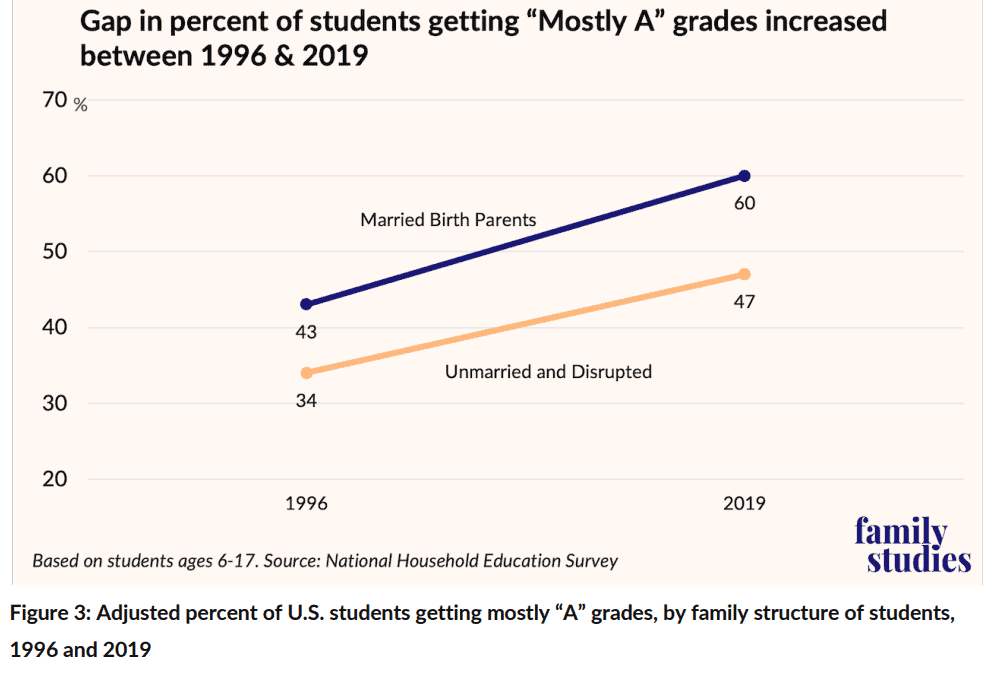
This good news comes from a larger IFS research brief on the impact married moms and dads and intact families have on academic performance. The report addresses the problem of rising grade inflation in American schools. In the mid-90s, 40 percent of students in elementary, middle and high school in the U.S. earned “mostly A” grades on their report cards. In 2019, that number rose to 54%.

Good news, right? Students are doing better.

Not quite. Nicholas Zill explains,

These grading and disciplinary changes are partly the result of well-intentioned though largely cosmetic efforts to improve social mobility and reduce gaps between racial, ethnic, and economic groups in this country. Progressive education reformers have sought to make family background less of a determinant of how well a student does in school.

However, he adds some very important news,

Despite the ballooning number of students getting stellar grades on their report cards, those being raised by their married birth parents are still more likely to get mostly “A” grades than those being raised by single parents, stepparents, cohabiting birth parents, or other relative or non-relative guardians. This is the case even after taking account of parent-education and family-income differences across family types, as well as differences in their racial and ethnic composition.

Zill demonstrates the trendlines this way.

He then explains, “The intact family advantage has actually increased as grading has become more lenient.” Specifically, “It went from 1.45 times better odds in 1996 to 1.68 times better odds in 2019, a statistically significant change.”

Schools Contacting Parents for Troubling Behavior

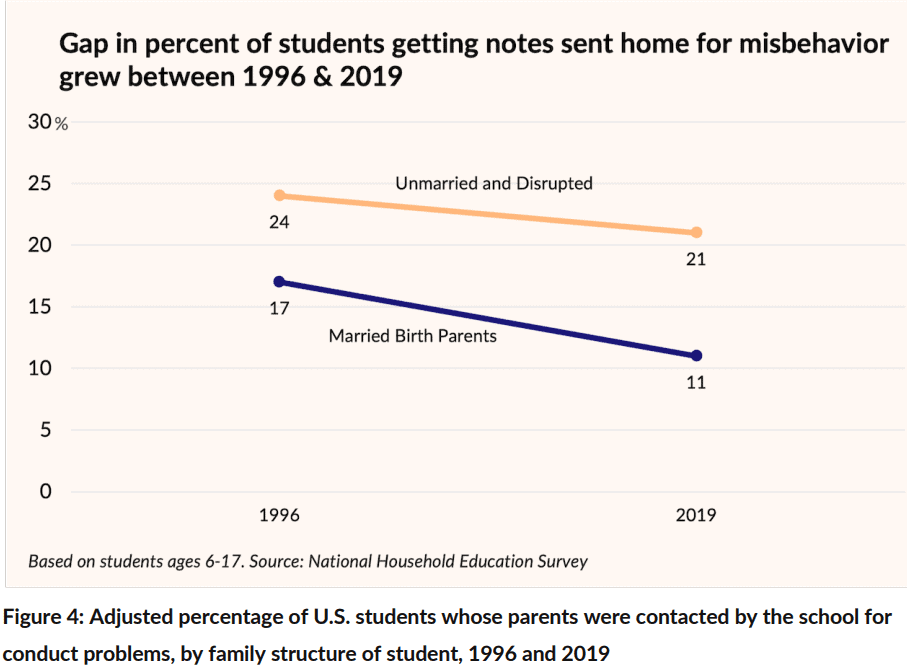
It’s not only grades that are improved by intact married families. Not surprising, behavior does too. IFS finds that “Despite the overall drop in school contacts with parents, students being raised in unmarried and disrupted families are more likely to get emails sent to their parents from the school than those being raised by their married birth parents.” This remains true even after scholars adjust for parent’s education, race/ethnicity and family income differences across various family types.

These disciplinary trendlines look like this.

Dr. Zill asserts, “The disrupted family disadvantage increased even though disciplinary practices have become more lenient. It went from 1.63 times higher odds in 1996 to 2.09 times higher odds in 2019, a statistically significant change.”

Conclusion

IFS finds that these benefits to children being raised by married mothers and fathers are due to how marriage boosts well-being and success for parents. They hold these married parents “are also more likely to have followed the “success sequence” of first finishing school, then finding employment, then getting married, and then having children.” Contrarily, “Never-married mothers have, by definition, not followed at least part of that sequence.” Of course, these relatively simple but consequential life choices matter.

This new research report concludes,

The results reported here are a further demonstration of the difficulty of overcoming family influences — both hereditary and environmental — on student achievement and adjustment.

The moral of the story is that married homes, with moms and dads investing in their marriages and in their parenting as a team make real measurable differences in the lives of their children and the larger community.

Related Articles and Resources

New Report Gives Update on Family Formation and Child Well-Being

Important New Book Explains Why Marriage Still Matters

Family Scholars Explain the Current Marriage Paradox in America

New Research Shows Married Families Matter More Than Ever

Mapping Declining US Marriage Rates

Mapping US Fertility and Married Parenting Rates

Mapping US Divorce Rates

Mapping US Unmarried Cohabitation Rates

Why Marriage Really Matters – 3 Focus on the Family Reports

Research Update: The Compelling Health Benefits of Marriage

Cohabitation Still Harmful – Even as Stigma Disappears

Image from Shutterstock.

Written by Glenn T. Stanton · Categorized: Family · Tagged: IFS

Mar 04 2025

Liberal Women are Sadder Than Conservatives: Less Faith, Fewer Marriages?

It is fairly well-documented in the academic literature that women suffer poorer mental health compared to men and this is generally true cross-culturally. It is also well documented that conservatives tend to have greater mental health and happiness compared to liberals. This gap has been demonstrated since the 1970s.

Additional research shows that girls who lean more left politically are experiencing plummeting levels of mental health. A new report, highlighted by the Institute for Family Studies (IFS), indicates this trend is not diminishing, but growing more stark.

It is tragic.

IFS explains “Young liberal women are markedly less satisfied with life than their conservative peers.”

  • 37% of conservative women report being “completely satisfied” with life.
  • 28% of moderates indicated this.
  • Only 12% of liberal women reported being completely satisfied.

This means young conservative women are just over three times more likely to feel very happy in their lives than their liberal peers. IFS adds, “Moreover, liberal women are two to three times more likely to report they are ‘not satisfied’ with their lives, compared to conservative women.”

Journalist Matthew Yglesias has an idea for what causes this disparity, saying, “One possible culprit for this widespread sadness is that social media apps are especially damaging to girls’ psychological health, a thesis long championed by Jonathan Haidt.”

But this does not fully explain the stark conservative/liberal divide. IFS thinks there is more to the story, explaining,

Given that we’re “social animals,” as Aristotle noted, we think different levels of “social integration” between liberal and conservative young women also may have a hand in the happiness divide between the two groups.

They explain how young conservative women are far more likely to be married and much less likely to be cohabiting. They are also far more likely, by almost five times, to be attending weekly church services.

Add to this, liberal women ages 18 to 40 are much more likely to report frequent feelings of loneliness and 29% report feeling this way many times a week. Only 11% of conservative women report this. Marriage and church boost social integration, which is an important mental and physical health factor.

The take-away here is that ideas have big consequences, as Richard Weaver famously put it. What we believe and what we practice in our lives matters for good and bad. All ideas are not created equal. Some led to better heath and contentment. Some create less happiness and feelings of loneliness.

IFS concludes “that any efforts to bridge this ideological gap in young women’s emotional well-being will seemingly require not only a change in thinking but also a renewal of young liberal women’s connection to America’s core institutions—family and faith.”

Related articles and resources:

Four Things to Enhance Marital Happiness Among Wives

Research Finds Republican Husbands More Faithful; Religious Even More

New Research: Marriage Still Provides Major Happiness Premium

Marriage and Family Improves Happiness Far More Than a Pay Raise

Married Mothers and Fathers Are Happiest According to Gold-Standard General Social Survey

Important New Book Explains Why Marriage Still Matters

Why You Should Care About the Growing Positive Power of Marriage

Why Soulmate Marriage is Less Healthy Than Family-Centric Unions

MythBuster: No, the Divorce Rate is Not as High in the Church as the World

Written by Glenn T. Stanton · Categorized: Marriage · Tagged: IFS, marriage

  • « Go to Previous Page
  • Page 1
  • Page 2

Privacy Policy and Terms of Use | Privacy Policy and Terms of Use | © 2026 Focus on the Family. All rights reserved.

  • Cookie Policy