Best Age to Marry? Good Research Offers an Answer

Most everyone who marries intends to be married for life, for isn’t that what our marriage vows promise, to “have and to hold from this day forward, … till death do us part?”
Thus, parents and young adults ask this question quite often: What is the best age to marry?
They want to make sure that new marriages are established upon the strongest foundation of life, love, experience, and maturity.
But more people are putting off marriage until later in life. Today, the median age at first marriage in the United States is 30 for men and 28 for women. It has been rising markedly since 1960 where it was 23 for men and 20 for women. In 2000, it was 27 for men and 25 for women.
Is this delay in marriage wise? Is there an age at first marriage that is more ideal for marital longevity than others for men and women? Let’s look at what the research says.
A 2010 study conducted by Norval Glenn, a noted and now deceased sociologist of family from the University of Texas Austin, reported, “The greatest indicated likelihood of being in an intact marriage of the highest quality is among those who married at ages 22–25.” He adds that “findings do suggest that most persons have little or nothing to gain in the way of marital success by deliberately postponing marriage beyond the mid-twenties.”
A 2023 study of this question was conducted by a careful graduate student at Brigham Young University, Anne Marie Wright Jones. The scholar examined 16 marriage quality measures – things such as forgiveness, relationship communication, conflict management, relationship satisfaction, sexual satisfaction and marital instability – relative to age at first marriage.
She explains, “I found few significant links between age at marriage and marital quality for women or men. When statistically significant relationships emerged, they were relatively weak.”
Marital relationship satisfaction by age at first marriage looked like this:
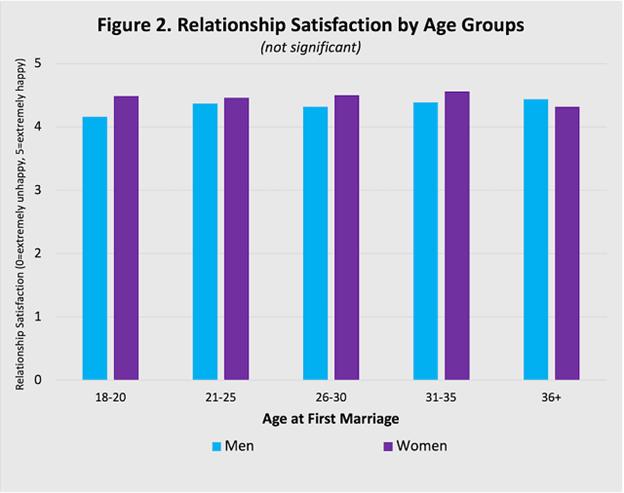
She adds, “Also, while most men and women were happy in their marriage, age at marriage did not significantly influence their marital happiness.” She also found that “the presence of children, are a much stronger predictor of marital quality than age at marriage.” Her data showed “little support for the widely-accepted idea that marrying in your early 20s produces lower quality marriages.”
Widely respected sociologist of marriage Andrew Cherlin was likely the first scholar to distinguish between what have become known as capstone and cornerstone marriages. What are these?
Capstone marriages are those that take place in later 20s or 30s, as the crowning capstone on individual educational and career achievements by the man and woman. Cherlin explained this in 2004: Marriage is now more often “a status one builds up to, often by living with a partner beforehand, by attaining steady employment or starting a career, by putting away some savings, and even by having children.” Marriage as the final, celebratory cap on material and status achievement.
Cornerstone marriages are essentially marriages where a couple marries in their early 20s and the marriage serves as their foundation of building a life of further education, career establishment and having kids together. For these, marriage is the foundational cornerstone facilitating life achievement and family growth.
Cherlin adds:
These are indeed two competing views of marriage in the adult life course. Is one better at establishing a long-term, healthy marriage and life than the other? Many assume capstone marriages would be stronger because they come after schooling and career are established. This does not appear to be true.
The National Marriage Project at the University of Virginia released a report in 2022 which employed three reputable datasets with large, nationally representative samples to compare marital success outcomes from cornerstone and capstone marriages. The team “found little evidence that capstone marriages are more stable than cornerstone marriages.”
In fact, they found “some evidence that, on average, cornerstone or early marriages may enjoy slightly higher relationship quality than capstone marriages.”
The good folks at the Institute for Family Studies (IFS) have written two very helpful articles on the positives of early adulthood marriages.
One entitled “Marry Early and Flourish Together” makes the case for the measurable benefits of early twenty-something marriages. After presenting compelling research evidence for his case, author Kasen Stephensen concludes:
The other IFS piece, by Lyman Stone and Brad Wilcox, presents “evidence suggesting that religious Americans are less likely to divorce even as they are more likely to marry younger than 30.” One leading reason is because “religious marriages in America may be more stable is that religion reduces young adults’ odds of cohabiting prior to marriage, even though it increases their likelihood of marrying at a relatively young age.”
Finally, noted University of Texas sociologist Mark Regnerus has also persuasively made a case for wisdom of early marriages. In 2009 he contended:
Marriage is vitally important. Society cannot function without it, literally. So, founding new marriages on a strong foundation is essential, not just for the couple, but for the community.
There are compelling reasons why early twenty-something marriage can be wise for young, mature couples of serious faith who have the support of their parents. It can serve as a helpful and empowering cornerstone for a long, prosperous and rewarding life of growing together. It can also serve as a witness and encouragement to others who are considering marriage but believe the growing societal script that they are “too young to marry.”
Afterall, ask any couple who has been married fifty years or more, and you are likely to hear a story of an early twenty-something marriage that served as their own cornerstone launching pad for the successful and rewarding life they now live.
Related Articles and Resources
Research Shows Marriage Boosts Well Being
Are Men or Women More Likely to Be Married?
New Research Shows Married Families Matter More Than Ever
Why You Should Care About the Growing Positive Power of Marriage
Important New Research on How Married Parents Improve Child Well-Being
New Research: Marriage Still Provides Major Happiness Premium
Cohabitation Still Harmful – Even as Stigma Disappears
Don’t Believe the Modern Myth. Marriage Remains Good for Women
Don’t Believe the Modern Myth. Marriage Remains Good for Men.
Yes, Married Mothers Really Are Happier Than Unmarried and Childless Women
Marriage and the Public Good: A New Manifesto of Policy Proposals


ABOUT THE AUTHOR