Fixing Feminism with a Christian Worldview: Is it Possible?
Feminism has long been an absolute disaster.
You know the movement is bankrupt when it is unwilling to simply define what a woman is. As bad as that is, feminism’s problems run far beyond this. As Chesterton rightly observed a century ago, feminism came to despise the truly feminine. Feminism worships abortion and contraception. It abhors domesticity. It is set against motherhood.
It’s almost like feminists don’t actually like women.
But it was not always this way. Early feminism fully celebrated important aspects of being a woman, particularly the gift of motherhood. In fact, the temperance movement – wives and mothers working to protect their husbands and sons from the dangers of alcohol – was much more numerous and powerful than the suffragette movement. Matrons of the feminist movement were strongly pro-life and pro-motherhood. It was second and the third wave feminism that made such a mess of things.
But an important new effort by some brilliant women seeks to build a new women’s movement centered upon the full beauty and mystery of what it genuinely means to be a woman, a wife and mother, while also accentuating how men and women need each other in society and in marriage.
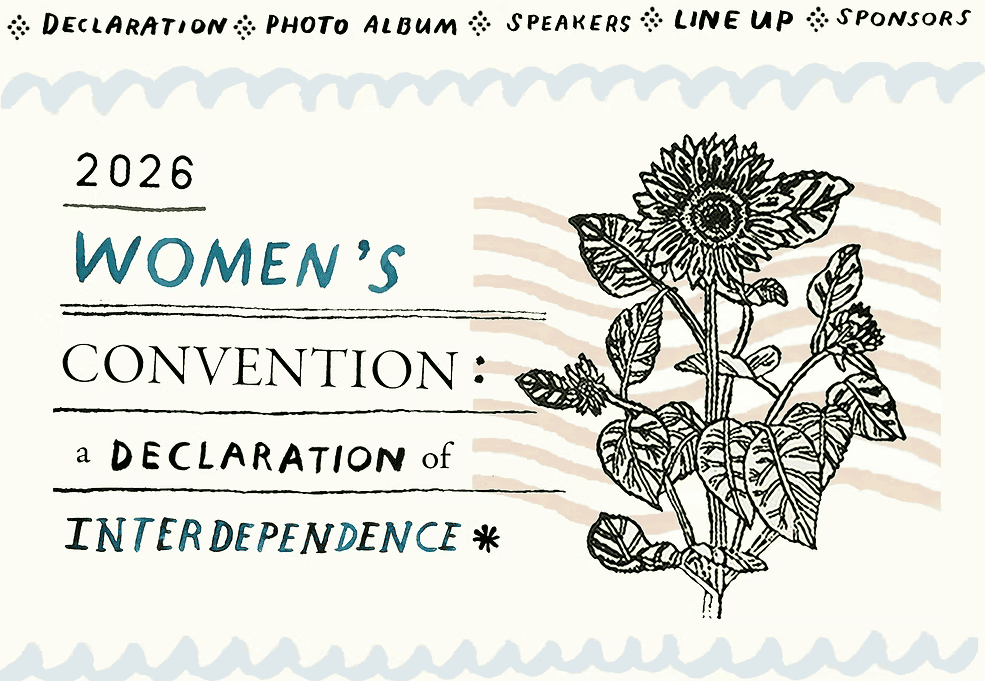
This effort held its first national convention on September 17-19 in Rochester, New York at the historic Academy of Medicine. The gathering was entitled “2026 Women’s Convention: A Declaration of Interdependence,” operating under a conference theme of “A better way forward for women.” Champions of the family and those who care about culture should know about this development. This movement stems from the work of the ground-breaking online journal Fairer Disputations, which features the work of leading thinkers trying to forge a better understanding of why family, fidelity, marriage, and natural fertility and family are so important.
Approximately 200 women attended this inaugural event with one journalist noting the conspicuous prevalence of babies happily being toted around by their mothers. That is an obvious quality that sets this gathering apart. Katelyn Walls Shelton, a visiting fellow studying concerns around reproductive biotechnology at the conservative Ethics and Public Policy Center,participated in the convention. She told the Daily Citizen, “The Women’s Convention really felt like history in the making.”
This convention also launched an important public declaration, its Declaration of Interdependence, a document that’s the brainchild of pro-life legal scholar and mother of seven children at home, Erika Bachiochi and was drafted in cooperation with other convention organizers. The statement celebrates the necessity of men and women for each other in marriage, parenthood and family as well as the larger society. Thus, the key word in the title: Interdependence. Cecelia Lester, President of Feminists Choosing Life of New York, called the convention to order and thanked her husband for his influence and support in her community life in her remarks.
Bachiochi told Commonplace magazine, “A lot of the people associated with the convention are doing the best thinking on this, they want marriage and family to work.” She said they also have a different motivation. “They are tired of … the gender wars because many of us have men in our lives who we care deeply about, who care deeply about us.” These women are trying to build a women’s movement that is true to the motions of what it means to be a woman and live in a life-giving way in the reality that men and women are different and cannot exist without each other.
The declaration bemoans the development that “Radical autonomy has come to be regarded by many as life’s highest good, as though our obligations to one another ought not order our lives.” They observe, “This has left women and children vulnerable to new forms of exploitation.” Predominately, the exploitation of current feminism itself which teaches us that women should try to be more like men.
“A lifetime on contraceptive pills, abortion at the ready, the availability of egg freezing and other reproductive technologies, all to ensure that she can engage in the bedroom and the marketplace along the normative patterns of a man,” Bachiochi explained.
Shelton told the Daily Citizen, “This new women’s movement is anti-pornography, anti-prostitution and anti-abortion,” adding, “But it’s not just contrarian; we are anti- these things because we are pro-human — pro-man, pro-woman, pro-children, pro-family and pro-life.” She concluded, “Our ideals are rooted in reality and in the timeless truths of Scripture” which is why, “I’m excited to be a part of a new movement that promotes true human flourishing for both men and women.”
But some women of faith are communicating doubt that such values can be established under “feminism” as a category. Nora Kenney Mittiga, who also attended the conference, noted in her reflections at Word on Fire that she was encouraged by the speakers at the conference and the topics addressed, “But I was skeptical of other framing elements, including whether feminism itself, even reconstructed with Catholic bioethics, is the right framework for the task at all.”
But a new women’s movement crafted largely by conservative women of deep faith and rigorous theological and intellectual training deserves a chance to prove itself. That is because current feminism is such a destructive disaster. That is demonstrated nowhere better than in the fact thatGloria Steinem told a 2020 gathering at Carnegie Hall in New York City, “We have this thing called a womb. If we didn’t have wombs, we’d be fine.”
The old feminism has real problems indeed. A genuine celebration of natural feminine power and beauty along with respect for life, marriage, motherhood and fatherhood, and natural marital procreation should be given a solid chance to replace it.
The Daily Citizen will be keeping our eye on this movement with great interest.
Related Articles and Resources:
Breakpoint: A Declaration for a New Women’s Movement
Protecting Our Sons: Navigating a Radical Feminist Culture
Marriage: A Feminist Institution
Why Men and Women Are Different


ABOUT THE AUTHOR