Only Citizens Should Vote: Why Federal Voting Rights May Need a Constitutional Amendment
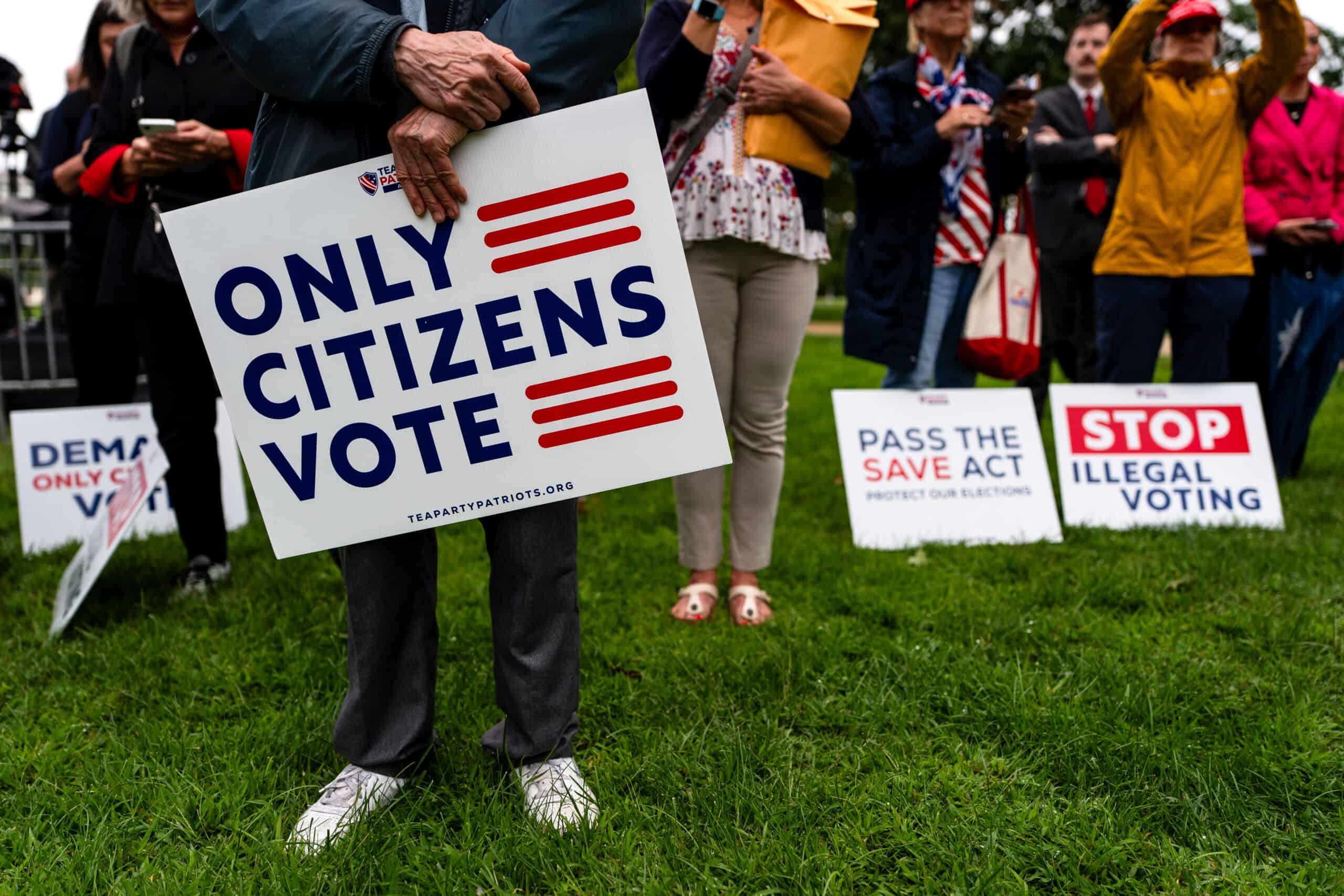
Last month, Rep. Laurel Lee (R-FL) introduced “House Joint Resolution 152” — a constitutional amendment requiring anyone voting for a president, a senator or a member of the House of Representatives, to be a United States citizen.
If you’re wondering why we need an amendment to codify that which everyone has long seemed to know to be law, you wouldn’t be alone.
But writing in this week’s Wall Street Journal, Bradley A. Smith, a former member of the Federal Election Commission, warns about the growing ambiguity surrounding the debate:
When it comes to congressional and presidential elections, Article I of the Constitution grants Congress power to regulate the time, place and manner of holding elections but not who is eligible to vote. The Supreme Court affirmed this in Arizona v. Inter-Tribal Council (2013).
And the Constitution is clear: Under Article I and the 17th Amendment, any person who is allowed to vote in a state legislative election is automatically also allowed to vote for members of Congress. A federal statute can’t trump the Constitution’s explicit, exclusive grant of power to each state to determine who is eligible to vote.
Because federal law can be changed or repealed by a future Congress, Rep. Lee and several of her colleagues are pushing for the amendment.
“It’s simple: only Americans should vote in American elections,” said Rep. Jim Jordan (R-OH). Congresswoman Lee’s amendment is a commonsense proposal that creates a uniform, nationwide standard that will protect federal elections permanently.”
Not too long ago, the idea of limiting voting to only U.S. citizens was a bipartisan principle. President Clinton signed the “Illegal Immigration Reform and Immigrant Responsibility Act of 1996 (IIRIRA),” into law that year. It was passed in the Senate by a vote of 97-3.
“We are a nation of immigrants, but we are also a nation of laws,” said President Clinton. “It is wrong and ultimately self-defeating for a nation of immigrants to permit the kind of abuse of our immigration laws that we have seen in recent years.”
He added:
“Today’s legislation strengthens the rule of law by cracking down on illegal immigration.”
Rep. Lee’s attempt to clarify and codify this long-supported principle is a much-needed effort, especially given that non-citizens are already voting in some local elections (school board and mayoral elections, etc.) in such places as Washington, D.C., California, Illinois, and Vermont.
“Relying on statute alone leaves this principle subject to future changes that could undermine this long-standing principle,” Rep. Lee declared. “This amendment ensures that no matter what happens in Washington or at the state level, federal elections will remain reserved for United States citizens.”
Constitutional amendments face a difficult and uphill climb, of course. Rep. Lee’s resolution will need to pass by a two-thirds majority in both the House and the Senate before heading to the states for ratification by three-fourths or 38 states.


ABOUT THE AUTHOR