• Skip to main content
Daily Citizen
  • Subscribe
  • Categories
    • Culture
    • Life
    • Religious Freedom
    • Sexuality
  • Parenting Resources
    • LGBT Pride
    • Homosexuality
    • Sexuality/Marriage
    • Transgender
  • About
    • Contributors
    • Contact
  • Donate

family

Dec 15 2025

Celebrating a Letter From a Mother to Her Heisman-Winning Son

Elsa Mendoza, mother of Heisman Trophy winner Fernando Mendoza, is battling multiple sclerosis. Just prior to her son receiving the famed award in New York on Saturday, she wrote him an emotional letter expressing gratitude for how he’s supported her over the years.

Mothers and fathers sacrificially pour themselves into their sons and daughters when it comes to athletics. Whether it’s driving them to practices, attending their games, taking on a second job to afford camps or simply playing with them in the backyard or driveway, sport moms and dads are a unique breed.

But the Mendoza story is unlike most. Given Mrs. Mendoza’s physical challenges, we learn a bit more about the Indiana Hoosier’s character by reading her letter to him.

Here are a few excerpts Elsa’s note to Fernando:

“You’ve made me feel seen. Whether it was giving me full debriefs of your college visits, what you liked and disliked (pictures included) … or it was calling me before some big game I had to miss while in treatment … or it’s being so vocal and passionate about MS fundraising … When you have to carry me up the stairs … you’ve always kept that same spark in your eye.

“No matter what kind of state I’ve been in, or day I’ve been having — you’ve never once looked away. You’ve never once treated me like I’m embarrassing, or deficient, or anything other than someone you love and are standing by.

“And even as my condition has gotten worse, and as our lives continue to change around that fact: You manage to make me feel like I’m still every part of myself. Like I’m still that same person you’ve been teammates with since we got through our first Boston winter together. Like I’m still that same mom.

“Your accomplishments will NEVER impact how proud of you I am. Because you are already everything I could have hoped for as a mother…. and that has nothing to do with the miles you throw or the touchdowns you score. It has everything to do with the man you’ve grown into.

“As an oldest brother who shows the way. As a hard worker who has an unstoppable spirit. As a Cuban American athlete who represents his community. As a leader who lifts up, and lends kindness, even when no one is looking. As a person of faith, who leans on God and trusts Him, even when it’s an uneasy road. You have a future that’s so bright and a heart that’s so full. My gentle giant. My darling son. My buddy. My teammate. I believe in you with every part of me. I’m proud of you, not just today, but every day.”

On Saturday night, as Fernando received the award, he said:

Mami, this is your trophy as much as mine. You’ve always been my biggest fan. You’re my light, you’re my why, you’re my biggest supporter. Your sacrifices, courage and love have been my first playbook and the playbook I will carry by my side through my entire life.

You taught me that toughness doesn’t need to be loud, it can be quiet and strong. It’s choosing hope, it’s believing in yourself when the world doesn’t give you much reason to. Together, you and I are rewriting what people think is possible. I love you.

After Indiana University upset Ohio State in the Big Ten Championship, Mendoza told ESPN:

I want to give all the glory to God. We were never supposed to be in this position, but by the glory of God, the great coaches, great teammates, everyone we have around us, we were able to pull these off.

Mendoza is from Miami. He attends Mass and leads a weekly Bible study.

Whether on the field or off, Fernando is guided by a simple but profound truth, quoting Scripture:

“With God, all things are possible.”

Photo credit: ESPN

Written by Paul Batura · Categorized: Family · Tagged: family

Dec 10 2025

To Save America, Have Lots of Children

White House Chief of Staff for Policy Stephen Miller was on Will Cain’s FOX News television show on Tuesday and made a rather startling statement.

“What they don’t teach you in school is that from 1920 to 1970, there was negative migration [in America],” Miller told Cain. “There was a half century of negative migration. The foreign-born population declined by 40 percent for half a century … [Yet] during that same time period, the U.S. population doubled.”

How was that possible?

American families were having lots of children.

“That was the cauldron in which a unified shared national identity was formed,” Miller continued. “They went through a depression together, they went through world war together, they landed on the moon together. This great period in American history happened at a time when there was negative migration.”

The debate remains red-hot these days over illegal immigration and even, to some degree, over legal immigration, too. But students of history recognize that tension over those immigrating to the United States is not a new phenomenon.

Just over one-hundred years ago, the number of newly arriving immigrants was skyrocketing and putting pressure on all the country’s services. The Immigration Act of 1924, also known as the “Johnson-Reed Act,” was designed to address the huge influx of individuals and limit how many and from what parts of the world they would be allowed to come from.

Months after the legislation was signed into law, Major Henry H. Curran, who was serving as Commissioner of Immigration at Ellis Island, was quoted in a New York Times editorial:

“We are getting half as many as we did under the old law and that is a good thing for all concerned,” he said. “It is good for the country because we can assimilate them better. Therefore, it is good for the immigrant. He receives more attention than he could otherwise get at the stations and because he is one of a lesser number his opportunities are correspondingly better.”

He then added:

With the quantity cut in half we are getting immigrants of a quality twice as good as under the old law. That, of course, is for the best interests of the country. 

Those arriving were required to present a certificate of good character from their home government. Individuals were also required to present birth certificates and a certificate of health. A literacy test was required.

The legislation had its intended effect. By 1940, the number of legal immigrants entering the United States had dropped by over 90%. And yet, as Miller indicated, the U.S. population nearly doubled from 106 million in 1920 to 203 million people by 1970.

That’s because birthrates in America steadily climbed from a low of 2.06 children per woman in 1940 to 3.58 in 1960. Today, the fertility rate is hovering around 1.6 children per woman, well below the replacement rate.

The United States is not alone. With rapidly declining birthrates across the industrialized world, the only countries growing rely heavily on immigration to keep their nation afloat.

Demagoguery over well-meaning efforts to protect America’s borders and safely and wisely welcome individuals to America serves nobody but raw and radical interests that seem determined to undermine our nation’s ideals. It’s true the United States is a land of immigrants. But it’s thrived because it’s also historically been a nation of law and order.

Much like in the 1920s, America today faces an existential threat with a declining birth rate and an escalating national debt that compromises and threatens its ability to provide crucial social services to those who are here and unable, at least in the short-term, to support themselves. The country found its way through the crisis in the first half of the last century by reforming immigration laws, but also by marrying and having lots of kids. Expanding the blessings of family was the best way forward a hundred years ago – and it still remains the best way out of the mire right now.

Written by Paul Batura · Categorized: Culture · Tagged: family, immigration

Dec 10 2025

New Research Shows Marriage and Fatherhood Regulate Male Sexual Energy

Did you know that when men marry according to God’s design and become fathers, nature is aligned in such a way that it lowers their testosterone (T) levels in helpful ways? Men with lower T tend to be more focused on their duties toward marriage and family as it lowers libido, aggression and infidelity risk. This increases nurturing behaviors and long-term pair-bonding. The Daily Citizen reported on this larger body of research last year.

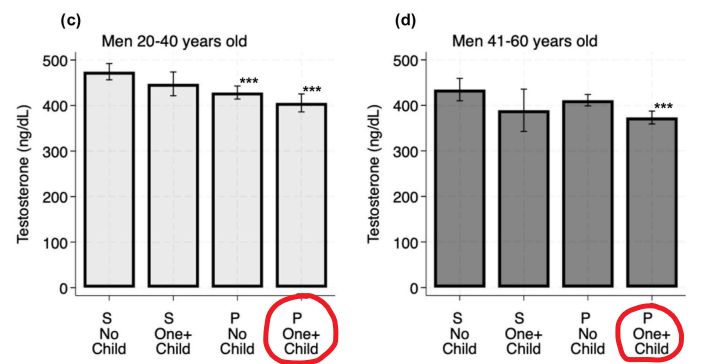
But new research conducted by scholars from the University of Notre Dame have shown that this reduction in T induced by marriage and fatherhood remains for years, even decades and is maintained with the addition of more children into one’s family. A data graph from this study demonstrates that partnered men (P) with one or more children have the lowest T levels among peers in other familial settings or being single.

These scholars explain, “Specifically, we found that partnered men living with older children, particularly two or more, had lower testosterone than single men and partnered men not residing with children.” The effect size was notable. They add, “This is among the first evidence showing lower testosterone in … fathers with older children, specifically.”

They also explain, “In our analysis of young-to-middle aged U.S. men, we found that partnered men, including those residing with children, did not have increased risk of clinically-low testosterone compared to single men not living with children.” This means that T reduction for married fathers is at ideally helpful levels and not harmful to health and well-being.

These researchers explain that “fathers with lower testosterone engage in more nurturant, direct care of children and have higher quality relationships” with their wives.

There has been a good bit of research published on this question over the last 20 years.

A 10-year follow-up study of over one thousand 30 to 60-year-old men published in 2017 observed how T declined as men entered into marriage and lived as husbands, as opposed to just comparing married with unmarried men. These men were part of a long-term health survey in Denmark. The research team reports, “We observed that men who went from unmarried to married experienced the largest decline in circulating T levels over a ten-year period.” Men newly divorced experienced increased T levels as they found themselves back “on the market.”

A 2015 study in the journal Evolutionary Psychology found that outside of marriage “men in polyamorous relationships (with multiple committed partners) have greater levels of testosterone than those in monogamous relationships.” Wives settle men down, but multiple women as partners have the opposite effect. And the more permanent and long-term the relationship, the lower the T levels, compared to single men. This study also explains, “Further findings suggest that fathers have lower levels of testosterone than non-fathers independently of relationship status, and that pair-bonded fathers demonstrate lower levels than pair-bonded non-fathers.”

A 2011 study, conducted by the author of this new Notre Dame study, demonstrates how testosterone levels properly fluctuate for men through the life-course of seeking a mate, living as a settled-down married men, then as a father:

Using longitudinal data, these results demonstrate that high T not only predicts mating success (i.e., partnering with a female and fathering a child) in human males but that T is then greatly reduced after men enter stable relationships and become fathers.

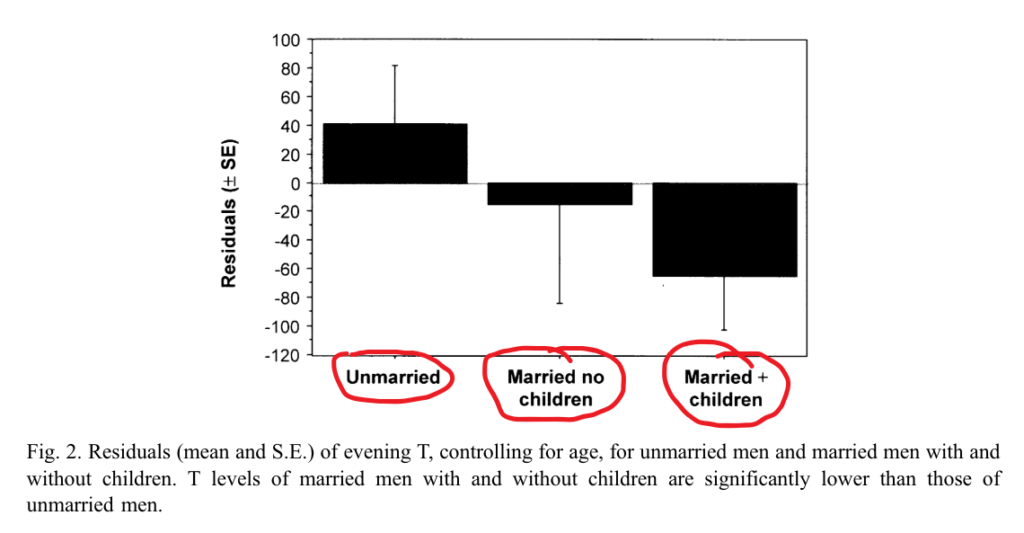
 One of the earlier efforts to study this phenomenon, a 2002 Harvard paper published in Evolution and Human Behavior, established that controlling for age, married fathers have markedly lower T levels compare to their unmarried peers and slightly lower levels compared to married men without children.

This chart shows the distinction:

In a 2006 Canadian study, investigators state bluntly that their data “suggests that the relationship between T and partner status is only seen in individuals who are interested in, and partner with, women.” Very interesting.

Men do not tend to settle other men down. Wives and mothers do this for men because female sexuality and biology are more family focused. George Gilder explains this in his critically important work, Men and Marriage: “The crucial process of civilization is the subordination of male sexual impulses and biology to the long-term horizons of female sexuality.”

This influential exchange between men and women is something that family health and longevity require. Research from leading universities around the world tell us this happens at a very intimate and invisible hormonal level between husband and wife.

We are indeed fearfully and wonderfully made.

Written by Glenn T. Stanton · Categorized: Marriage · Tagged: family, marriage, men, testosterone

Sep 22 2025

Don’t Wait to Get Married Until You Can Afford It

Saturday’s Wall Street Journal highlighted the “Capstone Model of Marriage,” the belief that you only tie the knot after the big milestones and personal goals of life are met – namely getting your education, buying a house, or landing the lucrative job.

The article quoted Krista Westrick-Payne, assistant director of the National Center for Marriage and Family Research.

“People don’t want to get married until they have an education, have that job that can support them and they can afford a house, and they are also looking for a partner that ticks all those boxes,” she observed.

Delaying marriage to achieve all those things may avoid some of the financial strain that might otherwise be present, but it also invites a litany of other problems.

Waiting to get married often results in marrying someone else down the line – or not getting married at all. It also leads to an increased risk of cohabitation, which then leads to an increased risk of divorce. Cohabitation is also outside of God’s will. Writing to early believers in Greece, the apostle Paul warned,

“It’s God’s will that you should be sanctified: that you should avoid sexual immorality, that each of you should learn to control his own body in a way that is holy and honorable, not in passionate lust like the heathen who do not know God” (1 Thess. 4:3).

Well meaning Christians may feel getting all your “ducks in a row” is the responsible course to take – but it’s not a zero-sum game. Couples who marry on a shoestring can still be responsible, and that means living within their means and even below how they’ve been living prior to getting married.

The late Dr. James Dobson, Focus on the Family’s founder, liked to joke that early in his marriage to Shirley, they never suffered from money problems – because they didn’t have any money. They shared one car, didn’t eat out – and when they ate at all, they were sure to do so frugally.

The opposite of “capstone marriage” is “cornerstone marriage” where you get married young and build your life around the union with your spouse. It doesn’t mean you can’t still go to school, buy a house and have a satisfying and good-paying career. The difference is you do it together.

Couples in cornerstone marriages recognize early what many of those in capstone marriages may recognize too late. Sharing your life with another person and having and raising children are among life’s greatest joys for the vast majority of people.

Rachel Campos Duffy, who is a conservative media personality and who is married to Secretary of Transportation Sean Duffy, has nine children. She’s famously advised, “Fall in love, get married, have more babies than you can afford.”

New York Times’ columnist and professor David Brooks counsels students “to obsess less about your career and to think a lot more about marriage. Please respect the truism that if you have a great career and a crappy marriage you will be unhappy, but if you have a great marriage and a crappy career you will be happy.”

Christian cornerstone marriage, however, puts Christ in the middle of the marital union. Husbands and wives enjoy the greatest chance of success when their faith in the Lord is the foundation of their marriage.

Don’t wait to get married until everything is “just right” – get married when you meet the right person and bathe that relationship in prayer, seeking God’s will and discernment regarding next steps.

Image from Shutterstock.

Written by Paul Batura · Categorized: Family · Tagged: family

Jul 08 2025

‘Times’ Calls for More Male Role Models While Ignoring Role of Fathers

The New York Times concluded last weekend what Focus on the Family (now, officially, a “hate group”) has argued for years — boys need positive male role models.

In “What Happens When Most of the Adults in Boys’ Lives are Women,” Times reporter Claire Cain Miller writes, “At a crucial time in their lives, boys are increasingly cared for by women, especially the many boys whose fathers aren’t a regular presence,” continuing:

This lack of male role models, say researchers, parents, young men and those who work with them, is contributing to [young men’s] struggles in school and employment — and the overall feeling that they’re adrift.

The Times deserves credit for finding and printing the truth. Legacy media too frequently parrot modern lies about the natural family unit being “racist,” “homophobic” or a Western invention.

That said, the article’s treatment of the truth leaves much to be desired.

Anthropologists and sociologists have agreed on the social value of male leadership for going on a century. In her book Male and Female, renowned cultural anthropologist Margaret Mead concluded:

Every known human society rests firmly on the learned nurturing behavior of men.

The Times‘ piece omits anthropology and sociology altogether. Rather, Miller presents her elementary conclusion — that girls aren’t the only ones who benefit from male roles models — like revelatory, potentially controversial information.

“Much academic research on the role model effects has been about girls,” she prevaricates, “but some studies have shown how having men in their lives helps boys.”

“Some studies?” Try more than six decades of anthropological social research and debate, all of which show fathers are far and away the most influential role models in young boys’ lives. They are irreplaceable.

Here’s a small sample of what we know.

Children that grow up in a house with a married mother and father are, on average:

  • Dramatically more likely to meet benchmarks for healthy development.
  • More likely to graduate college.
  • Less likely to be impoverished, both as a child and an adult.
  • Less likely to be convicted of a crime.
  • Less likely to experience childhood depression.
  • Less likely to have children young.

Children with unmarried or divorced parents, conversely, face significant challenges. A report on the long-term effects of divorce from the National Bureau of Economic Research found children of divorced parents face dramatically reduced life outcomes as teens and adults compared to peers with married parents, including:

  • A 60% increase in teen births.
  • A 20% increase in child mortality.
  • A 40-45% increase in incarceration rates.
  • A significant decrease in income as an adult.
  • A decreased chance of attending college.

Scholars attribute these challenges to three factors: a substantial decline in household income, an increased likelihood of living in a low-quality neighborhood and “obvious distance and disaffection from at least one parent” — usually the father.

Importantly, the same report found 95% of children live with their mother after a divorce.

Fathers demonstrate similar absence in households where they are not married to their children’s mother. Melissa Kearney, noted economist and author of Two Parent Privilege, tells Focus on the Family’s Jim Daly only 25% of children living with a single mom get child support from their father.

“These kids are much less likely to have the benefit of contributed engagement with a nonresident parent [the father] or even financial support going forward,” she concludes.

A recent report cites Rob Palkovitz, a human development and family studies scholar at the University of Delaware, who explains paternal engagement, specifically, increases educational attainment in children of both sexes. Children with engaged fathers are also significantly less likely to experience depression, poverty and neighborhood violence.

Palkovitz writes:

After controlling for parent education, family income, race of child, immigrant status and sex and age of the child, the odds of exposure to violence were 10 times higher for children in father-absent homes than for children with both parents present in the home.

Perhaps the most dramatic evidence of a father’s impact on boys comes from the Institute for Family Studies (IFS), which performed data analysis showing young men from intact families were just as likely to graduate college (36%) as men from father-absent families were likely to go to prison.

Though the Times’ article acknowledges growing up without a father “particularly disadvantages boys,” its solution to boys’ lack of male role models, curiously, has nothing to do with fathers. Instead, it recommends more men:

  • Take jobs working with children.
  • Lead extra-curricular and community activities.
  • Train to become “effective mentors” to boys.

It’s unclear whether Miller is unaware of the larger anthropological context in which she is writing or simply unwilling to acknowledge it. But recommending more men become teachers to address boys’ lack of role models, as opposed to addressing fatherless and broken homes, is like treating a paper cut on a gun-shot victim. It misses the point entirely.

Additional Articles and Resources

Married Fatherhood is Key to Recovering Thriving Masculinity

Different Family Forms Lead to Prison or College for Young Men

Important New Research on How Married Parents Improve Child Well-Being

New Scholarly Fatherhood Report Offers Important New Insights

Premier Research Documents Long-Term Divorce Harms for Adult Children

New Report Gives Update on Family Formation and Child Well-Being

The Two-Parent Privilege: Understanding Contemporary Family Formation

Boys Need Men to Admire

Myth Buster: The Religious Right Didn’t Start the Family Culture War

Leading Family Journal Warns ‘White Heteropatriarchal Supremacy’ and ‘Marriage Fundamentalism’ Threatens Equality

Written by Emily Washburn · Categorized: Family · Tagged: family, Fathers

  • « Go to Previous Page
  • Page 1
  • Page 2
  • Page 3
  • Page 4
  • Page 5
  • Go to Next Page »

Privacy Policy and Terms of Use | Privacy Policy and Terms of Use | © 2026 Focus on the Family. All rights reserved.

  • Cookie Policy