• Skip to main content
Daily Citizen
  • Subscribe
  • Categories
    • Culture
    • Life
    • Religious Freedom
    • Sexuality
  • Parenting Resources
    • LGBT Pride
    • Homosexuality
    • Sexuality/Marriage
    • Transgender
  • About
    • Contributors
    • Contact
  • Donate

family

Dec 10 2025

New Research Shows Marriage and Fatherhood Regulate Male Sexual Energy

Did you know that when men marry according to God’s design and become fathers, nature is aligned in such a way that it lowers their testosterone (T) levels in helpful ways? Men with lower T tend to be more focused on their duties toward marriage and family as it lowers libido, aggression and infidelity risk. This increases nurturing behaviors and long-term pair-bonding. The Daily Citizen reported on this larger body of research last year.

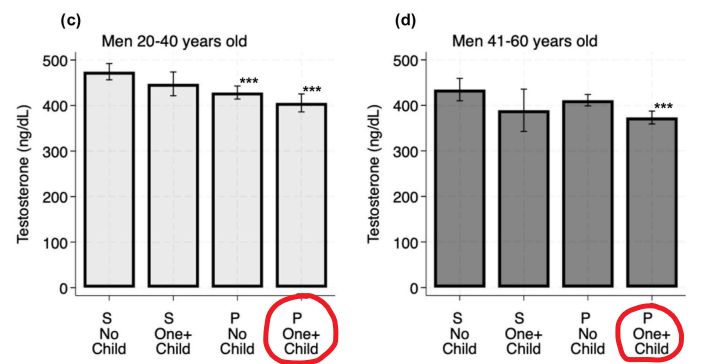
But new research conducted by scholars from the University of Notre Dame have shown that this reduction in T induced by marriage and fatherhood remains for years, even decades and is maintained with the addition of more children into one’s family. A data graph from this study demonstrates that partnered men (P) with one or more children have the lowest T levels among peers in other familial settings or being single.

These scholars explain, “Specifically, we found that partnered men living with older children, particularly two or more, had lower testosterone than single men and partnered men not residing with children.” The effect size was notable. They add, “This is among the first evidence showing lower testosterone in … fathers with older children, specifically.”

They also explain, “In our analysis of young-to-middle aged U.S. men, we found that partnered men, including those residing with children, did not have increased risk of clinically-low testosterone compared to single men not living with children.” This means that T reduction for married fathers is at ideally helpful levels and not harmful to health and well-being.

These researchers explain that “fathers with lower testosterone engage in more nurturant, direct care of children and have higher quality relationships” with their wives.

There has been a good bit of research published on this question over the last 20 years.

A 10-year follow-up study of over one thousand 30 to 60-year-old men published in 2017 observed how T declined as men entered into marriage and lived as husbands, as opposed to just comparing married with unmarried men. These men were part of a long-term health survey in Denmark. The research team reports, “We observed that men who went from unmarried to married experienced the largest decline in circulating T levels over a ten-year period.” Men newly divorced experienced increased T levels as they found themselves back “on the market.”

A 2015 study in the journal Evolutionary Psychology found that outside of marriage “men in polyamorous relationships (with multiple committed partners) have greater levels of testosterone than those in monogamous relationships.” Wives settle men down, but multiple women as partners have the opposite effect. And the more permanent and long-term the relationship, the lower the T levels, compared to single men. This study also explains, “Further findings suggest that fathers have lower levels of testosterone than non-fathers independently of relationship status, and that pair-bonded fathers demonstrate lower levels than pair-bonded non-fathers.”

A 2011 study, conducted by the author of this new Notre Dame study, demonstrates how testosterone levels properly fluctuate for men through the life-course of seeking a mate, living as a settled-down married men, then as a father:

Using longitudinal data, these results demonstrate that high T not only predicts mating success (i.e., partnering with a female and fathering a child) in human males but that T is then greatly reduced after men enter stable relationships and become fathers.

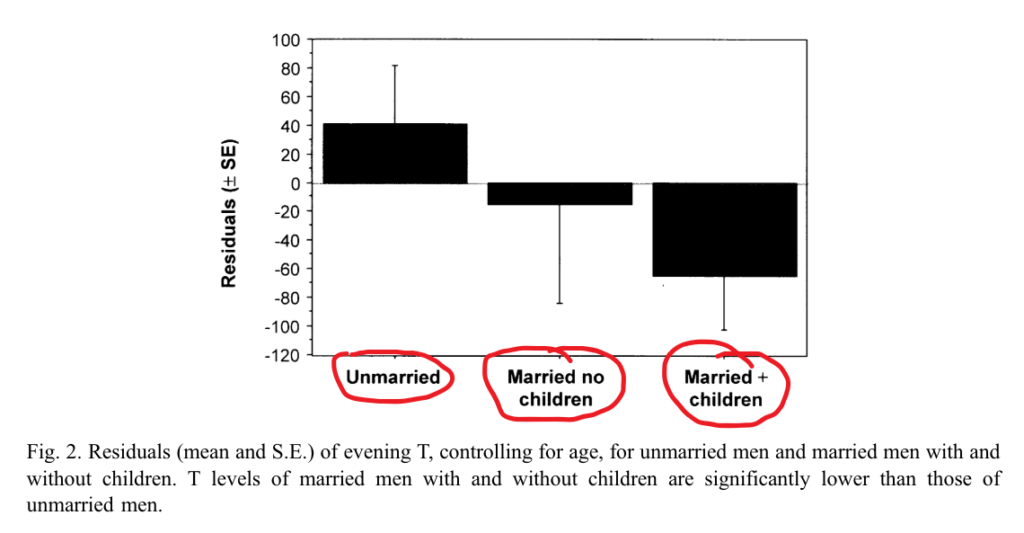
 One of the earlier efforts to study this phenomenon, a 2002 Harvard paper published in Evolution and Human Behavior, established that controlling for age, married fathers have markedly lower T levels compare to their unmarried peers and slightly lower levels compared to married men without children.

This chart shows the distinction:

In a 2006 Canadian study, investigators state bluntly that their data “suggests that the relationship between T and partner status is only seen in individuals who are interested in, and partner with, women.” Very interesting.

Men do not tend to settle other men down. Wives and mothers do this for men because female sexuality and biology are more family focused. George Gilder explains this in his critically important work, Men and Marriage: “The crucial process of civilization is the subordination of male sexual impulses and biology to the long-term horizons of female sexuality.”

This influential exchange between men and women is something that family health and longevity require. Research from leading universities around the world tell us this happens at a very intimate and invisible hormonal level between husband and wife.

We are indeed fearfully and wonderfully made.

Written by Glenn T. Stanton · Categorized: Marriage · Tagged: family, marriage, men, testosterone

Sep 22 2025

Don’t Wait to Get Married Until You Can Afford It

Saturday’s Wall Street Journal highlighted the “Capstone Model of Marriage,” the belief that you only tie the knot after the big milestones and personal goals of life are met – namely getting your education, buying a house, or landing the lucrative job.

The article quoted Krista Westrick-Payne, assistant director of the National Center for Marriage and Family Research.

“People don’t want to get married until they have an education, have that job that can support them and they can afford a house, and they are also looking for a partner that ticks all those boxes,” she observed.

Delaying marriage to achieve all those things may avoid some of the financial strain that might otherwise be present, but it also invites a litany of other problems.

Waiting to get married often results in marrying someone else down the line – or not getting married at all. It also leads to an increased risk of cohabitation, which then leads to an increased risk of divorce. Cohabitation is also outside of God’s will. Writing to early believers in Greece, the apostle Paul warned,

“It’s God’s will that you should be sanctified: that you should avoid sexual immorality, that each of you should learn to control his own body in a way that is holy and honorable, not in passionate lust like the heathen who do not know God” (1 Thess. 4:3).

Well meaning Christians may feel getting all your “ducks in a row” is the responsible course to take – but it’s not a zero-sum game. Couples who marry on a shoestring can still be responsible, and that means living within their means and even below how they’ve been living prior to getting married.

The late Dr. James Dobson, Focus on the Family’s founder, liked to joke that early in his marriage to Shirley, they never suffered from money problems – because they didn’t have any money. They shared one car, didn’t eat out – and when they ate at all, they were sure to do so frugally.

The opposite of “capstone marriage” is “cornerstone marriage” where you get married young and build your life around the union with your spouse. It doesn’t mean you can’t still go to school, buy a house and have a satisfying and good-paying career. The difference is you do it together.

Couples in cornerstone marriages recognize early what many of those in capstone marriages may recognize too late. Sharing your life with another person and having and raising children are among life’s greatest joys for the vast majority of people.

Rachel Campos Duffy, who is a conservative media personality and who is married to Secretary of Transportation Sean Duffy, has nine children. She’s famously advised, “Fall in love, get married, have more babies than you can afford.”

New York Times’ columnist and professor David Brooks counsels students “to obsess less about your career and to think a lot more about marriage. Please respect the truism that if you have a great career and a crappy marriage you will be unhappy, but if you have a great marriage and a crappy career you will be happy.”

Christian cornerstone marriage, however, puts Christ in the middle of the marital union. Husbands and wives enjoy the greatest chance of success when their faith in the Lord is the foundation of their marriage.

Don’t wait to get married until everything is “just right” – get married when you meet the right person and bathe that relationship in prayer, seeking God’s will and discernment regarding next steps.

Image from Shutterstock.

Written by Paul Batura · Categorized: Family · Tagged: family

Jul 08 2025

‘Times’ Calls for More Male Role Models While Ignoring Role of Fathers

The New York Times concluded last weekend what Focus on the Family (now, officially, a “hate group”) has argued for years — boys need positive male role models.

In “What Happens When Most of the Adults in Boys’ Lives are Women,” Times reporter Claire Cain Miller writes, “At a crucial time in their lives, boys are increasingly cared for by women, especially the many boys whose fathers aren’t a regular presence,” continuing:

This lack of male role models, say researchers, parents, young men and those who work with them, is contributing to [young men’s] struggles in school and employment — and the overall feeling that they’re adrift.

The Times deserves credit for finding and printing the truth. Legacy media too frequently parrot modern lies about the natural family unit being “racist,” “homophobic” or a Western invention.

That said, the article’s treatment of the truth leaves much to be desired.

Anthropologists and sociologists have agreed on the social value of male leadership for going on a century. In her book Male and Female, renowned cultural anthropologist Margaret Mead concluded:

Every known human society rests firmly on the learned nurturing behavior of men.

The Times‘ piece omits anthropology and sociology altogether. Rather, Miller presents her elementary conclusion — that girls aren’t the only ones who benefit from male roles models — like revelatory, potentially controversial information.

“Much academic research on the role model effects has been about girls,” she prevaricates, “but some studies have shown how having men in their lives helps boys.”

“Some studies?” Try more than six decades of anthropological social research and debate, all of which show fathers are far and away the most influential role models in young boys’ lives. They are irreplaceable.

Here’s a small sample of what we know.

Children that grow up in a house with a married mother and father are, on average:

  • Dramatically more likely to meet benchmarks for healthy development.
  • More likely to graduate college.
  • Less likely to be impoverished, both as a child and an adult.
  • Less likely to be convicted of a crime.
  • Less likely to experience childhood depression.
  • Less likely to have children young.

Children with unmarried or divorced parents, conversely, face significant challenges. A report on the long-term effects of divorce from the National Bureau of Economic Research found children of divorced parents face dramatically reduced life outcomes as teens and adults compared to peers with married parents, including:

  • A 60% increase in teen births.
  • A 20% increase in child mortality.
  • A 40-45% increase in incarceration rates.
  • A significant decrease in income as an adult.
  • A decreased chance of attending college.

Scholars attribute these challenges to three factors: a substantial decline in household income, an increased likelihood of living in a low-quality neighborhood and “obvious distance and disaffection from at least one parent” — usually the father.

Importantly, the same report found 95% of children live with their mother after a divorce.

Fathers demonstrate similar absence in households where they are not married to their children’s mother. Melissa Kearney, noted economist and author of Two Parent Privilege, tells Focus on the Family’s Jim Daly only 25% of children living with a single mom get child support from their father.

“These kids are much less likely to have the benefit of contributed engagement with a nonresident parent [the father] or even financial support going forward,” she concludes.

A recent report cites Rob Palkovitz, a human development and family studies scholar at the University of Delaware, who explains paternal engagement, specifically, increases educational attainment in children of both sexes. Children with engaged fathers are also significantly less likely to experience depression, poverty and neighborhood violence.

Palkovitz writes:

After controlling for parent education, family income, race of child, immigrant status and sex and age of the child, the odds of exposure to violence were 10 times higher for children in father-absent homes than for children with both parents present in the home.

Perhaps the most dramatic evidence of a father’s impact on boys comes from the Institute for Family Studies (IFS), which performed data analysis showing young men from intact families were just as likely to graduate college (36%) as men from father-absent families were likely to go to prison.

Though the Times’ article acknowledges growing up without a father “particularly disadvantages boys,” its solution to boys’ lack of male role models, curiously, has nothing to do with fathers. Instead, it recommends more men:

  • Take jobs working with children.
  • Lead extra-curricular and community activities.
  • Train to become “effective mentors” to boys.

It’s unclear whether Miller is unaware of the larger anthropological context in which she is writing or simply unwilling to acknowledge it. But recommending more men become teachers to address boys’ lack of role models, as opposed to addressing fatherless and broken homes, is like treating a paper cut on a gun-shot victim. It misses the point entirely.

Additional Articles and Resources

Married Fatherhood is Key to Recovering Thriving Masculinity

Different Family Forms Lead to Prison or College for Young Men

Important New Research on How Married Parents Improve Child Well-Being

New Scholarly Fatherhood Report Offers Important New Insights

Premier Research Documents Long-Term Divorce Harms for Adult Children

New Report Gives Update on Family Formation and Child Well-Being

The Two-Parent Privilege: Understanding Contemporary Family Formation

Boys Need Men to Admire

Myth Buster: The Religious Right Didn’t Start the Family Culture War

Leading Family Journal Warns ‘White Heteropatriarchal Supremacy’ and ‘Marriage Fundamentalism’ Threatens Equality

Written by Emily Washburn · Categorized: Family · Tagged: family, Fathers

Jun 27 2025

Why Focus on the Family Believes Obergefell Must Be Struck Down

This week marks the 10th anniversary of the landmark U.S. Supreme Court Obergefell v. Hodges decision that radically redefined marriage and the family by nationalizing the de-sexing of both. That is precisely what happens when that court required every state in the union to accept that same sex couplings are every bit as valuable and important as the ageless and life-producing marital and familial union of the two essential parts of humanity in male and female.

Marriage between a man and a woman is a cross-cultural institution that existed before it was defined in human laws. What the court did in Obergefell was a logical impossibility. It has been hailed as a progressive victory, but the result has been terribly regressive.

There are at least four compelling reasons why Obergefell must be struck down.

First, Obergefell neutered our legal conception of what it means to be human. If male nor female are not essential to the family – and this is precisely the defective logic this landmark decision resulted in — both lose any consequential meaning. This is why it was absolutely no coincidence that the transgender movement was launched when Bruce Jenner infamously appeared as “Caitlyn” on the July 2015 cover of Vanity Fair magazine … within hours of Obergefell being handed down! There was no daylight between these two revolutionary events because one follows from the other.

If male and female have no essential, distinctive meaning for the family, they then have no real meaning for society. People can just assume new “gender identities” at will … and they are.

Second, Obergefell should be overturned because it does a dramatic injustice to children by asserting children have no fundamental right to be loved and cared for by their own mother and father. Every same-sex family, by definition and design, denies every child it contains the maternal and paternal love he or she craves and requires. And does so to fulfill novel adult wishes. Thus, Obergefell establishes the right of adults to form experimental sexless families over any child’s right to his or her own mother and father. This is always immoral, full stop.

Third, Obergefell fails to protect women by casually dismissing the essential power, quality and character of the feminine. It was largely males who argued most persuasively for this redefinition of marriage, demonstrated in numerous early books on the topic, here, here, here, and here. And if the family headed by two males does everything and meets every need that a wife and mother can – and this is, after all, precisely the claim of gay marriage proponents and the reasoning of the Obergefell majority – then the feminine half of humanity becomes meaningless. This created the worst and most dramatic brand of misogyny.

Fourth, Obergefell is based on bad law. As Justice Clarence Thomas correctly explained in his dissent to the razor-thin majority opinion in Obergefell, “The Court’s decision today is at odds not only with the Constitution, but with the principles upon which our Nation was built.” He then noted an indisputable fact:

[T]he majority invokes our Constitution in the name of a ‘liberty’ that the Framers would not have recognized, to the detriment of the liberty they sought to protect.

The Constitution provides no right to so radically change and redefine the essential human institution of marriage and family that predate all human law. Obergefell, just like Roe v. Wade before it, is radically bad law because it is extra-constitutional. It is usurped legislative power.

Obergefell compels all Americans to do the impossible: assent to the radical idea that male and female are merely optional for the noble and essential purposes of marriage and the family which are universal human truths given by God to all of humanity in His wise goodness. That decision put us on a vast, untested experiment with the family and our very understanding of what it means to be human as male and female.

Some warned gay marriage would lead us to slippery slopes. It certainly has. But the wildest imagination never considered it would create this wildly popular cosplay misogyny or this full frontal assault on mothers and fathers. The intentional queering of the family wrought all this and our nation’s Supreme Court enabled it ten years ago this week.


For all these reasons and more, Focus on the Family strongly calls for the overturning of Obergefell v. Hodges and we will work hard to achieve that end.

Written by Glenn T. Stanton · Categorized: Culture, Family · Tagged: family, marriage, Obergefell

Jun 25 2025

Warning: Not Having Children Can Rob You of Countless Joys

To paraphrase Ronald Reagan, “There they go again.”

Wednesday’s New York Times contains an essay and online video titled, “Motherhood Should Come With a Warning Label” – a piece highlighting reader feedback from women discussing their path to parenthood.

As the Times regularly does, motherhood is presented in a somber and heavy-handed manner. 

Finances take center stage in the presentation. From having less monthly income to negatively impacting personal retirement accounts, the casual reader could easily be left wondering why any woman would trade the office for diapers and carpool lines.

Dig into the article and we read about the so-called “motherhood penalty” – the financial hit women take when they either postpone or suspend their professional careers to care for their children.

Then there’s the decline in mental health that mothers supposedly endure. 

Overall, the entire tone of the article is that mothers are victims. We’re told they’re not only underpaid and underappreciated but also disrespected and even disdained.

It quite literally takes until the last three sentences for the author of the piece to share any positive sentiment about motherhood at all. 

“Was it worth it?” asked one reader. “100 percent,”

Clearly, The New York Times and the majority of its readers whom the paper chose to highlight disagree. Not only that, they feel quite aggrieved and convinced that society is somehow conniving to find ways to punish mothers – or in the very least, not doing enough to accommodate them when it comes to employment outside the home. 

The wearisome diatribe is just one small piece of a larger anti-natalist cultural campaign that aims to rundown and discourage couples from having children. We regularly see astronomical numbers about how expensive it is to raise a child as studies quote figures in the hundreds of thousands of dollars.

What’s so insidious about this offering is how they weaponize and exaggerate age-old realities regarding the typical challenges of parenthood.

News flash to those coming of childbearing age: motherhood and fatherhood have always taken the measure of women and men.

No matter the economy, raising children costs money – money that you won’t have to sock away in a retirement fund or use to buy the boat or country club membership. 

Since time immemorial, mothers have endured moments or seasons of feeling underappreciated. Children can be difficult, demanding, exhausting and even exasperating. There’s a reason God included the commandment to “Honor your father and your mother” in the instructions given to Moses (Exodus 20:12).

This has always been the case – what’s changed is the introduction or expansion of an entitlement mentality that life should be self-focused and comfortable. According to this inward focus, Heaven forbid that adults are inconvenienced or forced to sacrifice. This “me”-focused mentality is why there are more dogs in San Francisco than children.

It’s also why the majority of the readers of America’s leading liberal publication, some of whom are mothers themselves, appear so down on the institution itself. Brainwashed by the leading lights of anti-natalism, they’re bombarded with propaganda suggesting parenthood itself is some sort of handicap. 

Yes, motherhood holds its share of challenges, but like that lone reader acknowledged, it also holds countless joys.

In fact, what the Times and groups predisposed to discourage having children should do would be to highlight those who deliberately avoid having children. If they did, they would discover that intentional childlessness often leads to selfishness and emptiness.

Years ago, the late legendary talk show host Larry King was being interviewed by Charlie Rose.

“You’re not a father, are you?” Larry asked Charlie.

“No,” answered Rose.

“You miss the great joy of life,” reflected King, who was father to five.

A lifetime of success at work will never outpace the pleasures and satisfaction of pouring yourself into the task and privilege of raising a child.

Written by Paul Batura · Categorized: Family · Tagged: family

  • « Go to Previous Page
  • Page 1
  • Page 2
  • Page 3
  • Page 4
  • Page 5
  • Page 6
  • Go to Next Page »

Privacy Policy and Terms of Use | Privacy Policy and Terms of Use | © 2026 Focus on the Family. All rights reserved.

  • Cookie Policy