• Skip to main content
Daily Citizen
  • Subscribe
  • Categories
    • Culture
    • Life
    • Religious Freedom
    • Sexuality
  • Parenting Resources
    • LGBT Pride
    • Homosexuality
    • Sexuality/Marriage
    • Transgender
  • About
    • Contributors
    • Contact
  • Donate

Fathers

Jun 19 2026

The Good and Bad News on the State of Fatherhood in America Today

As we near Father’s Day 2026, we must appreciate anew how important fathers are to children, families and society. As Dr. Kyle Pruett of Yale University has long emphasized, fathers matter because they do not mother. Fathers parent as men and that makes profound differences in the lives of children. Dads are irreplaceable.

So, what is the state of fatherhood in America today?

Brad Wilcox, a leading sociologist of the family from the University of Virginia, and a longtime friend of Focus on the Family, wrote this week over at The Free Press, “This Father’s Day, the state of American fatherhood is strong.” A strong body of literature, here, here and here, shows that younger fathers who live with their children spend about three times more hours per day actively engaged with their children than fathers in past generations.

That is great news. Increased father involvement makes men happier, and it meets the vital needs of their children. Science journalist Derek Thompson explained last month, “You will be hard-pressed to find any part of day-to-day modern life that has changed more in the last half-century than the way today’s parents – and fathers, in particular — spend their time” with their children.Fathering time with children has quadrupled over the past few generations. That is very good news.

University of Southern California Professor of Psychology Darby Saxbe notes the wonder of fatherhood in her important new book, Dad Brain: The New Science of Fatherhood and How It Shapes Men’s Lives:

As I discovered when researching my new book, becoming a committed father also directly benefits men. Men who prioritize fatherhood may lose some sleep, gain some extra weight and enjoy less free time, but they can also discover a richer life with greater meaning, purpose and connection. And when it comes to brain health and mental fitness, becoming a father is one of the best things you can do.

Saxbe’s book documents further findings on how fatherhood is essential for children and how it improves the well-being and happiness of men. She adds,

Men with two children had an estimated brain age that was 0.6 years younger than their childless peers had, and for men with three children, it was 0.7 years younger. That’s similar to the brain benefit associated with exercising 2.5 hours a week.

She also notes that fathers may even get a stronger cognitive benefit from fathering their children than mothers do at mothering.

Yet, in order to enjoy the benefits of fatherhood, a man must get married and have a baby with his wife. This is where the news gets less positive. The number of married couples raising children has been declining markedly over the last 50 years in America and across the globe. Yet, the number of children living with married biological parents has thankfully increased just a bit since 2012 in the United States.

However, the Institute for Family Studies (IFS) just released a new report detailing how more men are sadly opting out of fatherhood. Fatherhood is clearly declining among young men, ages 25-45.
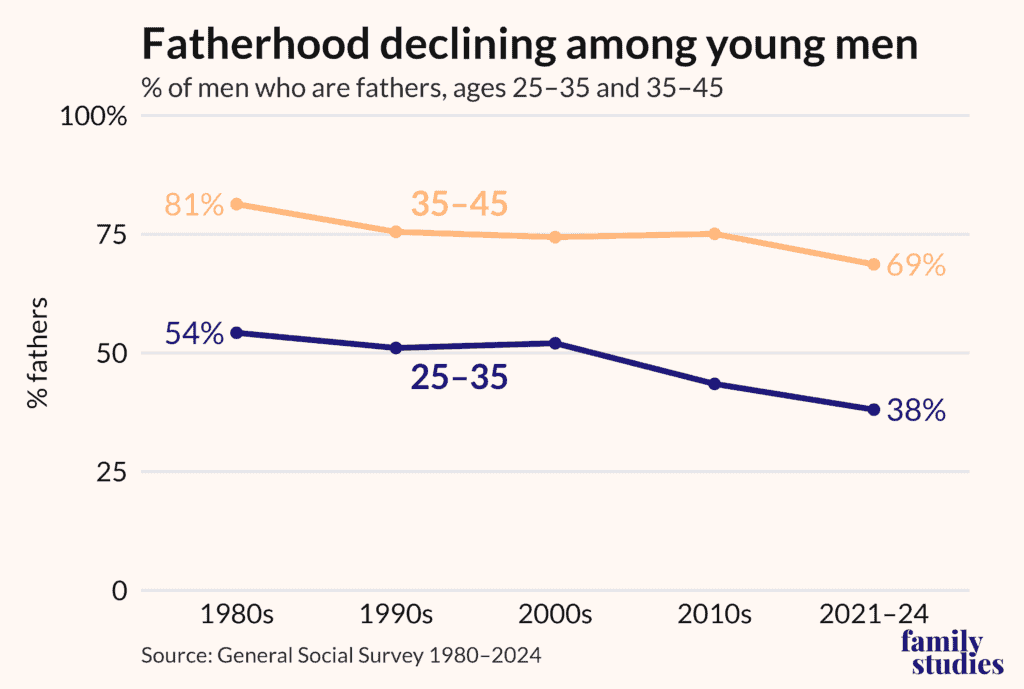
The reason for this decline is two-fold. Primarily it is because birthrates are simply declining as marriage rates decline. Fewer men and women are having babies. Married fertility has been dropping substantially, but married couples are more likely to be the ones having children. The other reason for the decline of fatherhood is simply because nearly all people are delaying having children – that sets the numbers back as well. And those who do marry are marrying later than they were decades ago.

But it remains true: Men who are fathers are happier than their childless male peers.
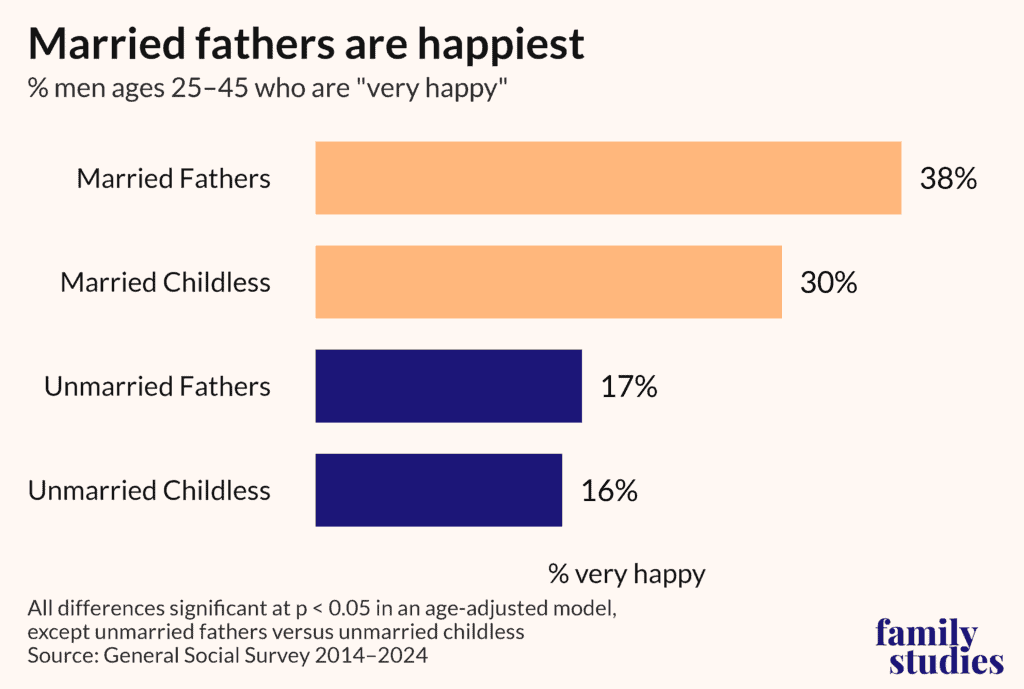
IFS explains,

Men without children are typically living lives that are lonelier, less purposeful, and less happy than their peers who are engaged fathers – most typically in the context of marriage. Indeed, there is no question that married fathers are the happiest men in America today – they are more than twice as likely to be “very happy” with their lives, compared to their peers who are childless and unmarried.

So, the American story on fatherhood this year is a good news and bad news story. We need to get more men married which is the proper foundation for fatherhood. That will improve their lives, the lives of their children, the women they are married to and society as whole.

This is why fatherhood matters. So, celebrate your father well this Father’s Day!

Related Articles and Resources:

New Study Shows Becoming a Father Rewires the Male Brain

New Research Shows How Fatherhood Uniquely Boosts Child Health

The Important Parenting Differences Between Moms and Dads

Why Children Need Both a Mom and a Dad

Married Fatherhood Makes Men Better

Important New Research on How Married Parents Improve Child Well-Being

New Research Shows Married Families Matter More Than Ever

New Research: Marriage Still Provides Major Happiness Premium

Cohabitation Still Harmful – Even as Stigma Disappears

Yes, Married Mothers Really Are Happier Than Unmarried and Childless Women

Married Mothers and Fathers Are Happiest According to Gold-Standard General Social Survey

Written by Glenn T. Stanton · Categorized: Family · Tagged: Father's Day, Fathers

Jul 08 2025

‘Times’ Calls for More Male Role Models While Ignoring Role of Fathers

The New York Times concluded last weekend what Focus on the Family (now, officially, a “hate group”) has argued for years — boys need positive male role models.

In “What Happens When Most of the Adults in Boys’ Lives are Women,” Times reporter Claire Cain Miller writes, “At a crucial time in their lives, boys are increasingly cared for by women, especially the many boys whose fathers aren’t a regular presence,” continuing:

This lack of male role models, say researchers, parents, young men and those who work with them, is contributing to [young men’s] struggles in school and employment — and the overall feeling that they’re adrift.

The Times deserves credit for finding and printing the truth. Legacy media too frequently parrot modern lies about the natural family unit being “racist,” “homophobic” or a Western invention.

That said, the article’s treatment of the truth leaves much to be desired.

Anthropologists and sociologists have agreed on the social value of male leadership for going on a century. In her book Male and Female, renowned cultural anthropologist Margaret Mead concluded:

Every known human society rests firmly on the learned nurturing behavior of men.

The Times‘ piece omits anthropology and sociology altogether. Rather, Miller presents her elementary conclusion — that girls aren’t the only ones who benefit from male roles models — like revelatory, potentially controversial information.

“Much academic research on the role model effects has been about girls,” she prevaricates, “but some studies have shown how having men in their lives helps boys.”

“Some studies?” Try more than six decades of anthropological social research and debate, all of which show fathers are far and away the most influential role models in young boys’ lives. They are irreplaceable.

Here’s a small sample of what we know.

Children that grow up in a house with a married mother and father are, on average:

  • Dramatically more likely to meet benchmarks for healthy development.
  • More likely to graduate college.
  • Less likely to be impoverished, both as a child and an adult.
  • Less likely to be convicted of a crime.
  • Less likely to experience childhood depression.
  • Less likely to have children young.

Children with unmarried or divorced parents, conversely, face significant challenges. A report on the long-term effects of divorce from the National Bureau of Economic Research found children of divorced parents face dramatically reduced life outcomes as teens and adults compared to peers with married parents, including:

  • A 60% increase in teen births.
  • A 20% increase in child mortality.
  • A 40-45% increase in incarceration rates.
  • A significant decrease in income as an adult.
  • A decreased chance of attending college.

Scholars attribute these challenges to three factors: a substantial decline in household income, an increased likelihood of living in a low-quality neighborhood and “obvious distance and disaffection from at least one parent” — usually the father.

Importantly, the same report found 95% of children live with their mother after a divorce.

Fathers demonstrate similar absence in households where they are not married to their children’s mother. Melissa Kearney, noted economist and author of Two Parent Privilege, tells Focus on the Family’s Jim Daly only 25% of children living with a single mom get child support from their father.

“These kids are much less likely to have the benefit of contributed engagement with a nonresident parent [the father] or even financial support going forward,” she concludes.

A recent report cites Rob Palkovitz, a human development and family studies scholar at the University of Delaware, who explains paternal engagement, specifically, increases educational attainment in children of both sexes. Children with engaged fathers are also significantly less likely to experience depression, poverty and neighborhood violence.

Palkovitz writes:

After controlling for parent education, family income, race of child, immigrant status and sex and age of the child, the odds of exposure to violence were 10 times higher for children in father-absent homes than for children with both parents present in the home.

Perhaps the most dramatic evidence of a father’s impact on boys comes from the Institute for Family Studies (IFS), which performed data analysis showing young men from intact families were just as likely to graduate college (36%) as men from father-absent families were likely to go to prison.

Though the Times’ article acknowledges growing up without a father “particularly disadvantages boys,” its solution to boys’ lack of male role models, curiously, has nothing to do with fathers. Instead, it recommends more men:

  • Take jobs working with children.
  • Lead extra-curricular and community activities.
  • Train to become “effective mentors” to boys.

It’s unclear whether Miller is unaware of the larger anthropological context in which she is writing or simply unwilling to acknowledge it. But recommending more men become teachers to address boys’ lack of role models, as opposed to addressing fatherless and broken homes, is like treating a paper cut on a gun-shot victim. It misses the point entirely.

Additional Articles and Resources

Married Fatherhood is Key to Recovering Thriving Masculinity

Different Family Forms Lead to Prison or College for Young Men

Important New Research on How Married Parents Improve Child Well-Being

New Scholarly Fatherhood Report Offers Important New Insights

Premier Research Documents Long-Term Divorce Harms for Adult Children

New Report Gives Update on Family Formation and Child Well-Being

The Two-Parent Privilege: Understanding Contemporary Family Formation

Boys Need Men to Admire

Myth Buster: The Religious Right Didn’t Start the Family Culture War

Leading Family Journal Warns ‘White Heteropatriarchal Supremacy’ and ‘Marriage Fundamentalism’ Threatens Equality

Written by Emily Washburn · Categorized: Family · Tagged: family, Fathers

Privacy Policy and Terms of Use | Privacy Policy and Terms of Use | © 2026 Focus on the Family. All rights reserved.

  • Cookie Policy