U.S. Department of Education Rejects Ban on Religious Contractors
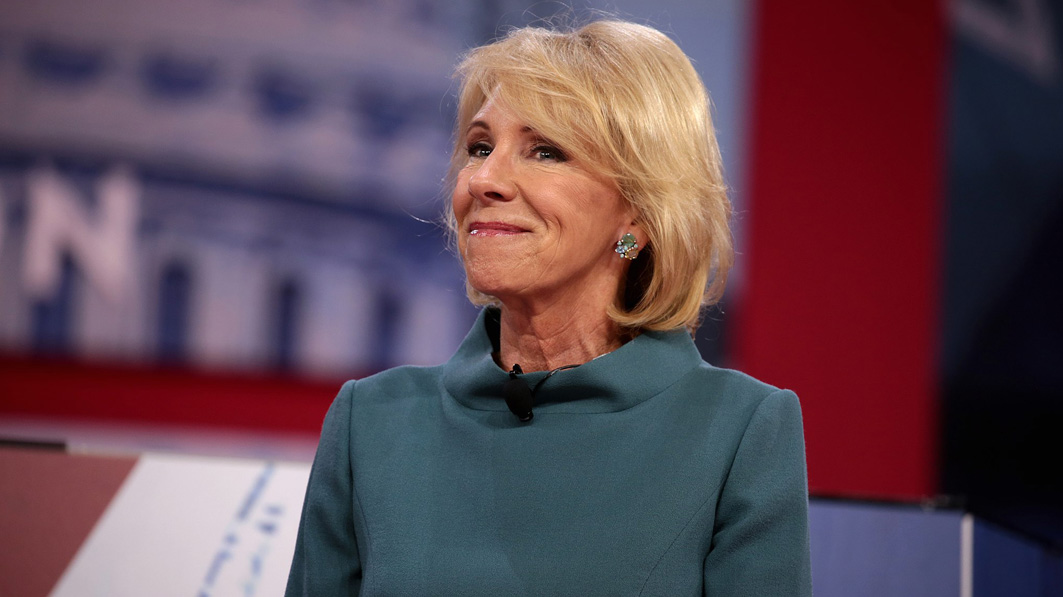
Betsy DeVos, the Secretary of the U.S. Department of Education (DOE), announced that DOE will no longer enforce a ban on religious organizations serving as contractors to provide services for private schools.
DeVos made the announcement at the annual meeting of the Council for American Private Education being held in Washington, D.C.
The ban, found in the federal law known as the Elementary and Secondary Education Act (ESEA), requires “equitable service providers” to be independent of any religious organization. When low-income or vulnerable children attend private (including religious) schools, the ESEA requires the local public school district to provide the same services to those children as it would to low-income or vulnerable children in the public schools. The district either provides the services itself, or contracts for those services with third parties, and those third parties are referred to as “equitable service providers.”
DeVos noted that since the Supreme Court’s 2017decision in Trinity Lutheran Church v. Comer holding that it is unconstitutional to exclude religious organizations from a generally available public program simply because of the organization’s religious nature, the DOE and the U.S. Department of Justice have determined that the ESEA’s religious ban is unconstitutional.
The DOE’s action will not impact other provisions of the ESEA that require all such equitable services to be neutral and non-religious in content, nor will it change the law’s requirement that the third-party provider not be affiliated with the private school where the services are being offered.
Critics of the new DOE policy argue that Trinity Lutheran was a narrow decision having to do with playground surfaces, not educational services. Americans United for Separation of Church and State, a secular organization whose mission seems to be the eradication of all mention of God from the public square, swiftly denounced the decision of DOE not to enforce the law. “Betsy DeVos is neither the Supreme Court nor Congress. She does not get to unilaterally declare that a statute is unconstitutional,” according to Maggie Garrett, AU’s vice president for public policy.
There is no word yet whether the new policy will be challenged in court.


ABOUT THE AUTHOR