New Study: Online Dating Produces Fewer Healthy Relationships
It’s basic law of nature: Young men meet young women, get married and begin building a meaningful life together. It’s how a family starts.
But how couples meet today really matters. By strong margins, most couples now meet online. Unfortunately, very few meet through family or church.
In fact, in 1960, most U.S. couples (24%) met through friends; 19% met through family, while only 6% met through church.
In 2000, friend introductions held strong at 28%, while co-worker introductions and meeting at a bar took second and third place (15% and 13%, respectively). Family introductions took fourth place at 11%.
Only 5% met at church, rivaled by online dating (also 5%).
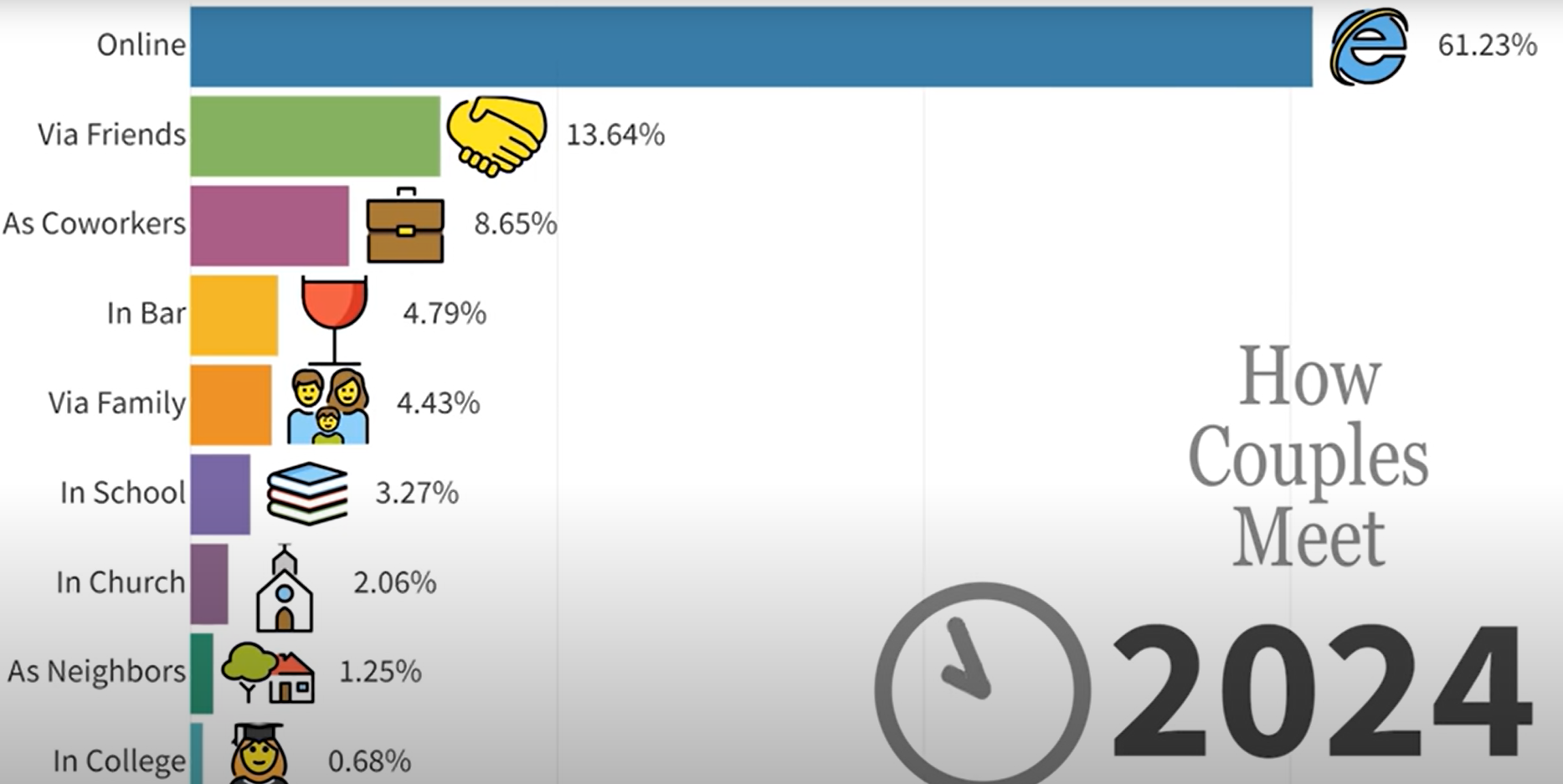
By 2024, a whopping 61% of couples met online, followed by meeting through friends (14% ) and coworkers (9%). Family was a paltry 4% and church was 2%.
You can see the changing trends in this creative video.
With most couples meeting online, it’s inevitable that relational strength and success will be impacted.
Early research indicated that meeting online had a slight positive effect on marital satisfaction and protecting against separation or divorce.
But later research conducted by the Institute for Family Studies demonstrated that meeting online was the least beneficial source for happy marriages, trailed only by bars. Church-facilitated meetings resulted in the highest levels of being “very happy” in marriage.
A new study by a team of psychologists from Poland’s University of Wroclaw examined this question anew with nationally representative data from 50 internationally diverse countries.
The first line of their study correctly notes, “The Internet has fundamentally reshaped how people meet and form romantic relationships.”
They concluded meeting online is not the best way to build the strongest, happy relationships and marriages.
They report, “On average, participants who met their partners online reported lower relationship satisfaction and lower intensity of experienced love compared to those who met offline, with effect sizes ranging from small to medium.”
Those who met in person tended to have healthier and more satisfactory interactions in intimacy, passion and commitment. The research team reported “these differences were generally small” but “importantly, these differences remained significant even after controlling for a broad set of demographic covariates, including gender, age, relationship length, socioeconomic status, [and] education.”
Why the Difference?
Why do online-introduced couples generally have less fulfilling relationships? Scholars offer three possible reasons:
- People who meet through their families, friends, church or work communities tend to have similar values and interests because how they meet selects for these similarities. Sociologists call this homogamy, or similarities in people’s sociological, educational and values background. People have fewer similarities when meeting online.
- Although related, having an overabundance of choices is uniquely a problem of online dating. Meeting a potential spouse through family, friends, school, work or one’s own neighborhood are all very powerful sifting mechanisms. One is likely to find like-minded individuals through similar interests and activities or through family and friends who know you well. Online dating, however, opens the door to many more possibilities. People are more likely to compromise in important areas because of the many options out there.
- In online dating, people commonly misrepresent themselves and it is difficult to distinguish between reality and fiction. The research team explains, “These inaccuracies are harder to conceal in face-to-face meetings, especially when shared social circles enable easier verification of personal details.”
As online dating becomes the main way people meet a potential spouse today, it is important to realize some ways of meeting a spouse produce healthier relationships and marriages over others.
These scholars conclude the study with this warning, “While online venues offer unprecedented opportunities for connection – especially across geographic and social boundaries – our findings suggest that relationships initiated offline are, on average, characterized by higher satisfaction and more intense feelings of love.”
Just another reason to favor and invest in IRL (in real life) communities of meaning.
Related Articles and Resources
If you or someone you know is struggling with marriage issues, Focus on the Family offers a one-time complimentary consultation with our ministry’s professionally trained counseling staff. The consultation is free due to generous donor support.
To reach Focus on the Family’s counseling service by phone, call 1-855-771-HELP (4357) weekdays 6:00 a.m. to 8:00 p.m. (Mountain Time). Please be prepared to leave your contact information for a counselor to return a call to you as soon as possible. Alternatively, you can fill out our Counseling Consultation Request Form.
Don’t Believe the Modern Myth. Marriage Remains Good for Men
New Focus on the Family Report: Marriage Health in America
Important New Research on How Married Parents Improve Child Well-Being
How Marriage Fights Against Deaths of Despair
Yes, Married Mothers Really Are Happier Than Unmarried and Childless Women
New Research: Marriage Still Provides Major Happiness Premium
Focus on the Family Marriage Report: Few Troubled Marriages Seek Needed Help
Harvard Evolutionary Biologist Brilliantly Explains Necessity of Monogamous Marriage
Important New Book Explains Why Marriage Still Matters
Image credit: Data is Beautiful / YouTube