Canada Euthanized a Record 16,499 Patients in 2024

While there is a technical distinction between euthanasia and physician-assisted suicide, this article will use the terms interchangeably.
Canadian physicians killed a record 16,499 people via euthanasia in 2024, representing 5.1% of all deaths in Canada.
New Report
The nation released its Sixth Annual Report on Medical Assistance in Dying in Canada (the 2024 report) on November 28, 2025.
The new data shows euthanasia deaths rose 6.9% from 15,427 in 2023, with the annual rate of growth decreasing significantly from the 36.8% growth rate between 2019 and 2020.
Nevertheless, the number of people in Canada who opt to end their lives via physician-assisted suicide continues to increase every year. The rate of growth naturally decreases as the number of people killed get larger each year.
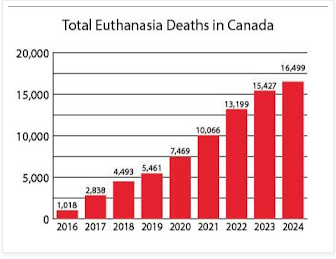
Photo from Euthanasia Prevention Coalition.
There have been 76,475 deaths due to euthanasia in Canada since the nation first legalized the practice in 2016, and 2024.
Alex Schadenberg, Executive Director of the Euthanasia Prevention Coalition, estimates at least 92,000 people have died by euthanasia in Canada as of November 2025.
Next year, barring an unexpected decrease in euthanasia deaths, Canada will have killed over 100,000 people via physician-assisted suicide in just 10 years – an ongoing and entirely preventable human rights tragedy.
Two Euthanasia “Tracks”
Tragically, Canada doesn’t limit euthanasia to the terminally ill.
Canada has two “Tracks” for individuals to access physician-assisted suicide. An individual can be approved for euthanasia under “Track 1” if their natural death is “reasonably foreseeable” (i.e., they are close to death). But individuals can also be approved if their death is not “reasonably foreseeable” (i.e., they do not have a terminal condition) under “Track 2.”
In the 2024 report, the number of Track 2 deaths increased by 17% to 732 deaths last year, representing 4.4% of all euthanasia deaths. Schadenberg describes the increase in Track 2 deaths as “very concerning.”
“People who die by euthanasia based on a Track 2 approval tend to be younger, are more likely to be women, and far more likely to be living with a disability,” Schadenberg notes.
To qualify for either euthanasia Track, an individual must have a “grievous and irremediable medical condition.” However, this term is not defined in law.
Physicians can approve individuals for cancer, organ failure, neurological conditions, respiratory diseases, cardiovascular conditions and “other conditions.” These “other” conditions can include: diabetes, frailty, autoimmune conditions, chronic pain, mental disorders or even hearing and visual issues – largely treatable and medically manageable conditions.
Furthermore, Schadenberg observes that “feelings of loneliness and isolation [were] related to 21.9% of Track 1 euthanasia deaths and 44.7% of Track 2 euthanasia deaths.”
“Based on the 2024 report there were at least 3,800 people who listed loneliness and isolation as a primary reason for being killed,” he elaborates.
Further Expansion
In 2027, Canada is set to expand its euthanasia regime even further by making individuals suffering solely from a mental health condition – like anxiety or depression – eligible for physician-assisted suicide.
The Canadian Parliament made the change in March 2021 by passing Bill C-7 to “permit euthanasia for a mental illness alone,” but delayed the modification for a few years. “Mental illness as sole underlying medical condition is excluded until March 17, 2024,” the 2024 report states.
A bill has been introduced in the Parliament – Bill C-218 – to reverse the expansion of euthanasia for mental illness, though it’s unclear whether it will pass.
Additionally, one group, Dying With Dignity Canada, is advocating for “mature minors” – those under 18 years of age – to be made eligible for euthanasia. The group argues that its “unfair to allow a 70-year-old with terminal cancer the choice of a peaceful death but deny a 17-year-old … the same choice.”
Of course, the same logic could be used to legalize euthanasia for 16-year-olds. Or 15-, 14- and 13-year-olds, and so on.
Euthanasia Always Violates Human Dignity
When talking about physician-assisted suicide, we must be clear what we’re discussing: We’re talking about killing people. And we should all be opposed to killing innocent people.
Every person is made in the image and likeness of God (Genesis 1:27, ESV). Permitting or assisting a person’s suicide – even to reduce human suffering – is always morally wrong and violates their dignity and worth.
Moreover, euthanasia is essentially never necessary to reduce human suffering. Thanks to great strides in palliative care and hospice, it’s possible to reduce or eliminate almost any individual’s suffering at the end of life without resorting to euthanasia.
As Christians, we must care for those people who are suffering, walk alongside them, and share their burdens to the best of our ability. At the same time, we must uphold the value of human life by opposing killing innocent people via physician-assisted suicide.
To speak with a family help specialist or request resources, please call us at 1-800-A-FAMILY (232-6459).
Focus on the Family offers a one-time counseling consultation with a trained or pastoral counselor free of charge thanks to generous donor support. If you would like to request a consultation with Focus’ Counseling Department, call 1-855-771-HELP (4357) weekdays from 6:00 AM to 8:00 PM (Mountain Time) or complete our Counseling Consultation Request Form.
Related articles and resources:
Counseling Consultation & Referrals
A Godly Perspective on End-of-Life Decisions
Answers to Common Questions About Physician-Assisted Suicide
The Problem With Ending It All: A Response to Physician-Assisted Suicide
Aging Loved Ones and Physician-Assisted Suicide
Canada to Report Killing Over 100,000 People With Physician-Assisted Suicide
NY Legislature Passes ‘Nightmare’ Bill Legalizing Physician-Assisted Suicide
Photo from Shutterstock.


ABOUT THE AUTHOR