Serious Faith Drives Sexual Satisfaction

America is in a curious sex recession. It’s even happening among young adults, and outlets like The Atlantic and The New York Times have taken notice and shown concern.
But an important new research report from the exacting scholars at the Institute for Family Studies (IFS) documents one group for which their sex lives are doing quite well. In fact, they are doing better than most others. This would be faithfully married Christian couples who regularly attend church. Even elite left-wing magazines have taken notice and trumpeted the news.
Presenting facts from the gold-standard of social science data in America – the General Social Survey from the University of Chicago – this report explains that in the 1990s, 64% of married young and older adults reported having sex at least once a week. This was true for both Christian and secular respondents. Things have changed though. Today, only 48% of secular couples who never or seldom attend religious services report weekly sex. Yet, a full 62% of faithfully attending Christians report this, a 14-point differential.
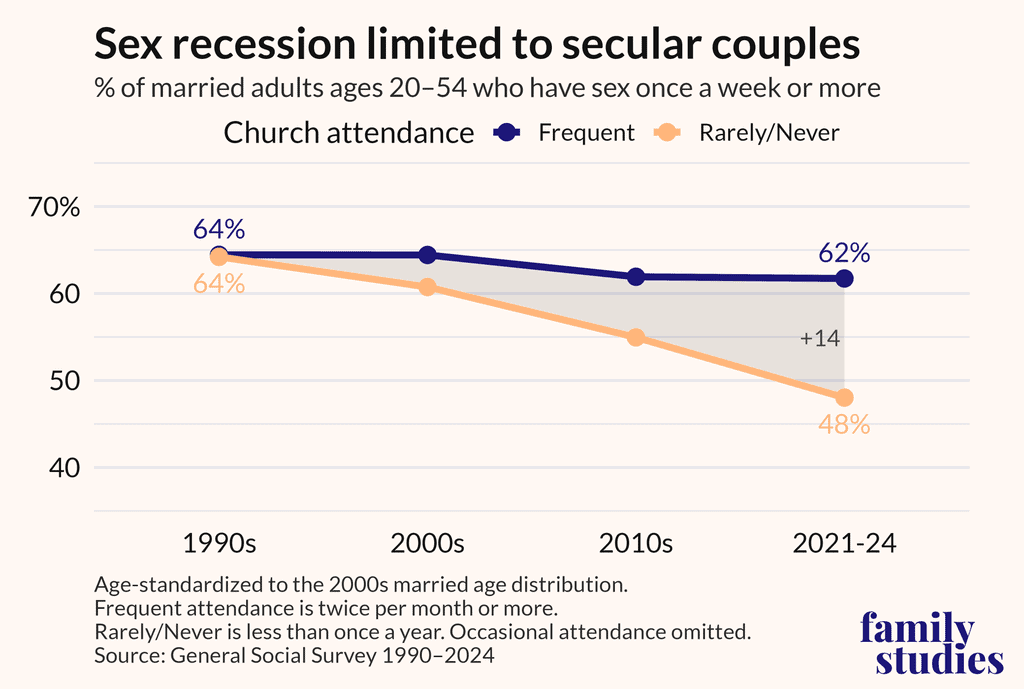
IFS explains, “So, there is a growing religious-secular divide in married sex – and it favors religious couples.”
The 2026 IFS Religion and Family Survey solidifies this finding as well. Their examination specifically looked at Protestant and Catholic populations of Christianity. Sixty-nine percent of regular Catholic churchgoers reported having sex at least weekly, while only 60% of nominal Catholics did. Sixty percent of regular attending Protestants reported weekly sex or more and 52% of seldom attending Protestants did. But only 47% of those with no faith reported this. These scholars explain, “Net of controls for education, race, and age, churchgoers had 1.49 times higher odds of having weekly sex than married peers who do not regularly attend religious services.”
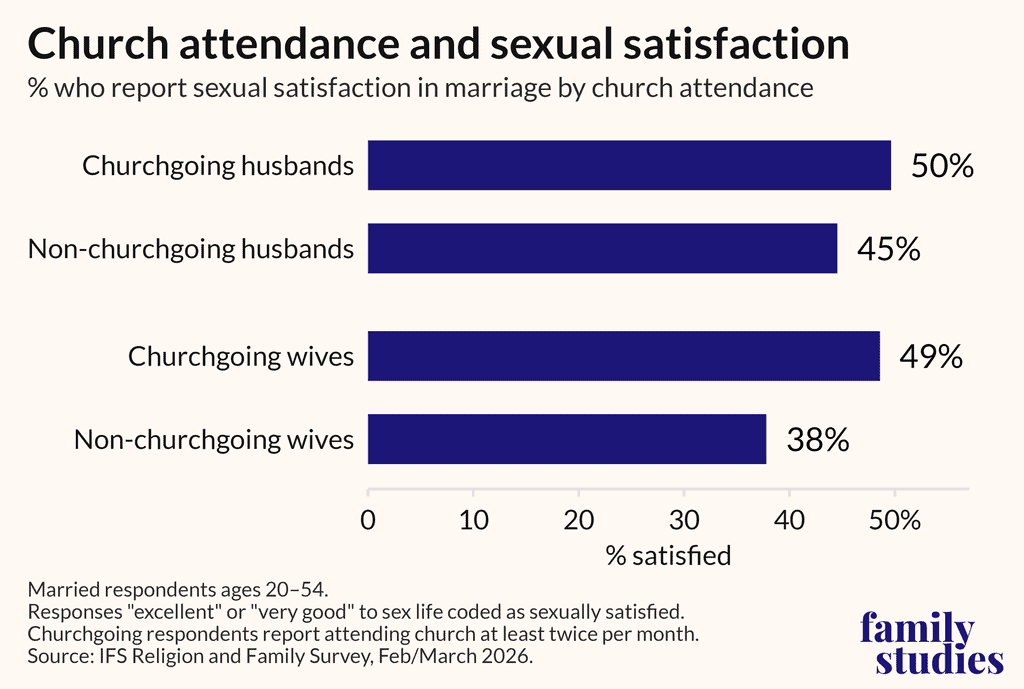
Of course, being sexually satisfied in one’s marriage is related to greater sexual frequency. So, it is not surprising that regular church going husbands and wives are most likely to report higher sexual satisfaction, with 50% of such husbands and 49% of wives stating this, compared to 45% and 38% of their non-attending peers doing so. By subgroup, 55% of regular attending Catholics and 45% of consistently attending Protestants rate their marital sex lives as either “excellent” or “very good.” Only 40% of Nones, 45% of nominal Catholics and 35% of nominal Protestants report high levels of sexual satisfaction.
Prayer matters also. Catholics edge out Protestants in terms of prayer and sexual satisfaction, but together “Catholics and Protestants who pray daily have 1.29 times higher odds of sexual satisfaction than [their peers] who do not.”
IFS explains, “Overall, churchgoing Catholics are the most likely of any group to report frequent sex and sexual satisfaction, while Nones scored significantly lower than nearly every other group on both measures.” Protestants trail Catholics closely. IFS’s new report contends, “The cultural trope of the sexually prudish, frustrated religious American does not fit the data.”
The IFS report also found that regular church-attending adults are notably more likely to be married, 18 percentage points over those who attend seldom or never, 60% to 42% respectively.They are also more likely to report being happily married. IFS explains, “For example, churchgoing husbands (78%) and wives (74%) ages 20 to 54 are more likely to be happy with their marriage compared to non-churchgoing husbands (66%) and wives (63%).” Considering controls for various socio-economic factors like race, education, income and age, these scholars found, “churchgoers have 1.49 times higher odds of being happily married, compared to non-religious spouses.”
Faith does matter, in very important ways. God’s design for men and women does too. We are His image made for each other, and marriage solves the paradox that humanity is made of male and female. And God meets us in our personal relationships. When we live in and out of this, we thrive. Social science research proves this, time and again. This is what this new IFS report does so beautifully and truthfully.
Related articles and resources:
Marriage and the Pursuit of Happiness
Research Shows Marriage Boosts Well Being
Are Men or Women More Likely to Be Married?
New Research Shows Married Families Matter More Than Ever
Why You Should Care About the Growing Positive Power of Marriage
Important New Research on How Married Parents Improve Child Well-Being
New Research: Marriage Still Provides Major Happiness Premium
Cohabitation Still Harmful – Even as Stigma Disappears
Marriage Before the Baby Carriage? More Americans Are Saying ‘Yes’
Don’t Believe the Modern Myth. Marriage Remains Good for Women
Don’t Believe the Modern Myth. Marriage Remains Good for Men.
Yes, Married Mothers Really Are Happier Than Unmarried and Childless Women
Marriage and the Public Good: A New Manifesto of Policy Proposals