Marriage and the Pursuit of Happiness

It is the greatest line Thomas Jefferson ever conceived, in the greatest document he ever penned:
As our nation celebrates its 250th birthday, launched by the unparalleled greatness of the Declaration of Independence, it is important that we consider the unalienable rights our Creator equally endowed to all people. Jefferson listed life first, the right to be alive and to live one’s life. We also possess the right to live that life in liberty.
But what about this curious third right, “the pursuit of Happiness”?
Is “happiness” too cheap and transitory a value to be listed among “life” and “liberty” as foundational human values? The great Bob Dylan sure thought so. A reporter from Rolling Stone magazine asked him in 1991 on his fiftieth birthday if he was happy. He fell silent, stared at his hands and retorted, “You know, these are yuppie words, happiness and unhappiness” adding, “It’s not happiness or unhappiness, it’s either blessed or unblessed.”
Dylan then quoted the first line of the Psalms to the reporter, “As the Bible says, ‘Blessed is the man who walketh not in the counsel of the ungodly.’”
Yet, Jefferson was certainly not referring to a mere feeling of happiness, but something deeper. It is likely the Founding Father was inspired by George Mason’s Virginia Declaration of Rights penned just three weeks earlier, which guarantees “the enjoyment of life and liberty, with the means of acquiring and possessing property, and pursuing and obtaining happiness and safety.”
Years later, Jefferson wrote to a school master in Maine who asked for some irrefutable wisdom to pass on to his students. Citing Cicero’s Tusculan Disputations, Jefferson explained that there is no happiness without virtue. For Cicero stated, “It is certain that without virtue there can be no happiness” and as such, “a happy life is the consequence of virtue.”
For Jefferson and others in that era, this is what happiness meant. Not the pursuit of pleasure or a fleeting feeling, but the pursuit of virtue – a habit or trait that leads to goodness and human flourishing.
Few in the world today would consider marriage an important schoolhouse for learning virtue, but it certainly is. And the character-shaping nature of marriage leads to greater overall life happiness, especially when husband and wife have a serious faith. This is amply demonstrated in findings from the General Social Survey, the gold standard of sociological population research.
Wives who regularly attend church are more likely to report being “very happy” compared to their unmarried and secular peers, as demonstrated here.
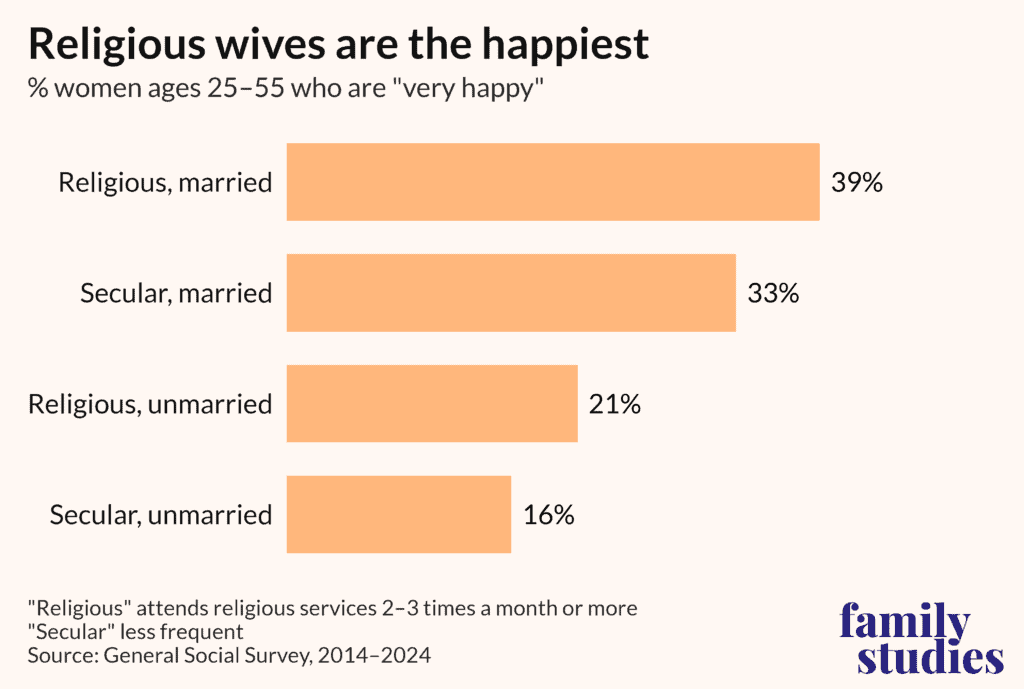
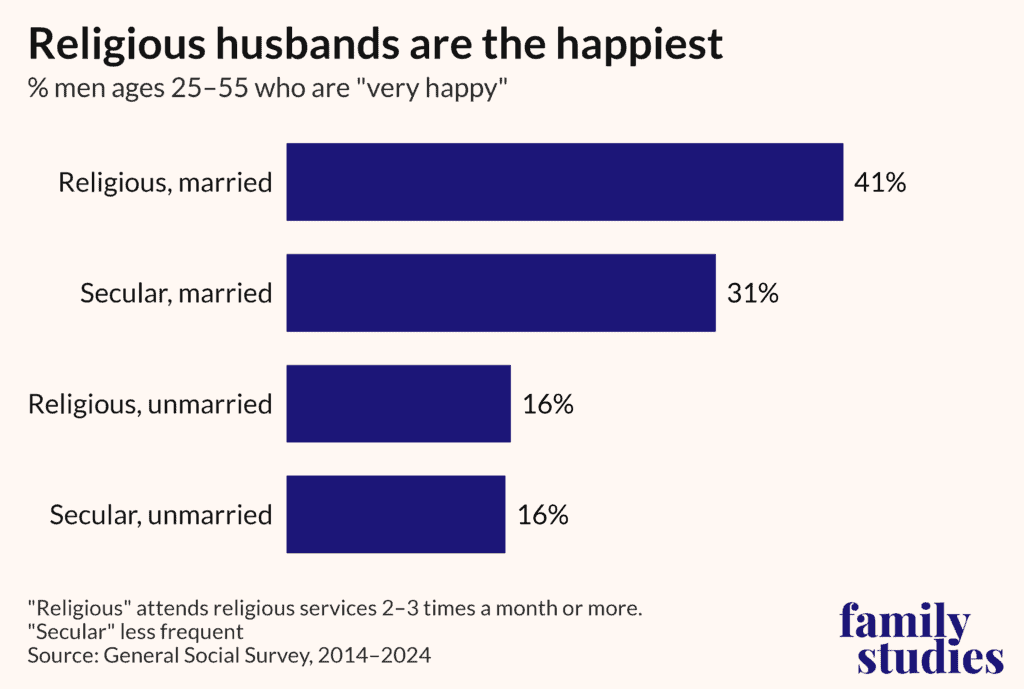
The Institute for Family Studies (IFS) recently reported that “religious, married women and men aged 25 to 55 are more than twice as likely to report being ‘very happy’ in life compared to unmarried religious counterparts.”
The happiness differentials for faithful married men look like this:
A 2025 IFS report on what life factors lead to strong, stable marriages explains:
The Daily Citizen has reported on recent research demonstrating the powerful happiness premium marriage provides for men and women. Professor emeritus Sam Peltzman of the University of Chicago found, “Being married is the most important differentiator with a 30-percentage point happy-unhappy gap over the unmarried.” This remains true when controlling for important socio-economic factors like age, race, sex, educational status, income and geographical location.
And this has remained consistently true across the decades when married men and women are compared to their cohabiting and single peers.
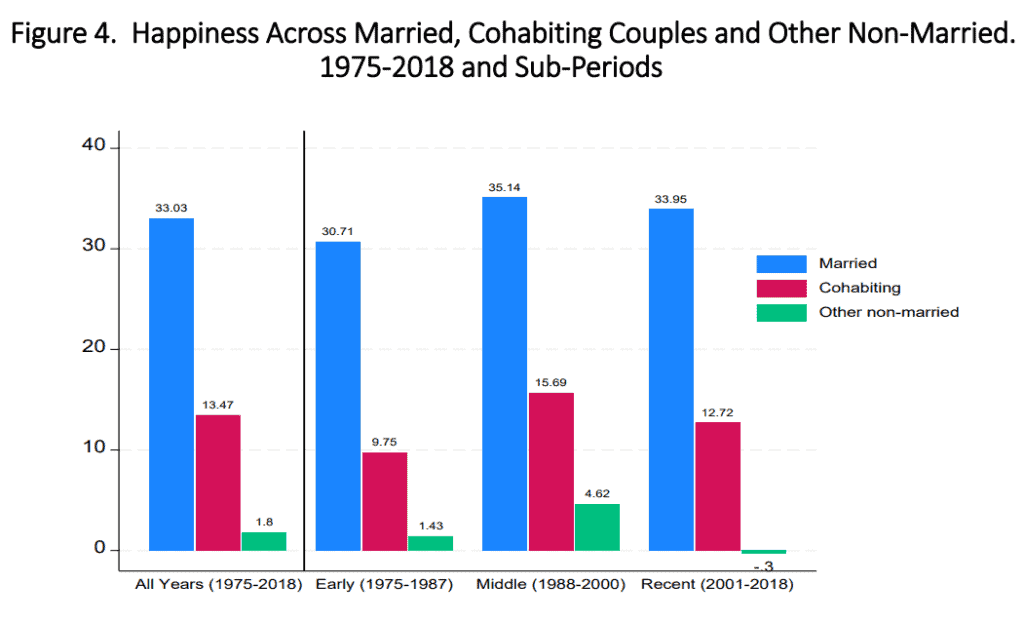
Marriage is a profound and consistent happiness boost. In fact, Peltzman calls it a “landslide.”
Peltzman adds, “Conservatives are distinctly happier than liberals,” indicating married conservatives enjoy an even higher happiness dividend.
As we consider the wonderful founding of our nation and the opportunities the United States affords to so many for a better life, it is essential we appreciate how much faith and marriage contribute to our collective pursuit of happiness.