20 Powerful Excerpts from Secretary Marco Rubio’s Eloquent Defense of Western Civilization
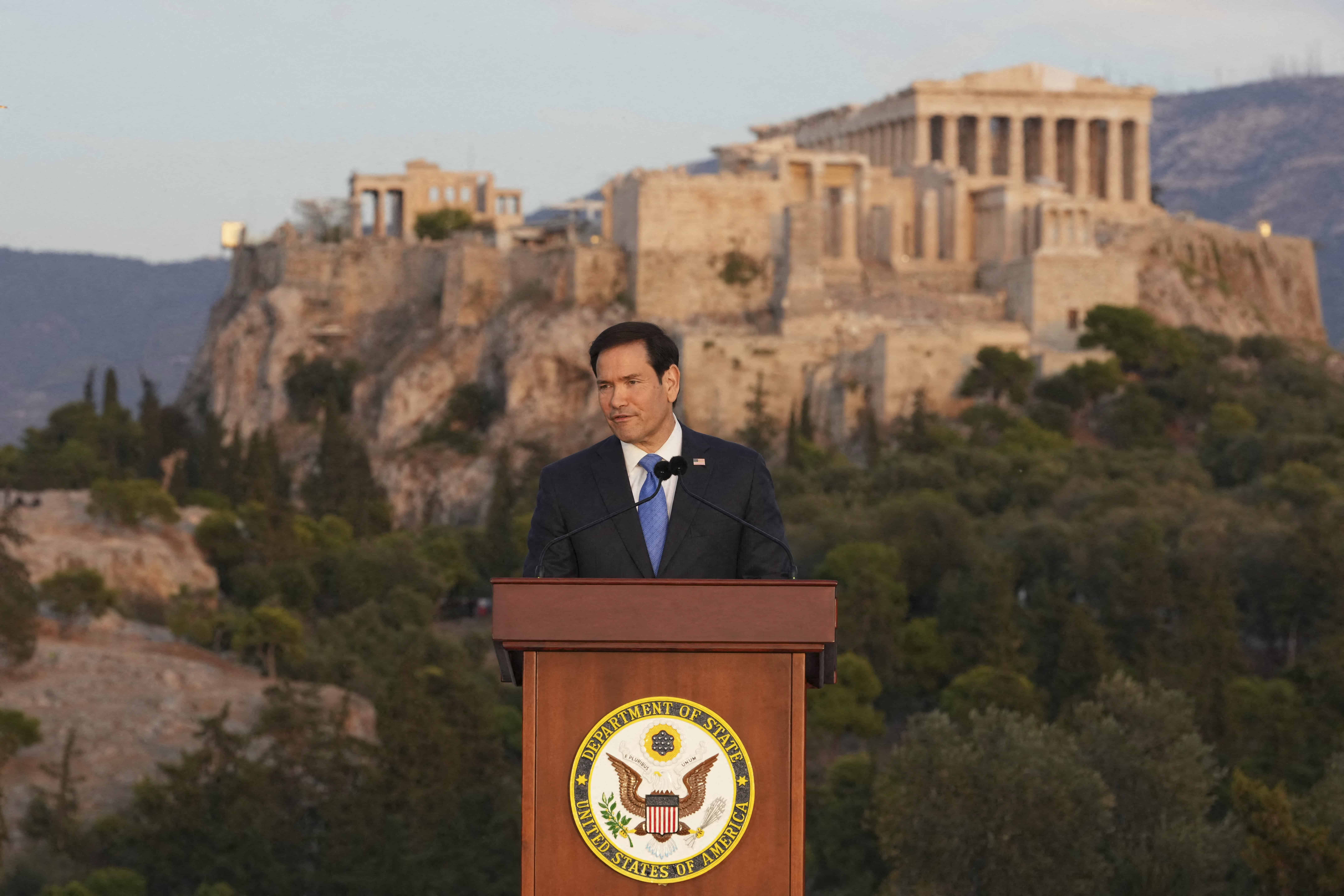
Secretary of State Marco Rubio, speaking on Wednesday at the Pnyx, the famous hillside in central Athens in Greece where democracy was born, offered both a history lesson and an eloquent, full-hearted endorsement of the enormous benefits of Western thought and principles.
Meeting with NATO partners and also attending the sixth U.S.-Greece Strategic Dialogue conference, Secretary Rubio’s remarks covered a lot of years.
At times, his words were warm, praising the foundational contributions of the Greeks.
But the overarching theme in his message was a stark warning to the West. The former Florida senator suggested the world is facing an inflection point.
“We are at an inflection point,” Secretary Rubio stated. “An inflection point not only in the history of my nation, but an inflection point in the whole of our civilization.”
As is often the case, Mr. Rubio was diplomatic, but he was also unapologetic about America’s role in leading the way and in the values our nation strives to manifest and uphold.
With the ruins of the Acropolis over his shoulder, his speech was pointed and poetic, delivering a not-so-subtle message: America and Europe share a common heritage and should still possess a similar bond and ambition.
Here are 20 of the most memorable passages of the speech:
1. “Most of us are familiar with the basic history: Athens gave us democracy. Plato and Aristotle gave us Western philosophy. Our ideas of law, of virtue, of citizenship, and republican government were shaped in the Greek city-states. Even much of our political vocabulary – words like democracy, tyranny, the word ‘politics’ itself – found its origins here.”
2. “In Athens, we found the first full realization of all the essential traits that would come to define the West: fierce individuality and relentless ambition; daring exploration and invention; a yearning for discovery, for adventure, risk and glory. An insatiable curiosity about the world and the principles by which it operates, a hunger to know the mysteries of nature and grasp the secrets of the cosmos. An impatience with the notion of impossibility, chafing at all boundaries and limits, straining to peer into the depths of the unknown.”
3. “What blossomed here in this place was the Western desire to uncover all that ignorance, darkness, and distance had kept hidden from the mind of man. The Greeks did not just shape history; the Greeks gave us history itself.”
4. “It is not just the ambition to explore the unknown that we inherit from the Greeks; it is the conviction that the unknown can be known. The confidence that the world can be charted and measured and mapped and understood – and that there is a rational order to the cosmos, governed by certain fundamental laws, laws that men can observe and the mind can come to understand.”
5. “This was the foundation of the Western mind: our math, our science, our medicine. Our philosophy, ethics, and religion. It paved the way for the gospel of Jesus Christ to find fertile soil in Europe and flourish into the empire of Christendom. It was the foundation of the riches of Christian theology – of Augustine and Aquinas and the whole tradition of natural law.”
6. “It gave birth to a civilization marked not just by a common culture. It was marked by a common anthropology – a common view of man and his place in the universe. Its descendants would share not just the idea of a natural order, but a distinctive understanding of virtue; of destiny and fate; of truth, goodness, and beauty; of a code that dictates how men ought to live; of objective standards and ideals to strive towards.”
7. “For the Greeks of antiquity, the pursuit of excellence was the very principle of man’s existence. They organized all of civic life around contest, ambition, competition: in philosophy and poetry, in sculpture and drama, in athletics and art, in war and statecraft. The classical Greek city was an arena for great men to test and prove themselves, to hone their potential through perpetual struggle – to be the best, the strongest, the most beautiful, straining to inch ever closer to perfection.”
8. “Now I know that to modern ears, what I just described, this way of life, may sound odd. It may even sound cruel. The ideal of many ideologies in our time has, frankly, become a world of perfect safety, devoid of risk or failure, with neither the glory of victory nor the shame of defeat. Too often these days, we build downwards. We design our standards to ensure no one will lose; we preoccupy ourselves more with the comfort of the worst than the potential of the best. We hold the most exceptional things among us hostage to the average, the ordinary, the mediocre.”
9. “The word ‘nationalism’ became a dirty word. And so we tore down our monuments; we condemned our own history. And in too many places, we taught our children to be ashamed of the countries they would inherit. In the process, we opened our borders and outsourced our industry, and allowed our militaries to wither and to decay.”
10. “We find ourselves at a crossroads. Because the next decade and the decisions we make will write the story of the next century. The course we take will determine whether the West maintains its place at the head of the world or resigns itself to a future of atrophy and servitude and decline. We will either choose to act now or lose the choice to act at all.”
11. “We choose the unapologetic pursuit of national power: to take back control of our critical supply chains, to reindustrialize our economy, to rebuild our defense, to fight for dominance of the technologies and industries of the future.”
12. “We choose to reach for new frontiers … To unleash our energy, to rebuild our factories, to return our astronauts to the moon and launch a new age of exploration in space.”
13. “Though passions may, at times, have strained the bonds of affection between the United States and Europe, it must not be allowed to break them. Together, we must strengthen an alliance capable of confronting the threats of our age.”
14. “It has become fashionable today to believe that enlightened foreign policy means prioritizing the global community over one’s own people. And I think here, too, we have much to learn from the men of ancient Greece because they knew that there was nothing selfish or wrong about loyalty to your nation, nor anything selfish or wrong about fighting to defend its interests above all else.”
15. “These are the qualities that would shape the Western moral imagination: From the Christian martyr who refused to betray his faith to the patriot who gave his life for his country; from Saint Thomas More to the Battle of the Alamo, running through the immortal closing words of the Declaration of Independence of the United States which says, ‘We mutually pledge to each other our Lives, our Fortunes and our sacred Honor.’”
16. “It is from the Greeks that the West inherited its sense of duty – an unbreakable loyalty to one’s code, one’s cause, one’s country.”
17. “Our heroes may be willing to die for their cause; but our heroes do not worship death. It is precisely because we value life that we come to recognize the heroism in those who would sooner sacrifice it than to betray their principles.”
18. “The greatest Americans of every generation have carried the unmistakable features of their forefathers – born in Athens, formed by Rome, baptized in Christendom, hardened in the furnace of medieval Europe, endowed with the English genius for liberty, and then carried across the Atlantic to be reborn on the shores of a new world.”
19. “We must rebuild our institutions and our alliances to face these threats together – understanding that the purpose of these things is not to abolish the sovereignty of the nations that constitute them; it is to defend them. And that nations need not abandon their distinct identities in order to recognize their common interests.”
20. “The story of our civilization is the greatest story ever known to man. And it began here, with the first men and women of the West. From them – from them – we can rediscover the virtues, the courage, and the strength to confront the dangers that we face in our time.”
Secretary Rubio’s speech was a declaration that history alone won’t hold a civilization together. Instead, what’s needed is a commitment to the underlying virtues and principles that previous generations courageously and faithfully embraced.


ABOUT THE AUTHOR