Kentucky Lawmakers Vote to Return Ten Commandments Monument to State Capitol
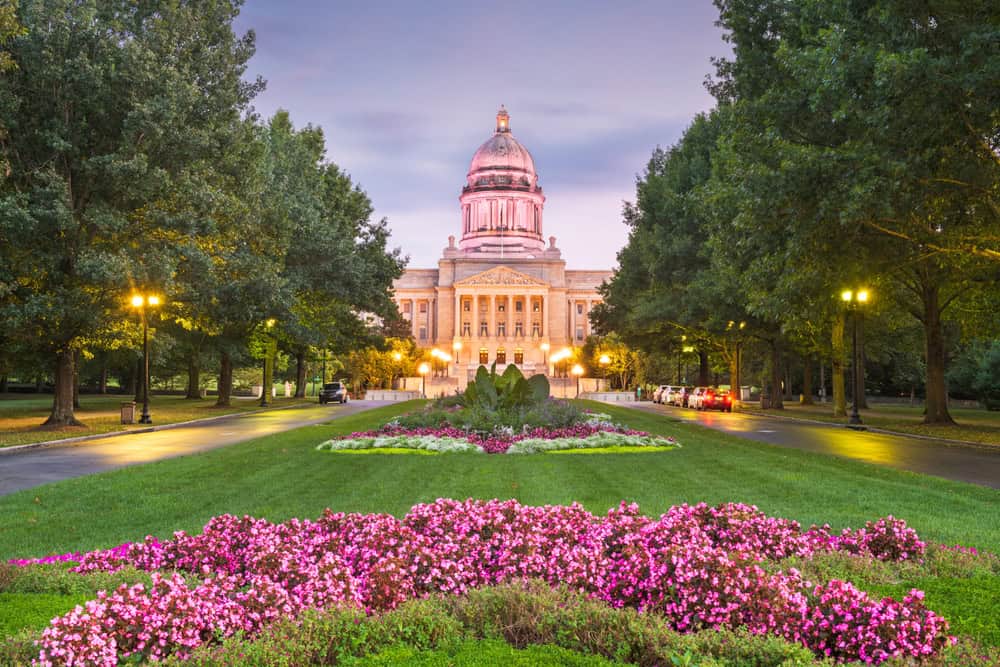
A resolution to bring back the Ten Commandments to the Kentucky Capitol, which was approved overwhelming by the state’s Legislature, became law last week.
The Legislature passed Kentucky House Joint Resolution 15 (HJR 15) which calls for a “return for permanent display on the New State Capitol grounds the granite Ten Commandments monument given to the Commonwealth of Kentucky in 1971 by the Fraternal Order of Eagles.”
The Kentucky House approved the resolution on February 19 in a 79-13 vote, while the state Senate approved it on March 13 in a 32-6 vote. The bill became law on March 27 without Gov. Andy Beshear’s signature.
The monument, gifted by the non-profit organization over 5 decades ago, was removed in the 1980s due to a construction project.
In 2000, a legislative resolution signed into law required the monument be returned to the Capitol grounds for permanent display. However, a federal appeals court, relying on the Lemon test, blocked the resolution.
The Lemon test, created by the U.S. Supreme Court in the 1971 case Lemon v. Kurtzman, called for a three part inquiry into whether a law violated the Constitution’s Establishment Clause, examining (1) whether the law had a secular purpose, (2) if its effect was to advance or inhibit religion and (3) whether it excessively entangled the church and state.
The Lemon test was responsible for the removal of various religious symbols, monuments and practices – like crosses and the Ten Commandments – from public spaces over the years, seeing them as an “establishment of religion.”
Thankfully, in recent years the Supreme Court recognized that the Lemon test was unworkable.
In 2019, the Supreme Court upheld the constitutionality of the Bladensburg Peace Cross, and mandated that established monuments, symbols and practices deserve a “presumption of constitutionality.”
In 2022, in Kennedy v. Bremerton School District, the court finally overruled Lemon entirely. In place of Lemon, the court directed lower courts to interpret the Establishment Clause with “reference to historical practices and understandings” and examine whether laws “accord with history and faithfully reflect the understanding of the Founding Fathers.”
First Liberty Institute, which represents Eagles Aerie 3423 in Hopkinsville, Kentucky, said the group will return the monument to the state to be placed on the Capitol grounds.
“We applaud the Kentucky Legislature for restoring a part of Kentucky’s history,” said Roger Byron, Senior Counsel for First Liberty, in a statement after the vote, adding,
Vic Jeffries, trustee of Eagles Aerie 3423, said his organization is “thrilled to return the Ten Commandments monument to the state and have it restored to the Capitol grounds, its historic location.”
“The Eagles have donated over 100 Ten Commandments monuments to state and local governments over the years, and we’re glad to have ours back where it belongs,” Jeffries added.
The Ten Commandments are perhaps the greatest moral commands ever given. Jews and Christians alike believe they were divinely revealed by God.
People of any – or no – religious affiliation should appreciate the special significance the commandments have had upon our Western cultural and legal heritage. Far from being unconstitutional, the Ten Commandments provide the basis for many of our moral standards and legal practices in the first place.
It’s deeply encouraging that Kentucky’s lawmakers have seen fit to return it to the state Capitol.
To speak with a family help specialist or request resources, please call us at 1-800-A-FAMILY (232-6459).
Related articles and resources:
Appeals Court Favors Louisiana Ten Commandments Law for Now
Judge Temporarily Blocks Ten Commandments in Classrooms, Louisiana Will Appeal
Oklahoma Superintendent Directs All School Districts Teach the Bible
Ten Other Bible Verses that Could Be Posted in Every Public School
Louisiana’s Ten Commandments Bill is Good for Kids, Communities, and the Nation
Louisiana Is Right To Want the 10 Commandments in Classrooms
Photo from Shutterstock.


ABOUT THE AUTHOR