New Dire Fertility Prospects for the United States and Real Hope for a Fix

It has been well documented that fertility is falling in the U.S. and in nearly every part of the world. The Daily Citizen has tracked this well, here, here, here and here.
Sustained declining fertility violates God’s first command to humanity to not only be fruitful and have children, but to actually multiply – to have more children than the couple themselves. A demographic truism is that a population that is not moderately multiplying is slowly dying. That is the present fact of global fertility.
Leading UPenn demographer Jesús Fernández-Villaverde has explained, “Humanity has entered a new era of rapid population decline.” He adds, “If we are unable to address our fertility crisis, the US will face an existential economic crisis driven by a steep decline in fertility rates – one that could have an impact measured in the quadrillions of dollars.”
Fewer people means more economic troubles because people are producers. They work. They create ideas, goods and resources that make life better for other people. Humans innovate. In fact, Paul Romer won the 2018 Nobel Prize in economics for mathematically demonstrating how people are much stronger, more powerful producers of goods and solutions to real problems than they are dangerous consumers. As Romer showed, our minds are more beneficial to the future of humanity than our stomachs are a threat. This fact turned what most people wrongly believed about population growth on its head. God is right. Population growth is not a problem. It is essential to human thriving and an improved and growing civilization.
A new report from the scholars at the Institute for Family Studies (IFS) further documents just how serious the problem of fertility decline is for America. They note that as we celebrate our nation’s 250th birthday, we must recognize what got us to “our current scale and strength as a nation – families raising their own children.”
IFS laments, “Without a new birth of family life in America, the greatest days of freedom will indeed be behind us.” They properly add, “The future of liberty for all of us depends on the future of family.”
Their report, entitled The Demographic Dead End: 2026 State of Fertility, shows the U.S. is now in its third historic period of extended below replacement fertility. And this third period is longer and more sustained than previous declines. They chart national U.S. fertility since 1800 to the present and it looks like this:
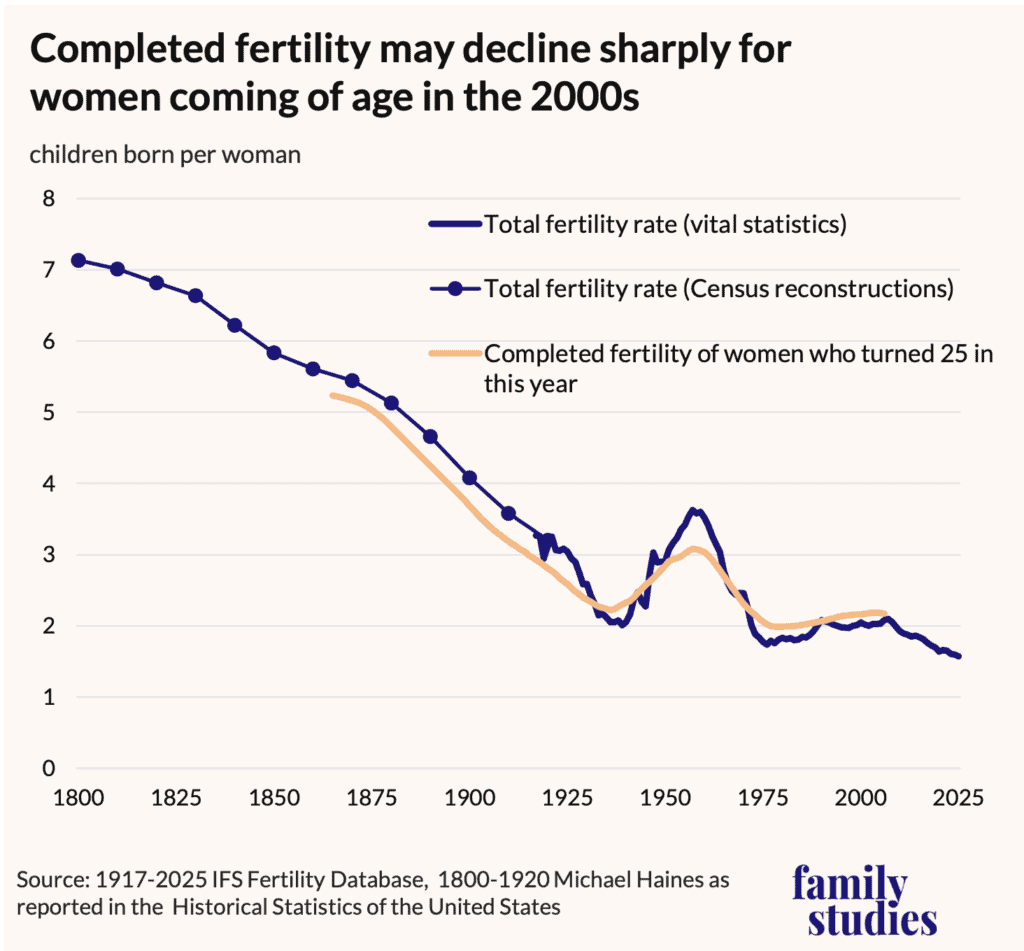
This is certainly not a growth trend line. IFS reports that if this downward trend continues, the U.S. population will peak in 2054, decades ahead of projections, and then start declining in the 2080s.
Once a population starts to decline, it is nearly impossible to bring it back up to replacement level. In fact, a leading group of Gates Foundation funded demographers reported in a major study from 2020 that “once global population decline begins, it will probably continue inexorably.” The Cambridge dictionary defines “inexorably” as “in a way that continues without any possibility of being stopped.”
This fact is sobering, as it means this sustained trend will likely be the eventual end of humankind.
Desired Fertility vs. Actual Fertility
Yet, IFS expresses hope.
Data consistently shows that actual fertility – babies actually being born – is lower than desired fertility, the number of children young couples or singles say they want to have one day. For Americans, actual fertility is 1.6. Desired fertility is, according to Gallup, 2.7.
And beliefs about God and life impact this. States with higher levels of church attendance, happy marriages and family strength tend to have higher birth rates than states with lower rates of faith,marriage and intact family formation. An additional IFS report, The Ideological Fertility Divide, explains how “liberals are more likely to hold views linked to fewer kids.”
But the fact is, no generation has ever had all the children they say they desire. Every age lags between the family size they say they want and what they actually have. For various confounding reasons, this is a human truism.
But it is good that the stated desire is there. It is something to work with.
This is even more meaningful when we consider that IFS, in their new Demographic Dead End report, explains that fertility is not so much a function of economics, but of social dynamics.Drawing from this IFS report, Rob Henderson, a senior fellow at the Manhattan Institute, concludes the trick to getting more babies is having more friends, and ideally, more friends who have babies themselves. Henderson states, “Americans are not having fewer children because they want fewer children.” He adds, “They are having fewer children, in part, because friendship has thinned and social support for family life has weakened.”
The decline of social familism drives down fertility. Thus, according to Henderson, “The gap between desired and actual family size is the widest it has been since the early 1970s.”
So it is not really economics and housing costs that limit fertility. IFS found that for Americans under 30 with a small circle of friends who are generally less supportive in helping with common life struggles, their fertility rate is about 1.7. For those reporting a larger, more supportive friend base, their fertility rate was 2.8, just above what Gallup reports as desired fertility. As Henderson explains, “having friends with kids predicts wanting more kids yourself.” Philosophical anthropologist René Girard would say this is because of mimetic desire, the fact that humans tend to desire what they observe other people enjoying. We need to see more young couples enjoying having kids.
We humans must revive the culture of fertility, having and enjoying plenty of children. Others will catch on to the craze. Human civilization depends on this shared habit. It is, after all, the first thing God told us to do. And demographers are now telling us how much it matters. Our very future depends on it.
Related articles and resources:
The Pressing Need to Fix Global Fertility Decline and How to Do It
Is Inflation Driving Fertility’s Decline?
American Deaths to Exceed Births Faster Than Expected, CBO Reports
U.S. Fertility Rate Falls to Lowest on Record – Again
Global Population Has Passed ‘Peak Child’ – an Ominous Milestone
Why Americans Over and Under 50 Say They Don’t Have Kids
Death of the West? U.S. Fertility Rate Falls to Record Low.
China’s Population Drops by 2 Million in 2023 Due to Record Low Birth Rate
Discarding Genesis 1, U.S. Population Set to Decline This Century Amid World Population Collapse
The Importance of God’s Design for Marriage and Family
New Report Gives Update on Family Formation and Child Well-Being


ABOUT THE AUTHOR