
• Skip to main content
Daily Citizen
  • Subscribe
  • Categories
    • Culture
    • Life
    • Religious Freedom
    • Sexuality
  • Parenting Resources
    • LGBT Pride
    • Homosexuality
    • Sexuality/Marriage
    • Transgender
  • About
    • Contributors
    • Contact
  • Donate

age verification

Aug 07 2025

Proposed ‘App Store Accountability’ Act Would Force Apps and App Stores to Uphold Basic Child Safety Protections

JUMP TO…
  • Unseen Dangers
  • The Act
  • Powerful Incentives
  • In the States
  • Why It Matters

Children increasingly access and engage with the internet through smartphone and tablet apps. But app stores and developers have almost no legal duty to protect these vulnerable users.

Congress will consider changing that this year with the App Store Accountability Act.

The bicameral legislation, which Senator Mike Lee (UT) and Representative John James (MI) introduced in May, closes regulatory loopholes that allow:

  • Children to download apps, make in-app purchases and sign terms of service contracts without parent’s consent.
  • App developers to determine their own age ratings, which neither app stores nor developers are penalized for lying about.

The act is based on model legislation created by Digital Childhood Alliance (DCA), a group of more than 100 child advocacy groups including Focus on the Family-allied Family Policy Alliance.

DCA argues the bill will bring app stores and developers into compliance with U.S. contract law, which requires parties to a contract be at least 18 years old and possess informed consent.

“App stores are the digital gatekeepers of children’s online lives, but they cause systematic harm by treating minors like adults and allowing them to consent to exploitative contracts with large corporations,” DCA writes.

“App stores face little accountability for misleading age ratings, and they routinely make critical details, such as app content descriptions, hard to access,” they continue. “This makes informed consent effectively impossible.”

Unseen Dangers

Unregulated apps and app stores don’t just circumnavigate parents — they strip children of parents’ protection online.

Device-level parental controls don’t filter what children see in apps. Age ratings mean nothing, because app developers are the ones who get to set them.

In the Apple App Store, TikTok rates its app appropriate for ages 12 and up. Apple recommended it change that rating to 17 and up in 2022 after finding the app displayed “frequent or intense mature and suggestive content.

TikTok refused to comply.

Age ratings rarely reflect the content of an app’s advertisements. Games designed for young children can contain violent, pornographic or other harmful pop-up ads. These ads also contain portals to the internet, which children can use to search without parental controls.

To illustrate the scope of the problem, DCA founder Melissa McKay posted a video on X of someone accessing a porn site through the weather app.

“[Google] says it’s ‘silly’ to regulate apps like the weather app, implying most apps pose no risk,” she points out, warning,

The weather app is rated [four-and-up] in the Apple App Store, while [the app’s] own terms of service want parental consent for users [under 18 years old]. And there are MANY back doors to porn.
The Bill

The App Store Accountability Act would force app stores and developers to obtain parental consent before doing business with minors.

The legislation is made up of two components. The first requires app stores to run age-verification checks on people who download apps and tell developers which users are minors. Developers would prompt app stores to re-verify users’ ages every year, or any time they suspect an account has been transferred or hacked.

The second component increases app stores and developers’ accountability to parents. App stores would have to obtain parental consent before allowing a minor to download, purchase or make purchases inside an app.

Stores would also have to notify parents if one of their child’s apps:

  • Monetizes new features.
  • Changes the kinds of user data it collects or how it collects them.
  • Changes its age rating or description.

The act wouldn’t require developers to communicate directly with parents. It would, however, force them to acknowledge underage users and follow applicable child protection laws — including those limiting what online data can be mined from minors.

The Federal Trade Commission (FTC) would investigate violations of the App Store Accountability Act as deceptive and unfair business practices. The legislation would also allow states to sue violators on behalf of their citizens.

Powerful Incentives

The App Store Accountability Act shields developers from legal liability if an app store fails to provide them with age-verification data. But this carveout only applies to developers that can prove they acted in good faith to protect young users from accessing inappropriate content.

That means developers have significant legal incentive to shield children from harm — even if the law doesn’t explicitly require it.

In the States

Utah, Texas and Louisiana have passed state-level App Store Accountability laws based on Digital Childhood Alliance’s model legislation. Each allows affected families to sue app stores and developers for violations.

Ohio lawmakers introduced an App Store Accountability bill in April. Alabama failed to pass one earlier this year after intense push-back from Big Tech lobbies and e-commerce sites.

Why It Matters

It’s parents’ responsibility to protect their children online — but they deserve a fighting chance. Unregulated app stores and developers make it difficult for even the most conscientious parents to shield their kids from internet garbage.

The Daily Citizen supports any legislation that enables parents to better do their jobs.

To learn more about the act, click here.

To learn more about tech safety check out the links below.

Additional Articles and Resources

A.I. Company Releases Sexually-Explicit Chatbot on App Rated Appropriate for 12 Year Olds

‘The Tech Exit’ Helps Families Ditch Addictive Tech — For Good

Supreme Court Upholds Age-Verification Law

UPDATED: Pornography Age Verification Laws — What They Are and Which States have Them

Proposed SCREEN Act Could Protect Kids from Porn

‘Big Tech’ Device Designs Dangerous for Kids, Research Finds

President Donald Trump, First Lady Sign ‘Take it Down’ Act

Social Psychologist Finds Smartphones and Social Media Harm Kids in These Four Ways

Four Ways to Protect Your Kids from Bad Tech, From Social Psychologist Jonathan Haidt

Parent-Run Groups Help Stop Childhood Smartphone Use

The Harmful Effects of Screen-Filled Culture on Kids

Written by Emily Washburn · Categorized: Government Updates · Tagged: age verification, app store accountability

Jun 27 2025

Supreme Court Upholds Age-Verification Law

The Supreme Court upheld Texas’ age-verification legislation today in a 6-3 decision, with the six conservative justices ruling states can constitutionally require pornography companies to verify consumers’ ages.

“This is a major victory for children, parents and the ability of states to protect minors from the damaging effects of online pornography,” Texas Attorney General Ken Paxton, who defended the contested law, wrote in a press release.

“Companies have no right to expose children to pornography and must institute reasonable age verification measures.”

Background

Free Speech Coalition v. Paxton concerned HB 1181, a 2023 Texas law requiring websites with a substantial amount of obscene or adult content — more than one-third of all content offered — verify consumers’ ages.

The Free Speech Coalition (FSC), which represents more than a dozen pornography companies, sued Texas, claiming HB 1181 infringed on pornographers’ freedom of speech, citizens’ privacy and adults’ right to access obscene content.

U.S. District Judge David Alan Ezra prevented Texas from enforcing HB 1181 in 2023 after determining it would not pass strict scrutiny — the highest standard of legal review reserved for laws that restrict speech based on its content.

The Fifth Circuit Court of Appeals reversed the lower court’s ruling in 2024, holding HB 1181 should be evaluated under rational-basis review — the lowest standard of legal review that only evaluates whether a law serves a legitimate government interest.

The Supreme Court heard oral arguments in Paxton on January 13. Though the court had previously evaluated obscenity cases with strict scrutiny, some justices acknowledged new precedent may be necessary in a digital age.

Opinion

Justice Clarence Thomas authored the majority, joined by Chief Justice Roberts and Justices Alito, Kavanaugh, Gorsuch and Barrett.

The Court held HB 1181 must pass intermediate scrutiny — a middling standard of review appropriate for laws that only incidentally burden free speech.

“Adults have the right to access speech obscene only to minors, and submitting to age verification burdens the exercise of that right,” Thomas acknowledged, continuing:

But adults have no First Amendment right to avoid age verification. Any burden on adults is therefore incidental to regulating activity not protected by the First Amendment.

To pass intermediate scrutiny, a law must serve a compelling government interest without “burden[ing] substantially more speech” than necessary to serve that purpose.

States not only have an undeniable interest in protecting children from obscenity, Thomas noted, but long-standing Constitutional authority to use age-verification laws to fulfill this interest.

“States have long used age-verification requirements to reconcile their interest in protecting children from sexual material with adults’ right to avail themselves of such material,” he wrote.

“HB 1181 simply adapts this approach to the digital age.”

FSC had argued age-verification would dissuade adults from exercising their right to consume pornography. Thomas found these arguments “unpersuasive.”

“The use of pornography has always been the subject of social stigma,” he reasoned. “This social reality has never been a reason to exempt the pornography industry from otherwise valid regulation.”

Justice Elena Kagan’s dissent, which Justices Sotomayor and Jackson joined, acknowledges the state has a compelling interest in protecting children from obscenity. It contended, however, HB 1181 should be evaluated under strict scrutiny.

Kagan wrote:

Texas’ law defines speech by content and tells people entitled to view that speech that they must incur a cost to do so. That is, under our First Amendment law, a direct (not incidental) regulation of speech based on its content — which demands strict scrutiny.

To pass strict scrutiny, a law must serve a compelling interest and restrict speech in the least burdensome way possible. Kagan does not believe HB 1181 would pass this test.

In the majority opinion, Thomas dismissed strict scrutiny as an inappropriate standard because HB 1181 does not ban adults from accessing obscene content. He further noted strict scrutiny should not be used to evaluate laws, like age-verification, that are “traditional and widely accepted as legitimate.”

Impact

The ruling establishes a constitutional avenue for states to require pornography companies to verify online consumers’ ages. It could also provide precedent for a federal age-verification law, like the SCREEN Act.

Porn consumption — and porn companies’ profits — plummet when states force them to check consumers’ ages. Traffic to Pornhub.com dropped 80% in Louisiana after it passed age-verification legislation in 2022, one spokesperson told the Institute for Family Studies.

That’s great news, given what we know about the exploitative pornography industry and its effect on human sexuality. The National Center on Sexual Exploitation writes of the ruling:

All of the world’s most abusive, violent and racist pornographic content is easily accessible to children online. That’s why today’s decision by the Supreme Court is so critical.
Now children in Texas will have a measure of protection from accessing pornography websites that are rampant with content that includes sexual assault, rape, child sexual abuse, image-based sexual abuse [and] other violent and racist themes.

The Daily Citizen applauds the Supreme Court upholding the constitutionality of HB 1181 and, ultimately, siding with parents trying to protect their children from pornography.

Additional Articles and Resources

UPDATED: Pornography Age Verification Laws — What They Are and Which States have Them

Pornography is Bad for Humans. The Progressive Left Can’t Afford to Admit It.

Porn Companies Condition viewers to Desire Illegal and Abusive Content

Porn Companies Sued for Violating Kansas Age Verification Law

National Center on Sexual Exploitation Targets law Allowing Tech Companies to Profit from Online Sex Abuse

Proposed SCREEN Act Could Protect Kids from Porn

A Mother’s Sensibility at the Supreme Court Regarding Pornography

Pornhub Quits Texas Over Age Verification Law

Written by Emily Washburn · Categorized: Culture · Tagged: age verification, paxton, supreme court

May 14 2025

Porn Companies Sued for Violating Kansas Age Verification Law

A child accessed hardcore pornography after four porn sites violated Kansas’ age verification law, the National Center on Sexual Exploitation (NCOSE) alleges in a new lawsuit.

NCOSE and co-counsel sued Chaturbate.com, Jerkmate.com, Superporn.com and Titan Websites this week on behalf of 14-year-old Q.R. In a press release, NCOSE explains that, though his mother had diligently supervised his online activity, Q.R. successfully searched for pornography on an old laptop he found forgotten in a storage closet.

Q.R. and his mother live in Kansas, one of more than twenty states that require pornography companies to verify the ages of their consumers. NCOSE alleges the defendants violated this law by allowing Q.R. to access hardcore pornography on their platforms without checking his age.

Q.R.’s case is precedent-setting; until now, porn companies have never been sued for violating state age verification laws. But Kansas’ statute creates a clear path for parents like Q.R.’s mom to sue companies that negligently allow their children to access adult content.

The porn cites could face stiff financial penalties if the U.S. District Court for the District of Kansas finds them guilty, including paying:

  • No less than $50,000 per violation of Kansas law.
  • Q.R.’s attorney and legal fees.
  • Damages to cover the harm Q.R. may experience because of their negligence.

“It is unreasonably dangerous for these pornography websites to provide this product, which they know is harmful to children, that children are drawn to access, and do access, without employing age verification as required by Kansas law,” Dani Pinter, Senior Vice President and Director of NCOSE’s Law Center, wrote in the press release.

“Our plaintiff deserves every measure of justice.”

Pornography consumption among minors correlates with cascading social, relational and mental harms. A 2024 study from the Institute for Family Studies (IFS) connects early pornography exposure to “negative development outcomes” like:

  • “A greater acceptance of sexual harassment.
  • “Sexual activity at an early age.
  • “Acceptance of negative attitudes to women.
  • “Unrealistic expectations [of sexual relationships].
  • “Skewed attitudes of gender roles.
  • “Greater levels of body dissatisfaction.
  • “[Acceptance of] rape myths [like allocating] responsibility for sexual assault to a female victim.
  • “Sexual aggression.”

Porn companies, meanwhile, work hard to hook minors on explicit content. Children, with their impressionable, easily-addicted brains, make some of the best customers.

Age verification laws help parents triumph over porn companies’ influence. When Louisiana adopted the first one in 2023, state traffic to PornHub reportedly dropped by 80%.

Nearly half of all states (24) have adopted age verification legislation to date, with another 15 considering age verification bills this year. Congress is also considering passing the SCREEN Act, which would institute national age verification requirements.

In 2023, an organization representing porn companies sued Texas over its age verification law. The U.S. Supreme Court heard arguments in that case — Free Speech Coalition v. Paxton — earlier this year. Their imminent decision will determine whether state laws requiring porn companies to verify customer’s ages are constitutional.

The Daily Citizen will continue covering this legal push to help parents keep their kids safe online.

Additional Articles and Resources

Proposed SCREEN Act Could Protect Kids from Porn

UPDATED: Pornography Age Verification Laws — What They Are and Which States have Them

A Mother’s Sensibility at the Supreme Court Regarding Pornography

Pornhub Quits Texas Over Age Verification Law

Kid’s Online Safety Act—What It Is and Why It’s a Big Deal

Counseling Consultation & Referrals

Help For Pornography Addiction

Addicted to Pornography

Your Marriage Can Win the Battle Against Pornography

Written by Emily Washburn · Categorized: Culture · Tagged: age verification, pornography

May 14 2025

UPDATED: Pornography Age Verification Laws — What They Are and Which States Have Them

Arizona became the 24 state requiring pornography companies to check online consumers’ ages on May 13, joining Louisiana, Arkansas, Virginia, Utah, Montana, Texas, North Carolina, Indiana, Idaho, Florida, Kentucky, Nebraska, Georgia, Alabama, Kansas, Oklahoma, Mississippi, South Carolina, South Dakota, Wyoming, North Dakota and Missouri.

Twelve more states hope to pass age verification legislation before the year is up. Congress is also considering the SCREEN Act, which would institute national age verification requirements.

Described by Politico as “perhaps the most bipartisan laws in the country,” age verification laws empower parents to protect their kids by making it harder for minors to access harmful content like pornography.

Most age verification bills follow a template laid out by the Institute for Family Studies (IFS) and the Ethics and Public Policy Center (EPPC) in 2022:

  • They require companies who publish a “substantial” amount of adult content — usually 1/3 or more of their total production — to check the age of every person accessing their website.
  • They create a way for parents to sue pornography companies if their kids access content they shouldn’t.

Some states add social media age restrictions to their bills — another one of IFS and EPPC’s recommended policies. House Filing 1875 in Minnesota prevents children younger than 14 years old from creating social media accounts and requires parents to consent before 14- and 15-year-olds can sign up.

Other states, like Hawaii, separated its legislation into two bills — one establishing an age verification requirement and another creating penalties for violators. This strategy allows representatives to approve age verification laws even if they disagree with proposed penalties.

Still other states incorporate child media protections into their bills. Ohio’s House Bill 84 would crack down on AI deepfakes by forbidding the use of “another person’s likeness to create sexual images of the other person.” Maryland’s House Bill 1212 would require manufacturers to add age verification features to all smart devices activated in the state.

Wyoming’s HB 43, now law, jettisons the “33% adult content” threshold embraced by other states. The bill requires all online companies that publish or host adult content — no matter how little — to verify consumers’ ages.

While not perfect, age verification laws greatly restrict the amount of porn young people can consume. After Louisiana became the first state to pass such legislation in 2022, traffic to Pornhub.com from that state dropped by 80%, one spokesperson told IFS.

Scroll down to see the status of age verification bills in different states. To find out more about age verification and parents’ rights legislation in your state, contact your local Focus on the Family-allied Family Policy Council.
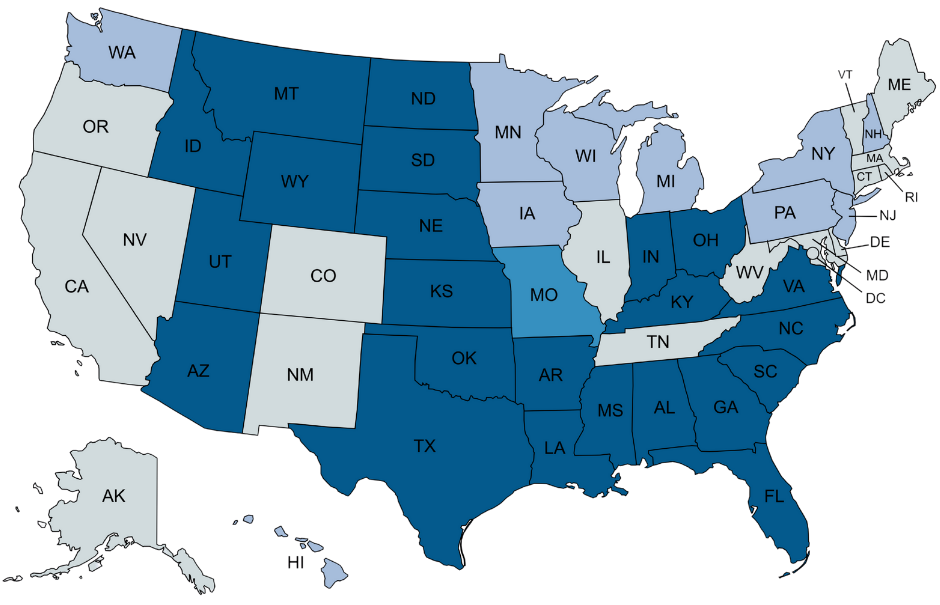
States in dark blue have passed age verification laws. States in light blue have active age verification bills.
Age Verification Laws

Louisiana
HB 142 became law on June 15, 2022.

Arkansas
SB 66 became law on April 11, 2023.

Virginia
SB 1515 became law on May 12, 2023.

Utah
SB 0287 became law on May 4, 2023.

Montana
SB 544 became law on May 19, 2023.

Texas
HB 1181 became law on June 12, 2023.

North Carolina
HB 8 became law on September 29, 2023.

Indiana
SB 17 became law on March 13, 2024.

Idaho
HB 498 became law on March 21, 2024.

Florida
HB 3 became law on March 25, 2024.

Kentucky
HB 278 became law on April 5, 2024.

Nebraska
Online Age Verification Liability Act became law on April 16, 2024.

Georgia
SB 351 became law on April 23, 2024.

Alabama
HB 164 became law on April 24, 2024.

Kansas
SB 394 became law without the Governor’s signature on April 25, 2024.

Oklahoma
SB 1959 became law on April 26, 2024.

Mississippi
HB 1126 became law without the Governor’s signature on April 30, 2024.

South Carolina
HB 3424 became law on May 29, 2024.

Tennessee
HB 1642/SB 1792 became law on June 3, 2024.

South Dakota
HB 1053 became law on February 27, 2025.

Wyoming
HB 43 became law on March 13, 2025.

North Dakota
HB 1561 became law on April 11, 2025.

Missouri
Rule 15 CSR 60-17.010 published on May 7, 2025.

Arizona
HB 2112 became law on May 13, 2025.

Age Verification Bills

Hawaii
HB 1212: referred to House Consumer Protection and Commerce Committee on January 27.
HB 1198: referred to House Consumer Protection and Commerce Committee on January 27.

Illinois
SB 2082: introduced in the Senate on
February 6.
HB 1103: referred to the Senate Rules Committee on January 9.

Iowa
HF 864 (formerly HF 62): passed House Judiciary Committee on March 4; scheduled to be read in the House on March 7.
SF 443 (formerly SF 236): passed Senate Committee on Technology on February 26.

Maryland
HB 1212: referred to House Committee on Economic Matters on February 6.
HB 394: first hearing in the House Judiciary Committee on February 5.

Minnesota
HF 1875: referred to House Committee on Commerce, Finance and Policy on March 5.
SF 2105 (HF 1434): referred to Senate Committee on Commerce and Consumer Protection on March 3.
HF 1434 (SF 2105): referred to House Committee on Commerce, Finance and Policy on February 24.

New York
S 3591: referred to Senate Committee on Internet and Technology on January 28.

Nevada
AB 294: referred to Assembly Committee on Commerce and Labor on February 25.

New Mexico
HB 44: referred to House Commerce and Economic Development Committee on January 22.

Ohio
HB 84: referred to House Technology and Innovation Committee on February 12.

West Virginia
HB 2689 (SB 293): referred to House Judiciary Committee for the third time on March 11.
SB 293 (HB 2689): referred to Senate Judiciary Committee for second time on February 25.

Oregon
HB 2032: referred to House Judiciary Committee on January 17.

Wisconsin
AB 105: first public hearing held in Assembly Committee on State Affairs on March 12.

Written by Emily Washburn · Categorized: Culture, How to Get Involved · Tagged: age verification, parental rights, social media

Privacy Policy and Terms of Use | Privacy Policy and Terms of Use | © 2025 Focus on the Family. All rights reserved.

  • Cookie Policy