
An important new survey from the Institute for Family Studies (IFS) on the marital and fatherhood interests of young men in America tell us that only 6% of those age 18 through 23 are married and just 25% of those between 24 and 29-years of age have a wedding ring on their finger. And less than one-third of unmarried men are currently in a romantic relationship. For those young men who do marry, most of them marry after age 30 as the average age of first marriage for men is 30.2.
As IFS notes, “Young men, in sum, are having a hard time in matters of love.”
So, are young men even interested in marriage and fatherhood? That is an extremely important question for the family formation prospects in the United States, and the news might be better than most imagine.
This new IFS data indicates that young men still have a high interest in marrying with 68% saying a definite “yes” while only 21% are “not sure” for various reasons and only 11% express no desire to marry at all. Conservatives are notably more likely than moderates or liberals to indicate an interest in marriage, as well as those currently in a relationship.
Religious young men are notably more likely to show an interest in marriage over their secular or nominally religious peers. The differentials are 88%, 60% and 71% respectively.
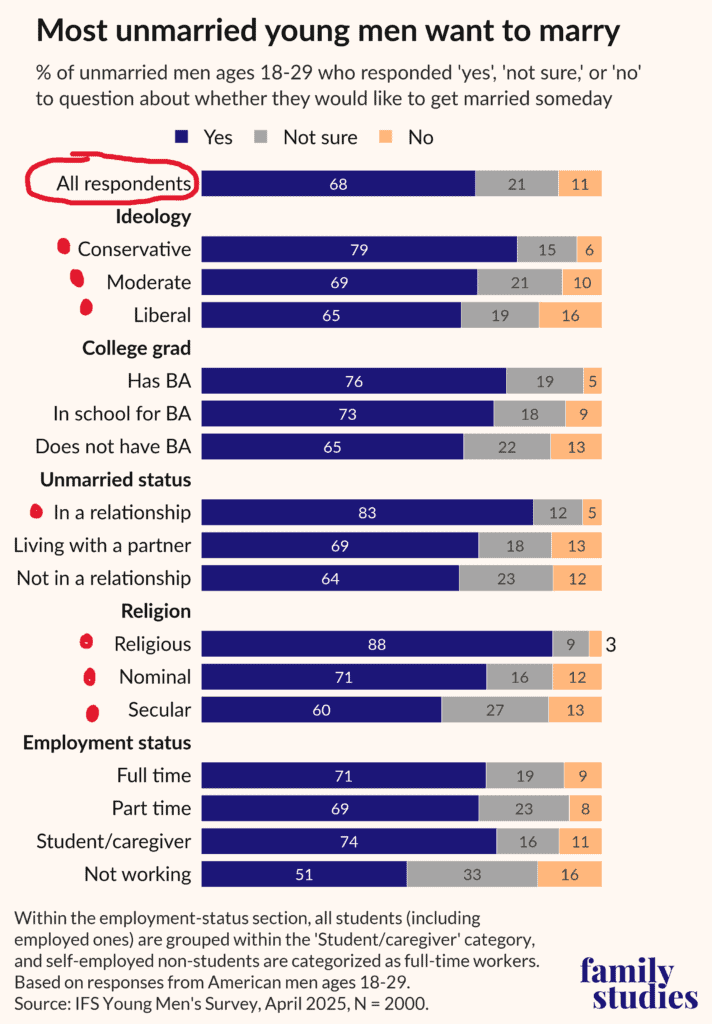
Those who have earned or are pursuing a college education are more likely to be interested in marrying. Not surprisingly, those who are not currently working are much more likely to be unsure or not interested in marrying. This is significant as the number of young men classified as NEET – not employed, pursuing any education or training – has increased, doubling since 1990.
For the minority of men who are not sure or not planning to marry, the leading reasons given were “hard to find the right person” (44%), “other life priorities” (40%), “unnecessary” (38%), and “not ready to make a commitment” at 36%. Only 32% listed finances as a leading hinderance.
Desire to be Dads
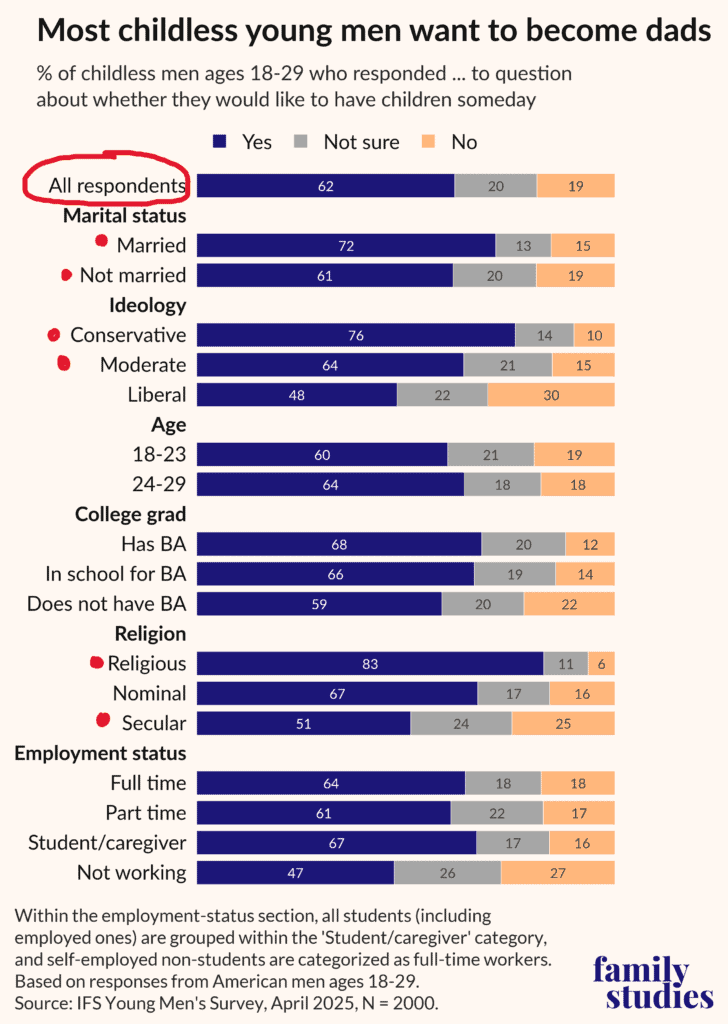
A strong majority of young American men (62%) say they would like to have children one day. Only 19% said they definitely would not, while 20% said they were not sure. Married men were more likely to say they wanted children (76% vs 61% for unmarried), once again showing that marriage is one of the greatest promoters of national fertility.
Conservative-leaning men are the most likely to say they want children at 76%, while only 48% of liberal men said they definitely want children. Just 10% of conservative men said they were sure they did not want children, while 30% of liberal and 15% of moderate-leaning men said they did not.
Like marriage, religion is a very positive factor driving greater interest in fatherhood. Eighty-three percent of religious men said they wanted to become fathers with only 6% of them saying they had no interest. In fact, religion was the most powerful differential followed by conservatism. Only 51% of secular men desire to be fathers, while a quarter said they did not desire this and 24% were “not sure.” Nominal believers fell right in the middle between these two.
The Dating Hurdle
Of course, young men cannot get married and become married fathers if they never meet the girl who will become their wives. There is a very real dating drought in America.
Yet this new IFS data tells us that young single men are very interested (74%) in dating and religious (82%) and conservative men (80%) are far more likely to be interested in dating than their secular (71%) and liberal (71%) peers. Full-time employed and college students were highly likely to be interested in dating as well, at 77% and 79%.
So, what is keeping these men from getting out there and meeting their romantic interest? IFS explains, “About half indicate that it has been difficult to find someone who will go out with them, and nearly 6 in 10 report that that the fear of being turned down makes them reluctant to ask.” This matches with a recent IFS report that said 29% of men reported feeling “confident when approaching someone I’m interested in.” Only 39% of young men believe, “I am attractive to potential dating partners.”
A mere third of men confessed they were good at picking up on social cues on a date, while 42% said they were “good at managing my emotions when on a date.” And just 39% of men said, “I trust my judgement when it comes to choosing a romantic partner.” Sadly, only 31% of men were able to stay positive after a bad date or a relationship setback. These are very sad findings.
So, the real problems facing men meeting their future wife and mother of their children is not one of desire or interest. It is a lack of confidence in one’s potential as a desirable partner and ability to be an interesting, poised date.
This is hopeful news because the desire for dating, marriage and fatherhood is clearly present in young men. We just need to help them build the confidence and skills needed to meet, propose to, and marry the woman who will be their future wife. Family formation in America rests on us doing a better job at helping these young men develop these basic adult skills. We must get busy coming up with sure ways to build this confidence in young men. This polling data reveals they are asking for that help!
Related Articles and Resources:
The American Dating Drought and Hope for Fixing It
New Study: Online Dating Produces Fewer Healthy Relationships
Young Person Explains Why Young People Aren’t Getting Married
Who Falls in Love Faster, Men or Women?
Make Dating for Marriage Great Again
Don’t Believe the Modern Myth. Marriage Remains Good for Men
Important New Research on How Married Parents Improve Child Well-Being
How Marriage Fights Against Deaths of Despair
New Research: Marriage Still Provides Major Happiness Premium
Harvard Evolutionary Biologist Brilliantly Explains Necessity of Monogamous Marriage