
• Skip to main content
Daily Citizen
  • Subscribe
  • Categories
    • Culture
    • Life
    • Religious Freedom
    • Sexuality
  • Parenting Resources
    • LGBT Pride
    • Homosexuality
    • Sexuality/Marriage
    • Transgender
  • About
    • Contributors
    • Contact
  • Donate

Euthanasia

Dec 18 2025

Invoking God’s ‘Mercy,’ NY Gov. Kathy Hochul To Sign Assisted-Suicide Bill

New York Governor Kathy Hochul on Wednesday announced her intention to sign a bill legalizing physician-assisted suicide into law. The Empire State will become the 13th state to legalize euthanasia, following Illinois, which became the 12th state just days earlier.

The New York Assembly approved the Medical Aid in Dying Act (AB 136) on April 29 in a 81-67 vote. The state Senate passed the bill on June 9 in a 35-27 vote.

The governor wrote in the Albany Times Union that state lawmakers will modify the bill to include a residency requirement, a five-day waiting period and a requirement that patients record their oral request to end their lives.

Gov. Hochul, a Catholic, unashamedly cited God’s “mercy” and “compassion” as part of her reasoning for signing the bill, writing,

I reflected on this during a Catholic funeral Mass for a family friend where the priest spoke of the welcome home to eternal life. I was taught that God is merciful and compassionate, and so must we be.
This includes permitting a merciful option to those facing the unimaginable and searching for comfort in their final months in this life.

The governor reflected upon her mother’s death from ALS, saying she “watched that vicious disease steal away the strong woman who raised me as it took her ability to walk, to eat, to speak and, ultimately, to live.”

“I have come to see [physician-assisted suicide] as a matter of individual choice,” the governor said.

Catholic Bishop John Barres, bishop of Rockville Centre, issued a statement calling Gov. Hochul’s reflections during the funeral Mass “profoundly misled.”

“Jesus calls us to help the suffering to carry their crosses with love,” the bishop urged, “not to participate in the willful taking of a life.”

The Catholic Church steadfastly opposes euthanasia. The Catechism of the Catholic Church states:

Euthanasia consists in putting an end to the lives of handicapped, sick, or dying persons. It is morally unacceptable.
Thus an act or omission which, of itself or by intention, causes death in order to eliminate suffering constitutes a murder gravely contrary to the dignity of the human person and to the respect due to the living God, his Creator.
This murderous act … must always be forbidden and excluded (CCC 2277).

The New York Catholic bishops released a joint statement following the governor’s announcement.

“We are extraordinarily troubled by Governor Hochul’s announcement that she will sign the egregious bill passed by the legislature earlier this year sanctioning physician-assisted suicide in New York State,” the bishops wrote.

“This new law signals our government’s abandonment of its most vulnerable citizens, telling people who are sick or disabled that suicide in their case is not only acceptable, but is encouraged by our elected leaders,” they added. “Tragically, this new law will seriously undermine all of the anti-suicide and mental health care investments Governor Hochul has made through her tenure.”

The New York Families Foundation, a Focus on the Family-allied state family policy council, explained that amending the bill doesn’t solve its central problems.

“Empathy, however sincere, cannot justify a public policy that abandons the state’s responsibility to protect vulnerable people and that fundamentally alters the role of medicine,” the organization stated. “Amendments cannot cure a law that is fundamentally flawed.”

Christians should keep these points in mind when discussing euthanasia:

  1. Euthanasia always violates a person’s dignity, since it kills an innocent human being who is made in God’s image.
  2. Physician-assisted suicide is not an “individual choice” since it always involves a physician killing another person – either actively or passively.
  3. Euthanasia violates the Hippocratic Oath to “do no harm.”
  4. Physician-assisted suicide is essentially never necessary to reduce a patient’s suffering thanks to great improvements in palliative care and hospice.
  5. Many patients choose euthanasia due to depression or to avoid “being a burden to others”; suicide is never the answer to these problems.
  6. Euthanasia can easily transform the so-called “right to die” into a “duty to die” to save the government and healthcare system money.

As physician-assisted suicide continues to expand throughout Western countries, and into more U.S. states, we must be even more resolute and fierce in opposing state-sanctioned death for the terminally ill.

As Jesus taught in John 10:10, “The thief comes only to steal and kill and destroy. I came that they may have life and have it abundantly” (ESV).

To speak with a family help specialist or request resources, please call us at 1-800-A-FAMILY (232-6459).

Focus on the Family offers a one-time counseling consultation with a licensed or pastoral counselor free of charge thanks to generous donor support. If you would like to request a consultation with Focus’ Counseling Department, call 1-855-771-HELP (4357) weekdays from 6:00 AM to 8:00 PM (Mountain Time) or complete our Counseling Consultation Request Form.

Related articles and resources:

Counseling Consultation & Referrals

Mental Health Resources

Physician-Assisted Suicide

A Godly Perspective on End-of-Life Decisions

Understanding God’s Plan for the End of Life

Answers to Common Questions About Physician-Assisted Suicide

The Problem With Ending It All: A Response to Physician-Assisted Suicide

Aging Loved Ones and Physician-Assisted Suicide

Illinois Governor JB Pritzker Signs ‘Dangerous’ Euthanasia Bill Into Law

NY Governor Kathy Hochul Seeks Changes to ‘Nightmare’ Assisted Suicide Bill

Photo from Getty Images.
Written by Zachary Mettler · Categorized: Government Updates, Life · Tagged: Euthanasia, Hochul

Dec 15 2025

Illinois Governor JB Pritzker Signs ‘Dangerous’ Euthanasia Bill Into Law

Illinois Governor Jay Robert “JB” Pritzker signed a bill legalizing physician-assisted suicide into law on Friday. The decision makes the Land of Lincoln the 12th state to legalize euthanasia.

The Illinois Senate passed the End-of-Life Options for Terminally Ill Patients Act (SB 1950) in the dead of night on Halloween by the bare minimum of votes (30-27). The Illinois House had approved the bill on May 29 in a 63-42 vote.

The law legalizes physician-assisted suicide for adults who have a terminal disease with a prognosis of six months or less to live. It will take effect in September 2026.

Eleven other states – California, Colorado, Delaware, Hawaii, Montana, Maine, New Jersey, New Mexico, Oregon, Vermont and Washington – and the District of Columbia have legalized physician-assisted suicide. New York Governor Kathy Hochul is considering signing a bill to legalize euthanasia in her state.

In a statement, Gov. Pritzker said the legislation will help patients “avoid unnecessary pain and suffering at the end of their lives” and will be “thoughtfully implemented so that physicians can consult patients on making deeply personal decisions with authority, autonomy, and empathy.”

Just days earlier, the Jewish governor had met with Pope Leo XIV, a native Chicagoan. The Vatican didn’t release any details about what was discussed during the visit, the Catholic News Agency reports, though the governor later said he and the pontiff discussed immigration.

The Catholic Conference of Illinois, which speaks for the Catholic bishops in the state, denounced the governor’s decision in a statement released on Dec. 12.

“When Governor Pritzker signed the physician assisted suicide bill into law, he put Illinois on a dangerous and heartbreaking path – one that legitimizes suicide as a valid solution for life’s challenges,” the conference warned.

“Rather than investing in real end-of-life support such as palliative and hospice care, pain management, and family-centered accompaniment, our state has chosen to normalize killing oneself.”

The Thomas More Society, a nonprofit legal advocacy group, lamented that Illinois politicians have “crossed a profound moral and legal red line” by legalizing physician-assisted suicide.

“This is a dark and sorrowful day for Illinois,” said Thomas Olp, executive vice president at Thomas More Society, in a statement. “Instead of offering true compassion, support, and care, this law offers a fatal prescription. That is not mercy. It is abandonment.”

The organization forewarned the new law threatens physicians who are morally opposed to facilitating an assisted suicide. The bill “requires physicians who object to assisted suicide on moral or religious grounds to refer patients to providers who will participate in ending their lives.”

This “compelled-referral mandate” is “unconscionable coercion, plain and simple,” Olp emphasized. “No doctor should be ordered by the government to participate directly or indirectly in a process that deliberately ends a human life.”

Furthermore, the law forces “religious hospitals and clinics to retain staff who promote assisted deaths on-site, as long as those staff provide lethal drugs off-site.”

Bishop Robert Barron, bishop of the Diocese of Winona-Rochester, posted a video on X addressing the topic of physician-assisted suicide one day after Gov. Pritzker signed the legislation.

Don’t believe what they tell you about these assisted suicide bills. pic.twitter.com/j4uzmBYDKk

— Bishop Robert Barron (@BishopBarron) December 13, 2025

Sixty years ago, conservative writer and intellectual William F. Buckley Jr. founded National Review. Part of its mission, Buckley wrote, was to “stand athwart history, yelling Stop, at a time when no one is inclined to do so, or to have much patience with those who so urge it.”

That reality applies just as much to modern conservatives, weary that far-Left individuals and states have never found a bad idea they didn’t like – such as killing people, both the preborn and the terminally ill.

Conservative commentator Matt Walsh recently warned that euthanasia is “spreading like a cancer” across Western civilizations.

Euthanasia is spreading like a cancer. It’s already one of the leading causes of death in Canada. Western civilization is quite literally killing itself. Conservatives should be spending a lot more time speaking out against this. It’s one of the darkest evils we face in modern… https://t.co/6dfCXe7ha2

— Matt Walsh (@MattWalshBlog) December 14, 2025

Christians and conservatives should keep these six points in mind when considering the grave problems with physician-assisted suicide:

  1. Euthanasia always violates a person’s inviolable dignity as a human being made in the image and likeness of God, the Imago Dei.
  2. Physician-assisted suicide is not an “individual choice,” nor is it a “personal” decision. It always involves one person killing another person – either actively or passively.
  3. Euthanasia violates the Hippocratic Oath to “do no harm,” turning physicians into dealers of death.
  4. Physician-assisted suicide is essentially never necessary to reduce a terminally ill patient’s suffering, thanks to great improvements in palliative care and hospice.
  5. Many patients choose physician-assisted suicide primarily to avoid “being a burden to others” or because of depression; suicide is never the answer to these problems.
  6. Euthanasia opens the door to involuntary killings to manage health-care costs, transforming the so-called “right to die” into a “duty to die.”

As euthanasia continues to expand into more states, we must all-the-more fiercely advocate for every person’s inalienable right to life.

To speak with a family help specialist or request resources, please call us at 1-800-A-FAMILY (232-6459).

Focus on the Family offers a one-time counseling consultation with a licensed or pastoral counselor free of charge thanks to generous donor support. If you would like to request a consultation with Focus’ Counseling Department, call 1-855-771-HELP (4357) weekdays from 6:00 AM to 8:00 PM (Mountain Time) or complete our Counseling Consultation Request Form.

Related articles and resources:

Counseling Consultation & Referrals

Mental Health Resources

Physician-Assisted Suicide

A Godly Perspective on End-of-Life Decisions

Understanding God’s Plan for the End of Life

Answers to Common Questions About Physician-Assisted Suicide

The Problem With Ending It All: A Response to Physician-Assisted Suicide

Aging Loved Ones and Physician-Assisted Suicide

Illinois Senate Passes ‘Tragic’ Bill to Legalize Physician-Assisted Suicide

Photo from Getty Images.

Written by Zachary Mettler · Categorized: Government Updates, Life · Tagged: Euthanasia, Pritzker

Dec 10 2025

NY Governor Kathy Hochul Seeks Changes to ‘Nightmare’ Assisted Suicide Bill

New York Governor Kathy Hochul is requesting substantial changes to a “nightmare” bill that would turn New York into a destination state for physician-assisted suicide.

The New York Assembly approved the Medical Aid in Dying Act (AB 136) on April 29 in a 81-67 vote. The state Senate subsequently passed the bill on June 9 in a 35-27 vote.

The bill permits individuals with “an incurable and irreversible illness, with six months or less to live,” to kill themselves with a doctor’s help via a lethal cocktail of drugs.

Importantly, the bill currently contains no residency requirement, allowing terminally ill individuals from out of state to come to New York to end their lives. This provision would essentially ensure all Americans could access physician-assisted suicide.

The New York Alliance Against Assisted Suicide has raised several additional concerns about the legislation, warning the bill would:

  • Allow terminally ill persons to be prescribed lethal drugs without an in-person visit with a physician.
  • Make New York into an assisted suicide tourism state.
  • Not require any psychiatric assessment of a person requesting state-sanctioned suicide.
  • Open the door to future expansions of state-sanctioned deaths, which has occurred in Canada.

To date, Gov. Hochul has not publicly indicated whether she intends to sign the bill into law, only saying she will decide before the end of the year.

“I hear from a lot of people on [the issue of assisted suicide]; it is strong,” she said in September. “There are strong views on both sides of the spectrum, intense views on this, and I’m conscious of that, and it’s gonna be a very weighty decision on me between now and the end of the year.”

The governor has reportedly been seeking changes to the bill behind the scenes. According to North County Public Radio, the governor wants to:

  • Add a requirement people video their requests for physician-assisted suicide.
  • Create a seven-day waiting period for patients requesting physician-assisted suicide.
  • Require patients wanting to end their lives undergo a psychiatric assessment.
  • Include a residency requirement in the bill.

It’s unclear whether the governor intends to sign the bill if the state Legislature rejects her proposed changes. However, the fact the governor is requesting changes in the first place, rather than rejecting the bill wholesale, may indicate she is leaning towards signing it.

Bob Bellafiore, a spokesperson for the New York State Catholic Conference, said the governor’s proposed amendments are “basically deck chairs on the Titanic.”

“They don’t change the fundamental truth that this bill sanctions suicide, diminishes medicine forever and is guaranteed to lead to tragedies, mistakes and unintended consequences that the governor will be responsible for,” he added.

On December 3, hundreds of concerned New Yorkers gathered across Albany, Tonawanda, Syracuse and Manhattan – with 75 assembling outside the governor’s mansion – for candlelight vigils urging Gov. Hochul to veto the bill.

“New Yorkers are recognizing that assisted suicide isn’t compassion — it’s abandonment,” Jason McGuire, executive director of New York Families Action, told the crowd.

“Our vigil tonight shows that people from every background want the state to choose care, not killing. A sleeping giant is awakening on this issue.”

If you live in New York, please consider contacting the governor, respectfully urging her to veto AB 136. You can also sign the New York State Catholic Conference’s pre-filled message asking Gov. Hochul to veto the bill.

To speak with a family help specialist or request resources, please call us at 1-800-A-FAMILY (232-6459).

Focus on the Family offers a one-time counseling consultation with a licensed or pastoral counselor free of charge thanks to generous donor support. If you would like to request a consultation with Focus’ Counseling Department, call 1-855-771-HELP (4357) weekdays from 6:00 AM to 8:00 PM (Mountain Time) or complete our Counseling Consultation Request Form.

Related articles and resources:

Counseling Consultation & Referrals

Mental Health Resources

Physician-Assisted Suicide

A Godly Perspective on End-of-Life Decisions

Understanding God’s Plan for the End of Life

Answers to Common Questions About Physician-Assisted Suicide

The Problem With Ending It All: A Response to Physician-Assisted Suicide

Aging Loved Ones and Physician-Assisted Suicide

NY Governor Kathy Hochul Must Veto ‘Nightmare’ Assisted Suicide Bill

NY Legislature Passes ‘Nightmare’ Bill Legalizing Physician-Assisted Suicide

Photo from Getty Images.

Written by Zachary Mettler · Categorized: Government Updates, Life · Tagged: Euthanasia, Hochul, new york

Dec 05 2025

Canada Euthanized a Record 16,499 Patients in 2024

While there is a technical distinction between euthanasia and physician-assisted suicide, this article will use the terms interchangeably.

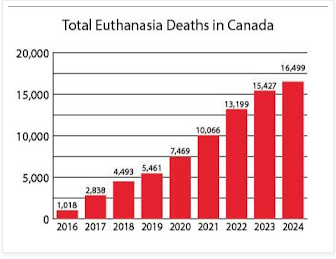
Canadian physicians killed a record 16,499 people via euthanasia in 2024, representing 5.1% of all deaths in Canada.

New Report

The nation released its Sixth Annual Report on Medical Assistance in Dying in Canada (the 2024 report) on November 28, 2025.

The new data shows euthanasia deaths rose 6.9% from 15,427 in 2023, with the annual rate of growth decreasing significantly from the 36.8% growth rate between 2019 and 2020.

Nevertheless, the number of people in Canada who opt to end their lives via physician-assisted suicide continues to increase every year. The rate of growth naturally decreases as the number of people killed get larger each year.

Photo from Euthanasia Prevention Coalition.

There have been 76,475 deaths due to euthanasia in Canada since the nation first legalized the practice in 2016, and 2024.

Alex Schadenberg, Executive Director of the Euthanasia Prevention Coalition, estimates at least 92,000 people have died by euthanasia in Canada as of November 2025.

Next year, barring an unexpected decrease in euthanasia deaths, Canada will have killed over 100,000 people via physician-assisted suicide in just 10 years – an ongoing and entirely preventable human rights tragedy.

Two Euthanasia “Tracks”

Tragically, Canada doesn’t limit euthanasia to the terminally ill.

Canada has two “Tracks” for individuals to access physician-assisted suicide. An individual can be approved for euthanasia under “Track 1” if their natural death is “reasonably foreseeable” (i.e., they are close to death). But individuals can also be approved if their death is not “reasonably foreseeable” (i.e., they do not have a terminal condition) under “Track 2.”

In the 2024 report, the number of Track 2 deaths increased by 17% to 732 deaths last year, representing 4.4% of all euthanasia deaths. Schadenberg describes the increase in Track 2 deaths as “very concerning.”

“People who die by euthanasia based on a Track 2 approval tend to be younger, are more likely to be women, and far more likely to be living with a disability,” Schadenberg notes.

To qualify for either euthanasia Track, an individual must have a “grievous and irremediable medical condition.” However, this term is not defined in law.

Physicians can approve individuals for cancer, organ failure, neurological conditions, respiratory diseases, cardiovascular conditions and “other conditions.” These “other” conditions can include: diabetes, frailty, autoimmune conditions, chronic pain, mental disorders or even hearing and visual issues – largely treatable and medically manageable conditions.

Furthermore, Schadenberg observes that “feelings of loneliness and isolation [were] related to 21.9% of Track 1 euthanasia deaths and 44.7% of Track 2 euthanasia deaths.”

“Based on the 2024 report there were at least 3,800 people who listed loneliness and isolation as a primary reason for being killed,” he elaborates.

Further Expansion

In 2027, Canada is set to expand its euthanasia regime even further by making individuals suffering solely from a mental health condition – like anxiety or depression – eligible for physician-assisted suicide.

The Canadian Parliament made the change in March 2021 by passing Bill C-7 to “permit euthanasia for a mental illness alone,” but delayed the modification for a few years. “Mental illness as sole underlying medical condition is excluded until March 17, 2024,” the 2024 report states.

A bill has been introduced in the Parliament – Bill C-218 – to reverse the expansion of euthanasia for mental illness, though it’s unclear whether it will pass.

Additionally, one group, Dying With Dignity Canada, is advocating for “mature minors” – those under 18 years of age – to be made eligible for euthanasia. The group argues that its “unfair to allow a 70-year-old with terminal cancer the choice of a peaceful death but deny a 17-year-old … the same choice.”

Of course, the same logic could be used to legalize euthanasia for 16-year-olds. Or 15-, 14- and 13-year-olds, and so on.

Euthanasia Always Violates Human Dignity

When talking about physician-assisted suicide, we must be clear what we’re discussing: We’re talking about killing people. And we should all be opposed to killing innocent people.

Every person is made in the image and likeness of God (Genesis 1:27, ESV). Permitting or assisting a person’s suicide – even to reduce human suffering – is always morally wrong and violates their dignity and worth.

Moreover, euthanasia is essentially never necessary to reduce human suffering. Thanks to great strides in palliative care and hospice, it’s possible to reduce or eliminate almost any individual’s suffering at the end of life without resorting to euthanasia.

As Christians, we must care for those people who are suffering, walk alongside them, and share their burdens to the best of our ability. At the same time, we must uphold the value of human life by opposing killing innocent people via physician-assisted suicide.

To speak with a family help specialist or request resources, please call us at 1-800-A-FAMILY (232-6459).

Focus on the Family offers a one-time counseling consultation with a trained or pastoral counselor free of charge thanks to generous donor support. If you would like to request a consultation with Focus’ Counseling Department, call 1-855-771-HELP (4357) weekdays from 6:00 AM to 8:00 PM (Mountain Time) or complete our Counseling Consultation Request Form.

Related articles and resources:

Counseling Consultation & Referrals

Mental Health Resources

Physician-Assisted Suicide

A Godly Perspective on End-of-Life Decisions

Answers to Common Questions About Physician-Assisted Suicide

The Problem With Ending It All: A Response to Physician-Assisted Suicide

Aging Loved Ones and Physician-Assisted Suicide

Canada to Report Killing Over 100,000 People With Physician-Assisted Suicide

NY Legislature Passes ‘Nightmare’ Bill Legalizing Physician-Assisted Suicide

Photo from Shutterstock.

Written by Zachary Mettler · Categorized: Culture, Life · Tagged: Canada, Euthanasia

Privacy Policy and Terms of Use | Privacy Policy and Terms of Use | © 2026 Focus on the Family. All rights reserved.

  • Cookie Policy