Constitution Day Survey Finds Americans’ Civic Knowledge Increasing
Constitution Day, celebrated annually on September 17, commemorates the signing of the U.S. Constitution. Thirty-eight delegates to the Constitutional Convention, representing 12 states, endorsed the document at Independence Hall on September 17, 1787.
The signing concluded the four-month-long convention process. Under Article VII of the Constitution, the signers agreed it would not be binding until nine of the 13 existing states ratified it.
Over the next nine months, Alexander Hamilton, James Madison and John Jay produced 85 essays known as The Federalist Papers, published in newspapers throughout the colonies, arguing in favor of ratifying the Constitution.
On June 21, 1788, New Hampshire became the ninth of 13 states to ratify the Constitution, making it the official governing charter of the United States.
Congress established Constitution Day as an American federal observance in 2004.
The Annenberg Constitution Day Civics Survey, conducted annually by the Annenberg Public Policy Center at the University of Pennsylvania and released in time for Constitution Day, polls Americans’ civic knowledge about the U.S. Constitution.
The 2025 survey found that Americans’ civic knowledge increased over the past year, with more than two-thirds of U.S. adults (70%) able to name all three branches of government – the executive, legislative and judicial – compared to last year (65%).
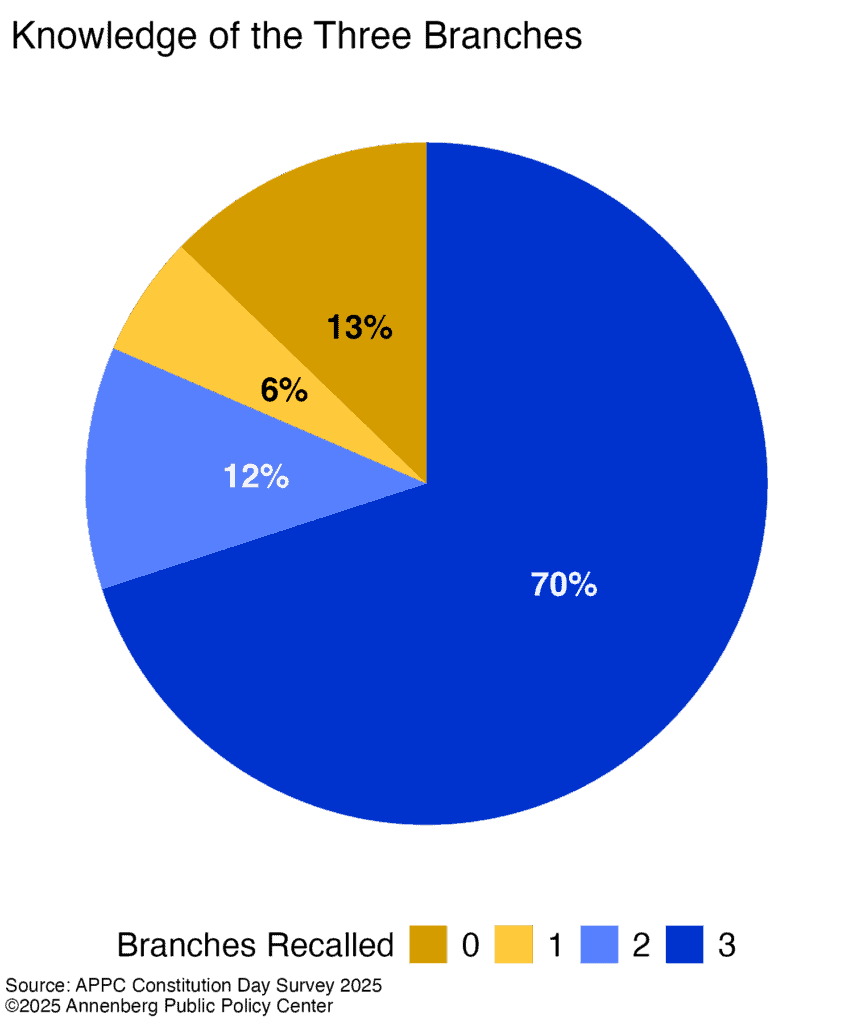
The number is also up substantially from 2018, when only 32% of the public could name all three branches of government.
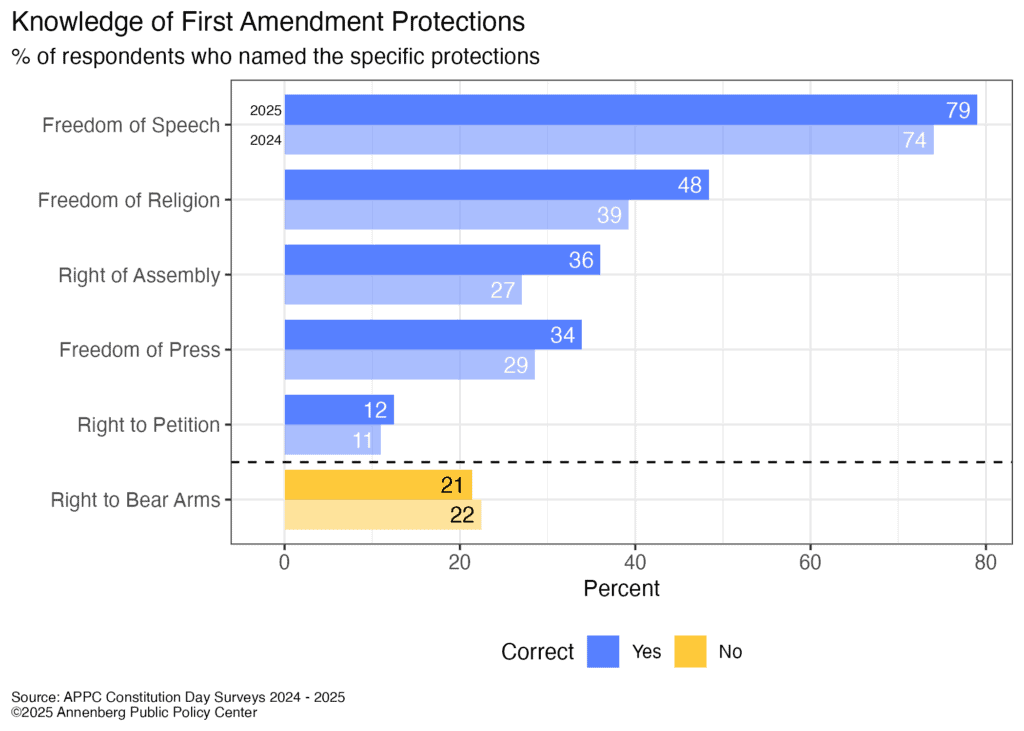
This year’s survey also found an increase in public awareness of the five rights guaranteed under the First Amendment. Still, most Americans could name only one – the freedom of speech.
Asked if they could name the rights guaranteed by the First Amendment, the survey reported:
- Nearly 4 out of 5 (79%) say freedom of speech, up significantly from 74% in 2024.
- Nearly half (48%) say freedom of religion, up 9 percentage points from 2024.
- Over a third (36%) say right of assembly, up from 27% in 2024.
- Over a third (34%) say freedom of the press, which is not statistically different from last year – but this right fell to fourth place from third place in the public’s recollection.
- And 12% say the right to petition, about the same as last year.
Additionally, 21% of Americans incorrectly said the First Amendment protects the right to keep and bear arms – a right protected by the Second Amendment.
“People can’t cherish, safeguard, or exercise their constitutionally protected rights unless they know that they have them and understand how effective use of them sustains our system of government,” said Kathleen Hall Jamieson, director of the Annenberg Public Policy Center.
“Civics education at home and in schools should be a high priority as a result,” she added.
The Annenberg center surmised that “a torrent of executive actions and the resulting judicial cases and actions by Congress produced a seemingly nonstop rush of political news,” helping increase Americans’ civic knowledge over the past year.
The center found no significant difference in civic knowledge when compared by political party affiliation. However, it did find that people in both parties – Republicans and Democrats – were more knowledgeable than independent voters who said they didn’t lean toward either party.
The Founding Fathers spoke often about the importance of civic knowledge in preserving freedom and liberty.
“Liberty cannot be preserved without a general knowledge among the people, who have a right from the frame of their nature, to knowledge, as their great Creator who does nothing in vain, has given them understandings, and a desire to know,” wrote John Adams in 1765.
In his 1796 Farewell Address, President George Washington said, “Promote then, as an object of primary importance, institutions for the general diffusion of knowledge. In proportion as the structure of a government gives force to public opinion, it is essential that public opinion should be enlightened.”
R. Lance Holbert, director of the center’s Leonore Annenberg Institute for Civics, said in a statement about this year’s survey,
“This year’s APPC Constitution Day Civics Survey points to some clear knowledge gains,” he added, “but there is also evidence indicating that there is more work to be done.”
Related articles and resources:
Tim Goeglein – Reversing the Cultural Revolution Through Faith and Family
Trump Ends Radical Indoctrination, Promotes Education Freedom
Most Americans Don’t Know Their First Amendment Rights. Do You?
Many Americans Unaware of Key Facts About U.S. Constitution, Survey Finds
Today is Constitution Day: Let’s Celebrate the Document That Made America
Photo from Shutterstock.


ABOUT THE AUTHOR