Are Men or Women More Likely to Be Married?

Marriage is built on the lifelong union of a man and a woman. So, when sociologists ask “Who is more likely to be married, men or women?,” the answer seems obvious. Both, right?
The truth more complex than it initially seems. Men and women have different likelihoods of being married and at different life stages.
This is a topic the Institute for Family Studies (IFS) has brought much needed understanding to; young men are indeed less likely to be married than young women.
But curiously, they note that “while men are more likely than women to be ‘never married,’ they are also more likely to be currently married.”
IFS demonstrates this in the following two charts.
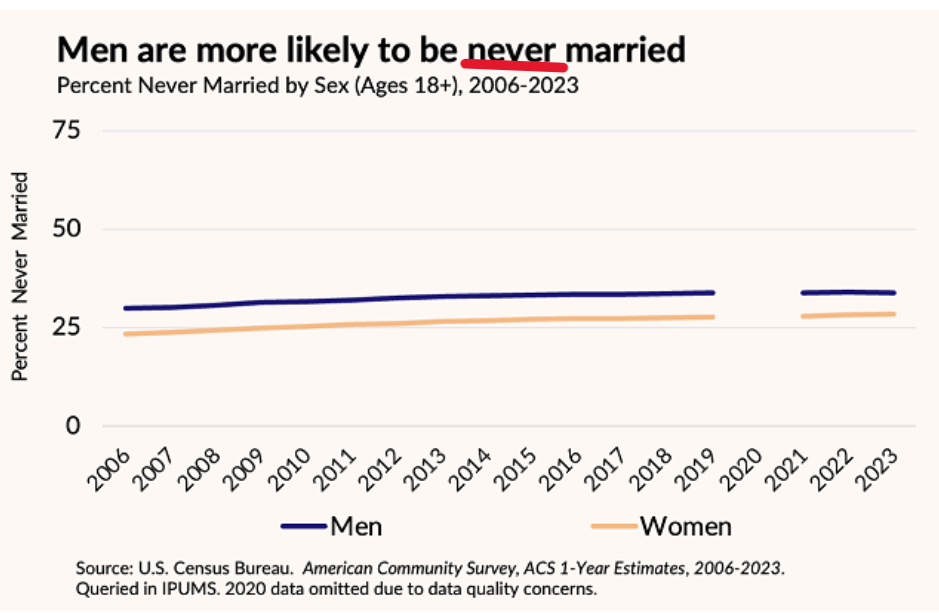
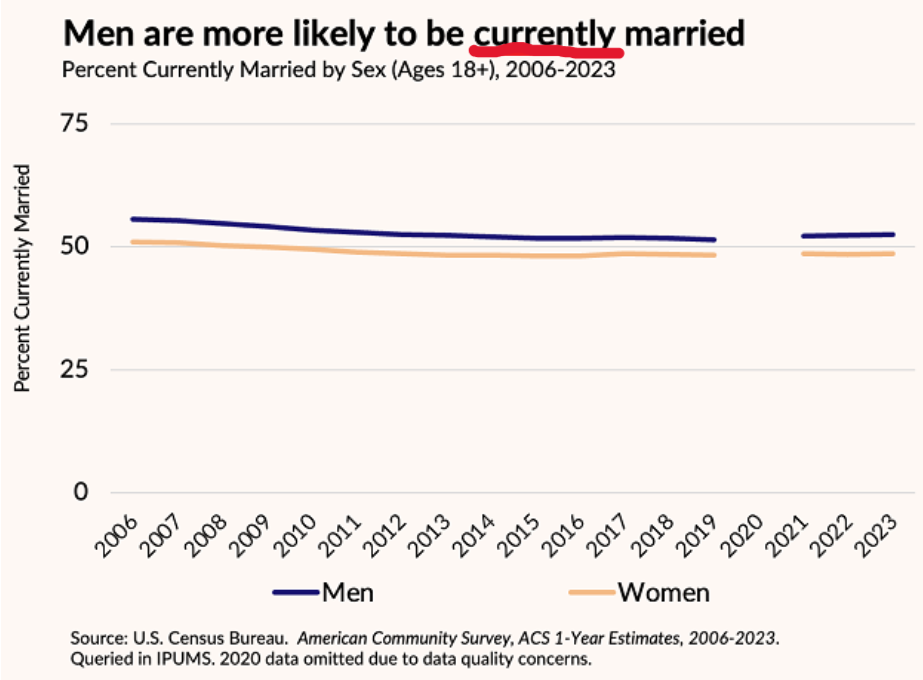
IFS explains these seemingly conflicting facts are not paradoxical, but rather “reflect differences in the timing of marriage, divorce, remarriage, and mortality between the sexes.”
Most of the confusion on this topic is when looking at the data for young adults; young men do marry less than young women. “Among U.S. adults ages 25-34, approximately 42% of women are married compared with only 35% of men in 2023 – a gap of about 7 percentage points.”
Marriage rates for all U.S. adult men and women, however, is completely reversed.
IFS states, “Among all U.S. adults in 2023, approximately 49% of women were currently married compared to 53% of men.” Other family scholars report the same sex-distinct trends.
Women in the United States, like in most countries, marry at younger ages compared to males.
In 2024, the median age of a first marriage was 30.2 (men) and 28.6 (women).
As men and women move into later years, however (ages 34-44), a difference in marital status by sex largely disappears: 60% of men and 61% of women are married.
IFS explains that sex differences in those unmarried also disappear with age (7% in 2023 for both men and women).
The scholars report, “That is, despite differences in when they get married, men and women have similar lifetime likelihoods of ever being married.”
But marriage differences emerge among men and women when we look at other important life factors.
Men are notably more likely to re-marry after divorce compared to women. This consistent fact “leaves the population of those divorced – and not currently married – disproportionately female.”
Therefore, among all divorced U.S. adults (or those who indicate they are divorced), only 73 men for every 100 women report this.
Older men are more likely to be married because women disproportionately populate the widow category; statistically, men more likely to die younger than women, by dramatic margins. Additionally, widowed men are significantly more likely to remarry.
IFS notes there are only 31 widowed men for every 100 widowed women in the United States. And
These are the primary reasons why more men than woman tend to be married in later age categories.
IFS explains, “Sixty-eight percent of men ages 65 and over are currently married while less than half (47%) of women ages 65 and over are currently married – a gap of about 22 percentage points.”
In essence, it really depends on age. Women marry younger, but men are more likely to be married than their female peers because they are less likely to become widows or remain unmarried after divorce.
These are just a few more examples of how men and women are indeed different. Marriage involves one man and one woman, but men and women live different lives.
Related Articles and Resources
Family Scholars Explain the Current Marriage Paradox in America
New Research Shows Married Families Matter More Than Ever
Why You Should Care About the Growing Positive Power of Marriage
Important New Research on How Married Parents Improve Child Well-Being
New Research: Marriage Still Provides Major Happiness Premium
Cohabitation Still Harmful – Even as Stigma Disappears
Don’t Believe the Modern Myth. Marriage Remains Good for Women
Don’t Believe the Modern Myth. Marriage Remains Good for Men.
Yes, Married Mothers Really Are Happier Than Unmarried and Childless Women
Marriage and the Public Good: A New Manifesto of Policy Proposals
Image from Shutterstock.


ABOUT THE AUTHOR