Justice Thomas Warns Progressivism Opposes America’s Founding Principles
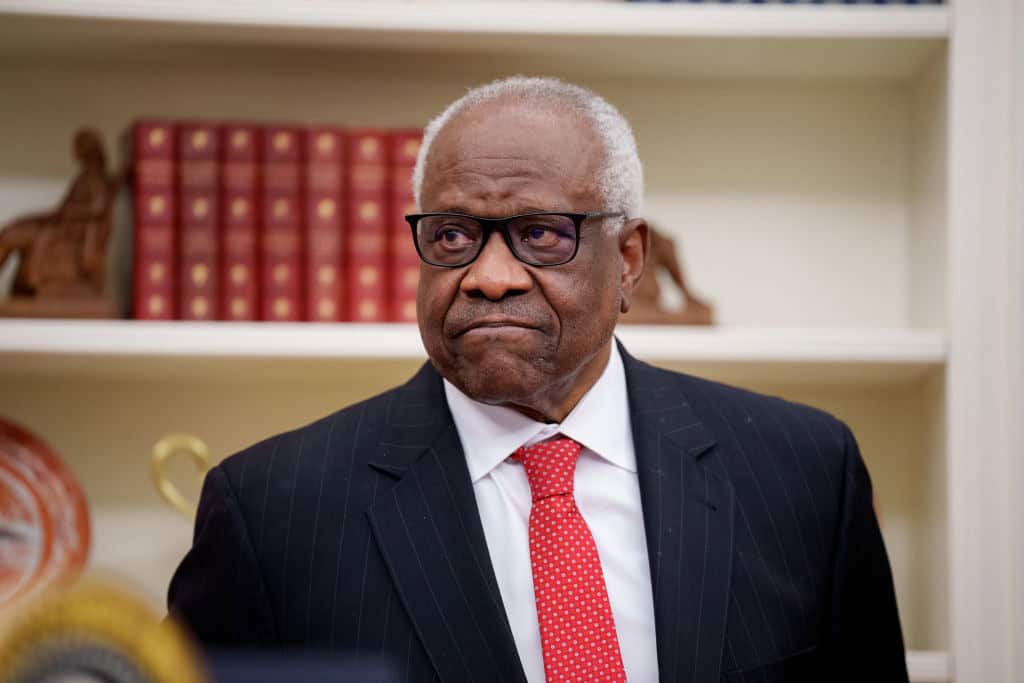
Justice Clarence Thomas is celebrating America’s 250th birthday by urging Americans to return to our nation’s founding principles.
Thomas has been one of the U.S. Supreme Court’s most steadfast constitutionalist judges since being nominated to the Court by former President George H.W. Bush in 1991.
Now the Court’s fourth longest-serving justice, Thomas was famous for his 17 years of near silence on the bench during the Court’s oral arguments, stating he doesn’t find them particularly helpful. Of course, Thomas made his thoughts perfectly clear in numerous well-written and convincing opinions in his 34 years on the high Court.
Now, Thomas is boldly speaking out, urging Americans to return to our nation’s founding principles found in the Constitution and Declaration of Independence.
Justice Thomas recently spoke at the University of Texas, Austin to preview the 250th anniversary of the signing of the Declaration.
“The Constitution is the means of government; it is the Declaration that announces the ends of government,” Justice Thomas stated. “The Constitution achieves this purpose by protecting our natural rights and liberties from concentrated power and excessive democracy.”
He warned about how progressive ideology – introduced to Americans in the 20th century – is at odds with our nation’s founding principles.
“As we meet today, it is unclear whether these principles will endure,” Thomas forewarned, giving a brief history lesson:
Early progressives viewed America’s commitment to limited government, natural rights and equality as impediments to “more advanced and sophisticated” forms of government, Thomas shared.
These progressives preferred to concentrate power in the hands of a well-educate, elite class of society, rather than diffuse it among the people, and rejected the Declaration’s acknowledgment of self-evident natural rights that preexist governments and are granted by God – rights that are “endowed by their Creator” – in the words of the Declaration, penned by former President Thomas Jefferson.
For these individuals like Wilson and John Dewey, “Liberty no longer preceded the government as a gift from God, but was to be enjoyed at the grace of the government,” Thomas summarized. “Progressivism seeks to replace the basic premises of the Declaration of Independence, and hence our form of government.”
For this reason, the American people face a time of choosing. We can choose the philosophy of government adopted at our nation’s founding: constitutionalism. Or we can continue down the Wilsonian path: progressivism.
Thomas quoted from former President Calvin Coolidge, who on the 150th anniversary of the Declaration, pointed out that “progress” beyond our nation’s founding principles is not progress at all:
We thank Justice Thomas for the boldness and clarity of his remarks. As our nation approaches its 250th birthday, we must heed Justice Thomas’ warning and recommit ourselves to our nation’s founding principles.
As Andrew Walker writes in WORLD, “If America is to regain the Christian imagination it had at its beginnings, it cannot be progressive.”
Related articles and resources:
Clarence Thomas Becomes Nation’s Fifth Longest-Serving Supreme Court Justice
Celebrating Clarence Thomas’ Remarkable 32 Years on the U.S. Supreme Court
On This Independence Day, Clarence Thomas Explains What’s Great About America
Justice Clarence Thomas Spotted Laying Wreaths at Arlington Cemetery to Honor our Military
Celebrating Giants Like Justice Clarence Thomas During Black History Month
Created Equal: Clarence Thomas in His Own Words
Photo from Getty Images.


ABOUT THE AUTHOR