President Trump: “I think God is very proud of the job I’ve done.”

At Tuesday’s White House briefing marking the one-year anniversary of the second Trump administration, a reporter asked President Trump the following question:
“Last year, you told me that you believed that the reason you won the election is because God put you in this place so that you could save the world. Looking back [after] one year, do you feel like God is proud of the effort that you’ve [given]?”
To be clear, it was during President Trump’s second Inaugural address that he stated, “Just a few months ago, in a beautiful Pennsylvania field, an assassin’s bullet ripped through my ear. But I felt then and we believe even more so now that my life was saved for a reason. I was saved by God to make America great again.”
President Trump didn’t quibble with the reporter’s premise, but did answer with a bit of a chuckle.
“I do actually,” he said. “I think God is very proud of the job I’ve done.” He then added, “We’re protecting a lot of people that are being killed. Christians, Jewish people, and lots of people are being protected by me that wouldn’t be protected …”
Assessment and admiration are in the eye of the beholder, of course.
Less than 24 hours after Mr. Trump touted his track record for protecting the First Amendment rights of Americans, the Interfaith Alliance’s Reverend Paul Brandeis Raushenbush released a statement decrying “One Year of The Trump Administration’s Attacks on Faith Communities and Abuse of Religion.”
The Interfaith Alliance began in 1994 and has been a constant critic of social conservatism, regularly championing the reimagination and redefinition of biblical Christianity itself.
“This White House uses faith for power,” Reverend Raushenbush has stated. “This is all from a Christian nationalist playbook. They don’t have wide support. They have support from a very narrow slice of American Christianity which is white, Protestant, Christian nationalists who are on a quest for power.”
The Christian nationalism trope is a favorite go-to for progressives who regularly confuse patriotism with unhealthy idol worship. Hillsdale College professor Wilfred M. McClay has provided a helpful distinction and definition:
Patriotism, in the American context, is an intricate latticework of ideals, sentiments, and overlapping loyalties. Since its founding, America has often been understood as the incarnation of an idea, an abstract and aspirational claim about self-evident truths that apply to all of humanity. There is certainly some truth to this view, but to focus on it exclusively ignores the very natural and concrete aspects of American patriotism: our shared memories of our nation’s singular triumphs, sacrifices, and sufferings, as well as our unique traditions, culture, and land.
But the suggestion that President Trump and his administration are an enemy of religious freedom? In fact, Reverend Raushenbush concludes:
“The most pressing threat to religious liberty in our country today is the Trump administration itself.”
Last fall, the Trump administration laid out the “Top 100 Victories for People of Faith.”The list included:
The establishment of a White House Faith Office, the creation of “Centers for Faith” with Faith Directors or Faith Liaisons in every department and agency, the establishment of the “Religious Liberty Commission,” and the “Task Force to Eradicate Anti-Christian Bias.”
Additional faith-based accomplishments highlighted:
• The Department of Justice supported religious charter schools and tax exemptions for religious groups at the U.S. Supreme Court.
• The Department of Justice found that speech from a house of worship to its congregation in connection with religious services through its usual channels of communication on matters of faith does not run afoul of the Johnson Amendment.
• The U.S. Office of Personnel Management issued guidance supporting religious accommodations and protecting religious expression in the federal workplace.
• The Department of Health and Human Service has launched multiple investigations into health care facilities that violated healthcare workers’ conscience rights.
• The Department of Veterans Affairs rescinded a Biden-era speech code that censored the sermons of military chaplains.
• The Small Business Administration eliminated a Biden-era ban on disaster relief for faith-based organizations.
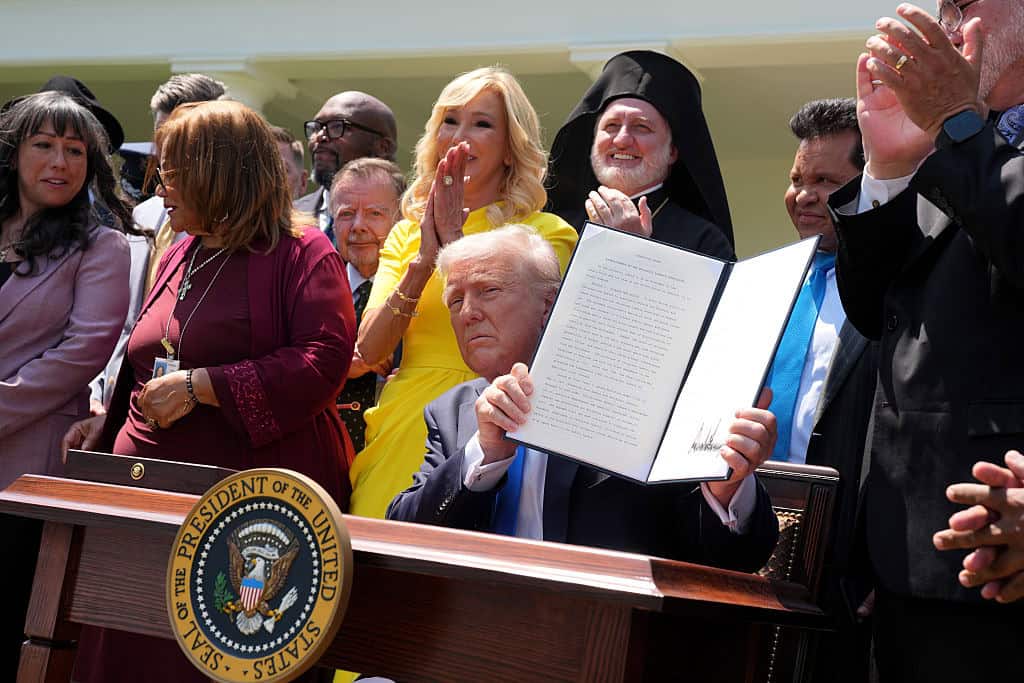
President Trump issued and signed numerous executive orders designed to protect people of faith:
• An executive order ending the weaponization of the federal government against all Americans, including people of faith.
• An executive order restoring free speech and ending federal censorship.
• An executive order combating the debanking of Americans based on their political affiliations, religious beliefs, and lawful business activities.
God’s Word is clear we’re to pray for our leaders. Wrote Paul to Timothy: “I urge, then, first of all, that petitions, prayers, intercession and thanksgiving be made for all people—for kings and all those in authority, that we may live peaceful and quiet lives in all godliness and holiness” (1 Tim. 2:1-2).
Regardless of your party or your political persuasion, please join us in praying for President Trump and all our elected leaders.


ABOUT THE AUTHOR