President Trump Outpacing First Term in Confirmed Judge Picks
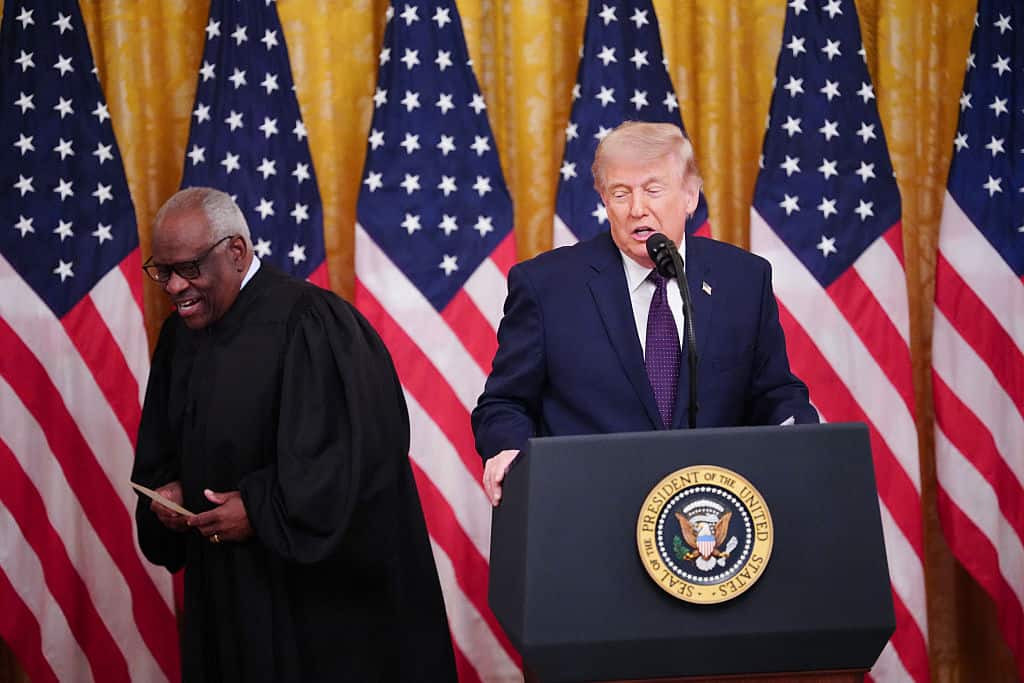
President Donald J. Trump’s picks for federal judgeships are being confirmed at a faster clip in his second term compared to his first.
Article III of the Constitution establishes the judicial branch of the federal government, made up of one U.S. Supreme Court and “such inferior Courts as the Congress may from time to time ordain and establish.”
Congress has created 13 federal courts of appeals along with 94 lower district courts. While the Supreme Court has the final word in deciding cases and controversies, our nation’s other courts – particularly the 13 appeals courts – are vitally important to our nation’s judicial system.
The Supreme Court receives roughly 7,000 requests to hear cases each year; it accepts around 1% of them, leaving the other 99% to be decided by the lower courts.
The Constitution’s appointments clause grants the president the power to appoint federal judges. The Senate provides “advice and consent” on each nominee.
Upon confirmation, judges are granted a lifetime appointment to the federal bench, meaning they can serve far longer than a president’s time in office. This makes the president’s job of selecting and nominating federal judges extremely important.
In his first term, President Trump nominated three Supreme Court justices: Neil Gorsuch, Brett Kavanaugh and Amy Coney Barrett. He also nominated 54 judges to serve on our nation’s federal appellate courts and 174 federal district judges.
In his second term, the U.S. Senate has confirmed 10 of the president’s nominees for the 13 federal appellate courts. Two more are awaiting confirmation.
Most recently, on July 23, the Senate confirmed Judge Daniel Traynor, previously a federal district judge, to the U.S. Court of Appeals for the 8th Circuit, one of the nation’s most conservative federal appellate courts.
In announcing his appointment of Traynor to the court in May, President Trump said he “has issued courageous decisions, and blocked illegal Federal Government actions under the previous Administration.”
President Trump also recently gained a chance to fill a vacancy on the U.S. Court of Appeals for the 5th Circuit after Judge Kurt Engelhardt, who has served on the court since 2018, announced his intention to take senior status, a form of semi-retirement, upon the confirmation of his successor. The president has nominated Anna St. John for the seat.
The Senate has also confirmed 42 of President Trump’s district court nominees since January 20, 2025.
Overall, Senate Republicans have confirmed the president’s judicial picks at a faster clip than Trump’s first term.
“As chairman, I’ve ensured efficient consideration of nominations and under my leadership this Congress we’re processing judicial nominations at a historic pace,” said Senate Judiciary Committee Chairman Chuck Grassley.
“In fact, if you look at the time between nomination and confirmation, we’ve advanced and confirmed Article III judges faster than at any time since Ronald Reagan’s presidency.”
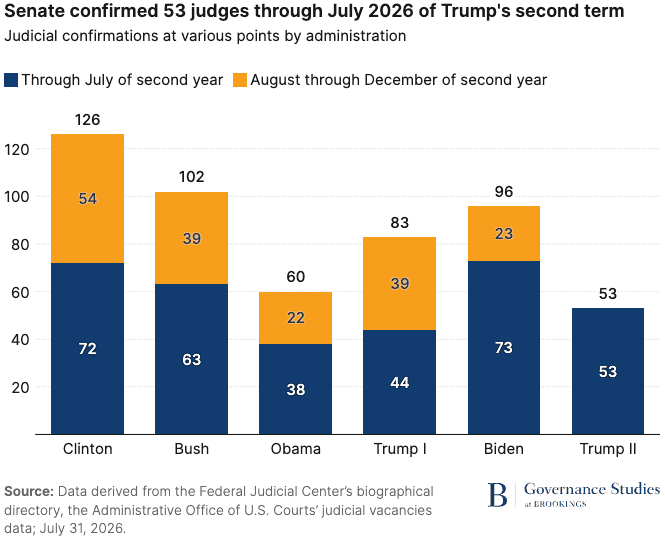
Photo Credit: Brookings Institution
According to the left-leaning Brookings Institution, “Nearly 1 in 3 full-time lower-court federal judges are Trump appointees, due largely to his near-record number of first term confirmations.”
However, given a much lower level of judicial vacancies, Brookings expects the confirmation of new judges to slow. The district and appellate courts now have only 30 vacancies compared to 92 vacancies in July 2018.
Federal judges confirmed today could serve for 30 or 40 years. Each judge’s judicial philosophy matters greatly to how they might rule on issues of life, religious freedom, free speech, parental rights, the protection of girls sports and more.
As we’ve written previously, “Focus on the Family believes that the judicial system plays a vital role in our government, our families and society in general. … The federal judicial system set up by the Founders held up the ideal of limited judicial authority: Judges should stick to offering ‘judgment’ and exercising ‘neither force nor will.’”
Our nation needs more judges today who understand their job is to say what the law is, not what they would like it to be.
As former Justice Antonin Scalia said, “A judge must be, above all else, a servant of the law – and not an enforcer of his personal predilections – about the issues that come before him. The good judge must suppress his personal views and must decide each case as the law dictates, not as he would have resolved the matter if he had drafted the law or the constitutional provision at issue.”
In our constitutional system, the people – not unelected, unaccountable federal judges – get to determine what the law is through their lawfully elected representatives. That’s what it means to have a nation that is of, by and for the people.
Related articles and resources:
US Supreme Court Ends Judicial Tyranny: No More ‘Universal Injunctions’
Judicial Tyranny: Solutions to the Problem of Rogue Federal Judges
Trump Victory Likely Cements Conservative Supreme Court for Decades to Come
Why Elections Matter – The Judicial Impact
Photo from Getty Images.