Close Family Relationships Offer Long-Term Social Benefits, Study Finds

Humans are social creatures. Our success as adult citizens rests largely in the vibrancy and size of our social networks. After all, the unapologetically Christian poet, John Donne properly noted, “No man is an island, Entire of itself.”
A new study published in JAMA Pediatrics documents how important close family relationships in adolescence are in helping our children develop robust and meaningful social connections throughout adulthood. The four Columbia University researchers who conducted this study explain, “Higher family connection in adolescence was significantly associated with a greater prevalence of high social connection in adulthood.”
As well, they state, “These findings suggest that safe, stable, and nurturing family relationships during adolescence may contribute to greater relational well-being in adulthood, potentially reducing social disconnection.”
Specifically, this research team reported that high levels of meaningful social connection were“more than twice as common” for adults who had “high” levels of family connectedness as adolescents compared to peers who grew up with the lowest levels of family connectedness.
Closer connections in one’s family of origin contributed not only to more social relationships, but also higher quality community friendships compared with those who grew up without close family ties.
Young adults with high levels of family relatedness in adolescence were consistently shown to have higher levels of weekly connection with friends and neighbors, and to have two or more close friends.
They also benefit from high social support, feel very close with both parents, never report feelings of isolation, and enjoy higher relational satisfaction with a spouse or romantic partner. You can see how consistently this finding demonstrated itself in this chart from the published study. Individuals with high family connectedness are shown in dark green.
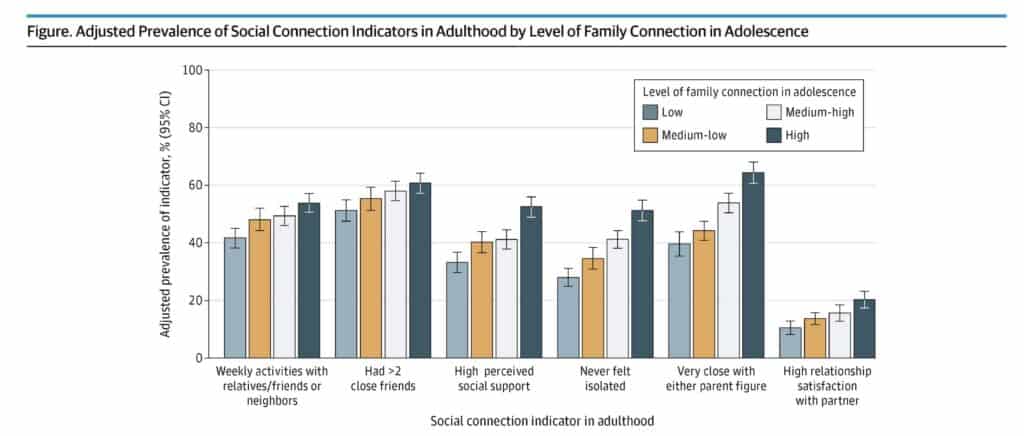
This research was conducted over two decades with a nationally representative, racially diverse sample of more than 7,000 adults who joined the study as adolescents. The authors explain that their data is corroborated by additional U.S. and international research.
It is interesting when reading research articles like this to see how academics couch and contort their language for their colleagues. These Columbia University researchers did not disappoint, as their final line demonstrates,
A very curious way to phrase their findings indeed. Even The New York Times, in reporting on this study, observed, “Researchers have long known that a strong parent-child relationship correlates with well-being in adulthood, but most studies have focused on internal measures like self-acceptance or a sense of purpose, rather than external dimensions such as satisfaction with relationships.”
Common sense does tell us, and scholars often stumble upon this truth, that close family relationships with one’s own married mother and father translate into strong, positive outcomes for children as they move into adulthood.
Related Articles and Resources
New Family Study Shows Importance of Married Parenting
Important New Research on How Married Parents Improve Child Well-Being
New Research Shows Married Families Matter More Than Ever
Why You Should Care About the Growing Positive Power of Marriage
Research Shows Marriage Boosts Well Being
New Research Shows Marriage and Fatherhood Regulate Male Sexual Energy
New Research: Marriage Still Provides Major Happiness Premium
Cohabitation Still Harmful – Even as Stigma Disappears
Don’t Believe the Modern Myth. Marriage Remains Good for Women
Don’t Believe the Modern Myth. Marriage Remains Good for Men.
Yes, Married Mothers Really Are Happier Than Unmarried and Childless Women
Marriage and the Public Good: A New Manifesto of Policy Proposals


ABOUT THE AUTHOR