• Skip to main content
Daily Citizen
  • Subscribe
  • Categories
    • Culture
    • Life
    • Religious Freedom
    • Sexuality
  • Parenting Resources
    • LGBT Pride
    • Homosexuality
    • Sexuality/Marriage
    • Transgender
  • About
    • Contributors
    • Contact
  • Donate

Fertility

Jan 30 2026

Is Inflation Driving Fertility’s Decline?

It has been well-documented that fertility is declining sharply in the United States and in most parts of the world.

In fact, the Congressional Budget Office recently reported that the U.S. fertility rate has declined so quickly, they advanced their projection of when deaths would outpace births in America by ten years over their 2024 projection. That year they projected this ominous milestone would happen in 2040. They now say births will drop lower than deaths in 2030. It will likely happen sooner as our current fertility trendline is dramatic.
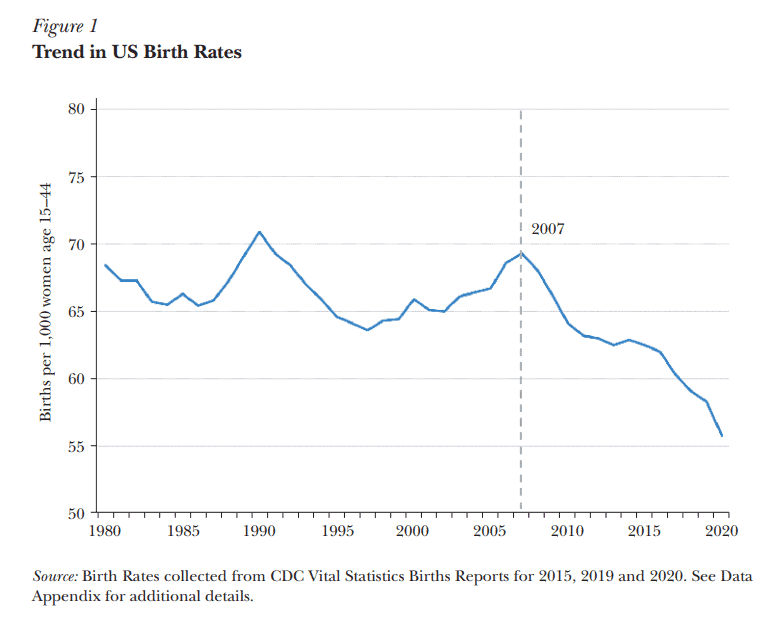
Economists have been very interested in the question of why two-thirds of the world’s population now live in a country with below replacement fertility. What is driving this very concerning decline?

Is it simply because babies are just too expensive in a tightening economy? There is great debate over that question.

One celebrated economics paper recently explored the question, “Why is fertility so low in high income countries?” In fact, they point out fertility “has fallen in recent decades in almost all high-income countries.” They find this decline is not driven solely by increasing costs of living, but “conclude that the decline in fertility likely reflects a complex mix of changing norms around work, parenting, gender roles, and leisure.” To put it directly, they say fertility is declining in high income countries because of “shifting priorities, reducing the priority of parenthood.”

This is very concerning news, given the fundamental importance of parenthood to the present and future betterment of the world.

Unfortunately, there are seriously misleading messages from our government that the costs of raising a child today are beyond most people’s comprehension. But the empirical truth is that they are not. Mothers and fathers have been raising kids and successfully launching them out into the world on extremely little. Just ask your grandparents.

But a new economics paper from two emerging scholars from the University of Mississippi indicates rising costs and unexpected inflation are indeed having a negative impact on U.S. fertility. Writing for the Institute for Family Studies, these economists explain, “The main empirical result of our working paper shows that unexpected inflation had a negative and significant impact on the total fertility rate in the United States from 2004-2023.”

Their paper finds, “A one percentage point increase in unexpected inflation is expected to result in 3-5 fewer births per 1,000 reproductive-age women.”

This is not insignificant. But we must note, it does not mean that these increases make having children unfordable. It just means that it makes people increasingly believe that a child is unaffordable. Much of this has to do with the “shifting priorities” highlighted in the first paper noted above.

And interestingly, these University of Mississippi scholars find men and women respond differently to the challenges of rising prices when it comes to the thought of having children. Youth plays a factor as well. “Our results suggest that young women are mostly responsive to unexpected inflation.”

These scholars conclude their “findings are consistent with the argument that substantial increases in unexpected inflation could prompt households to postpone their childbearing decisions, leading to a reduction in fertility rate.”

These findings leave us with a challenge. We can let fear of an uncertain economic future prevent young adults from engaging in one of life’s most rewarding and essential human activities. Or we can remind young people that having children and starting a family is always an act of sacrifice and some struggle, but is the only way toward a growing human future. We must remind them that they came from parents and grandparents who had very slim resources starting out, and it was scary, but it all worked out well for the most part. After all, these adult children would not exist today without this sacrifice.

God’s command to go forth and be fruitful is still very much in effect, and the age-old problem of rising prices has not put it on hold.

Related articles and resources: 

American Deaths to Exceed Births Faster Than Expected, CBO Reports

U.S. Fertility Rate Falls to Lowest on Record – Again

Global Population Has Passed ‘Peak Child’ – an Ominous Milestone

Why Americans Over and Under 50 Say They Don’t Have Kids

Death of the West? U.S. Fertility Rate Falls to Record Low.

China’s Population Drops by 2 Million in 2023 Due to Record Low Birth Rate

Discarding Genesis 1, U.S. Population Set to Decline This Century Amid World Population Collapse

The Importance of God’s Design for Marriage and Family

New Report Gives Update on Family Formation and Child Well-Being
Written by Glenn T. Stanton · Categorized: Family · Tagged: birth rate, Fertility

Oct 30 2024

Red States are More Fertile than Blue. Here’s Why it Matters.

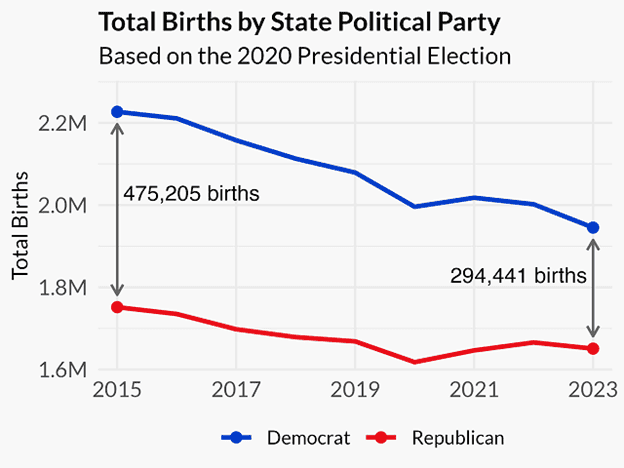
Scholars working jointly from the Institute for Family Studies and the American Enterprise Institute have documented an important fact about national growth: Red states produce more homegrown citizens that blue states.

Not only are parents much more likely to move out of blue states for red ones, they are more likely to become parents, and many times over, in red states. These scholars explain,

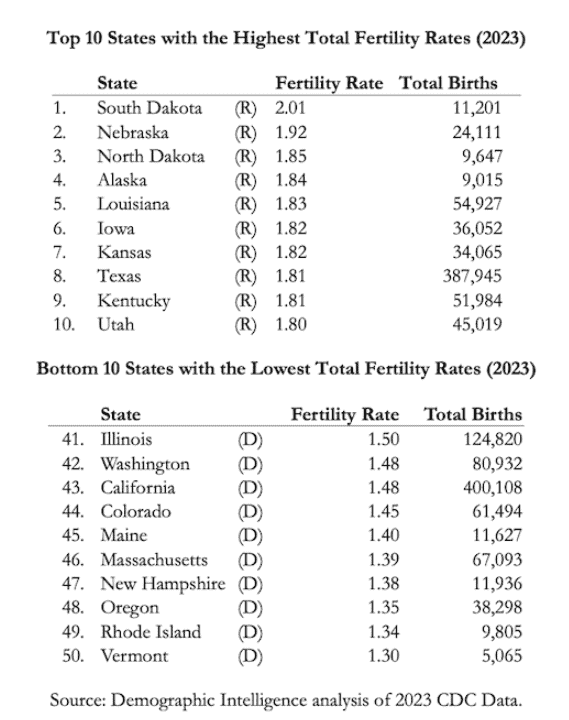
Republican states (those that Trump won in 2020) generally have markedly higher fertility rates than Democratic ones (those that Biden won), suggesting that more men and women feel confident about starting and raising families in red states than blue ones.

The data on this fact is actually very clear. And very consistent.

And the overall fertility decline has been less dramatic among those who vote red.

It is clearly the more conservative states in our Union that are fostering more and larger families than liberal states that boast “progressive family policies.” These scholars assert, “The red-state advantage regarding fertility can be chalked up to several cultural, policy and economic factors.”

They explain red states have better economic advantages for those starting families: more affordable housing, hotter job markets, and lower taxes.

Culturally, red states are more likely to value and promote marriage and family life and they offer parents more strategic educational choices for their children. These scholar hold that “These financial and cultural features of red-state life end up being more important than the suite of avowedly pro-family policies of their blue counterparts.”

Faith Also Plays a Big Part

It is also found that couples who take their faith seriously are more likely to have more children, and thus own the demographic future. This is true for serious Christians, Orthodox Jews, Muslims and Mormons. Some progressives and secularists have called this the “fundamentalist problem” – demonstrating that social Darwinism ironically rewards religion.

But faith also makes men better mates.

The Institute for Family Studies tells us, “Evidence suggests that religious fathers and husbands – more likely to be found in red states – prioritize marriage and family life, including housework, in ways that make family life more appealing to the women in their lives.”

All of this does not mean that red states are doing well in the necessary task of reproducing ourselves as a nation. Today only South Dakota is meeting the bare minimum replacement level of 2.1 births per woman. All other states are south of this essential threshold. Even Mormon-heavy Utah and Idaho are markedly below replacement level.

These scholars at the Institute for Family Studies explain,

The bottom line is both blue and red states have work to do to create a culture and a family-friendly economy for their young adults, one that would steer more states to a sustainable rate of family formation — about 2.1 babies per woman.

But red states with more conservative voters are indeed doing much better and their more liberal countrymen and women have some real catching up to do.

But if current fertility trends are any indication, Democratic states will have to work much harder to revive the fortunes of family life in their borders. That’s because trends in family migration and fertility suggest the blue-state family model is more family unfriendly than the red one to Americans interested in starting, growing or raising a family.

What we should all take away from this data is what the venerable University of Chicago political philosopher Richard M. Weaver famously told us: ideas have consequences. What people believe in their heads comes out in their actions. And conservative ideas are clearly better at guaranteeing humanity’s tomorrow because they lead to more fertility and growing families.

Those ideas and red states just need to do even better at this essential task if our nation is to grow properly.  

Related articles and resources:

Why Americans Over and Under 50 Say They Don’t Have Kids

Pro-Life and Pro-Family Policies are Essential for Conservatives

Brad Wilcox Exhorts Young People to ‘Get Married’

China’s Population Drops by 2 Million in 2023 Due to Record Low Birth Rate

Evangelicals Can Heed This One Trend from Mormons and MuslimsDiscarding Genesis 1, U.S. Population Set to Decline This Century Amid World Population Collapse

Image from Shutterstock.

Written by Glenn T. Stanton · Categorized: Culture · Tagged: Fertility

Privacy Policy and Terms of Use | Privacy Policy and Terms of Use | © 2026 Focus on the Family. All rights reserved.

  • Cookie Policy