
• Skip to main content
Daily Citizen
  • Subscribe
  • Categories
    • Culture
    • Life
    • Religious Freedom
    • Sexuality
  • Parenting Resources
    • LGBT Pride
    • Homosexuality
    • Sexuality/Marriage
    • Transgender
  • About
    • Contributors
    • Contact
  • Donate

relationships

Feb 03 2026

Close Family Relationships Offer Long-Term Social Benefits, Study Finds

Humans are social creatures. Our success as adult citizens rests largely in the vibrancy and size of our social networks. After all, the unapologetically Christian poet, John Donne properly noted, “No man is an island, Entire of itself.”

A new study published in JAMA Pediatrics documents how important close family relationships in adolescence are in helping our children develop robust and meaningful social connections throughout adulthood. The four Columbia University researchers who conducted this study explain, “Higher family connection in adolescence was significantly associated with a greater prevalence of high social connection in adulthood.”

As well, they state, “These findings suggest that safe, stable, and nurturing family relationships during adolescence may contribute to greater relational well-being in adulthood, potentially reducing social disconnection.”

Specifically, this research team reported that high levels of meaningful social connection were“more than twice as common” for adults who had “high” levels of family connectedness as adolescents compared to peers who grew up with the lowest levels of family connectedness.  

Closer connections in one’s family of origin contributed not only to more social relationships, but also higher quality community friendships compared with those who grew up without close family ties. 

Young adults with high levels of family relatedness in adolescence were consistently shown to have higher levels of weekly connection with friends and neighbors, and to have two or more close friends. 

They also benefit from high social support, feel very close with both parents, never report feelings of isolation, and enjoy higher relational satisfaction with a spouse or romantic partner. You can see how consistently this finding demonstrated itself in this chart from the published study. Individuals with high family connectedness are shown in dark green.
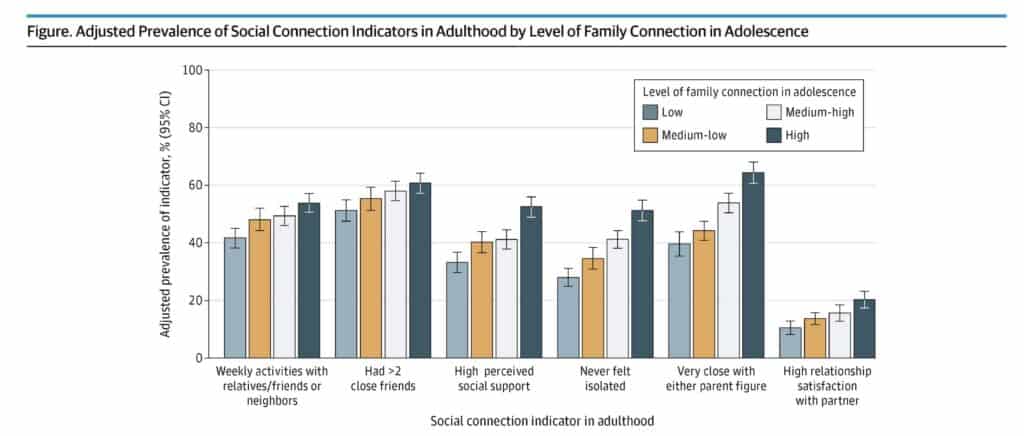
This research was conducted over two decades with a nationally representative, racially diverse sample of more than 7,000 adults who joined the study as adolescents. The authors explain that their data is corroborated by additional U.S. and international research.

It is interesting when reading research articles like this to see how academics couch and contort their language for their colleagues. These Columbia University researchers did not disappoint, as their final line demonstrates,

However, efforts to increase the exposure of adolescents to safe, stable, and nurturing relationships at home are unlikely to cause harm and may contribute to their capacity as adults to create and maintain social connection, thereby addressing the increasing prevalence of loneliness and social isolation.

A very curious way to phrase their findings indeed. Even The New York Times, in reporting on this study, observed, “Researchers have long known that a strong parent-child relationship correlates with well-being in adulthood, but most studies have focused on internal measures like self-acceptance or a sense of purpose, rather than external dimensions such as satisfaction with relationships.”

Common sense does tell us, and scholars often stumble upon this truth, that close family relationships with one’s own married mother and father translate into strong, positive outcomes for children as they move into adulthood.

Related Articles and Resources

New Family Study Shows Importance of Married Parenting

Important New Research on How Married Parents Improve Child Well-Being

New Research Shows Married Families Matter More Than Ever

Why You Should Care About the Growing Positive Power of Marriage

Research Shows Marriage Boosts Well Being

New Research Shows Marriage and Fatherhood Regulate Male Sexual Energy

New Research: Marriage Still Provides Major Happiness Premium

Cohabitation Still Harmful – Even as Stigma Disappears

Don’t Believe the Modern Myth. Marriage Remains Good for Women

Don’t Believe the Modern Myth. Marriage Remains Good for Men.

Yes, Married Mothers Really Are Happier Than Unmarried and Childless Women

Marriage and the Public Good: A New Manifesto of Policy Proposals

Written by Glenn T. Stanton · Categorized: Family · Tagged: parenting, relationships, research

Oct 15 2025

New Study: Online Dating Produces Fewer Healthy Relationships

It’s basic law of nature: Young men meet young women, get married and begin building a meaningful life together. It’s how a family starts.

But how couples meet today really matters. By strong margins, most couples now meet online. Unfortunately, very few meet through family or church.

In fact, in 1960, most U.S. couples (24%) met through friends; 19% met through family, while only 6% met through church.

In 2000, friend introductions held strong at 28%, while co-worker introductions and meeting at a bar took second and third place (15% and 13%, respectively). Family introductions took fourth place at 11%.

Only 5% met at church, rivaled by online dating (also 5%).

By 2024, a whopping 61% of couples met online, followed by meeting through friends (14% ) and coworkers (9%). Family was a paltry 4% and church was 2%.

You can see the changing trends in this creative video.


With most couples meeting online, it’s inevitable that relational strength and success will be impacted.

Early research indicated that meeting online had a slight positive effect on marital satisfaction and protecting against separation or divorce.

But later research conducted by the Institute for Family Studies demonstrated that meeting online was the least beneficial source for happy marriages, trailed only by bars. Church-facilitated meetings resulted in the highest levels of being “very happy” in marriage.

A new study by a team of psychologists from Poland’s University of Wroclaw examined this question anew with nationally representative data from 50 internationally diverse countries.

The first line of their study correctly notes, “The Internet has fundamentally reshaped how people meet and form romantic relationships.”

They concluded meeting online is not the best way to build the strongest, happy relationships and marriages.

They report, “On average, participants who met their partners online reported lower relationship satisfaction and lower intensity of experienced love compared to those who met offline, with effect sizes ranging from small to medium.”

Those who met in person tended to have healthier and more satisfactory interactions in intimacy, passion and commitment. The research team reported “these differences were generally small” but “importantly, these differences remained significant even after controlling for a broad set of demographic covariates, including gender, age, relationship length, socioeconomic status, [and] education.”

Why the Difference?

Why do online-introduced couples generally have less fulfilling relationships? Scholars offer three possible reasons:

  1. People who meet through their families, friends, church or work communities tend to have similar values and interests because how they meet selects for these similarities. Sociologists call this homogamy, or similarities in people’s sociological, educational and values background. People have fewer similarities when meeting online.

  2. Although related, having an overabundance of choices is uniquely a problem of online dating. Meeting a potential spouse through family, friends, school, work or one’s own neighborhood are all very powerful sifting mechanisms. One is likely to find like-minded individuals through similar interests and activities or through family and friends who know you well. Online dating, however, opens the door to many more possibilities. People are more likely to compromise in important areas because of the many options out there.

  3. In online dating, people commonly misrepresent themselves and it is difficult to distinguish between reality and fiction. The research team explains, “These inaccuracies are harder to conceal in face-to-face meetings, especially when shared social circles enable easier verification of personal details.”

As online dating becomes the main way people meet a potential spouse today, it is important to realize some ways of meeting a spouse produce healthier relationships and marriages over others.

These scholars conclude the study with this warning, “While online venues offer unprecedented opportunities for connection – especially across geographic and social boundaries – our findings suggest that relationships initiated offline are, on average, characterized by higher satisfaction and more intense feelings of love.”

Just another reason to favor and invest in IRL (in real life) communities of meaning.

Related Articles and Resources

If you or someone you know is struggling with marriage issues, Focus on the Family offers a one-time complimentary consultation with our ministry’s professionally trained counseling staff. The consultation is free due to generous donor support.

To reach Focus on the Family’s counseling service by phone, call 1-855-771-HELP (4357) weekdays 6:00 a.m. to 8:00 p.m. (Mountain Time). Please be prepared to leave your contact information for a counselor to return a call to you as soon as possible. Alternatively, you can fill out our Counseling Consultation Request Form.

Don’t Believe the Modern Myth. Marriage Remains Good for Men

New Focus on the Family Report: Marriage Health in America

Important New Research on How Married Parents Improve Child Well-Being

How Marriage Fights Against Deaths of Despair

Yes, Married Mothers Really Are Happier Than Unmarried and Childless Women

New Research: Marriage Still Provides Major Happiness Premium

Focus on the Family Marriage Report: Few Troubled Marriages Seek Needed Help

Harvard Evolutionary Biologist Brilliantly Explains Necessity of Monogamous Marriage

Important New Book Explains Why Marriage Still Matters

Image credit: Data is Beautiful / YouTube

Written by Glenn T. Stanton · Categorized: Family · Tagged: dating, marriage, relationships

Privacy Policy and Terms of Use | Privacy Policy and Terms of Use | © 2026 Focus on the Family. All rights reserved.

  • Cookie Policy