• Skip to main content
Daily Citizen
  • Subscribe
  • Categories
    • Culture
    • Life
    • Religious Freedom
    • Sexuality
  • Parenting Resources
    • LGBT Pride
    • Homosexuality
    • Sexuality/Marriage
    • Transgender
  • About
    • Contributors
    • Contact
  • Donate

smartphone

Aug 20 2025

More than Twenty States Limit Smartphone Use in Schools

Millions of students will start school sans smartphones this year as states continue restricting personal device use in schools.

Twenty new states have passed legislation this year limiting the use of smartphones, tablets and other wireless devices in public schools.

Now, eleven states — Arizona, California, Florida, Iowa, Indiana, North Carlina, Ohio, Tennessee, Virginia, Utah and West Virginia — prohibit smartphone use during class.

Another fourteen — New York, Alabama, Arkansas, Georgia, Kentucky, Louisiana, Nebraska, New Hampshire, North Dakota, Oklahoma, Oregon, South Carolina, Texas and Vermont — and the District of Columbia have passed “bell-to-bell” device bans forcing students to turn off and store personal tech during school hours.  

The wave of regulation reflects lawmakers and parents’ growing alarm over the effects of ubiquitous smartphones on children’s education.

“[Kids aren’t] developing the skills [they] need because they are distracted with the cell phones,” New York Governor Kathy Hochul defended New York’s “bell-to-bell” ban in March.

“Our teachers [are] trying to teach algebra and geography, and they’re competing with viral dances and messages from their friends, and sometimes threats [and] bullying.”

Nearly all available research supports Hochul’s take. A 2023 study from Common Sense Media found nearly 97% of teens use their smartphones during school hours — mostly to play video games, scroll social media or watch pornography.

A Seattle Children’s Research Institute study of more than 100 teenagers from the same year determined teens spend an average of 1.5 hours on their phone during a 6.5 hour school day.

Smartphones monopolize kids’ focus with near constant notifications. The average American teen gets between 192 and 237 messages and prompts every day — about eleven every waking hour.

The constant stimuli trains kids to hyperfocus on their device. Data shows a smartphone’s mere presence in a classroom — even turned off or tucked in a backpack — can decrease students’ academic performance.

Once distracted, it can take up to 20 minutes for students to recover their focus, a 2017 study from the Association for Consumer Research finds.

Internet access compounds the inherent harms of personal tech like smartphones. The Surgeon General’s 2023 advisory on social media, for instance, shows prolonged adolescent social media use correlates with higher instances of depression, lower overall life-satisfaction, low self-esteem, poor sleep and even problems with brain development.

Conversely, school districts with “bell-to-bell” tech bans report students engage in less bullying, make better eye contact and participate more.

Perhaps its no surprise, then, that Americans look more favorably on tech limits in school than ever before.

A 2025 Pew Research survey shows 74% of American adults support limiting school smartphone use in class — up 6% from last year. Support for “bell-to-bell” bans also increased, growing to 44% from just 36% in 2024.  

Importantly, the biggest demographic change occurred in adults under 30-years-old, many of whom were teens when cellphones became mainstream. Last year, only 45% supported banning phones during class. This year, 57% say they’re in favor.

Laws limiting the powerful, harmful distractions of smartphones in schools enable parents to better shield their children from dangerous, addictive tech. That’s something the Daily Citizen will always support.

Additional Articles and Resources

Plugged In Parent’s Guide to Today’s Technology

New York Prepares to Restrict School Smartphone Use

Florida School District Bans Cellphones, Gets Results

Parent-Run Groups Help Stop Childhood Smartphone Use

‘The Tech Exit’ Helps Families Ditch Addictive Tech — For Good

Video: Seven-Year-Old’s Confidence Soars After Ordering Chick-Fil-A By Himself

Proposed ‘App Store Accountability’ Act Would Force Apps and App Stores to Uphold Basic Child Safety Protections

Surgeon General Recommends Warning on Social Media Platforms

Four Ways to Protect Your Kids from Bad Tech, from Social Psychologist Jonathan Haidt

Social Psychologist Finds Smartphones and Social Media Harm Kids in These Four Ways

‘Big Tech’ Device Designs Dangerous for Kids, Research Finds

Survey Finds Teens Use Social Media More Than Four Hours Per Day — Here’s What Parents Can Do

Written by Emily Washburn · Categorized: Education · Tagged: smartphone

Jun 18 2025

‘The Tech Exit’ Helps Families Ditch Addictive Tech — For Good.

Social media, screens and smartphones, oh my — parents everywhere are struggling to keep their kids safe in an overwhelming technological age.

Clare Morell, a tech policy expert and fellow at the Ethics and Public Policy Center, throws frazzled families a lifeline in her new book, Tech Exit: A Practical Guide to Freeing Kids and Teens from Smartphones.

In Tech Exit, Morell encourages parents to challenge the idea that addictive technologies are an unavoidable part of modern childhood.

She and hundreds of other “Tech Exit” families are successfully raising their children without smartphones, social media, tablets or video games. The book lays out detailed, step-by-step instructions for families to join their number.

Tech Exit’s proposal might seem drastic — especially for families with older children already addicted to screens. Morell uses her own research and interviews with “Tech Exit” families to show leaving tech behind is not only possible, but logical.

She starts by debunking four myths about screen-based technology.

Myth 1: Screen-based technology is an inevitable part of childhood.

Morell helps create policies protecting children from dangerous technology. She gave birth to her own children as data began showing the catastrophic effects smartphone and social media use wreak on child development and mental health.

The new mom didn’t want her kids to suffer the same effects — but the advice she found in parenting books didn’t seem equal to the problems at hand.

“I saw a major disconnect,” she writes in Tech Exit. “I’d move from horrifying accounts of kids falling into sextortion schemes to advice like ‘set time limits’ [and] ‘turn on privacy settings on their accounts.’”

These aren’t bad strategies, Morell explains, but they also assume that children need access to screen-based technology. That’s not true. Her own family is proof that a “Tech Exit” is sustainable and beneficial.

Myth 2: Screen-based tech can be used in moderation.

We like to conceive of screens like sugar — something that can be enjoyed in moderation.

But screens aren’t like sugar. “For the developing brains of children and teens,” Morell writes, “they are more like fentanyl.”

As the Daily Citizen has previously reported, social networking apps, websites and devices — anything with a messaging or networking feature — triggers the release of dopamine, the brain’s reward chemical.

Crucially, dopamine trains the brain to “want” something but never produces feelings of satiety. Once kids get a taste of tech, they’ll always want more.

When parents bring screen-based tech into the house, they put themselves squarely between “a drug-dispensing machine and an underdeveloped brain,” as one of Morell’s interviewees puts it, and invite daily battles over its use.

“It’s an untenable, exhausting situation,” Morell writes.

Myth 3: The harms of screen-based tech can be fixed with screen-time limits.

Tech companies frequently imply parents can protect kids from screen-based technology by stopping them from spending too much time on their devices. That’s why, in part, screen-time limits are “the most prominent form of parental control [over kids’ devices],” according to Morell.

But addictive technology can negatively affect kids regardless of the amount of time they use them.

The dopamine released in just a couple of minutes of screen time can cause kids to desire tech for hours after it’s been put away. Over time, these intense chemical highs will make other, everyday pleasures seem boring.

The negative social effects of technology burden all kids and teens alike, regardless of their screen use. Morell writes:

The teen mental health crisis today is due not only to negative effects of digital technologies for individuals but also to the group social dynamic that smartphones and social media have created.

Smartphones, for example, change the way kids and teens create and maintain friendships. Every kid must play by these new social rules — even if they don’t use screen-based technology.

Myth 4: Parents can protect their children from danger using parental controls.

Device and app manufacturers have financial incentives to show children inappropriate content. Thus, parental controls are unintuitive, filled with bugs and intentionally easy to manipulate.

But that’s not how they’re sold to parents. Tech companies keep young customers by convincing parents they can sufficiently protect their kids from predators, scams and inappropriate content online.

It’s almost always an exercise in frustration.

Given these intractable problems, Morell uses a startling metaphor to illustrate parental controls’ effectiveness in the digital world:

We don’t take our children to bars and strip clubs and blindfold them or have them wear earplugs. That would be absurd. We just don’t let them go to those places.

Morell’s cost-benefit analysis suggests the benefits of raising children in largely tech-free households far outweigh the consequences. Tech Exit endeavors to create a clear, sustainable path for families to do just that.

Her approach centers around FEAST — an acronym for five common principles all “Tech Exit” families she interviewed follow:

  • Find Other Families: They connect with other “Tech Exit” families.
  • Explain, Educate, Exemplify: They get their kids on board by explaining why they are getting rid of screens, educating them on the dangers of the digital world and exemplifying good digital habits.
  • Adopt Alternatives: They look for creative alternatives to smartphones and other technologies.
  • Set Up Digital Accountability and Family Screen Rules: They create rules and boundaries governing technology in the home.
  • Trade Screens for Real-Life Responsibilities: They replace time spent on screens with independent play and responsibilities.

Morell offers a treasure trove of practical, honest advice and resources to help families adopt these principles in their own lives — even when it seems impossible.

Curious about becoming a “Tech Exit” family? You can find The Tech Exit: A Practical Guide to Freeing Kids and Teens from Smartphones here.

Additional Articles and Resources

Video: Seven-Year-Old’s Confidence Soars After Ordering Chick-Fil-A By Himself

Social Psychologist Finds Smartphones and Social Media Harm Kids in These Four Ways

Four Ways to Protect Your Kids from Bad Tech, From Social Psychologist Jonathan Haidt

Parent-Run Groups Help Stop Childhood Smartphone Use

The Harmful Effects of Screen-Filled Culture on Kids

‘Big Tech’ Device Designs Dangerous for Kids, Research Finds

Pornography Age Verification Laws: What They Are and Which States Have Them

Written by Emily Washburn · Categorized: Family · Tagged: smartphone, social media, technology

Apr 16 2025

New York Prepares to Restrict School Smartphone Use

New York could pass a statewide, “bell-to-bell” ban on smartphone use in schools within the month, multiple outlets report.

The policy, introduced by Governor Kathy Hochul in January, is one of many rolled in to the state’s 2026 budget proposal. It would allocate some $13 million dollars for school districts to purchase tools restricting school smartphones use.

Polling suggests most New York voters support all-day restrictions on smartphones in schools, but the specifics have proven difficult to iron out. Mayor Eric Adams stopped pursuing cellphone restrictions in New York City schools less than a year ago after encountering logistical issues.

Hochul’s statewide policy addresses three common objections to Adams’ failed district-wide restrictions:

  • It provides funding for schools to purchase equipment, like these lockable pouches.
  • It requires schools to provide at least one way for students and parents to communicate in an emergency.
  • It includes exceptions for students with learning disabilities and those who use their phones as translators.

But it’s not yet clear how much freedom districts would have to establish their own cellphone restrictions.

Some New York officials argue districts should be able to decide whether students can use smartphones during passing periods, lunch or other non-instructional times.

Hochul, on the other hand, supports what she calls a “bell-to-bell ban” — no cellphone use on school property during school hours.

“No smartphones, no earbuds, no cellphones,” Hochul told Telemundo 47 in March. “Here’s why: The mental health of our children, especially in middle school and high school is really declining.”

While introducing the policy, Hochul argued:

[Kids aren’t] developing the skills [they] need because they are distracted with the cell phones. Our teachers [are] trying to teach algebra and geography, and they’re competing with viral dances, and messages from their friends, and sometimes threats [and] bullying.

There’s no question that smartphone and social media use negatively affect adolescent’s development, mental health and academic achievement.

A 2023 study from Common Sense Media found 97% of teens use their cellphones during school hours, primarily to play video games, browse social media and watch porn.

Students that manage to put their phones down are lured back in with push notifications. The average American teen receives between 192 and 237 every day — about eleven every waking hour. This constant stimuli is so distracting, one study found, that the mere presence of a smartphone in the classroom, even tucked away in a backpack, decreases students’ academic performance.

Once students become distracted by their phone, a 2017 study from the Association of Consumer Research found it can take up to 20 minutes to recover their focus.

Constant distraction, or attention fragmentation, prevents adolescents from developing the parts of their brains responsible for self-control, decision-making and critical thinking, social psychologist Jonathan Haidt writes in his book The Anxious Generation.

Smartphones can also hamper adolescents’ social development. A 2023 surgeon general’s advisory on social media found excessive screentime hampers the development of the amygdala and prefrontal cortex, the parts of the brain controlling “emotional learning, behavior impulse control, emotional regulation and ability to moderate social behavior.”

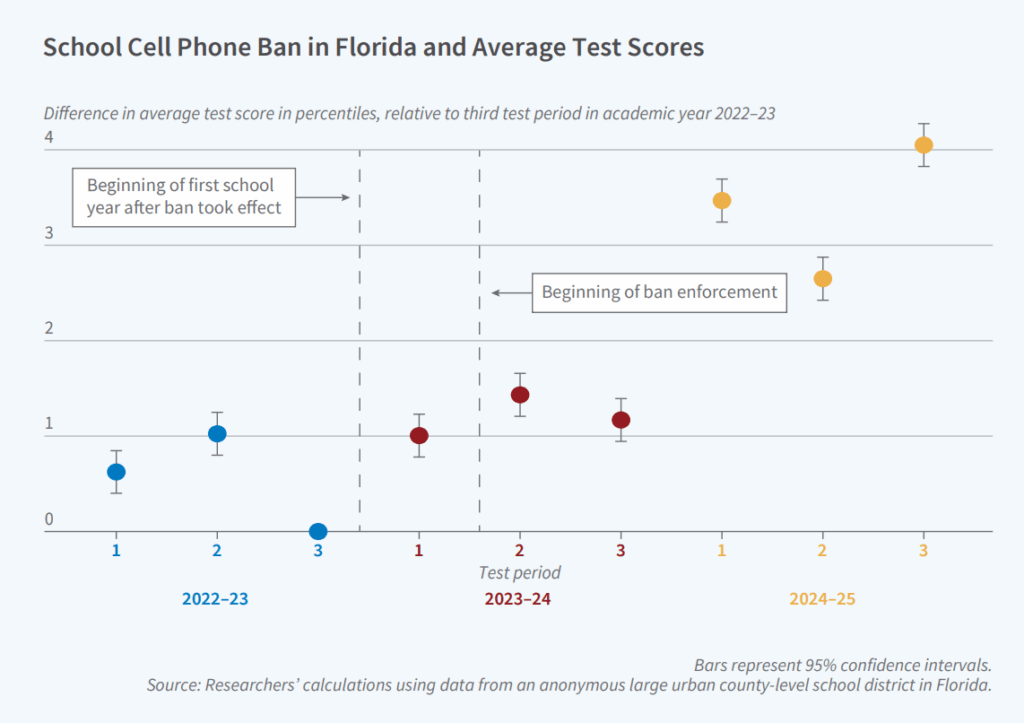
When Orange County school district in Florida instituted a total cell phone ban in November 2023, teachers and administrators saw improvement in kids’ focus and behavior. One teacher told The New York Times that students seemed “more talkative and collaborative.” Others found students made more eye contact and seemed more engaged. A principal claimed bullying decreased because students could no longer film embarrassing or harmful videos of their classmates to post on social media.

The surgeon general’s advisory cites studies supporting Orange County teachers’ experiences. A small study of college-aged kids found the severity of subjects’ depression lessened when they reduced their social media use to just thirty minutes a day.

Another small study found young adults and adults who abstained from social media for four weeks reported higher levels of subjective wellbeing, like happiness and life satisfaction. The improvements were equivalent to between 25% and 40% of benefits from other mental health interventions like therapy.

New York legislators are still finalizing the city’s 2026 budget — more than two weeks after the April 1 deadline. But outlets like Politico report the school cellphone policy isn’t causing the delay.

If the policy makes it into the state’s finalized budget, as expected, it will become the tenth state to restrict or ban school cellphone use at the state level, joining Arkansas, California, Florida, Indiana, Minnesota, Ohio, Virginia, Louisiana and South Carolina.

To learn more about how you can protect your kids from the harmful effects of social media and excessive screentime, check out the articles linked below.

Additional Articles and Resources

Parent-Run Groups Help Stop Childhood Smartphone Use

Four Ways to Protect Your Kids from Bad Tech, from Social Psychologist Jonathan Haidt

New York City Passes on School Cellphone Ban — For Now

Surgeon General Recommends Warning on Social Media Platforms

Social Psychologist Finds Smartphones and Social Media Harm Kids in These Four Ways

The Harmful Effects of Screen-Filled Culture on Kids

Survey Finds Teens Use Social Media More Than Four Hours Per Day — Here’s What Parents Can Do

Florida School District Bans Cellphones, Gets Results

‘Big Tech’ Device Designs Dangerous for Kids, Research Finds

Plugged in Parent’s Guide to Today’s Technology

Do Your Kids Have Healthy Phone Habits

Written by Emily Washburn · Categorized: Culture · Tagged: smartphone, social media

Privacy Policy and Terms of Use | Privacy Policy and Terms of Use | © 2025 Focus on the Family. All rights reserved.

  • Cookie Policy