Why Young People Are Failing to Date, Marry and Have Kids

It is well established that young adults across the world are increasingly not forming romantic relationships, dating, courting, marrying and having kids. Some have termed the problem a “dating drought.” The Atlantic calls it “The Great Romance Slump” and scholars at the Institute for Family Studies have carefully documented what they term “The Dating Recession.” The New York Times refers to the trend as “The Great Detachment.” The Financial Times says it’s a “relationship recession.”
Families cannot form if boys do not meet girls and establish something real out of their relationships.
An important new research-based book released today explores this troubling phenomenon in careful detail. Daniel Cox, senior fellow and director of the Survey Center on American Life at the American Enterprise Institute, has long been diligently working on Generation Uncoupled: America’s New Gender Divide and the Crisis of Human Connection.
Sadly, the share of 40-year-olds who are not married has increased four-fold over the last half century. In a pre-release interview with journalist Derek Thompson, Cox explained, “The book argues that problems with dating and romantic partnership are downstream from the decades-long deterioration of American social and civic life.” He adds, “It’s not entirely that young people have fewer social opportunities, but that they are encouraged to prioritize their own personal experiences and expression.”
This is all marked by the fact that we are, literally, talking to each other person-to-person much less than in the recent past. This has been documented in the social sciences. If young men and women are spending less time together eye-to-eye than previous generations, it’s no wonder healthy romance is declining.
Cox notes that social media culture has really cut into this. He calls it a “distorted curriculum for intimacy,” sharing a curious example of this in his book of how dance floors now stand empty where “almost everyone stands around the periphery holding their phones.” Young people seem crippled with fear that they could be filmed being vulnerably human and it could go viral. Cox explained in his interview with Thompson, “It’s sort of like walking around in the Matrix where anyone you meet could potentially document and share an embarrassing moment, social misstep, or inartful comment.” He adds, “It’s made young people hypervigilant, less understanding, and less forgiving” – all essential in being willing to take a chance in approaching a girl.
Cox notes there is also a political aspect to this decline. He says there is “solid evidence” that young women have been growing more liberal, starting in 2016, while young men have not. He explains, “Young men express greater distrust in the political and economic system and subsequently were more attracted to anti-establishment candidates who promise to disrupt the current political order.” Gallup charts the gender divide this way.
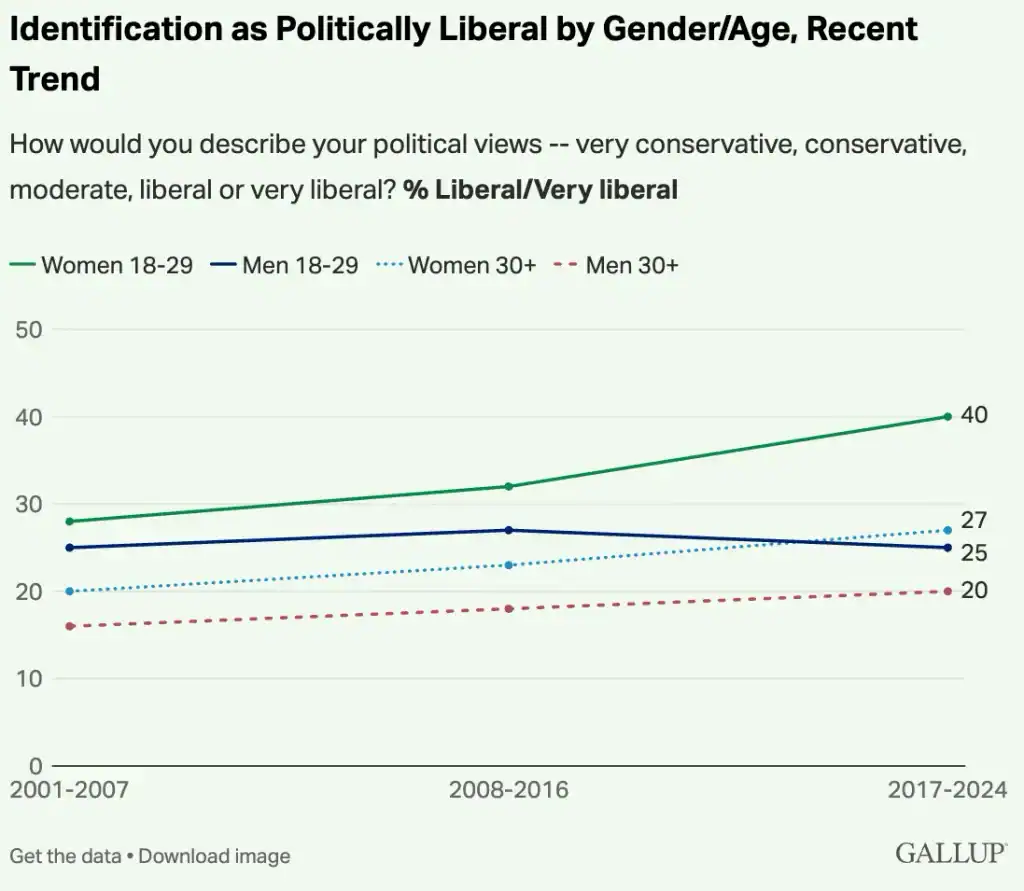
Cox told Thompson, “In the Trump era, political identity became shorthand for character – your political views no longer signaled your position on an issue, but the type of person you were.” This furthered the divide between men and women, as “more young adults became comfortable screening out people with discordant views, leaving them more politically segregated both online and off.”
In early August, Cox explained how the Gen X political divide between men and women grew to unprecedented margins, reaching a 22-point gap. Cox explained to Thompson, “The gender divide in partisan identity is larger among young adults than any other age group.”
The world of online dating apps has not helped either, with men and women having different negative experiences there. It all centers around the apparent wealth of options that online dating apps provide. Cox says men feel invisible and frustrated, even immobilized, with the amount of rejection they experience. Yet, that is only true for the minority of men bold enough to take the dating chance at all. Women feel overwhelmed by varying degrees of mediocre or sub-par options.
Cox explains, “It’s a volume problem. One young woman I talked to likened it to trying to find something to watch on Netflix; instead of making a quick selection, you spend your time endlessly scrolling through all the available options and not watching anything at all.” It’s the postmodern curse of too many options.
This dynamic has been documented in leading university research. Not only does a wealth of choices affect one’s ability to choose a potential mate, but it can also tend to taint the confidence one has in the partner they have chosen.
Humanity desperately needs more marriages and more children born to married parents.Unfortunately, we are getting far fewer of both. Increasingly this is driven, not by lack of desire in either, but because young people are losing the ability to live as full relational humans, meeting one another IRL, looking into the eyes of others, falling in love, dating with intentionality and having marriage serve as the foundation of building their adult life.
Scholars like Daniel Cox are documenting this sad development. It will be up to the rest of us to find some way to help turn things around. The family and the future of every nation depend on it.
Related Articles and Resources:
The American Dating Drought and Hope for Fixing It
New Study: Online Dating Produces Fewer Healthy Relationships
Young Person Explains Why Young People Aren’t Getting Married
Who Falls in Love Faster, Men or Women?
Make Dating for Marriage Great Again
Don’t Believe the Modern Myth. Marriage Remains Good for Men
Important New Research on How Married Parents Improve Child Well-Being
How Marriage Fights Against Deaths of Despair
New Research: Marriage Still Provides Major Happiness Premium
Harvard Evolutionary Biologist Brilliantly Explains Necessity of Monogamous Marriage