New Research: What Men and Women Are Looking For in a Spouse

It’s a simple syllogism: Family formation is essential for a healthy society. Family cannot happen if boy doesn’t meet girl. Thus, healthy and successful dating practices are essential for a healthy society.
But we are living amid a dating recession where young men and women are lacking the confidence needed to enter serious relationships that lead them to marriage. But, along with having the confidence to step out and risk a date, both must know what each is looking for in a potential spouse.
Rosemary Hopcroft, Professor Emerita of Sociology at the University of North Carolina, has just summarized some online dating research on what men and women are looking for in potential spouses for the Institute for Family Studies (IFS). This data is drawn from a relatively new and unique dating site, Keeper.ai. Keeper favors “long-term meaning over short-term gratification” and “is built for serious relationships, not casual swiping.” Its objective is to get men and women happily married and start growing families.
Jake Kozloski founded Keeper in May 2022, largely motivated by his own search for a good wife, his parents’ divorce when he was a baby and declining global fertility which is driven by declines in marriage rates. In a 2023 interview, Kozloski told IFS’s Alysse ElHage, “The marriage crisis is probably the primary factor in the fertility collapse because married people tend to have more babies than single people.”
As a site for men and women looking specifically for marriage, it is notable that women outnumber men on Keeper by about 5 to 1. More casual relationship sites like Grindr or Tinder are vastly more populated by men, 93 and 78% respectively. This is because women have tended to be more marriage minded, especially the younger they are. But, as we shall see below, that appears to be changing, unfortunately.
So, what are men and women looking for in a potential spouse? The surprising finding is their interests are quite similar, yet with some interesting differences.
Women’s 10 most frequently mentioned characteristics when describing an ideal husband, in order from most mentioned to least, are:
- values,
- sense of humor,
- relationship dynamic,
- communication style,
- intelligence,
- ambition,
- lifestyle,
- physical health,
- hygiene, and
- intimacy.
For men, the most to least specified characteristics are:
- values,
- relationship dynamic,
- communication style,
- sense of humor,
- intelligence,
- physical health,
- lifestyle,
- ambition,
- intimacy, and
- interests.
There are two differences between these lists. The first is that men listed “interests” as their No. 10, while women did not list this quality. The second is that women listed “hygiene” as No. 9, while men did not list that at all.
Both listed “values” as their No. 1. In general, both sexes placed a high value on shared values, a positive relationship dynamic, communication style, intelligence and a sense of humor.
Both want the man to be taller than the woman. But there is a marked difference here. A full 45% of men would be interested in a wife that was taller than him, while only 10% of women would settle for a man who was shorter than her.
Women also consistently desire age parity all through life, but men desire this when younger, but increasingly seek a younger wife as they age. Men ages 18 to 21 will settle for a wife who is about a year older, but as they age, their desired spouse gets younger and younger. Men ages 50 or older say they seek a wife about ten years younger. Men are roughly 11 times more likely than women to classify age as either very important or non-negotiable (16.1% of all men versus only 1.4% of all women).
In specific physical traits, women are more likely to indicate desires for things like build, hair or eye color. But men are far more likely to list body figure as very important, 8.2% versus 1.5%. Men said they were more unwilling to relocate for a new relationship compared to women, 26.7% of men to 14% of women.
Women are also more likely to state characteristics they do not desire in a partner. While men generally state “overweight” as their main no-go standard, women list things like “rude” first, followed by “overweight,” “short,” “mean” or “arrogant.”
Men and women are very similar, as they are both human, of course. But they also have different tastes and desires because men and women are indeed different. Increasingly young women are expressing less interest in dating than young men. Daniel Cox who runs the Survey Center on American Life at The American Enterprise Institute found in 2023 that women were falling behind men in this regard.
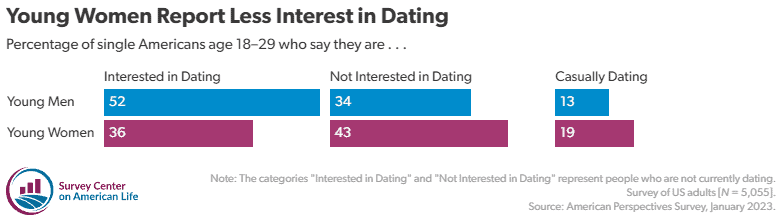
And Pew research revealed in 2025 that high school girls expressed notably less interest in marrying than their male peers, a marked change since the early 90s.
Cox explained that young women are more likely than young men to report they are not dating or interested in marriage because they “have more important priorities” with a marked differential of 45 to 29%, respectively. Roughly equal numbers – 35 percent for single men and 38 percent for single women – said difficulty meeting people was a hindrance in dating.
America’s faith and family communities need to find creative ways to encourage and embolden young men and women to start dating in healthy and serious ways. Families will not form and births will not start climbing without this happening.
Related Articles and Resources:
The American Dating Drought and Hope for Fixing It
New Study: Online Dating Produces Fewer Healthy Relationships
Young Person Explains Why Young People Aren’t Getting Married
Who Falls in Love Faster, Men or Women?
Make Dating for Marriage Great Again
Don’t Believe the Modern Myth. Marriage Remains Good for Men
Important New Research on How Married Parents Improve Child Well-Being
How Marriage Fights Against Deaths of Despair
New Research: Marriage Still Provides Major Happiness Premium
Harvard Evolutionary Biologist Brilliantly Explains Necessity of Monogamous Marriage