New Research Shows Marriage and Fatherhood Regulate Male Sexual Energy

Did you know that when men marry according to God’s design and become fathers, nature is aligned in such a way that it lowers their testosterone (T) levels in helpful ways? Men with lower T tend to be more focused on their duties toward marriage and family as it lowers libido, aggression and infidelity risk. This increases nurturing behaviors and long-term pair-bonding. The Daily Citizen reported on this larger body of research last year.
But new research conducted by scholars from the University of Notre Dame have shown that this reduction in T induced by marriage and fatherhood remains for years, even decades and is maintained with the addition of more children into one’s family. A data graph from this study demonstrates that partnered men (P) with one or more children have the lowest T levels among peers in other familial settings or being single.
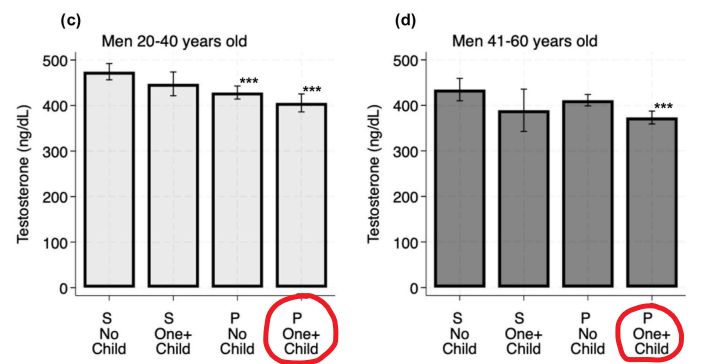
These scholars explain, “Specifically, we found that partnered men living with older children, particularly two or more, had lower testosterone than single men and partnered men not residing with children.” The effect size was notable. They add, “This is among the first evidence showing lower testosterone in … fathers with older children, specifically.”
They also explain, “In our analysis of young-to-middle aged U.S. men, we found that partnered men, including those residing with children, did not have increased risk of clinically-low testosterone compared to single men not living with children.” This means that T reduction for married fathers is at ideally helpful levels and not harmful to health and well-being.
These researchers explain that “fathers with lower testosterone engage in more nurturant, direct care of children and have higher quality relationships” with their wives.
There has been a good bit of research published on this question over the last 20 years.
A 10-year follow-up study of over one thousand 30 to 60-year-old men published in 2017 observed how T declined as men entered into marriage and lived as husbands, as opposed to just comparing married with unmarried men. These men were part of a long-term health survey in Denmark. The research team reports, “We observed that men who went from unmarried to married experienced the largest decline in circulating T levels over a ten-year period.” Men newly divorced experienced increased T levels as they found themselves back “on the market.”
A 2015 study in the journal Evolutionary Psychology found that outside of marriage “men in polyamorous relationships (with multiple committed partners) have greater levels of testosterone than those in monogamous relationships.” Wives settle men down, but multiple women as partners have the opposite effect. And the more permanent and long-term the relationship, the lower the T levels, compared to single men. This study also explains, “Further findings suggest that fathers have lower levels of testosterone than non-fathers independently of relationship status, and that pair-bonded fathers demonstrate lower levels than pair-bonded non-fathers.”
A 2011 study, conducted by the author of this new Notre Dame study, demonstrates how testosterone levels properly fluctuate for men through the life-course of seeking a mate, living as a settled-down married men, then as a father:
Using longitudinal data, these results demonstrate that high T not only predicts mating success (i.e., partnering with a female and fathering a child) in human males but that T is then greatly reduced after men enter stable relationships and become fathers.
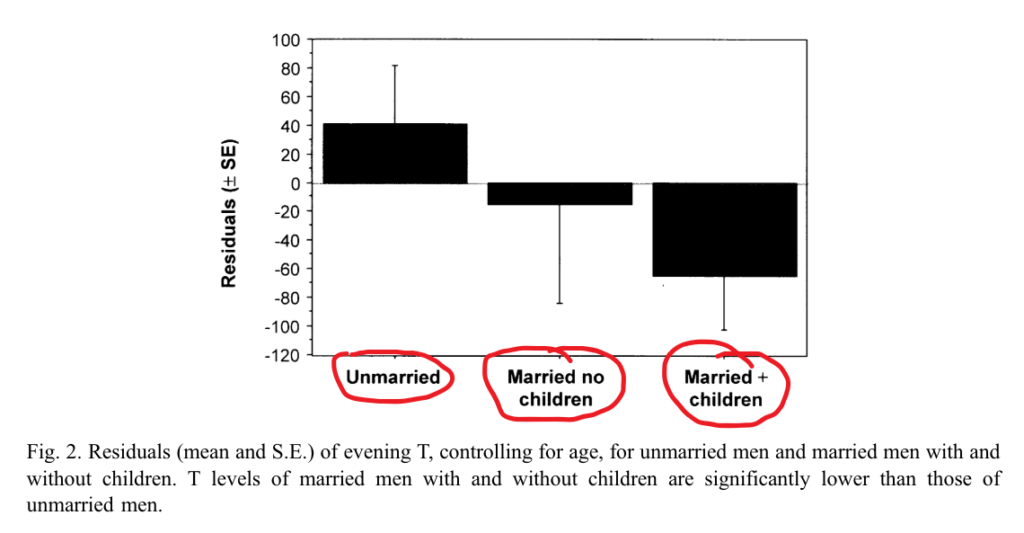
One of the earlier efforts to study this phenomenon, a 2002 Harvard paper published in Evolution and Human Behavior, established that controlling for age, married fathers have markedly lower T levels compare to their unmarried peers and slightly lower levels compared to married men without children.
This chart shows the distinction:
In a 2006 Canadian study, investigators state bluntly that their data “suggests that the relationship between T and partner status is only seen in individuals who are interested in, and partner with, women.” Very interesting.
Men do not tend to settle other men down. Wives and mothers do this for men because female sexuality and biology are more family focused. George Gilder explains this in his critically important work, Men and Marriage: “The crucial process of civilization is the subordination of male sexual impulses and biology to the long-term horizons of female sexuality.”
This influential exchange between men and women is something that family health and longevity require. Research from leading universities around the world tell us this happens at a very intimate and invisible hormonal level between husband and wife.
We are indeed fearfully and wonderfully made.


ABOUT THE AUTHOR