• Skip to main content
Daily Citizen
  • Subscribe
  • Categories
    • Culture
    • Life
    • Religious Freedom
    • Sexuality
  • Parenting Resources
    • LGBT Pride
    • Homosexuality
    • Sexuality/Marriage
    • Transgender
  • About
    • Contributors
    • Contact
  • Donate

Abortion Pill

May 20 2026

What Does the FDA Shakeup Mean for Abortion Pill Review?

Last week, FDA Commissioner Marty Makary resigned from his position amid growing tensions over his priorities, including escalating frustration from pro-life advocates over the slow pace of FDA’s abortion pill review. 

Attorney Kyle Diamantas has been appointed as acting FDA commissioner while the administration searches for a permanent replacement. 

At first, many pro-life advocates were uncertain about the new acting commissioner. 

Reports quickly surfaced that Diamantas previously served as legal counsel for Planned Parenthood.

Simultaneously, pro-life leaders reported receiving requests from Diamantas for a conversation. 

March for Life President Jennie Bradley shared on X that Diamantas was on the phone with pro-life leaders within a few hours of being named as the acting commissioner. 

Had a great convo last night with Kyle Diamantas, the new acting FDA Commissioner. In other words, within hours of being handed this big new job, he was on the phone with pro-life leaders – which is an encouraging sign of where his priorities lie.

After talking w him I'm…

— Jennie Bradley Lichter (@JennieMFL) May 13, 2026

It's true that Diamantas was on a case team representing a Planned Parenthood affiliate in FL when he was a junior associate. My understanding is that when he was initially put on the case he felt he couldn't say no — but he ultimately asked to be removed, for conscience…

— Jennie Bradley Lichter (@JennieMFL) May 13, 2026

Lichter told EWTN News that she shared her concerns about the safety of mifepristone with Diamantas and indicated, based on their conversation, she expected to see “real movement” on the mifepristone study by the FDA. 

She told EWTN, “I feel really comfortable that he is bringing in strong pro-life commitments and a commitment to transparency and to moving with all deliberate speed to take a close look at mifepristone and then take decisive action based on what that study shows.”

Live Action President Lila Rose also spoke with Diamantas and posted on X, “He told me he regrets work he performed as an outside attorney for Planned Parenthood…. He shared that he was assigned to the case by his law firm, performed work on it, and ultimately regretted his involvement because of his moral opposition to abortion.”

She also posted, “Diamantas told me that reviewing the abortion pill is a top priority for him and the administration.”

Today I spoke directly with Acting FDA Commissioner Kyle Diamantas.

He told me he regrets work he performed as an outside attorney for Planned Parenthood in Planned Parenthood of Greater Orlando v. MMB Properties. He shared that he was assigned to the case by his law firm,…

— Lila Rose (@LilaGraceRose) May 13, 2026

Other pro-life organizations, like Students for Life and Susan B. Anthony Pro-Life America, have been less vocal about who is brought in as the acting FDA commissioner and are more concerned about whether he will act quickly to review mifepristone. 

If the @US_FDA cares about the safety of women and children, they will revoke their approval of Chemical Abortion Pills ASAP. How many more women and babies must die before we stop these dangerous drugs? https://t.co/4454cJXNDG

— Kristan Hawkins (@KristanHawkins) May 19, 2026

We look forward to a new FDA Commissioner who will put an end to the mail-order abortion drug regime. We must return immediately to the 1st Trump Administration standard of in-person dispensing to protect women from coercion and abuse and allow the enforcement of pro-life state…

— Marjorie Dannenfelser (@marjoriesba) May 12, 2026

A comprehensive review would include scrutiny of the pill’s safety, emergency complications, adverse effects reporting, telehealth prescriptions and mail-order distribution.

Under the Trump administration, pro-life advocates expected the FDA to conduct a comprehensive review of mifepristone — the first drug in a two-pill regimen that results in a chemical abortion.

Under the Biden administration, safeguards meant to protect women were eliminated, including in-person visits, while mail-order distribution was approved.  

In light of a safety study released last May, pro-life advocates have been calling on the FDA to conduct a full and comprehensive review of the drug. 

The study, conducted by the Ethics and Public Policy Center, revealed that nearly 11% of women who take the abortion pill experienced serious side effects within 40 days, including sepsis, hemorrhaging, infection and emergency room visits. Those numbers are 22 times higher than the FDA’s current label.

For at least six months, Senator Hawley has been calling on the FDA to stop stonewalling the review of mifepristone and reinstate safety protocols.

But instead of carrying out a comprehensive review of the abortion medication, the FDA approved a generic drug for distribution. 

In the last year there has been growing pressure for the FDA to complete the promised safety review.

Interestingly, new data shows 70% of Americans, including a majority of each political party, support increased oversight for the distribution and consumption of chemical abortion pills like mifepristone.

Pro-life leaders are calling on Commissioner Diamantas to act now to pull the abortion pill from the market. 

The FDA’s review of mifepristone is separate from the legal battle playing out in the federal courts. Judges are still considering questions related to the interstate mailing of abortion pills, while the FDA has the authority to determine drug safety standards. 

For now, the pro-life movement seems cautiously optimistic that the FDA transition could create the opportunity for a serious and genuine review of mifepristone. 

Some women, after taking the first abortion pill (mifepristone), come to regret their decision. Thankfully, there is a way to reverse the pill’s effects if prompt action is taken.

To learn more about the abortion pill reversal protocol, visit abortionpillreversal.com or call 1-877-558-0333 to be connected with a medical professional who can guide callers through the process of reversing the pill’s effects.

Additionally, if you’re struggling and need a listening ear, Focus on the Family offers a free, one-time counseling consultation with our ministry’s professionally trained counseling staff. To request a counseling consultation, call 1-855-771-HELP (4357) or fill out our Counseling Consultation Request Form.

Related articles and resources:

Pro-Life Groups Raise Alarm Over Delayed FDA Review of Abortion Pill Safety

RFK Jr. Announces ‘Complete Review’ of Abortion Pill After ‘Alarming’ New Study Reveals Dangers

Louisiana, ADF Challenge Biden-Era Abortion-By-Mail Scheme

FDA Approves Generic Abortion Pill Despite Ongoing Safety Review

Become an Option Ultrasound Life Advocate

Dealing With an Unplanned Pregnancy

I’m Pregnant, Now What?

My Choice Network

New Insights on the Dangers of the Abortion Pill

Written by Nicole Hunt · Categorized: Life · Tagged: abortion, Abortion Pill

Apr 28 2026

Should Colleges Be Forced to Push Abortion Pills on Campus? Colorado Lawmakers Say Yes

Colorado is once again attempting to establish itself as one of the most progressive states in the nation on abortion policy.

A new bill would require most colleges and universities to provide access to abortion pills through student health centers. 

The measure, HB 26-1335, requires institutions of higher education to carry and dispense abortion pills on campus through a student health center or an on-site pharmacy, or submit a prescription for abortion pills to an off-site pharmacy.

The language of the bill includes an exception for religious colleges and universities, but the intent of the legislation is clear — to normalize and institutionalize abortion in taxpayer supported education systems. 

Colorado law already permits abortion throughout all 40 weeks of pregnancy for any reason whatsoever.

As reported by the Daily Citizen, in November 2024, Colorado voters passed an abortion amendment enshrining abortion access in the state constitution.

Then last April, Colorado lawmakers passed a new law forcing Colorado taxpayers to spend millions of their dollars every year to fund Medicaid abortions against their conscience.

Colorado received national attention when it considered this bill because the pro-abortion speaker of the House gave testimony in support of the measure saying it was cheaper for the state to pay for abortions than pay for a baby to be born. 

SHOCKING: Speaker Julie McCluskie (D) is effectively encouraging Coloradans on Medicaid to have an abortion instead of giving birth, because it's cheaper for the state.

This occurred yesterday. Really showing your cards @McCluskieforCO #COPolitics pic.twitter.com/lbhguaYLeO

— Scott Shamblin (@scottpshamblin) March 26, 2025

President of Focus on the Family Jim Daly responded, “To suggest that abortion is acceptable because it saves the state of Colorado money is dystopian and morally objectionable on every level. If we ever hope to attain a more civil society, we must start by respecting human life at all stages of development. Children are not a burden on society – they are a blessing.”

Forcing colleges and universities to provide access to abortion pills is just the next step in the abortion industry’s efforts to indoctrinate young people, normalize a culture of death, and use taxpayer dollars to support big abortion.

On April 27, 2026, the Colorado House of Representatives passed the bill 41-22. 

The measure now goes to the state Senate for consideration where it is expected to garner more than enough support to go to the governor’s desk for signature.

If it becomes law, Colorado will become one of only six states (including California, New York, Massachusetts, Delaware and Illinois) to require colleges and universities to provide access to abortion pills.

Abortion pills account for 63% of abortions committed in the United States each year.

In a chemical abortion a pregnant woman takes two medications. The first pill, mifepristone, kills the baby by stopping its development. The second set of pills, misoprostol, causes the mother’s body to expel the dead baby.

A study released last May by the Ethics and Public Policy Center revealed that nearly 11% of women who take the abortion pill experienced serious side effects within 40 days, including sepsis, hemorrhaging, infection and emergency room visits. Those numbers are 22 times higher than the FDA’s current label.

Prolife activists continue to call on the FDA to conduct a comprehensive review of abortion pill safety. 

Interestingly, new data shows 70% of Americans support increased oversight for the distribution and consumption of chemical abortion pills like mifepristone.

Some women, after taking the first abortion pill (mifepristone), come to regret their decision.

Thankfully, there is a way to reverse the pill’s effects if prompt action is taken. 

To learn more about the abortion pill reversal protocol, visit abortionpillreversal.com or call 1-877-558-0333 to be connected with a medical professional who can guide callers through the process of reversing the pill’s effects.

Additionally, if you’re struggling and need a listening ear, Focus on the Family offers a free, one-time counseling consultation with a licensed or pastoral counselor. To request a counseling consultation, call 1-855-771-HELP (4357) or fill out our Counseling Consultation Request Form.

Related articles and resources:

Become an Option Ultrasound Life Advocate

Dealing With Unplanned Pregnancy

I’m Pregnant, Now What?

My Choice Network

New Insights on the Dangers of the Abortion Pill

Written by Nicole Hunt · Categorized: Life · Tagged: abortion, Abortion Pill

Apr 07 2026

New Poll: 70% of Americans Support Medical Oversight for Abortion Pills

New polling data reveals most Americans agree there should be more oversight of the distribution and consumption of chemical abortion pills like mifepristone.

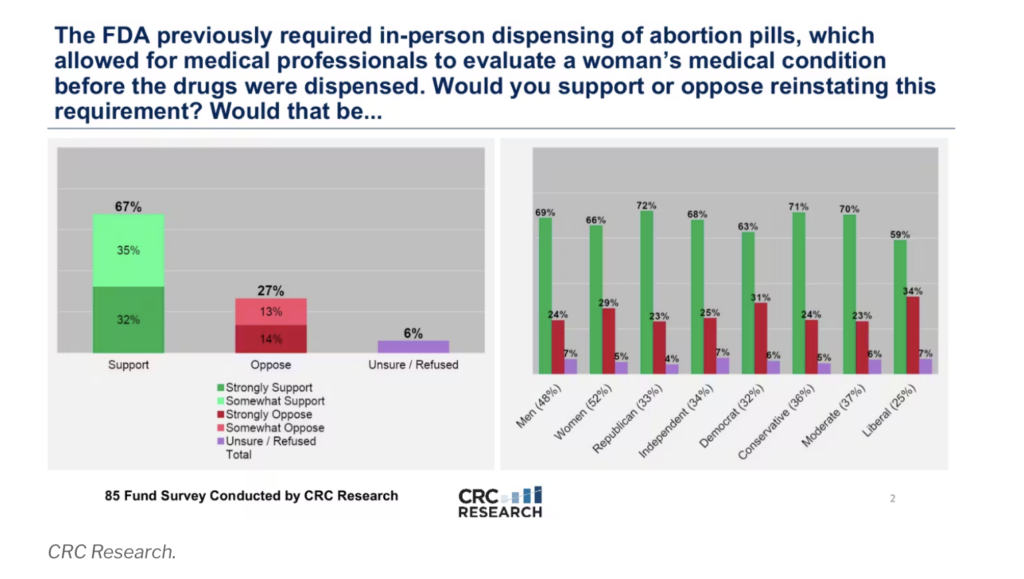
According to polling conducted by CRC Research for The 85 Fund, as reported by The Daily Wire and Susan B Anthony Pro-life America, approximately 70% of Americans support requiring an in person medical evaluation before and after taking the abortion pill.

A closely related question found that 67% of voters support requiring an in-person doctor’s visit in order to obtain the abortion pill. This policy was previously upheld by the FDA but abandoned by the previous pro-abortion administration.

Source: The Daily Wire

What makes this data so interesting and newsworthy is how it breaks down across political lines. Support for medical oversight was not limited to a single party. In fact, 72% of Republicans, 68% of Independents and 63% of Democrats all supported reinstating in-person doctor visits before accessing abortion pills.

The data shows a clear majority of Americans in every major political party support some form of in-person medical attention before abortion pills are dispensed.

Concerns over medical oversight are reinforced by research from the Ethics and Public Policy Center (EPPC), which raised questions about the safety of women using mifepristone last year.  

As reported by the Daily Citizen in May, the EPPC released a study revealing nearly 11% of women who take the abortion pill experienced serious adverse effects within 40 days, including sepsis, hemorrhaging, infection and emergency room visits. 

Those numbers are 22 times higher than the FDA’s current label, which suggests the rate of adverse effects is only 0.5%.

Following the release of the report, Senator Josh Hawley questioned HHS Secretary Kennedy at a committee hearing. The secretary committed to a complete review of the chemical abortion pill by the FDA.

Instead of cracking down on the abortion pill, the FDA has made abortion pills even more available by approving a generic abortion pill alternative.  

Several pro-life organizations and advocates have accused HHS and the White House of intentionally slow-walking the review. They argue that recent findings demonstrate the need for stronger safeguards and removing in-person visits and medical oversight allows for serious complications to go untreated.

Susan B. Anthony Pro-Life America is calling on the Trump administration to revisit current FDA protocols and reinstate requirements that were previously in place, including in-person dispensing and physician oversight. They argue basic medical standards should apply to abortion.

Recently, Senator Josh Hawley recently introduced a senate bill to ban the abortion pill and give women the right to sue manufacturers for damages. Congresswoman Diana Harshbarger, a pharmacist, introduced companion legislation in the House of Representatives.

When abortion policy is often sharply divided, broad bipartisan support from a majority of Americans for medical oversight of the abortion pill should not be ignored. HHS and the FDA should use their authority to restore in-person medical oversight for abortion pill use.

Written by Nicole Hunt · Categorized: Life · Tagged: abortion, Abortion Pill, culture

Dec 12 2025

Pro-Life Groups Raise Alarm Over Delayed FDA Review of Abortion Pill Safety

Pro-life organizations and advocates called for the FDA Commissioner to be fired this week over the failure of FDA health officials to review abortion pill safety.

The abortion pill is a two-step process. The first pill, mifepristone, prohibits a baby’s further development and eventually starves it. The second pill, misoprostol, expels the baby from the mother’s body.

As reported by the Daily Citizen, in May, the Ethics and Public Policy Center released a study revealing nearly 11% of women who take the pill experience serious adverse effects, including sepsis, hemorrhaging, infection, and emergency room visits.

That is 22 times higher than the FDA’s current label, which suggests the rate of adverse effects is only 0.5%.

When Senator Josh Hawley addressed the study with Health and Human Services Secretary Robert Kennedy at a senate hearing later that month, Secretary Kennedy acknowledged the data was “alarming” and pledged HHS would perform a “complete review” of mifepristone.

Since May, the FDA has not completed a review of mifepristone, and instead approved a generic version of the drug at the end of September.

In a post on X, Senator Hawley called the approval “shocking.” He declared:

I have lost confidence in the leadership at the FDA. [The] FDA had promised to do a top-to-bottom safety review of the chemical abortion drug, but instead, they’ve just greenlighted new versions of it for distribution.

Now, Susan B. Anthony Pro-Life America claims FDA leadership intentionally slow-walked the promised review of mifepristone and is calling for the FDA Commissioner Marty Makary to be fired.

Senator Hawley recently released his letter to the FDA Commissioner, calling on the agency to stop stonewalling the review and reinstate the mifepristone safety protocols instated during the first Trump Administration.

Live Action’s President Lila Rose called on the FDA to act immediately to protect children and mothers from mifepristone.

To date, the White House and Department of Health and Human Services deny slow-walking the review and maintain it simply takes time.

For now, mifepristone and its generic counterpart remain available to the public under existing FDA authority, and no leadership changes have been announced. But there is growing pressure for the FDA to complete the promised safety review.

Some women, after taking the first abortion pill (mifepristone), come to regret their decision. Thankfully, there is a way to reverse the pill’s effects if prompt action is taken.

To learn more about the abortion pill reversal protocol, visit abortionpillreversal.com or call 1-877-558-0333 to be connected with a medical professional who can guide callers through the process of reversing the pill’s effects.

Additionally, if you’re struggling and need a listening ear, Focus on the Family offers a free, one-time counseling consultation with a licensed or pastoral counselor. To request a counseling consultation, call 1-855-771-HELP (4357) or fill out our Counseling Consultation Request Form.

Related articles and resources:

RFK Jr. Announces ‘Complete Review’ of Abortion Pill After ‘Alarming’ New Study Reveals Dangers

Louisiana, ADF Challenge Biden-Era Abortion-By-Mail Scheme

FDA Approves Generic Abortion Pill Despite Ongoing Safety Review

Become an Option Ultrasound Life Advocate

Dealing With an Unplanned Pregnancy

I’m Pregnant, Now What?

My Choice Network

New Insights on the Dangers of the Abortion Pill

Written by Nicole Hunt · Categorized: Life · Tagged: abortion, Abortion Pill, chemical abortion, mifepristone

Oct 08 2025

FDA Approves Generic Abortion Pill Despite Ongoing Safety Review

The Food and Drug Administration (FDA) approved a generic abortion pill just days after it confirmed its new investigation into the safety of chemical abortions.

The FDA approved Evita Solutions’ application for a generic mifepristone pill on September 30 after finding it “bioequivalent and therapeutically equivalent” to the name brand pill, Mifeprex.

Mifepristone starves preborn children of essential blood flow and nutrients by blocking the pregnancy hormone progesterone. It is the first chemical women ingest in the two-step chemical abortion regimen.

Watch Focus on the Family’s broadcast about the abortion pill.

The FDA’s authorization of another abortion pill seemingly contradicts its commitment to reevaluate mifepristone’s safety.

Just eleven days before its letter to Evita Solutions, FDA Commissioner Dr. Marty Makary and Secretary of Health and Human Services (HHS) Robert F. Kennedy Jr. confirmed the FDA is conducting an evidentiary review of the abortion pill.

“HHS — through the FDA — is conducting its own review of the evidence, including real-world outcomes and evidence, relating to the safety and efficacy of the drug,” the wrote in a letter to 22 concerned state attorneys general.

The AGs had requested HHS and FDA reinstate stringent restrictions on mifepristone in July.

When the FDA legalized mifepristone in 2000, it required:

  • The patient be less than seven weeks pregnant.
  • The patient visit the doctor three times before ingesting the drug.
  • The drug be prescribed by a doctor in a doctor’s office.
  • The drug be ingested in a doctor’s office with a doctor’s supervision.
  • The patient follow up with the doctor at least once after ingesting the drug.

Scientists used the same stringent restrictions in mifepristone’s clinical trials.

Today, the FDA requires none of these safety precautions. Women can be prescribed pills by doctors online or order them from legally-dubious websites. They do not have to get a sonogram to determine the age of their child or whether they have an ectopic pregnancy.  Most go through the painful abortion in their bathrooms alone.

In April, the Ethics and Public Policy Center (EPPC) released data showing just how dangerous taking mifepristone has become.

The bombshell report analyzed insurance claims from a representative sample of more than 865,700 chemical abortions. It indicated nearly 11% of women experienced a severe or life-threatening adverse event within 45 days of taking mifepristone, including:

  • Sepsis – 0.10% of cases (824 women)
  • Infection — 1.34% (11,707)
  • Required blood transfusion – 0.15% (1,257)
  • Hemorrhage – 3.31% (28,658)
  • Required hospitalization for complications related to the chemical abortion – 0.66% (5,699)
  • Required ER visit for complications related to the chemical abortion – 4.73% (40,960)
  • Ectopic pregnancy — 0.35% (3,062)
  • Other life-threatening adverse events related to the chemical abortion, including cardiac and pulmonary complications, anaphylaxis, thrombosis and surgery – 0.22% (1,956)
  • Repeated surgical abortion to complete the chemical abortion – 2.84% (24,563)
  • Other complications related to the chemical abortion, including life-threatening mental health diagnoses – 5.68% (49,169)

These findings indicate women are up to 22 times more likely to experience severe or life-threatening harm after taking mifepristone than the FDA had previously claimed.

HHS and FDA promised to investigate the discrepancy. In their September 19 letter, Kennedy and Makary wrote:

Recent studies — such as the study by the Ethics and Public Policy Center (EPPC) … — indicate potential dangers that may attend offering mifepristone without sufficient medical support or supervision.”

They further revealed the FDA itself had documented thousands of mifepristone-related adverse events before it eliminated the drug’s safety protocols:

FDA’s own data collected between 2000 to 2012 indicated 2,740 adverse events, including 416 events involving blood loss requiring transfusions.
Since then, safeguards for women regarding the administration of mifepristone have been significantly reduced.

Members of the House Values Action Team (VAT) team are among the legislators asking why, if mifepristone is dangerous enough to warrant a safety investigation, the FDA is approving more of the drug to hit shelves.

“The FDA’s approval of a new generic version of the abortion pill, mifepristone, endangers women’s health and disregards the value of life,” Congressman and VAT Chairman Robert Aderholt wrote in a statement.

“By approving another generic iteration of this pill while a safety review is ongoing, the FDA risks undermining women’s health and safety across the United States.”

Read more statements from more VAT members.

Neither Makary nor Kennedy had commented on the issue as of October 8.

The FDA has an urgent problem on its hands. Upwards of 11% of women may be suffering severe harm from chemical abortions, which are only growing more common. Meanwhile, the abortion industry claims mifepristone is safer than Tylenol.

The FDA should never approve drugs used to end human life. Barring a complete prohibition on mifepristone, the FDA should not approve generic abortion pills while investigation the drug’s safety.

To speak with a family help specialist or request resources, please call us at 1-800-A-FAMILY (232-6459).

If you are experiencing an unexpected pregnancy and want to learn more about your options, visit My Choice Network.

Some women, after taking the first abortion pill (mifepristone) come to regret their decision. Thankfully, there is a way to reverse the pill’s effects if prompt action is taken. To learn more about the abortion pill reversal protocol, visit abortionpillreversal.com or call 1-877-558-0333 to be connected with a medical professional who can guide callers through the process of reversing the pill’s effects.

To learn more about pro-life legislation in your state, contact your state Family Policy Council.

To learn more about the consequences of a chemical abortion, visit the links below.

Additional Articles and Resources

FDA Launches Review of Abortion Pill and the Harms it Causes Women

Pro-Abortion States Beef Up Protections for Abortion Pill Prescribers

Texas Father Sues Out-of-State Abortionist for Killing His Preborn Children

Shield Laws Enable Chemical Abortion in Pro-Life States

Shield Law Abortion Providers Advertised Alongside Black Market Abortion Pills

Texas Sues New York Doctor for Prescribing Abortion Meds

New Abortion Pill Study Confirms Danger to Mothers

Woman Nearly Dies from Abortion Pill, Story Reflects Disturbing EPPC Data

Focus on the Family Broadcast: Abortion Pill Reversal

#AbortionChangesYou: A Case Study to Understand the Communicative Tensions in Women’s Medication Abortion Narratives (Health Communication)

The Abortion Pill Harms Women: Insurance Data Reveals One in Ten Patients Experiences a Serious Adverse Event (Ethics and Public Policy Center)

Written by Emily Washburn · Categorized: Life · Tagged: Abortion Pill, Life, mifepristone

  • Page 1
  • Page 2
  • Go to Next Page »

Privacy Policy and Terms of Use | Privacy Policy and Terms of Use | © 2026 Focus on the Family. All rights reserved.

  • Cookie Policy