• Skip to main content
Daily Citizen
  • Subscribe
  • Categories
    • Culture
    • Life
    • Religious Freedom
    • Sexuality
  • Parenting Resources
    • LGBT Pride
    • Homosexuality
    • Sexuality/Marriage
    • Transgender
  • About
    • Contributors
    • Contact
  • Donate

mifepristone

Aug 03 2026

Abortion Pill Chemical Mifepristone Found in Drinking Water

The drinking water in two American cities contains mifepristone, the active ingredient in chemical abortions, a bombshell new study shows.

Mifepristone is the first in the two-step chemical abortion regimen. It kills preborn babies by preventing them from absorbing progesterone, an essential hormone for fetal development.

The peer-reviewed report, which the Journal of Alliance for Hippocratic Medicine (JAHM) published on July 20, revealed the amount of mifepristone in water samples from Austin, Texas; Carbondale, Illinois and Blacksburg, Virginia.

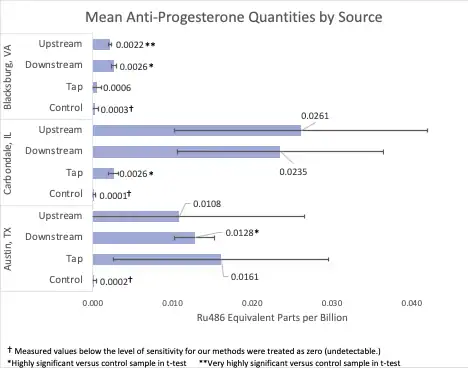
In each city, researchers collected and tested four water samples from upstream of a water treatment plant, four from downstream of a water treatment plant and four from the tap.

Researchers found statistically significant amounts of mifepristone in the upstream and downstream water samples from every city and in the tap water samples from Austin and Carbondale.

The chart below shows the mean concentration of mifepristone found in water samples from the three cities.
Courtesy of JAHM

“Quite frankly, I didn’t expect it to be at the tap,” Kristan Hawkins, the president of Students for Life, who commissioned the collection of the water samples, told the Daily Citizen.

“I don’t know, maybe I just had great faith in our wastewater treatment plants.”

The report itself concluded:

Conventional water treatment was not effective for removing this endocrine-disrupting compound [mifepristone] from water in all cities we tested.

Conventional water treatment was not effective for removing this endocrine-disrupting compound [mifepristone] from water in all cities we tested.

The findings are incredibly concerning. Progesterone, the hormone mifepristone prohibits, helps support biological systems in babies, women and men. Though progesterone is more commonly known for the role it plays in women’s health, the report emphasizes, “Low progesterone levels in men have been associated with multiple medical problems including alopecia, bone loss, erectile dysfunction, fatigue and obesity.”

“This is an everybody problem,” Hawkins emphasizes. “This is something that every American, regardless of how they view abortion, should be very concerned about.”

“You don’t have to be pro-life to want clean drinking water.”

The true amount of mifepristone-related chemicals in drinking water may be even higher than scientists measured.

The report measured unmetabolized mifepristone in the water, or mifepristone which hasn’t been metabolized by the body.

The average woman absorbs only about 70% of a mifepristone dose. The remaining 30% enters the water system unmetabolized.

Researchers believe most of the unmetabolized mifepristone in public water system enters through the waste of women who ingest chemical abortion pills, because mifepristone is almost exclusively used to end the lives of preborn babies.

Chemical abortions now account for more than 60% of American abortions.

But researchers also did not test the water samples for mifepristone metabolites — the chemical products of a person metabolizing mifepristone.

Though chemically different, mifepristone metabolites still suppress progesterone, just like their parent chemical. It is still dangerous for them to build up in our water.

Mifepristone metabolites enter public waterways through human waste, too. Tragically, they also enter through the physical remains of chemically aborted babies. Whereas hospitals might have protocols to dispose of human remains, chemical abortions enable mothers to dispose of their babies into the public waste system.

When Hawkins and Students for Life were commissioning the report’s research beginning in 2020, they gave a lot of thought to the ethical and medical implications of mifepristone metabolites in the remains of babies.

“I got contacted by a supporter of ours who was on our Students for Life email list,” she recalled of the beginning of their work. “She said, ‘I have a friend who works at a wastewater treatment plant here in California and he’s seen these babies [in wastewater].’”

The email continued:

They collect [the babies] at the wastewater treatment plant. They get caught in the nets.

Despite its groundbreaking — and troubling — findings, the JAHM report is not without critics. Many cite the 1996 environmental assessment of mifepristone which found the drug could be “used and disposed of without any expected adverse environmental effects.”

It’s important to note the assessment was conducted and submitted to the Food and Drug Administration (FDA) by the Population Council, the same group trying to get mifepristone approved for sale.

Glaring conflict of interest aside, the ’96 assessment based its conclusion off an equation which factored in:

  • The estimated amount of mifepristone produced each year.
  • The estimated amount of mifepristone entering the public water system each day.

These numbers have increased dramatically following the normalization of abortion, the gutting of mifepristone’s safety checks and the popularization of chemical abortion.

Beyond referencing the assessment, most critics repeated a version of the same refrain: “There is no scientific evidence that [chemical abortion pills] cause harm to the environment.” 

Hawkins wonders why abortion supporters feel emboldened to attack the water treatment study when the abortion industry can’t produce any of its own:

The abortion industry, for 26 years, has refused to even look at this [issue]. Now, they want to argue and say, “Well, your study wasn’t rigorous enough?”
Well, go ahead! Go do your own study! Prove to me that chemical abortion pills aren’t in the drinking water, because my study, which I have very high confidence in, proves it.

Hawkins hopes the report will prompt the FDA to conduct its own, independent environmental assessment of mifepristone.

“[The] FDA needs to go back and do an environmental assessment,” she says. “The drug should be pulled from the market while they’re doing this environmental assessment.”

She also recommends the Environmental Protection Agency (EPA) add mifepristone to the contaminants of concern listed in the Safe Drinking Water Act. Students for Life generated more than 3,000 comments in June encouraging the EPA to take this step.

As the Daily Citizen previously reported, a coalition of 14 AGs wrote a letter to the EPA in June in support of Student for Life’s campaign.

Hawkins knows this issue can change hearts and minds. She recommends Daily Citizen readers use water cleanliness as a way to broach the subject of life with pro-abortion friends and relatives.

“As Christians, we’re always [wondering], ‘How do we talk to our pro-abortion friends and get them to reconsider their views on abortion?’ I think this is a wonderful one.”

Hawkins continues:

This [issue] has our highest mind change rate on college campuses. [When we began touring with toilet bowls and toilet seats saying, “Hey, we don’t want toilet bowl abortions,” even students who would identify, I think, as largely pro-choice were, very concerned. They just didn’t like the thought of babies going in toilet bowls.

She concludes:

When we can lead [with this issue] and break that trust they have with the abortion industry, it’s much, much easier to change someone’s mind on abortion.

Additional Articles and Resources

The Abortion Pill: How Does It Work?

14 AGs Press EPA on Abortion Pill Water Contamination

Abortion Pill Chemicals May Be Contamination America’s Tap WaterFDA Will Reportedly Conclude Abortion Pill Safety Review by September

Written by Emily Washburn · Categorized: Life · Tagged: mifepristone

May 18 2026

Abortion Industry Promotes New, Dangerous Chemical Abortion Regimen

Pro-abortion organizations are touting a dangerous, unproven chemical abortion regimen to stymie potential regulations on the abortion drug mifepristone.

An FDA-approved chemical abortion requires two pills. The first, mifepristone, kills the baby by starving him or her of progesterone, which is critical for embryonic development. The second, misoprostol, induces labor, helping the mother pass her deceased child and the remaining products of her pregnancy.

“Mifepristone alone has a 13 to 23% abortion ‘failure’ rate, which can mean both an on-going pregnancy or an incomplete abortion where not all tissue passes,” Dr. Catherine Wheeler, an OBGYN and member of Focus on the Family’s Physician Resource Council, told the Daily Citizen. “Misoprostol alone has a 20 to 40% failure rate.”

But the Society of Family Planning, National Abortion Federation and World Health Organization are among several pro-abortion groups telling women misoprostol-only abortions are safe.

In a memo titled, “Science Says Misoprostol Only is Safe and Effective,” the Society of Family Planning claims, “Medical guidance in the US and around the globe supports the use of misoprostol only for abortion throughout pregnancy.”

Misoprostol is “widely available, inexpensive and easy to administer,” the memo continues, and particularly appropriate for women in places where “mifepristone is not legally available or is inaccessible.”

This is an interesting fact to include in a document boasting a supposedly safe and efficacious treatment. Why would misoprostol-only abortions be a better choice for women who can’t access mifepristone?

Because misoprostol-only abortions are significantly more dangerous than chemical abortions — which are plenty dangerous themselves.

An analysis of insurance claims from nearly 866,000 chemical abortions by the Ethics and Public Policy Center found nearly 11% of women experienced a severe or life-threatening adverse events within 45 days of taking a mifepristone/misoprostol combo.

The likelihood of experiencing severe complications increases significantly when women initiate a traditional chemical abortion in the second trimester.

But data compiled by the Lozier Institute indicates misoprostol-only abortions are even riskier. Nearly 25% of women who initiated misoprostol-only abortions experienced incomplete abortions requiring surgery, compared to nearly 20% of those who initiated traditional chemical abortions in the second trimester.

More than 15% of the women who went through misoprostol-only abortions experienced hemorrhage, compared to just under 12% of the women who went through chemical abortion in the second trimester.

More than 9% of women required readmission to the hospital after a misoprostol-only abortion, compared to fewer than 7% of women who went through chemical abortions in the second trimester.

Misoprostol-only abortions also cause horrifying consequences for growing babies.

Unlike traditional chemical abortions, misoprostol-only abortions do not end the child’s life before he or she is violently expelled from the womb.

Many children still die in this process. Others — up to 9%, according to a review of studies conducted by pro-abortion scientists — survive. But misoprostol causes devastating birth defects when strong contractions cut off the developing baby’s blood supply, including:

  • Skull defects
  • Bladder development problems leading to incontinence
  • Stiff joints and undeveloped, rigid muscles
  • Cranial palsies
  • Facial nerve malformations
  • Failure to develop arms and legs
  • Drooping face

Misoprostol-only abortions can also facilitate late-term abortions, OBGYN Dr. Bill Lile, another member of Focus on the Family’s Physician Resource Council, told the Daily Citizen.

“Misoprostol alone is used to kill babies at higher gestational ages because, by week 12, the primary progesterone production increases dramatically,” Dr. Lile explained.

“This increase dramatically decreases the effectiveness of mifepristone [and] the abortion protocol shifts from blocking support of the early pregnancy to severe uterine contractions to force a pre-viable baby out of the uterus.”

At more than 22 weeks gestation, Dr. Lile told us, abortionists will often kill the baby to “prevent ‘physician and patient discomfort.’” The infant will either experience a heart attack following a fatal injection or bleed out after being stabbed in the spine.

Misoprostol-only abortions do nothing but harm mothers and children. But the abortion industry has every incentive to promote their use.

Cutting out mifepristone makes chemical abortion pills cheaper to make and ship. Misoprostol is also used to treat stomach ulcers, a legitimate medical use which makes the drug more difficult to regulate under the Comstock Act — a law prohibiting the interstate mailing of materials which cause abortion.

Importantly, organizations like the Society of Family Planning did not declare misoprostol-only abortions safe after any dramatic change in the data. They declared them safe when they feared mifepristone access could be regulated.

“The abortion industry is so committed to increasing abortion that they minimize these high risks in order to advance abortion access and ‘self-managed abortion,’” Dr. Wheeler sums up.

It fits with what we know of the abortion industry, which pursues profit to the exclusion of every moral good.

“Time and time again, the argument from the pro-abortion side is that access trumps safety,” Students for Life President Kristan Hawkins told the Daily Citizen earlier this month.

“It’s horrific.”

Additional Articles and Resources

Supreme Court Restores Access to Mail-Order Abortion Pills While Legal Fight Continues

Kristan Hawkins Lobbies Feds to Enforce Comstock Act

Supreme Court Temporarily Restores Access to Mail-Order Abortion Pills

Texas Father Sues Out-of-State Abortionist for Killing His Preborn Children

Federal Government Makes Abortion Pill Widely Available, Okays Mail Orders Despite Law Prohibiting Them

Shield Laws Enable Chemical Abortion in Pro-Life States

Shield Law Abortion Providers Advertised Alongside Black Market Abortion Pills

#AbortionChangesYou: A Case Study to Understand the Communicative Tensions in Women’s Medication Abortion Narratives (Health Communication)

New Abortion Pill Study Confirms Danger to Mothers

The Abortion Pill Harms Women: Insurance Data Reveals One in Ten Patients Experiences a Serious Adverse Event (Ethics and Public Policy Center)

Written by Emily Washburn · Categorized: Life · Tagged: chemical abortion, mifepristone

May 08 2026

Kristan Hawkins Lobbies Feds to Enforce Comstock Act

The Supreme Court this week temporarily allowed women to obtain chemical abortion pills remotely while it considers Louisiana’s case against the FDA’s regulation of mifepristone.

Behind closed doors, Students for Life President Kristan Hawkins lobbied the Department of Justice (DOJ) to shut down the mail-order abortion industry altogether by enforcing the Comstock Act.

“All it would take is for the Trump DOJ to issue a memo and say, ‘We’re going to enforce the law.’” Hawkins told the Daily Citizen.

“That, overnight, would end this wild, wild west of abortion we are currently facing in our country.”

When the FDA began allowing physicians to prescribe the chemical abortion pill mifepristone remotely without “adequately studying” the safety of such a step, the agency birthed a massive, unregulated, interstate drug market.

“Any person — sex abuser, human trafficker, a man, a minor, a girl who has a life-threatening ectopic pregnancy — can go online to a couple of websites and order chemical abortion pills within two minutes,” said Hawkins. “It doesn’t matter what state she’s in.”

There’s no guarantee the pills these women receive contain mifepristone and misoprostol, the second chemical in the abortion cocktail which sends women into labor.

“It’s a problem [abortionists] are having in their own industry,” she explained. “There’s zero accuracy to make sure the pills women are getting are even abortion pills and not placebos.”

The federal government doesn’t need to pass a law to take on the wildly exploitative chemical abortion industry. It’s already illegal under the Comstock Act.

The act, which Congress passed in 1873, prohibits the interstate transportation of “obscene or crime-inciting” materials, including every “article, instrument, substance, drug, medicine or thing” used to facilitate or perform abortion.

Thus far, however, the DOJ has refused to enforce Comstock.

Under the Biden administration, the department issued an opinion finding the law did not apply to interstate shipments of chemical abortion pills.

The tortured take relies on judicial interpretations of Comstock from the early twentieth century which determined violators must knowingly send “obscene or crime-inciting” materials to perform, not just any abortions, but unlawful abortions.  

Of course, at the time of Comstock’s creation, virtually all abortions were unlawful. The DOJ apparently did not consider this fact when, in December 2022, it determined that Comstock did not apply to chemical abortion pills because abortionists could intend the pills be used in lawful abortions.

With the stroke of a pen, the current DOJ could rescind this memo and begin enforcing the act, effectively banning the sale of mifepristone and misoprostol across state lines.

“A simple memo tomorrow from the DOJ could save hundreds of thousands of lives,” Hawkins emphasized. “That’s all we’re asking for.”

Enforcing the Comstock Act wouldn’t just score the Trump administration a win with the pro-life community, Hawkins told DOJ officials. It would support the president’s belief that abortion policy should be determined by the states.

“Even while I disagree with the president on that fact,” Hawkins told the Daily Citizen, noting “terrible, tragic things” happen when leaders allow human rights to begin and end at state lines, “if he truly believes [abortion] to be a state’s rights issue, the solution is to get the federal government completely out of abortion.”

That, she elaborated, requires two things: Extending the defunding of Planned Parenthood and enforcing the Comstock Act, which would prevent pro-abortion states from flooding pro-life states with chemical abortion pills.

“These are simple things the administration can do that would be in alignment with what the president himself has said about abortion policy that would save hundreds of lives,” Hawkins reiterated.

She was encouraged to hear DOJ officials confirm the Comstock Act had come up in several conversations at the department.

“So at least they know about it!” she exclaimed.

If the DOJ didn’t before this week, they do now. Hawkins and Students for Life Action delivered tens of thousands of petitions to the department’s doorstep Wednesday supporting the Comstock Act’s enforcement.

As consequential questions about mail-order abortion, the true danger of mifepristone and funding for Planned Parenthood linger over Capitol Hill, the Daily Citizen prays the Trump administration will take bold steps to protect women, babies and life by enforcing the Comstock Act.

Additional Articles and Resources

Supreme Court Temporarily Restores Access to Mail-Order Abortion Pills

Texas Father Sues Out-of-State Abortionist for Killing His Preborn Children

Federal Government Makes Abortion Pill Widely Available, Okays Mail Orders Despite Law Prohibiting Them

Shield Laws Enable Chemical Abortion in Pro-Life States

Shield Law Abortion Providers Advertised Alongside Black Market Abortion Pills

#AbortionChangesYou: A Case Study to Understand the Communicative Tensions in Women’s Medication Abortion Narratives (Health Communication)

New Abortion Pill Study Confirms Danger to Mothers

The Abortion Pill Harms Women: Insurance Data Reveals One in Ten Patients Experiences a Serious Adverse Event (Ethics and Public Policy Center)

Written by Emily Washburn · Categorized: Life · Tagged: comstock, Life, mifepristone

Dec 12 2025

Pro-Life Groups Raise Alarm Over Delayed FDA Review of Abortion Pill Safety

Pro-life organizations and advocates called for the FDA Commissioner to be fired this week over the failure of FDA health officials to review abortion pill safety.

The abortion pill is a two-step process. The first pill, mifepristone, prohibits a baby’s further development and eventually starves it. The second pill, misoprostol, expels the baby from the mother’s body.

As reported by the Daily Citizen, in May, the Ethics and Public Policy Center released a study revealing nearly 11% of women who take the pill experience serious adverse effects, including sepsis, hemorrhaging, infection, and emergency room visits.

That is 22 times higher than the FDA’s current label, which suggests the rate of adverse effects is only 0.5%.

When Senator Josh Hawley addressed the study with Health and Human Services Secretary Robert Kennedy at a senate hearing later that month, Secretary Kennedy acknowledged the data was “alarming” and pledged HHS would perform a “complete review” of mifepristone.

Since May, the FDA has not completed a review of mifepristone, and instead approved a generic version of the drug at the end of September.

In a post on X, Senator Hawley called the approval “shocking.” He declared:

I have lost confidence in the leadership at the FDA. [The] FDA had promised to do a top-to-bottom safety review of the chemical abortion drug, but instead, they’ve just greenlighted new versions of it for distribution.

Now, Susan B. Anthony Pro-Life America claims FDA leadership intentionally slow-walked the promised review of mifepristone and is calling for the FDA Commissioner Marty Makary to be fired.

Senator Hawley recently released his letter to the FDA Commissioner, calling on the agency to stop stonewalling the review and reinstate the mifepristone safety protocols instated during the first Trump Administration.

Live Action’s President Lila Rose called on the FDA to act immediately to protect children and mothers from mifepristone.

To date, the White House and Department of Health and Human Services deny slow-walking the review and maintain it simply takes time.

For now, mifepristone and its generic counterpart remain available to the public under existing FDA authority, and no leadership changes have been announced. But there is growing pressure for the FDA to complete the promised safety review.

Some women, after taking the first abortion pill (mifepristone), come to regret their decision. Thankfully, there is a way to reverse the pill’s effects if prompt action is taken.

To learn more about the abortion pill reversal protocol, visit abortionpillreversal.com or call 1-877-558-0333 to be connected with a medical professional who can guide callers through the process of reversing the pill’s effects.

Additionally, if you’re struggling and need a listening ear, Focus on the Family offers a free, one-time counseling consultation with a licensed or pastoral counselor. To request a counseling consultation, call 1-855-771-HELP (4357) or fill out our Counseling Consultation Request Form.

Related articles and resources:

RFK Jr. Announces ‘Complete Review’ of Abortion Pill After ‘Alarming’ New Study Reveals Dangers

Louisiana, ADF Challenge Biden-Era Abortion-By-Mail Scheme

FDA Approves Generic Abortion Pill Despite Ongoing Safety Review

Become an Option Ultrasound Life Advocate

Dealing With an Unplanned Pregnancy

I’m Pregnant, Now What?

My Choice Network

New Insights on the Dangers of the Abortion Pill

Written by Nicole Hunt · Categorized: Life · Tagged: abortion, Abortion Pill, chemical abortion, mifepristone

Dec 09 2025

The Telephone Used to Save Lives. Now It Takes Them.

When Alexander Graham Bell was granted the first patent for the telephone in 1876, most people saw the invention as a triumph of mankind’s longtime challenge to communicate nearly instantaneously over long distances.

First through telegraph and then telephone, the first devices were primarily used by post offices, railroads, stock exchanges, newspapers and the wealthy – all to relay time-sensitive and urgent information.

The telephone was also used to save lives – mainly to call doctors and hospitals seeking help for sick or distressed patients.

Tragically, telecommunication technology is now being used to help facilitate the deaths of hundreds of thousands of pre-born children every year. From Tuesday’s New York Times:

Last year, one out of four abortions nationwide was provided via telehealth, compared to 5 percent before 2022, according to WeCount, a study led by the Society of Family Planning. And in states where abortion was totally banned, 99 percent of abortions were provided by telehealth.
“The reality is people are getting abortions, people are providing abortions, and the post-Dobbs environment is not stopping them,” said David Cohen, a law professor at Drexel University who co-wrote the book “After Dobbs.”

Despite bans or restrictions on abortion in upwards of 20 states, doctors in abortion-friendly states are mailing deadly drugs to patients, who then self-administer the toxic cocktail.

A new law in Texas now bans this practice. HB7, which went into effect last week, permits Texas citizens to sue abortion pill distributors for at least $100,000 per violation.

Predictably, abortion advocates are criticizing the legislation, calling it an intimidation tactic against doctors and a pseudo spy campaign that incentivizes private citizens to pry into people’s private lives.

Texas joins seven other states either banning the mailing of abortion pills or telehealth abortion: Arizona, Florida, Indiana, Kentucky, Oklahoma, South Carolina, and West Virginia.

Radical abortion enthusiasts have polished and perfected their talking points. Dr. Ushma Upadhyay, who is a professor and a public health scientist at the University of California, San Francisco, uses soft words to describe the hard truth about what’s at stake.

“All of this legislation will never take away from the fact that women will continue to need abortion care, and continue to get abortion care,” she says.

Merriam-Webster defines “health care” as “efforts made to maintain, restore, or promote someone’s physical, mental, or emotional well-being especially when performed by trained and licensed professionals.”

“Abortion care” is a term that’s been widely adopted – and widely abused. There is no such thing. Abortion isn’t a form of “care.” It doesn’t maintain, restore or promote anything – it destroys and decimates innocent life and inflicts long-term psychological damage on the mother.

The zealots wanting to allow the unfettered killing of preborn children are right that pro-life advocates have declared war on telehealth abortion. That’s because it not only destroys innocent life but also threatens the health and life of the mothers who often blindly ingest the toxic pills thinking they’re the equivalent of taking an aspirin.

Telecommunication isn’t the first invention to be coopted for evil purposes. Going back to fire itself, the broken and sinful have regularly misused and abused all types of discoveries and inventions. Telehealth allows those either unable to leave their homes or those without access to adequate medical care get the help they need. Legislators are wise to wrestle back control of it from those committed to corrupting and leveraging it for evil purposes like abortion.

Written by Paul Batura · Categorized: Life · Tagged: abortion, chemical abortion, mifepristone

  • Page 1
  • Page 2
  • Page 3
  • Go to Next Page »

Privacy Policy and Terms of Use | Privacy Policy and Terms of Use | © 2026 Focus on the Family. All rights reserved.

  • Cookie Policy