• Skip to main content
Daily Citizen
  • Subscribe
  • Categories
    • Culture
    • Life
    • Religious Freedom
    • Sexuality
  • Parenting Resources
    • LGBT Pride
    • Homosexuality
    • Sexuality/Marriage
    • Transgender
  • About
    • Contributors
    • Contact
  • Donate

family

May 16 2025

No, Michelle Obama, the Nuclear Family is Not a New Idea

Former first lady Michelle Obama has been out of the White House for eight years and keeps a relatively full schedule, including hosting a podcast with her brother, Craig Robinson.

“IMO” – which stands for “In My Opinion” – launched this past March. This podcast is her third. The show promises to answer “your real questions about life and everyday challenges you are facing.”

This past week, Mrs. Obama and her brother fielded a question from a woman named Shira who explained how she and her husband, along with their two young children, moved from New York City to Maine to escape the metaphorical city rat race. Now, several years into the new arrangement, the couple is missing the urban community they had developed.

“What guiding principles should we use when deciding where to set up our family for the greatest ability and success?” she asked the hosts. Here is how Michelle Obama responded:

I literally talk about this a couple of times a month with young people who are trying to figure out how to build a life. So, it’s one of the reasons why I was excited about this, because I know there are a lot of people who are grappling with this. But Barack and I have talked about this because he sent us an article.
It talked about how unusual the concept of the nuclear family is. I don’t know if you guys read that article, but it’s like, that is a concept. The concept of two parents and children building their lives together is a relatively new concept to this generation.
That it isn’t really how we were designed to be because we’re kind of pack animals. We live in community in ways that I think are more foreign to couples now, because a lot of young couples are thinking about, “How do I make it on my own? I moved away, I don’t have support.”

Mrs. Obama’s response is a curious one, but perhaps endemic of modern-day liberals who are woefully ignorant when it comes to history and especially the origin of the family.

As Focus on the Family’s Glenn Stanton has noted on numerous occasions, the nuclear family is not only foundational to our ability to thrive as a culture, but it goes back thousands of years. As Glenn writes:

The concept of the mother/father/child triad as the fundamental nucleus of all human society stretches back to the ancient philosopher Aristotle. In Aristotle’s Politics, his explanation for how human civilization functions best, the great philosopher begins in Book I explaining how the exclusive union of husband and wife and their common children serve as the literal nucleus upon which the village, state, and nation are established and successfully sustained.
Aristotle explains, “There must be a union of those who cannot exist without each other, for example male and female, that the race may continue.” He adds, “The family is the association established by nature for the supply of humanity’s everyday wants, and the members of it are called by Charondes ‘companions of the cupboard’ and by Epimenides the Cretan, ‘companions of the manger.’”

Of course, the Bible is clear that the nuclear family is God’s original idea. In the second chapter of Genesis, we read that man was lonely and needed a help mate (Genesis 2:18), and so God created the woman out of the man (Genesis 2:21-23). We then learn that God created marriage and directed the man to leave his mother and father and cling to his wife (Genesis 2:24).

Liberals have a habit of thinking what they’re living through is somehow new and unique. This is one of the reasons for the so-called climate crisis. It never occurs to them that weather is ever changing. We hear warnings about the warmest and coldest recorded temperatures, but the radicals fail to acknowledge that the earth has gone through a wide array of climate variations throughout its existence.

The nuclear family is not a new concept. It’s not a new idea. It’s a biblical creation as old as mankind itself. We’re also not pack animals. Each person is a unique and divine creation. It’s true that we are made for community, but despite what perspective Michelle Obama is parroting, men and women were designed to marry, have children, and care for the rising generation. We’re also commanded to care for the older generation, especially our mother and father (Exodus 20:12).

Ignorance of the family as an institution doesn’t disqualify anyone from enjoying the blessings of one. However late to the realization of the power and importance of mothers and fathers and children, it’s always good when the penny drops and the Lord lifts the blinders and impresses upon someone just how critical the family is to individuals and the culture at-large. 

Written by Paul Batura · Categorized: Family · Tagged: family

May 13 2025

Is the Global Population Decline Linked to Happiness Decline?

It is clearly documented that global population is tanking in most parts of the world. Could this decline be related to declining happiness, worldwide? There is interesting data indicating this could be the case.

In a recent article over at Public Discourse, professor Margarita Mooney Clayton, who teaches practical theology at Princeton Theological Seminary, asks “What are the social implications of a world with fewer children?” It is important to note that we are having fewer children, largely below replacement level, not because of any outside force discouraging us. We are doing so by choice. We are choosing not to marry in greater numbers and increasingly putting education and career before producing the next generation of humanity. This comes with certain substantial costs, namely a threatened human future and declining overall happiness.

Professor Clayton explains,

As it turns out, the freedom to pursue our self-interest without the constraints of marriage and children does not lead to happiness. On average … research shows married people with kids are happier than their single and childless counterparts.

Daily Citizen has documented the research showing this fact over the past few years here, here, and here. There are other research-based indicators that children lead to greater happiness. In the Gallup research group’s 2025 World Happiness Report, they have a whole chapter on how growing families foster greater happiness globally. Their scholars state, “Happiness is nurtured in relational spaces and the family is at the heart of these connections.” They note that “two-parent households are associated with higher levels of life satisfaction among adult members, while adults living in single-person and single-parent households tend to experience lower levels of happiness.”

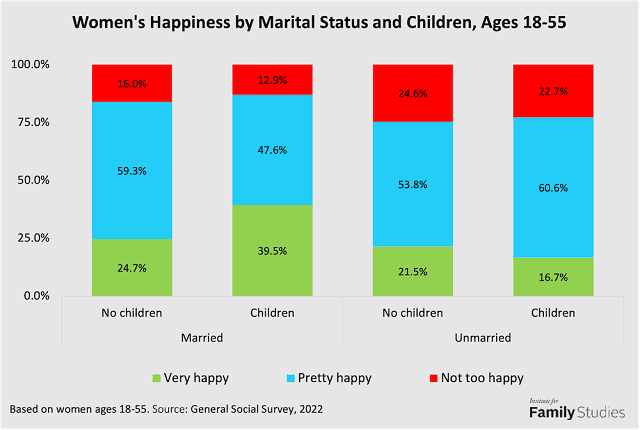
Data from the 2022 edition of the General Social Survey – what the Institute for Family Studies (IFS) calls “the nation’s preeminent social barometer” – shows that “a combination of marriage and parenthood is linked to the biggest happiness dividends for women.”  Leading IFS scholars Brad Wilcox and Wendy Wang add, “Among married women with children between the ages of 18 and 55, 40% reported they are ‘very happy,’ compared to 25% of married childless women, and just 22% of unmarried childless women.”

The happiness differentials for U.S. married mothers looks like this.

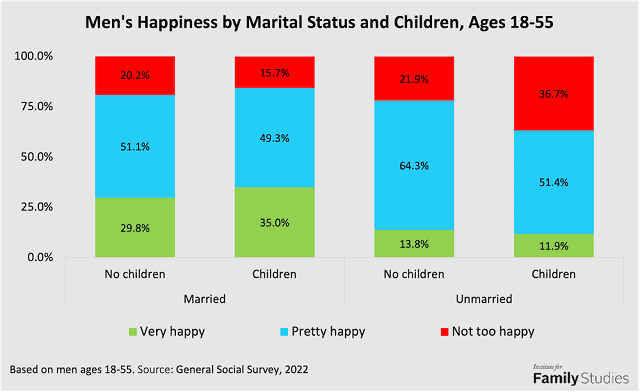
The happiness differentials for married fathers are similarly positive.

Wilcox and Wang explain,

By contrast unmarried childless men, and especially unmarried fathers are the least happy – with less than 15% of these men saying they are “very happy.” In other words, married men (ages 18-55) in America are about twice as likely to be very happy, compared to their unmarried peers.

Professor Clayton correctly observes at Public Discourse,

Children easily pour love into anyone around them, instantly expanding our hearts. If we stop being around children, it’s no wonder the American heart is closing. 

She is absolutely correct, concluding “Happiness is not an achievement; it’s a gift. Children are a blessing.” As the IFS scholars summarize, “As difficult as marriage and parenthood can be, in general, men and women who have the benefit of a spouse and children are the most likely to report that they are ‘very happy’ with their lives.”

Say “Yes!” to having children … and enjoy greater overall happiness.

Related Articles and Resources

Married Mothers and Fathers Are Happiest According to Gold-Standard General Social Survey

Why You Should Care About the Growing Positive Power of Marriage

Married Fatherhood Makes Men Better

Family Scholars Explain the Current Marriage Paradox in America

New Research Shows Married Families Matter More Than Ever

Important New Book Explains Why Marriage Still Matters

Research Update: The Compelling Health Benefits of Marriage

Important New Research on How Married Parents Improve Child Well-Being New Research: Marriage Still Provides Major Happiness Premium

Written by Glenn T. Stanton · Categorized: Family · Tagged: family, happiness, marriage

Mar 10 2025

Matt Walsh is Right: You Won’t Regret a Large Family

The Daily Wire’s Matt Walsh isn’t the type of person you’d characterize as a syrupy, sentimental, Mister Rogers-inspired soul.

A conservative provocateur, the popular podcaster, filmmaker and author has forged a reputation for his straight-forward, no-nonsense style of engagement. Whether it’s hosting his daily show or the blockbuster documentaries, What is a Woman? or Am I Racist?, Walsh isn’t afraid of stepping on toes or offending leftist sensibilities.

Then there are the unflattering profiles of him by mainstream outlets eager to discredit and undermine him. In many ways, these only seem to add fuel to his fire. Walsh seems to even enjoy the unhinged attacks. Adding to his public persona as something of curmudgeon is his own sass and crankiness.

But nobody is one-dimensional, and Matt Walsh is a lot more than just a conservative media sensation.

Married to Alissa since 2011, Matt and his wife have six children. He shared some thoughts about them over the weekend – sentiment that threatens to jeopardize his reputation as a garrulous grump.

Here’s what he wrote on Facebook:

Having a large family is the best. I know it won’t surprise you to hear me say that, since I’m certainly biased with six of my own. But I can tell you firsthand that there’s nothing like coming home to a house full of energy, laughter, and love. It’s chaos, sure. But it’s the best kind of chaos.
Just the other day, I walked in to find my 5-year-old daughter sitting at the counter, coloring in one of her princess books. The second she saw me, she dropped everything, jumped off her stool, and ran into my arms. My 8-year-old was in the other room, completely absorbed in some grand action figure battle. My 11-year-old son was outside practicing with his bow and arrow, my daughter was upstairs reading, and my 2-year-old twins were zooming around the house on their plastic cars, absolutely destroying the floors—but I don’t care. The house was alive.
I’ve lived both ways—coming home to an empty house and coming home to a full one. And I can tell you, without a doubt, the second option is so much better. It’s not even close. There’s a kind of joy, purpose, and meaning that only family can bring. And that’s true whether you’re rich or not. Kids don’t take away from your life, they make your life. If you have kids, have more. If you don’t, get to work. You won’t regret it.

What a wonderfully refreshing testimony to fatherhood and family. It’s the polar opposite of those who advocate for childlessness. Many of these ignorant and confused radicals often making the downright ridiculous claim that large families will somehow harm and strain the environment.

The campaign for fewer children or no children at all is predicated on the vicious lie that boys and girls are burdens. In fact, they are blessings.

“Children are a heritage from the Lord, the fruit of the womb a reward,” wrote the Psalmist. “Like arrows in the hand of a warrior are the children of one’s youth. Blessed is the man who fills his quiver with them! He shall not be put to shame when he speaks with his enemies in the gate” (Psalm 127:3-5).

In a world that embraces so many falsehoods like the anti-natalist movement champions, we’re in desperate need of men and women to marry and then have as many children as the Lord gifts to them.

Reading Matt’s post over the weekend, I was reminded of the beautiful words from another conservative radio icon, Ronald Reagan:

“There is no greater happiness for a man than approaching a door at the end of a day knowing someone on the other side of that door is waiting for the sound of his footsteps.”

Even better when those footsteps are those of a spouse and your many children.

Image credit: Matt Walsh

Written by Paul Batura · Categorized: Family · Tagged: family, marriage

Feb 13 2025

The Important Parenting Differences Between Moms and Dads

We know that mothers and fathers are fundamentally different when it to comes to creating children. Everyone knows that no one exists without a major contribution from a mother and a father. The difference in moms and dads is essential to successful procreation.

It’s an interesting contradiction that many people believe the difference in mom and dad ends there. They honestly believe there is no real meaningful difference between men and women when it comes to parenting. This is what is behind the simplistic and relativistic claim “Love makes a family!”

This assumption is contrary to an overwhelming body of careful medical, psychological and social science research on the importance of mothers and fathers to healthy child development.

Yale University’s Kyle D. Pruett is one of the leading scholars doing foundational work on mother/father differences in parenting. Writing in the medical journal Pediatrics in 1998, Professor Pruett explains that children, from earliest ages, can distinguish between whether it is their mother or father interacting with them and are drawn to either’s unique nature depending on their needs.

Babies aged seven to 13 months tend to respond more excitedly to being held by their fathers because father-love is simply more stimulating, thrilling and unpredictable.

Mother-love tends to be more predictable and soothing. This is essential for children’s development. Moms hold their babies for caregiving and comfort, while fathers are far more likely to pick up their children for play, using more verbal, facial, and physical stimulation.

Pruett explains the obvious difference, “Fathers’ typically larger size, deeper voice, courser skin, smell, physical attributes, and habits all combine to offer a distinctively different buffet of potential attachment behaviors.”

In more recent research, a systematic review of 31 separate research investigations on mom/dad parenting styles from over 15 countries around the globe, reports,

Our findings reveal that mothers as compared to fathers are perceived as more accepting, responsive, and supportive, as well as more behaviorally controlling, demanding, and autonomy granting than fathers…

This research also found that mothers and fathers were different in how they directed the behavior of their children, with mothers being more relational and fathers being more rule-based.

“These findings accord with the notion that in the context of child-rearing in the family, mothers play a more nurturing role while fathers play a more protective role.”

Dr. Natasha Cabrera, professor of human development at the University of Maryland, explains, “The research that I have been doing for the last twenty years now … what we observe is that fathers make a unique contribution to children’s development, which means it is not the same as moms’.”

She adds, “Moms, we do our thing, and dads do their thing and both things are super important for children’s development.”

Comfort, Confidence and Care

A major difference in what fathers and mothers bring to the lives of their children is the building of comfort and confidence, two essential qualities of healthy human development.

Fathers supply an indirect, but very real, sense of comfort by building confidence in their children. They do this in their unique orientation to the child. Mothers are generally more child-focused.

Fathers are different. They tend to have a world-child focus. Mothers are interested in protecting their child from the world. Fathers are more likely to introduce their child to the opportunities and challenges of the world. This prepares children for the world.

Therefore, father’s more expectant and broader interaction with the child has a very positive impact on a child’s ability to self-regulate in various challenging situation. This builds a sense of essential security that is distinct from how mom provides caring comfort.

Just consider how moms and dads are different in the importance of play.

Child’s Play is Serious Business

Erik Erikson, a pioneering child-development theorist, says that play for the child is the development of a sense of industry. They are imitating the adult world of work and accomplishment. This is essential to healthy development. While mother helps children play in the home at various tasks, it is father who helps his child really explore the larger outside world.

Think of a parent encouraging his child to climb higher in a tree or on playground equipment.

Run faster, jump higher or further, take risks. Is that likely to be mom or dad? We all know it’s dad. This encouragement builds confidence, physical skills and self-regulation. Dad helps the child take safe risks that often provide exciting payoffs. The challenging experience is usually followed by a congratulatory, hugely confidence-building “You did it!”

Both father and child are thrilled, while mother wonders why risk was necessary in the first place. It is very necessary.

Father-play is also more likely to develop large-motor-skills in their children, while mother-play operates more in fine-motor-skills. Think jumping, climbing, rolling, running and diving versus cutting, coloring, dressing, tying, eating and finger-play.

Throwing Babies

Think about babies being thrown in the air. It happens all over the world. We know a few things about this phenomenon. Babies are scared to death going up, but giggly excited when they land back in secure hands. This experience demonstrates the world can be scary, but it can also be exciting. That is why a child almost always yells “again!” after the experience.

The second thing we know is it is seldom mother who throws babies. Dads, uncles and grandfathers do this. And they are building confidence by introducing their children to controlled risk-taking experiences that result in exciting payoffs. This is an essential quality in secure, successful human beings.  

Language

Moms and dads are also different when it comes to language development.

One of the first things we do in relationship is we speak. We use words to connect. Nearly every new parent does two things at the arrival of their child, and these continue throughout that child’s life. They hold their new baby and speak to them. At birth, this is a profound moment. What parent doesn’t immediately look into their child’s opening eyes and naturally say, “Hello little one!” or “Welcome to the world ” and call out their name?

Professor Cabrera tells us, “One key example [of mother/father difference] is in language development.”

Back in the day, we would think that fathers talk to the children as adults, and that that’s bad. But in fact, what we find is that fathers talking to their children use complex and diverse words. That linguistic input is very important for children’s language development because fathers tend to be more linguistically challenging to their children than moms.

This is supported by other scholars who have studied the difference in mother/father communication with their children. Fathers tend to be more direct with their children in their requests, but are also more likely to ask compound questions, introducing many concepts for the child to consider. They don’t speak down to the level of the child as much. This builds confidence, critical thinking skills and a vocabulary lesson. This is why children who are well fathered tend to show up to school with richer linguistic skills.

Conclusion

Don’t let anyone ever tell you that mothers and fathers are essentially the same or optional for the family. They are not. Dr. Pruett, later in his career, explained in his book Partnership Parenting: How Men and Women Parent Differently,

… [R]esearch has shown just how important involved men are to raising healthy children, increasing the chance that they will be healthier emotionally and socially, strong cognitively and academically, and stable throughout their lifetime.

This is why he states, “Fathers are not substitute mothers.”

Kids need both mother and father to be created, but also to grow into healthy, productive human beings and citizens.

Related Articles and Resources

Important New Research on How Married Parents Improve Child Well-Being

Family Scholars Explain the Current Marriage Paradox in America

New Research Shows Married Families Matter More Than Ever

Important New Book Explains Why Marriage Still Matters

Why Marriage Really Matters – 3 Focus on the Family Reports

Reclaiming the Truth About Marriage

Research Update: The Compelling Health Benefits of Marriage

Brad Wilcox Exhorts Young People to ‘Get Married’

New Research: Marriage Still Provides Major Happiness Premium

Cohabitation Still Harmful – Even as Stigma Disappears

Don’t Believe the Modern Myth. Marriage Remains Good for Women

Don’t Believe the Modern Myth. Marriage Remains Good for Men.

Yes, Married Mothers Really Are Happier Than Unmarried and Childless Women

Married Mothers and Fathers Are Happiest According to Gold-Standard General Social Survey

Married Fatherhood Makes Men Better

Marriage and the Public Good: A New Manifesto of Policy Proposals

Written by Glenn T. Stanton · Categorized: Culture · Tagged: family, Random

Feb 10 2025

A New Agenda for Tech and Family

In Lewis Carroll’s Alice in Wonderland, Alice asks the Cheshire Cat, “Would you tell me please, which way I ought to go from here?”  

The wily cat replies, “That depends a good deal on where you want to get to.”  

Alice than says, “Well, as long as I get somewhere.”  

“Oh, you’re sure to do that,” the cat replies, “as long as you walk far enough.” 

The inseparable and essential relationship between the destination and the journey should be obvious, but it often isn’t. This is especially true of technology, which is progressing at a dizzying pace and taking us all along for the ride, often without a clear idea of where we’re going or why. 

From artificial intelligence to assisted reproduction to social media to automation to assisted suicide, new developments in technology are transforming how we live, love, communicate, procreate, and die. Few who are leading this technology seem willing or able to explain our destination. Is the purpose efficiency? Maximizing utility and pleasure? Making tech billionaires richer? With technology so pervasive and powerful, it’s essential to ask, like the cat, where society should go before deciding where it will go.  

A new project to explore how technological progress should serve human flourishing has united a stellar group of conservative leaders. A Future for the Family is asking where technology should take us. In a statement of principles that was just published in First Things, these leaders state: 

A new era of technological change is upon us. It threatens to supplant the human person and make the family functionally and biologically unnecessary. But this anti-human outcome is not inevitable. Conservatives must welcome dynamic innovation, but they should oppose the deployment of technologies that undermine human goods.  

The statement gives numerous examples. For instance, medical interventions in the form of IVF and surrogacy bypass the body in reproduction, turn vulnerable women into wombs-for-rent and commodify the smallest lives, often fatally. Technological efforts to control life and death have led to a slippery slope of euthanasia and assisted suicide on one hand, and a transhumanist quest for immortality on the other. Ever-expanding access to pornography and “digital prostitution” has turned sex into a product that propels addiction, predates on children, and corrupts essential relationships. And unchecked algorithms of social media have rewired children’s brains and hijacked their most vulnerable stages of development in the name of profit.  

In short, our technologies promise human connection and productivity while in actuality isolating users and placing us all under constant surveillance. This so-called “progress” has left life more disembodied, removing image bearers from the natural world, and making physical community and human contact an afterthought.  

The consequences have been especially terrible for the family, which is the institution most essential for human flourishing. Our technologies promise to redefine, renegotiate, and even redesign this fundamental aspect of how God made the world, but cannot deliver. “The triangle of truisms, of father, mother and child,” G.K. Chesterton wrote, “cannot be destroyed; it can only destroy those civilizations which disregard it.” 

Nothing could be more foolish than to place the future of families in the hands of tech companies whose sole motives are profit and efficiency. Good policy guidance, beginning at the federal level, is needed. This “Future for the Family” statement proposes ten sound principles to direct our technological journey. 

The list of signatories and organizations behind “A Future for the Family” is impressive to say the least. Together, these experts in policy, social science, family, and theology offer what has long been missing in the rush toward technological “progress.” This is a project Christians can celebrate, join, and support.  

Image from Shutterstock.

Written by John Stonestreet · Categorized: Culture · Tagged: family, Random

  • « Go to Previous Page
  • Page 1
  • Page 2
  • Page 3
  • Go to Next Page »

Privacy Policy and Terms of Use | Privacy Policy and Terms of Use | © 2025 Focus on the Family. All rights reserved.

  • Cookie Policy