• Skip to main content
Daily Citizen
  • Subscribe
  • Categories
    • Culture
    • Life
    • Religious Freedom
    • Sexuality
  • Parenting Resources
    • LGBT Pride
    • Homosexuality
    • Sexuality/Marriage
    • Transgender
  • About
    • Contributors
    • Contact
  • Donate

happiness

Jun 30 2026

Marriage and the Pursuit of Happiness

It is the greatest line Thomas Jefferson ever conceived, in the greatest document he ever penned:

We hold these truths to be self-evident, that all men are created equal, that they are endowed by their Creator with certain unalienable Rights, that among these are Life, Liberty and the pursuit of Happiness.

As our nation celebrates its 250th birthday, launched by the unparalleled greatness of the Declaration of Independence, it is important that we consider the unalienable rights our Creator equally endowed to all people. Jefferson listed life first, the right to be alive and to live one’s life. We also possess the right to live that life in liberty.

But what about this curious third right, “the pursuit of Happiness”?

Is “happiness” too cheap and transitory a value to be listed among “life” and “liberty” as foundational human values? The great Bob Dylan sure thought so. A reporter from Rolling Stone magazine asked him in 1991 on his fiftieth birthday if he was happy. He fell silent, stared at his hands and retorted, “You know, these are yuppie words, happiness and unhappiness” adding, “It’s not happiness or unhappiness, it’s either blessed or unblessed.”

Dylan then quoted the first line of the Psalms to the reporter, “As the Bible says, ‘Blessed is the man who walketh not in the counsel of the ungodly.’”

Yet, Jefferson was certainly not referring to a mere feeling of happiness, but something deeper. It is likely the Founding Father was inspired by George Mason’s Virginia Declaration of Rights penned just three weeks earlier, which guarantees “the enjoyment of life and liberty, with the means of acquiring and possessing property, and pursuing and obtaining happiness and safety.”

Years later, Jefferson wrote to a school master in Maine who asked for some irrefutable wisdom to pass on to his students. Citing Cicero’s Tusculan Disputations, Jefferson explained that there is no happiness without virtue. For Cicero stated, “It is certain that without virtue there can be no happiness” and as such, “a happy life is the consequence of virtue.”

For Jefferson and others in that era, this is what happiness meant. Not the pursuit of pleasure or a fleeting feeling, but the pursuit of virtue – a habit or trait that leads to goodness and human flourishing.

Few in the world today would consider marriage an important schoolhouse for learning virtue, but it certainly is. And the character-shaping nature of marriage leads to greater overall life happiness, especially when husband and wife have a serious faith. This is amply demonstrated in findings from the General Social Survey, the gold standard of sociological population research.

Wives who regularly attend church are more likely to report being “very happy” compared to their unmarried and secular peers, as demonstrated here.
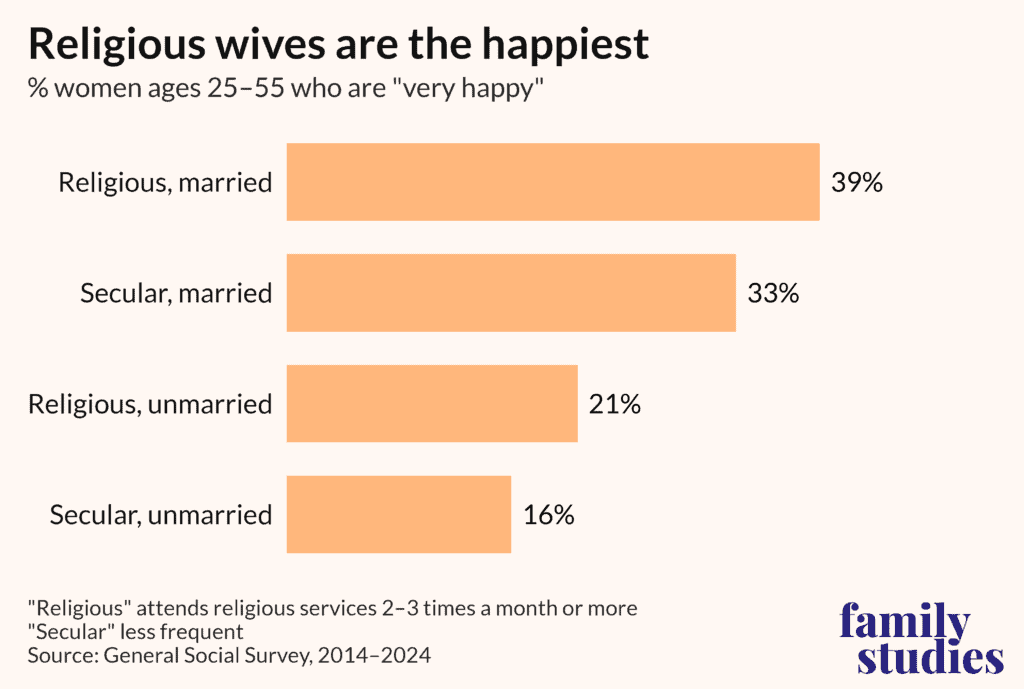
The Institute for Family Studies (IFS) recently reported that “religious, married women and men aged 25 to 55 are more than twice as likely to report being ‘very happy’ in life compared to unmarried religious counterparts.”

The happiness differentials for faithful married men look like this:
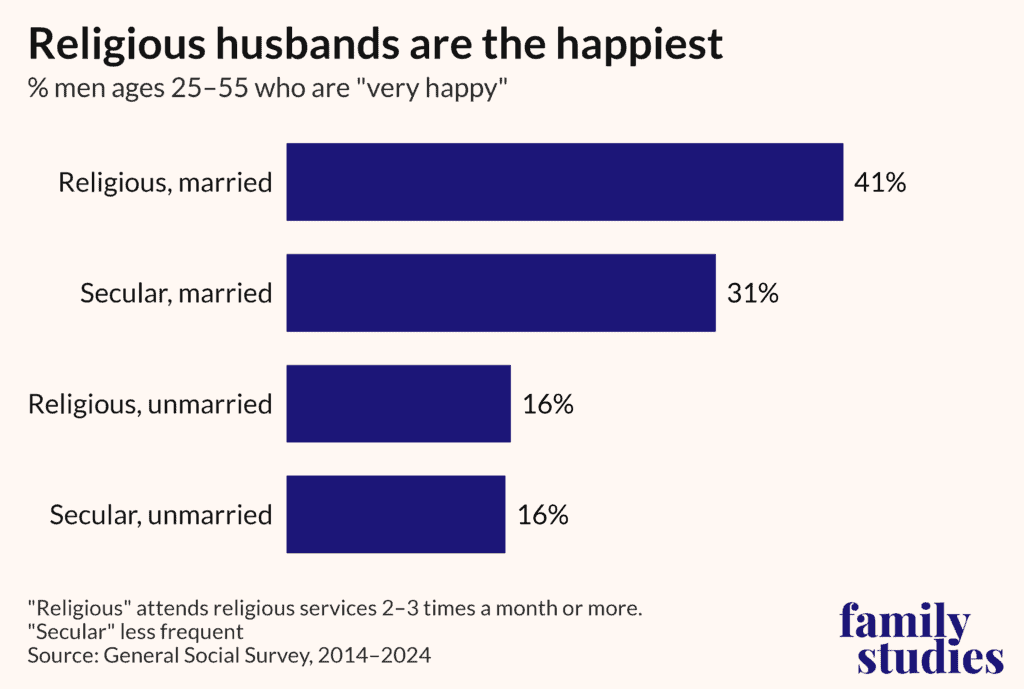
A 2025 IFS report on what life factors lead to strong, stable marriages explains:

Our analysis found that wives who attended church regularly with their husbands had odds of being very happy in marriage that were 112% higher than women who attended less often or not at all. For husbands, regular shared church attendance was associated with a 212% boost in their odds of being very happy in marriage compared with their less religious or non-religious peers.

The Daily Citizen has reported on recent research demonstrating the powerful happiness premium marriage provides for men and women. Professor emeritus Sam Peltzman of the University of Chicago found, “Being married is the most important differentiator with a 30-percentage point happy-unhappy gap over the unmarried.” This remains true when controlling for important socio-economic factors like age, race, sex, educational status, income and geographical location.

And this has remained consistently true across the decades when married men and women are compared to their cohabiting and single peers.
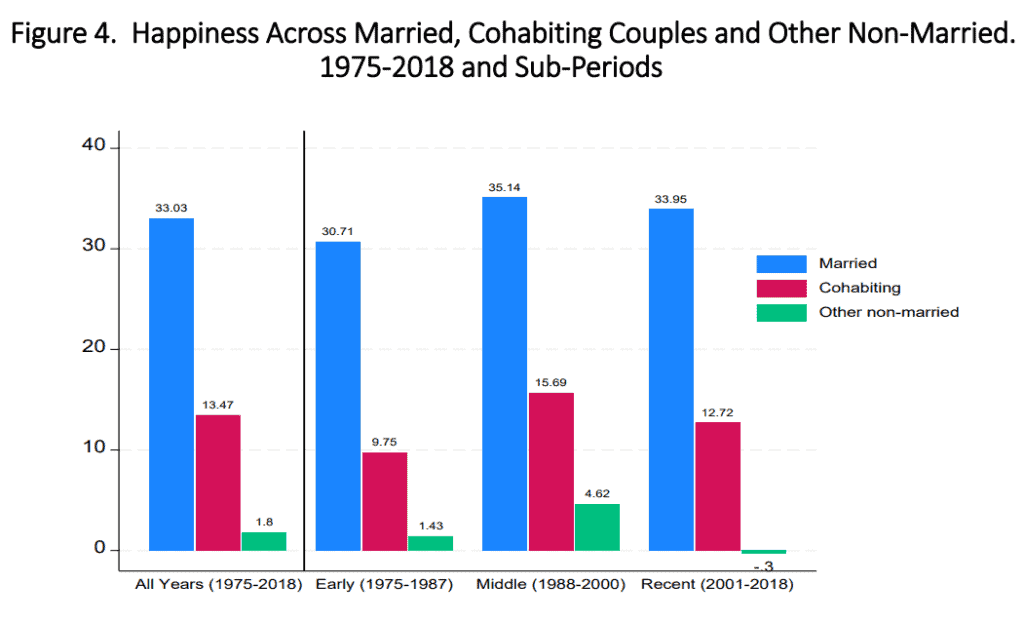
Marriage is a profound and consistent happiness boost. In fact, Peltzman calls it a “landslide.”

The happiness landslide comes entirely from the married. Low happiness characterizes all types of non-married. No subsequent population categorization will yield so large a difference in happiness across so many people.

Peltzman adds, “Conservatives are distinctly happier than liberals,” indicating married conservatives enjoy an even higher happiness dividend.

As we consider the wonderful founding of our nation and the opportunities the United States affords to so many for a better life, it is essential we appreciate how much faith and marriage contribute to our collective pursuit of happiness.
Written by Glenn T. Stanton · Categorized: Marriage · Tagged: happiness, marriage

May 13 2025

Is the Global Population Decline Linked to Happiness Decline?

It is clearly documented that global population is tanking in most parts of the world. Could this decline be related to declining happiness, worldwide? There is interesting data indicating this could be the case.

In a recent article over at Public Discourse, professor Margarita Mooney Clayton, who teaches practical theology at Princeton Theological Seminary, asks “What are the social implications of a world with fewer children?” It is important to note that we are having fewer children, largely below replacement level, not because of any outside force discouraging us. We are doing so by choice. We are choosing not to marry in greater numbers and increasingly putting education and career before producing the next generation of humanity. This comes with certain substantial costs, namely a threatened human future and declining overall happiness.

Professor Clayton explains,

As it turns out, the freedom to pursue our self-interest without the constraints of marriage and children does not lead to happiness. On average … research shows married people with kids are happier than their single and childless counterparts.

Daily Citizen has documented the research showing this fact over the past few years here, here, and here. There are other research-based indicators that children lead to greater happiness. In the Gallup research group’s 2025 World Happiness Report, they have a whole chapter on how growing families foster greater happiness globally. Their scholars state, “Happiness is nurtured in relational spaces and the family is at the heart of these connections.” They note that “two-parent households are associated with higher levels of life satisfaction among adult members, while adults living in single-person and single-parent households tend to experience lower levels of happiness.”

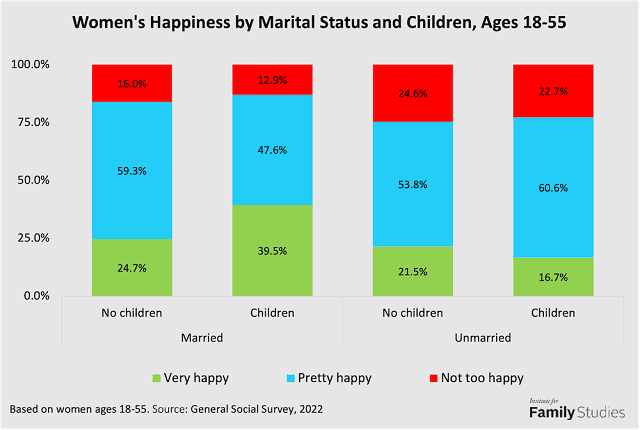
Data from the 2022 edition of the General Social Survey – what the Institute for Family Studies (IFS) calls “the nation’s preeminent social barometer” – shows that “a combination of marriage and parenthood is linked to the biggest happiness dividends for women.”  Leading IFS scholars Brad Wilcox and Wendy Wang add, “Among married women with children between the ages of 18 and 55, 40% reported they are ‘very happy,’ compared to 25% of married childless women, and just 22% of unmarried childless women.”

The happiness differentials for U.S. married mothers looks like this.

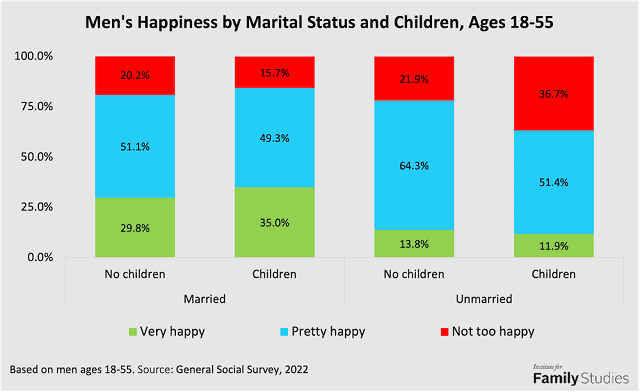
The happiness differentials for married fathers are similarly positive.

Wilcox and Wang explain,

By contrast unmarried childless men, and especially unmarried fathers are the least happy – with less than 15% of these men saying they are “very happy.” In other words, married men (ages 18-55) in America are about twice as likely to be very happy, compared to their unmarried peers.

Professor Clayton correctly observes at Public Discourse,

Children easily pour love into anyone around them, instantly expanding our hearts. If we stop being around children, it’s no wonder the American heart is closing. 

She is absolutely correct, concluding “Happiness is not an achievement; it’s a gift. Children are a blessing.” As the IFS scholars summarize, “As difficult as marriage and parenthood can be, in general, men and women who have the benefit of a spouse and children are the most likely to report that they are ‘very happy’ with their lives.”

Say “Yes!” to having children … and enjoy greater overall happiness.

Related Articles and Resources

Married Mothers and Fathers Are Happiest According to Gold-Standard General Social Survey

Why You Should Care About the Growing Positive Power of Marriage

Married Fatherhood Makes Men Better

Family Scholars Explain the Current Marriage Paradox in America

New Research Shows Married Families Matter More Than Ever

Important New Book Explains Why Marriage Still Matters

Research Update: The Compelling Health Benefits of Marriage

Important New Research on How Married Parents Improve Child Well-Being New Research: Marriage Still Provides Major Happiness Premium

Written by Glenn T. Stanton · Categorized: Family · Tagged: family, happiness, marriage

Privacy Policy and Terms of Use | Privacy Policy and Terms of Use | © 2026 Focus on the Family. All rights reserved.

  • Cookie Policy