
• Skip to main content
Daily Citizen
  • Subscribe
  • Categories
    • Culture
    • Life
    • Religious Freedom
    • Sexuality
  • Parenting Resources
    • LGBT Pride
    • Homosexuality
    • Sexuality/Marriage
    • Transgender
  • About
    • Contributors
    • Contact
  • Donate

marriage

Feb 28 2025

Four Things to Enhance Marital Happiness Among Wives

A recent study by the Institute for Family Studies and the Wheatley Institute reveals key factors that significantly enhance marital happiness among wives. The research indicates that four primary attributes in husbands – commitment, protectiveness, shared church attendance and regular date nights – lead to a much higher likelihood of wives reporting being “very happy” in their marriages.

Commitment

First, and perhaps not surprisingly, the study reveals that wives with committed husbands are 399% more likely to report being very happy in their marriages. This data point illustrates the importance of husbands demonstrating dedication to the marital relationship.

According to the report, four significant components of creating commitment in marriage are: a desire for a future together, the sense of being a team, prioritizing the relationship and sacrificing for one another. Commitment fosters trust and security in the marital relationship and is key to long-term satisfaction in marriage.

Protectiveness

Next, data indicates that wives are 137% more likely to report being very happy in their marriage if their husbands exhibit protective behaviors.

Researchers say this finding was an unexpected indicator of happiness. Protective was listed among other personal traits, including ambition, confidence, physical strength, being a good provider, being respectful, attractive, loving and sexually responsive.

Researchers believe that the term “protective” refers not only to a wife’s sense of physical safety but also to the sense of protection surrounding the relationship demonstrated through loyalty, faithfulness and fidelity. In a broad sense, protection reassures wives that their husbands are protective of the marital relationship, which leads to stability and happiness for wives.

Shared Church Attendance

Third, the study indicates that wives who attend church regularly with their husbands have a 112% higher chance of being very happy in their marriages.

Shared religious beliefs and practices provide couples with a common framework of values, which increases marital stability and a sense of meaning and purpose in their lives. Religious engagement also promotes virtues like forgiveness, compassion and love, which are very beneficial to the long-term health of marriages.

The study declares, “More often than not, the couple that prays together flourishes together.”

Researchers point out that marriage and family are a significant part of religious devotion in almost all world religions. Religion encourages prioritizing family and commitment in marriage, which are vital to healthy families and marriages.

In addition, the study suggests that shared religious activities help wives and husbands manage stress, deal with relationship challenges and positively focus on shared future hopes.

Regular Date Nights

Finally, the data indicates that wives who reported having regular date nights with their husbands were 56% more likely to be happily married. Interestingly, wives who reported regular date nights were 84% more likely to report feeling stability in their marriages.

Researchers suggest that the link between date night frequency and the feeling of stability in marriage reveals that date nights are one way women determine the quality of their marriage.

In addition, the report demonstrates that regular date nights lead to better communication, more commitment and greater sexual satisfaction.  

Checklist for Marital Happiness

So, if you are a husband looking to enhance your wife’s marital happiness and create a more fulfilling and stable relationship, consider incorporating these attributes into your marital life daily.

  • Demonstrate Unwavering Commitment: Prioritize the marriage and actively work through challenges together.
  • Be Protective: Offer support and reassurance, stand by your wife in times of need and faithfully protect your marital relationship.
  • Attend Church Together Regularly: Go to church with your wife and family, build a set of shared values and pray together.
  • Make Date Nights a Priority: Plan regular date nights and keep romance alive.

By embracing these behaviors, husbands can take the lead in building healthy and strong marriages.

Image from Shutterstock.
Written by Nicole Hunt · Categorized: Marriage · Tagged: marriage, Study

Jan 07 2025

Important New Book Explains Why Marriage Still Matters

The reasons why marriage still matters in a society where the institution seems to be declining as an ideal are, ironically, literally countless. Every way social scientists and other scholars know how to measure such things regularly demonstrates that marriage improves all important aspects of well-being for women, men, children and society as a whole.

In an effort to help document and explain this fact, two important Canadian scholars have just published a new book that is worth careful attention: I … Do? Why Marriage Still Matters. The authors, Andrea Mrozek and Peter Jon Mitchell, both with Cardus, a leading Canadian think tank, have long histories studying marriage as a social institution.

Their book, as they explain, “seeks to equip readers with the language and logic of marriage as a social institution that contributes to a flourishing, even and especially, for those who are nonreligious.” They explain that those who take faith seriously “have other theological underpinnings to lend color to the tapestry of life” but “nonreligious people who no longer get married are thus deprived of yet another source of meaning and stability in a transient world.”

They admit it “has become a cliché in certain circles” but their case is that family, established on the clarity of marriage, “is the building block of community and society.” Why? Because “family is the sine qua non of learning to live in community.” They continue, “Family is the primary place where children learn and are formed as people.”  Mrozek and Mitchell ask us to reflect on this. “We don’t often stop to ponder this point, but a stable and healthy home contributes to a healthy citizenry.” And marriage is what cements families together, better than any other social institution. Our authors explain, “Marriage continues to be relevant today, in part because it is focused on life beyond ourselves.” It is one of the only major social institutions to do so.

They ask, “How much evidence shows that married people tend to accumulate more wealth, enjoy better health and fulfillment, and their children experience better outcomes on a number of measures?” They answer, “At this point, quite a bit.” It’s true, and this finding is such a truism it has earned itself a name in academic circles. “These benefits have been termed the marriage advantage in the social sciences [emphasis in original].”

Boosting Fertility

Declining population is a very serious problem in most parts of the world today. But these authors explain “marriage and fertility remain firmly linked” and that fertility will not rise in any country if marriage rates continue to decline. They add, “Surveys show that women want to have more children than they are currently having, but under the right circumstances – marriage being a key factor.”

Andrea Mrozek, the lead author, explains the mission of their book here:

Mrozek and Mitchell close their book instructing us,

This book is ultimately an effort, using social-scientific research, to initiate a conversation about reimagining what marriage is and why it still matters. … The bottom line is we can no longer take marriage for granted. Public conversations about the benefits of marriage and the role family structure plays in well-being equip people with the knowledge to make their own informed choices and help public policymakers identify barriers to family formation.

Mrozek and Mitchell challenge us that “now more than ever, North Americans need to reimagine what a healthy marriage culture could look like in a pluralistic society.” Their important new book will go far in helping that happen. 

Related Articles and Resources

Reclaiming the Truth About Marriage

Research Update: The Compelling Health Benefits of Marriage

Important New Research on How Married Parents Improve Child Well-Being

How Marriage Fights Against Deaths of Despair

New Research: Marriage Still Provides Major Happiness Premium

Family Scholars Explain the Current Marriage Paradox in America

New Research Shows Married Families Matter More Than Ever

Why Marriage Really Matters – 3 Focus on the Family Reports

Brad Wilcox Exhorts Young People to ‘Get Married’

Cohabitation Still Harmful – Even as Stigma Disappears

Don’t Believe the Modern Myth. Marriage Remains Good for Women

Don’t Believe the Modern Myth. Marriage Remains Good for Men.

Yes, Married Mothers Really Are Happier Than Unmarried and Childless Women

Married Fatherhood Makes Men Better

Marriage and the Public Good: A New Manifesto of Policy Proposals

Written by Glenn T. Stanton · Categorized: Marriage · Tagged: marriage, Random

Dec 04 2024

How Marriage Fights Against Deaths of Despair

It has long been shown in the academic literature that marriage serves as a substantial buffer against numerous life factors that harm one’s health and as a powerful promoter of those things which enhance personal well-being.

This is true for men, women and children who have married parents, as well as society as a whole when marriage rates are strong in a community.

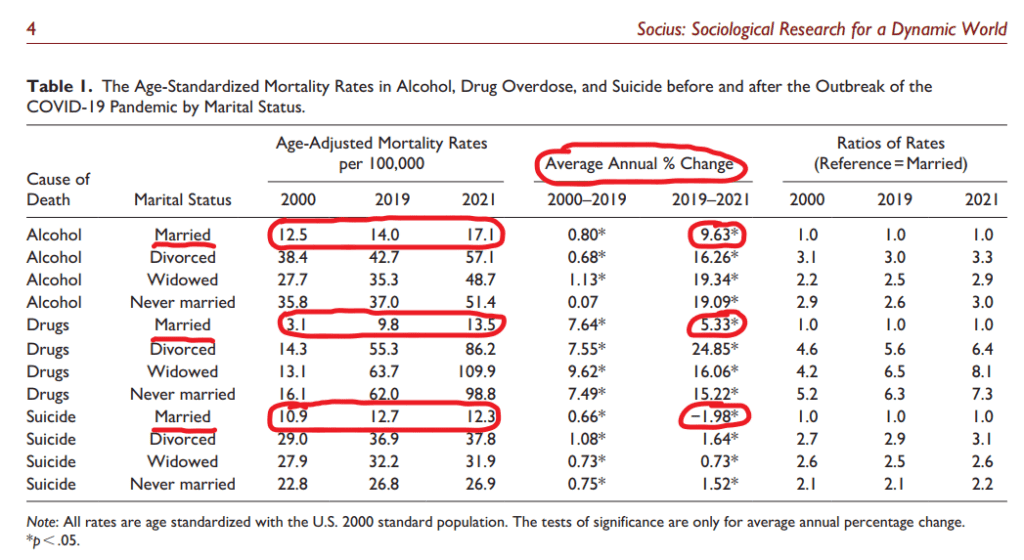
A new study published by the American Sociological Association examines how marital status impacts deaths of despair stemming from alcohol, drug overdose and suicide in the United States from the years 2000 to 2021.

The four scholars authoring this study explain “We found the nonmarried exhibit mortality rates 2 to 3 times higher in alcohol and suicide deaths and 4 to 5 times higher in drug-related deaths compared to the married population, net of education.” Those differentials are stunning.

They explain how powerful the marriage well-being premium is: “This magnitude of marriage advantage is comparable to educational differences in these deaths.” Marriage is as powerful as education in improving lives because it is an education. It teaches us to live well with others; and with ourselves.

Examining these three factors for life well-being is important as “the increase in mortality due to suicide, alcohol, and drug overdose has become the main factor leading to stagnation or decline in U.S. life expectancy over recent decades.” These scholars add “The marriage advantage widened substantially during the COVID-19 pandemic.”

As you can see in the second column of the graph below from this study, marriage was a profound protectant against deaths from alcohol, drugs and suicide across the board, but especially during the COVID years.

The third column, entitled Ratio of Rates, has married status as the baseline and shows how dramatically and consistently mortality rates are higher for divorced, widowed and never married individuals.  

Male/Female Differences

Marriage has been shown to benefit men and women when it comes to overall well-being, but it doesn’t do so equally.

This is because men and woman are different in dramatic and surprising ways. Marriage generally favors men because it settles them down, curtailing their more dangerous and less healthy behavior. This is a sociological truism.

This research demonstrates this. The authors state, “In fact, most of the deaths from alcohol, drug overdose, and suicide happened among males, and mortality increased faster among males than females in all three types of deaths.” But they add, “The marriage advantages are higher for males than females for alcohol- and drug-related deaths” and “the unmarried-married ratios are similar between males and females for suicide and that the absolute magnitude of mortality rates for females is substantially large [although still much lower than the males].”

General Conclusion

Beyond protecting from deaths of despair by alcohol, drugs and suicide, these scholars point out other important benefits of marriage:

More recent studies have shown that marriage establishes social norms and a sense of transcendental purpose/meaning of life, contributing to reducing risky and health-threatening behaviors and encouraging health-aware behaviors. The married population has been found to have lower levels of substance use, such as alcohol and drug use.

They continue,

Marriage also plays a crucial role in stress reduction and is a strong predictor of mental health outcomes, such as depression and anxiety. Furthermore, marriage provides economic benefits so that people can buffer stress and have better living conditions, better access to health services, and higher quality of care.

Marriage is a universal gift from God, a common grace given to humanity across all cultures and times. It is the first institution God gave to Adam and Eve, and humanity.

The Lord’s first command to humanity – to go forth and multiply – is also a marital command. No wonder social scientists who do good, honest work are discovering its benefits and publishing those findings in leading academic journals. They are simply observing and reporting on what God wired into humanity, whether they realize its source or not.

Related Articles and Resources

Family Scholars Explain the Current Marriage Paradox in America

New Research Shows Married Families Matter More Than Ever

Why Marriage Really Matters – 3 Focus on the Family Reports

Reclaiming the Truth About Marriage

Research Update: The Compelling Health Benefits of Marriage

Important New Research on How Married Parents Improve Child Well-Being

Brad Wilcox Exhorts Young People to ‘Get Married’

New Research: Marriage Still Provides Major Happiness Premium

Cohabitation Still Harmful – Even as Stigma Disappears

Don’t Believe the Modern Myth. Marriage Remains Good for Women

Don’t Believe the Modern Myth. Marriage Remains Good for Men.

Yes, Married Mothers Really Are Happier Than Unmarried and Childless Women

Married Mothers and Fathers Are Happiest According to Gold-Standard General Social Survey

Married Fatherhood Makes Men Better

Marriage and the Public Good: A New Manifesto of Policy Proposals

Image from Shutterstock.

Written by Glenn T. Stanton · Categorized: Marriage · Tagged: marriage

Nov 18 2024

The 4B Movement: Anti-Women, Accidentally Pro-Life

No dating. No marriage. No sex. No kids.

These are the four tenets of the 4B movement, a South Korean feminist initiative gaining traction among American women.

Originating almost a decade ago, 4B translates to no marriage (bi-hon), no childbirth (bi-chulsan), no dating (bi-yeonae) and no sex with men (bi-seksue). American women resurrected the movement after the election, accusing men of waging a war on women.

Or, more accurately, refusing to elect a pro-abortion candidate for president.

The American 4B movement collectively believes pro-life policies and candidates encroach upon women’s “right” to unlimited abortion access. Adherents blame these violations on men, whom it claims are inherent oppressors of women.  

Some converts see 4B as a way to punish their male overlords. Others hope decreasing birth rates will convince men to “protect women” — i.e. support abortion access — in future elections.  

Happily, by reducing extramarital sex, 4B followers are reducing abortions — and supporting the pro-life cause. 

The vast majority of abortions (95%) aren’t medically necessary. They occur because the baby is “unwanted or mistimed,” meaning the feels she mother cannot, or is unwilling to, care for her child.

These pregnancies primarily occur outside the confines of marriage, which provides critical economic and social infrastructure for raising children. This is evidenced, in part, by the advantages children raised in two-parent households experience over children from single-parent or cohabiting households.

Research compiled by sociologist Brad Wilcox and family studies scholar Alan J. Hawkins found children with married parents were far less likely to experience social and emotional problems like depression and far more likely to pursue higher education. According to Wilcox and Hawkins, these social disparities are only increasing.

Married families also experience more economic stability than single-parent or cohabiting homes. Wilcox and Hawkins found children with married parents four times less likely to experience poverty than those with single or unmarried parents. The findings echo those of economist Melissa Kearney, who writes,

On average, stable, married families enjoy markedly higher levels of financial security and resources than non-intact families.

Marriage socially and financially equips couples to have children. Outside this support system, pregnancy becomes a daunting obstacle many women choose to abort rather than face. If the 4B movement truly decreases extramarital sex, pro-lifers should be thrilled.

That being said, the 4B movement’s accidental protection of preborn babies doesn’t erase its ideological opposition to life and women.

That’s right — for all its feminist aspirations, the 4B movement is not pro-women. All available historical and sociological evidence suggest women thrive in partnership with men, not isolation from them.

Feminists have made this mistake before. In the 1960s and 70s, many predicted affordable birth control and abortion access, combined with better access to education and jobs, would increase women’s economic welfare.

Instead, many fell into poverty.

In 1978, Professor Diana Pearce, the director of the Center for Women’s Welfare at the University of Washington, wrote, “Poverty is rapidly becoming a female problem.”

Pearce noted this so-called “feminization of poverty” coincided with a 40%, single-generation jump in single mothers. But it wasn’t until the 1990s that Nobel Prize-winning economist George Akerlof connected the increase in women’s poverty to the disconnection of men from their reproductive responsibilities. Birth control and abortion, he posited, gave men no incentive to marry or support women they impregnated. The resulting decrease in “shotgun weddings” meant more single mothers and fewer economic prospects for women.

The “feminization of poverty” illustrated what would come to be a well-tested sociological phenomenon. Maggie Gallagher, a Yale-educated single mother turned pro-family researcher and activist, puts it this way:

Marriage is a powerful creator and sustainer of human and social capital for adults as well as children, about as important as education when it comes to promoting the health, wealth, and well-being of adults and communities.

Gallagher came to this conclusion in 2000. More than two decades later, Wilcox and Hawkins’ report confirms married men and women are economically, socially, mentally and even physically better off than their unmarried or divorced peers.

These benefits held up during one of the most economically and socially stressful periods in recent history — the pandemic.

According to the 2020 American Family Survey measuring women’s life satisfaction, married mothers were fare more likely to report being somewhat or completely satisfied with their life (83.55%) than childless women (60.75%), mothers (68.48%) and unmarried mothers (49.34%).

Married mothers also exceeded their peers in complete life satisfaction, with 38.52% reporting being completely satisfied compared to only 12.93% of childless women, 25.93% of mothers and 19.39% of unmarried mothers.

Gallagher says it best:

In virtually every way that social scientists can measure, married people do better than the unmarried or divorced: they live longer, healthier, happier, sexier and more affluent lives.

These benefits only accrue in partnership with men. By categorically ostracizing men as oppressive, the American 4B movement and its adherents reveal one of two things: either they don’t care about bettering women’s lives, or they have not seriously researched ways to do so.

Happily, 4B’s deeply misguided ideology doesn’t negate its pro-life benefits. If fewer women engage in premarital sex, fewer preborn children will be killed. And that’s always something to celebrate.

Additional Articles and Resources

Important New Research on How Married Parents Improve Child Well-Being

Family Scholars Explain the Current Marriage Paradox in America

Brad Willcox Exhorts Young People to ‘Get Married’

Cohabitation Still Harmful – Even as Stigma Disappears

Don’t Believe the Modern Myth. Marriage Remains Good for Women

Don’t Believe the Modern Myth. Marriage Remains Good for Men.

Myths Persist: Pop Culture Wrongly Steers Women Away From Marriage

Yes, Married Mothers Really Are Happier Than Unmarried and Childless Women

Married Fatherhood Makes Men Better

Marriage and the Public Good: A New Manifesto of Policy Proposals

Written by Emily Washburn · Categorized: Culture, Life · Tagged: feminism, marriage

Oct 28 2024

Young Person Explains Why Young People Aren’t Getting Married

Fair warning: If you are looking for an examination of marriage’s benefits or why it’s declining, this piece is not for you. Please read one of the articles linked at the bottom of the page.

If, however, you’re looking for an uncomfortably honest, completely anecdotal explanation of why the nice young men and women in your life aren’t getting hitched — I’m glad you’re here.

My name is Emily. I’m a twenty-something Christian with a college degree, a personality and the ability to make eye contact in conversation. For a long time, I assumed this would be enough to interest potential life partners. I entered the dating pool without artifice, looking for solid friendships and conversation that could eventually turn into something more.

That’s not how modern dating works. If you want to find a partner, you have to play the game — and the game is shaped by social media, dating apps and casual sex.

I am ill-equipped to play this game, a lesson I began learning in college when a fellow student asked for my Snapchat.

“I don’t have a Snapchat, but you can have my number!” I replied, much to his confusion.

Unbeknownst to me, I’d skipped several steps in a modern courtship ritual. When two people want to get to know each other better, they exchange social media accounts to communicate. Only when a relationship becomes more serious are phone numbers exchanged.

By prematurely offering my digits, I’d communicated an inappropriate amount of interest and completely freaked out my classmate. Safe to say he didn’t text me.

After this incident, I briefly obtained a Snapchat. Bad call. The app famous for its “disappearing” pictures is a favorite for sending nude pictures.

At first, I thought this was unique to one or two sleazy men. But I came to realize couples communicating over social media frequently exchanged explicit images, either as a precursor to a hook-up or a step toward making a relationship more serious.

I also learned that young people — particularly women — are expected to know that communicating on social media will result in some kind of proposition or unwanted image. People who send unsolicited images generally express surprise or confusion, rather than sheepishness, when their advances are (strenuously) rebuffed.

I think I deleted Snapchat within a month of downloading it. But it doesn’t change the impact social media, dating apps and casual sex had, and continues to have, on singles around me.

Most modern romantic interactions begin with the assumption that some sexual exchange will occur. Unless someone explicitly corrects this assumption, both parties interpret every word, look or gesture through this lens. If I had a nickel for every time I thought I’d made a genuine connection only to be aggressively propositioned and realize they didn’t remember my name — I’d have a lot of nickels.

The expectation of physicality comes, in part, from people’s expectation that romantic relationships form out of nothing. No longer do romantic relationships commonly spring from friendships. Single people turn to bars, dating apps and mixers to meet other people interested in a relationship. Outside these specific situations, romantic prospects are evaluated instantaneously (thank you, dating apps).

If none seem likely, the proverbial “dating glasses” come off. Singles in churches, offices and social groups stop looking for romantic relationships because they think they’ve already ruled them out.

This is the soup young people are swimming through. Many, including myself, frequently abstain from dating rather than mining for a genuine interaction in the muck.

There’s no quick solution to this problem; it’s the complex product of cultural attitudes toward sex and technology. But you can stop it from getting worse. Take time to understand the issue and show compassion to the twenty-somethings in your life. It’s wacky out here, and not all of us are lazy, spoiled or incompetent.

Additional Articles and Resources

Mapping Declining US Marriage Rates

Myths Persist: Pop Culture Wrongly Steers Women Away From Marriage

Family Scholars Explain the Current Marriage Paradox in America

Reclaiming the Truth About Marriage

Marriage Rates are Declining, But Christian Men and Women Still Very Likely to Get Married

No, Young Adults, Marriage Has Not ‘Outlived Its Usefulness’

Meta Takes Steps to Prevent Kids from Sexting

Written by Emily Washburn · Categorized: Culture, Marriage · Tagged: dating, marriage, opinion

  • « Go to Previous Page
  • Page 1
  • Page 2
  • Page 3
  • Page 4

Privacy Policy and Terms of Use | Privacy Policy and Terms of Use | © 2026 Focus on the Family. All rights reserved.

  • Cookie Policy