
• Skip to main content
Daily Citizen
  • Subscribe
  • Categories
    • Culture
    • Life
    • Religious Freedom
    • Sexuality
  • Parenting Resources
    • LGBT Pride
    • Homosexuality
    • Sexuality/Marriage
    • Transgender
  • About
    • Contributors
    • Contact
  • Donate

men

Dec 10 2025

New Research Shows Marriage and Fatherhood Regulate Male Sexual Energy

Did you know that when men marry according to God’s design and become fathers, nature is aligned in such a way that it lowers their testosterone (T) levels in helpful ways? Men with lower T tend to be more focused on their duties toward marriage and family as it lowers libido, aggression and infidelity risk. This increases nurturing behaviors and long-term pair-bonding. The Daily Citizen reported on this larger body of research last year.

But new research conducted by scholars from the University of Notre Dame have shown that this reduction in T induced by marriage and fatherhood remains for years, even decades and is maintained with the addition of more children into one’s family. A data graph from this study demonstrates that partnered men (P) with one or more children have the lowest T levels among peers in other familial settings or being single.
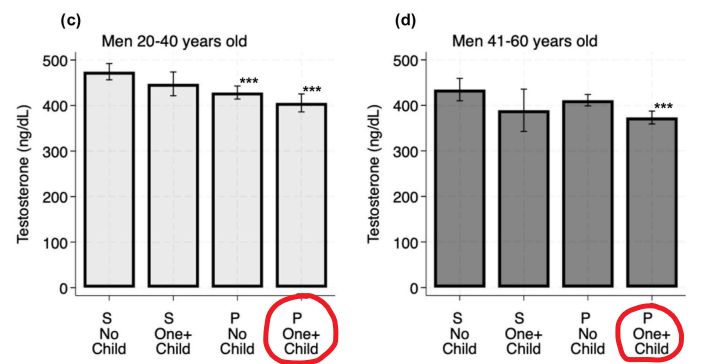
These scholars explain, “Specifically, we found that partnered men living with older children, particularly two or more, had lower testosterone than single men and partnered men not residing with children.” The effect size was notable. They add, “This is among the first evidence showing lower testosterone in … fathers with older children, specifically.”

They also explain, “In our analysis of young-to-middle aged U.S. men, we found that partnered men, including those residing with children, did not have increased risk of clinically-low testosterone compared to single men not living with children.” This means that T reduction for married fathers is at ideally helpful levels and not harmful to health and well-being.

These researchers explain that “fathers with lower testosterone engage in more nurturant, direct care of children and have higher quality relationships” with their wives.

There has been a good bit of research published on this question over the last 20 years.

A 10-year follow-up study of over one thousand 30 to 60-year-old men published in 2017 observed how T declined as men entered into marriage and lived as husbands, as opposed to just comparing married with unmarried men. These men were part of a long-term health survey in Denmark. The research team reports, “We observed that men who went from unmarried to married experienced the largest decline in circulating T levels over a ten-year period.” Men newly divorced experienced increased T levels as they found themselves back “on the market.”

A 2015 study in the journal Evolutionary Psychology found that outside of marriage “men in polyamorous relationships (with multiple committed partners) have greater levels of testosterone than those in monogamous relationships.” Wives settle men down, but multiple women as partners have the opposite effect. And the more permanent and long-term the relationship, the lower the T levels, compared to single men. This study also explains, “Further findings suggest that fathers have lower levels of testosterone than non-fathers independently of relationship status, and that pair-bonded fathers demonstrate lower levels than pair-bonded non-fathers.”

A 2011 study, conducted by the author of this new Notre Dame study, demonstrates how testosterone levels properly fluctuate for men through the life-course of seeking a mate, living as a settled-down married men, then as a father:

Using longitudinal data, these results demonstrate that high T not only predicts mating success (i.e., partnering with a female and fathering a child) in human males but that T is then greatly reduced after men enter stable relationships and become fathers.

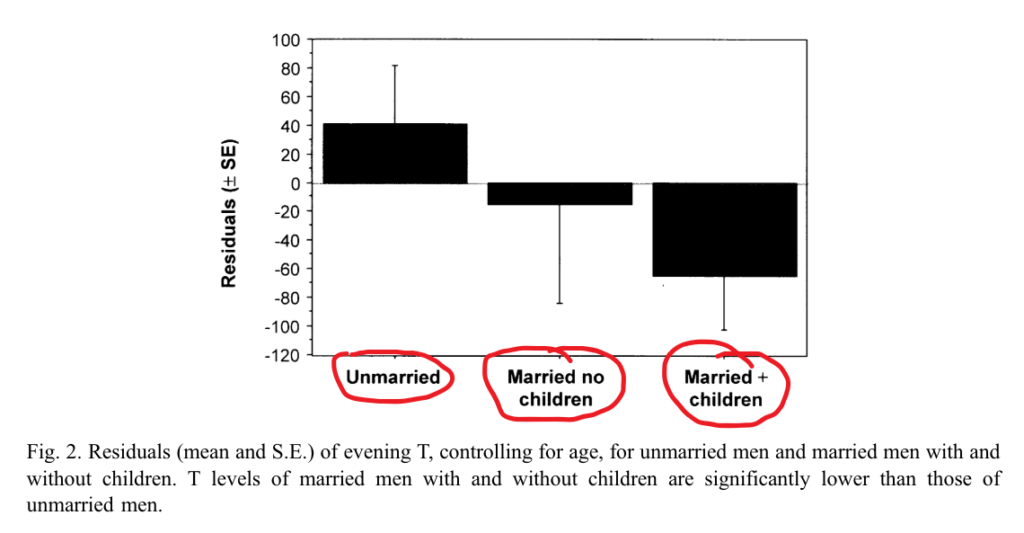
 One of the earlier efforts to study this phenomenon, a 2002 Harvard paper published in Evolution and Human Behavior, established that controlling for age, married fathers have markedly lower T levels compare to their unmarried peers and slightly lower levels compared to married men without children.

This chart shows the distinction:
In a 2006 Canadian study, investigators state bluntly that their data “suggests that the relationship between T and partner status is only seen in individuals who are interested in, and partner with, women.” Very interesting.

Men do not tend to settle other men down. Wives and mothers do this for men because female sexuality and biology are more family focused. George Gilder explains this in his critically important work, Men and Marriage: “The crucial process of civilization is the subordination of male sexual impulses and biology to the long-term horizons of female sexuality.”

This influential exchange between men and women is something that family health and longevity require. Research from leading universities around the world tell us this happens at a very intimate and invisible hormonal level between husband and wife.

We are indeed fearfully and wonderfully made.

Written by Glenn T. Stanton · Categorized: Marriage · Tagged: family, marriage, men, testosterone

May 19 2025

Are Government Policy and Culture Making Men Weak?

It has long been well-documented how men and male overall well-being is declining in America. Men have been increasingly dropping out of the workforce, dating, school, marriage and family formation, and out of public life in general.

A new article from the Institute for Family Studies (IFS) asks who or what is to blame for the increase in male malaise.

They blame a very culpable culprit: Uncle Sam.

A recent Wall Street Journal article asserts the same.

“Blame government, which showers benefits on able-bodied people who don’t work while at the same time subsidizing college degrees that don’t lead to productive employment. The result is millions of idle men and millions of unfilled jobs – what an economist would call a deadweight loss to society.”

The Journal says this has serious implications for family formation. “Single women might commiserate: A good worker, like a good man, can be hard to find these days.”

IFS states that in 1976, just 5% of young men ages 25 to 40 were not in the workforce. That number has more than doubled in 2024. They explain the problem is even worse for full-time employment among men, saying,

“Over the same period, the share of men in this age range not working full-time rose by 46%, such that now more than 1 in 5 men in this age group are not working full-time. In 2024, 3.8 million men ages 25 to 40 were not in the labor force, and a total of 7.8 million were not working full-time.”

This is an extremely troubling cultural and family indicator.

There is a striking difference for men when it comes to educational status. The increase in flight from work is up 79% among college educated men, but it is up a whopping 165% among less-educated men! IFS explains, “A large minority of young men who are not working, or who are working less than full-time, are collecting food or cash from the government.”

This robs young men of their motivation to branch out and fight to make an independent life for themselves, a key motivator that all young men need to earn their place in the world as an able-bodied contributor to society.

Anthropologist David D. Gilmore, in Manhood in the Making: Cultural Concepts of Masculinity, explains about one of the primary qualities of healthy manhood in society.

“Again and again we find that ‘real’ men are those who give more than they take; they serve others.” They are protectors and providers, not just of themselves, but of others … primarily of a wife and their children.

If a healthy young man is not married, he should put his energy into serving others through hard work and community service, by sacrificing himself through duty in the military, the church, to community volunteering or building a business or institution that creates necessary things and lifts others up.

But when government steps in and does these things for men, males lose their ambitious drive to do hard things, take chances, make their own way in the world and carve out a life for themselves and those who should be able to depend on them.

This motivational robbery is happening to men today on a massive scale. IFS notes that the 2024 Current Population Survey tells us that 31 to 40% of men aged 25-40 who are not employed full-time collected some form of cash or cash-equivalent assistance in the form of unemployment insurance, food stamps, Social Security disability, or Supplemental Security Income in the past year. This is true of a total of nearly 4 million men in America.

You cannot build a strong country and new, healthy families with facts like this.

Culture is to Blame, Too

IFS reports family break-down, video games, porn and cultural messaging are also to blame. Young men who grow up in a divorced or cohabiting family are 36% less likely to hold down a full-time in their mid-twenties compared to their peers in intact, healthy families.

Consumer culture is to blame as well. IFS founder Brad Wilcox explains in The American Conservative:

Many of the nation’s biggest business – from Alphabet (YouTube) to TikTok to Microsoft (Xbox) – are selling products that serve teenage boys and young men one dopamine hit after another. The problem with these products is they make school and work relatively less appealing, inhibiting the ability of many young men to develop the skills, ambition, and work ethic that would enable them to thrive in the twenty-first century economy.

What is more, Princeton economist Mark Aguiar and colleagues document that increased hours of screentime, primarily video games and porn, account for nearly half of the decline in hours of paid work for men in their twenties from 2004 to 2017.

Consider as well, a culture that is regularly telling young men their masculine energy is a “toxic” problem and that it serves society best by being kept in hiding. This has certainly led to the real cancer affecting masculinity today: passivity. Manhood must be publicly active. If it is not demonstrated in making life better, safer and more productive for others, authentic manhood does not exist.

If we hope to build a stronger nation and build new, thriving families, we must solve the motivation and employment problem among men. This is done by lifting boys and young men up, encouraging them to appreciate their strength and natural abilities, helping them find meaningful, contributory and ennobling employment in our society.

Boys grow into good men by working hard, learning essential skills, serving others and gaining a sense of significance and satisfaction in gainful employment that leads to a better future for them and all those around them.

Anything that prevents this is a serious detriment to society and the family.

Image from Shutterstock.

Written by Glenn T. Stanton · Categorized: Culture · Tagged: men, Random

Privacy Policy and Terms of Use | Privacy Policy and Terms of Use | © 2025 Focus on the Family. All rights reserved.

  • Cookie Policy