
• Skip to main content
Daily Citizen
  • Subscribe
  • Categories
    • Culture
    • Life
    • Religious Freedom
    • Sexuality
  • Parenting Resources
    • LGBT Pride
    • Homosexuality
    • Sexuality/Marriage
    • Transgender
  • About
    • Contributors
    • Contact
  • Donate

Random

Jun 18 2025

New Scholarly Fatherhood Report Offers Important New Insights

An important new research report from politically diverse scholars working from seven leading universities and think tanks explores the importance of fathers for healthy child development. The report’s scope focuses on the state of Virginia, but its implications are applicable across the nation and the world. It documents important ways fathers matter for child and societal well-being.

The report asserts, “A large body of research indicates that children who have the benefit of an engaged father are more likely to flourish.” And they flourish in every important measure of academic, physical, emotional and social well-being. University of Delaware scholar Rob Palkovitz explains early in the report,

Greater positive father involvement with young children tends to be associated with overall life satisfaction, happiness, and psychological well-being when offspring reach early adulthood and fewer behavioral problems for children and adolescents.

The report’s authors explain “Social scientists in recent decades have learned that the value of an engaged father extends well beyond his paycheck.” They add, “Their value derives in part from the fact that fathers often parent in distinctive ways.” This is because fathers, as males, parent differently. It is well-documented that fathers play differently, discipline their children differently, they protect them differently than mothers and they communicate differently. Each of these differences make essential and unique contributions to healthy child development.

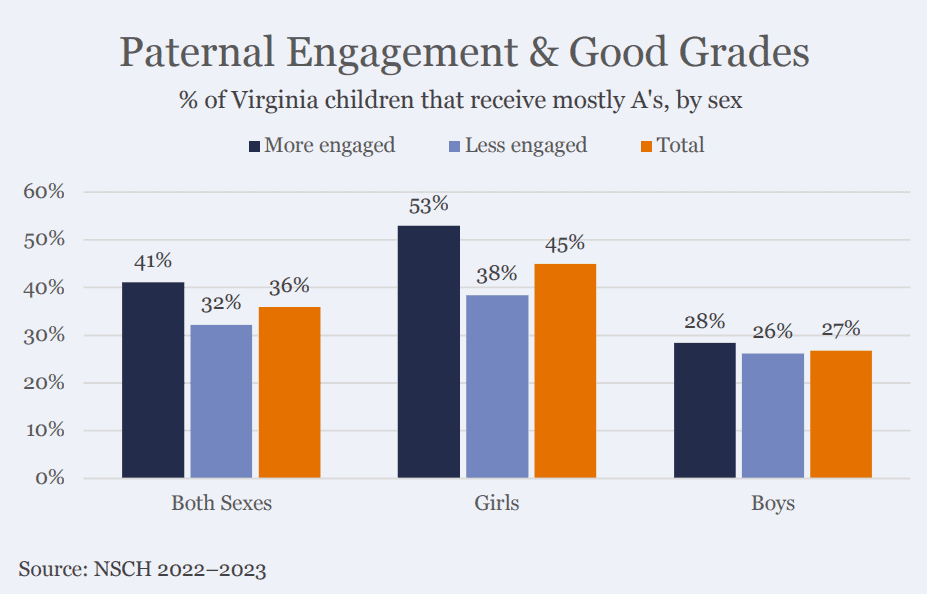
Father engagement has a measurable effect on children earning top grades in school. The following chart shows how fathers’ involvement boosts superior grade attainment for boys and girls.
Greater fatherhood engagement also has a dramatic impact in reducing depression in children.
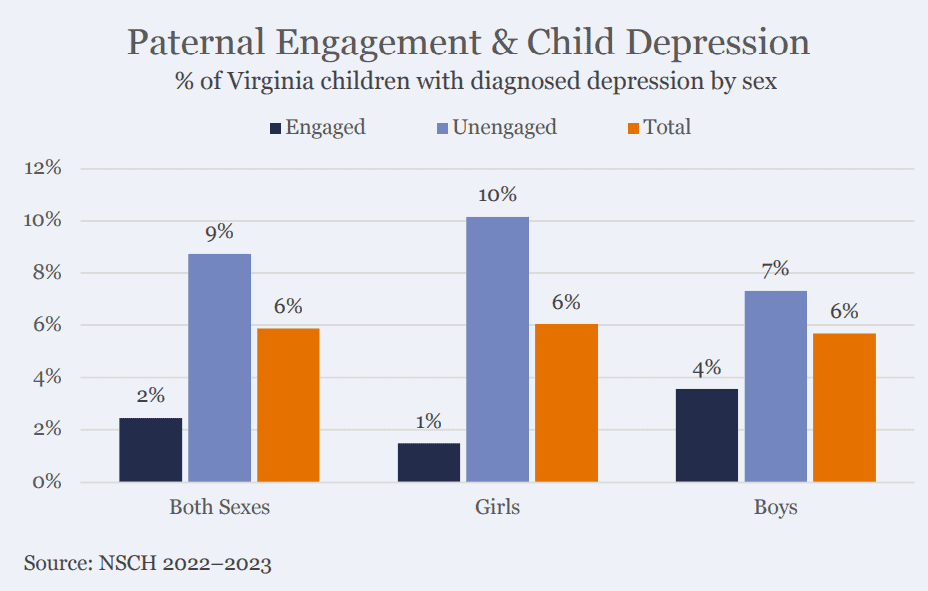
These scholars report,

When the association between paternal engagement and childhood depression is controlled for family intactness and demographic factors like race and parental education, the odds of a child being depressed are nearly four (3.7) times greater for children with uninvolved fathers as for those with highly engaged fathers.

What is more, fathers who live with their children and are married to their mother spend about 10 times more time with their children compared to kids with non-residential fathers.

Children living with their married mother and father are roughly five times less likely to be living in poverty compared to peers in fatherless families.

Minority Kids Benefit Even More

Data indicate both Black and Hispanic kids benefit more strongly from intact families and father involvement than White children do, as show in this graph.

Children living in homes where their mother is married to the father, creating a situation where dad is dramatically more likely to be involved in the lives of their children, translates into dramatic reductions in children ever experiencing or witnessing neighborhood violence. Of course, this is a marked positive indicator for child well-being.
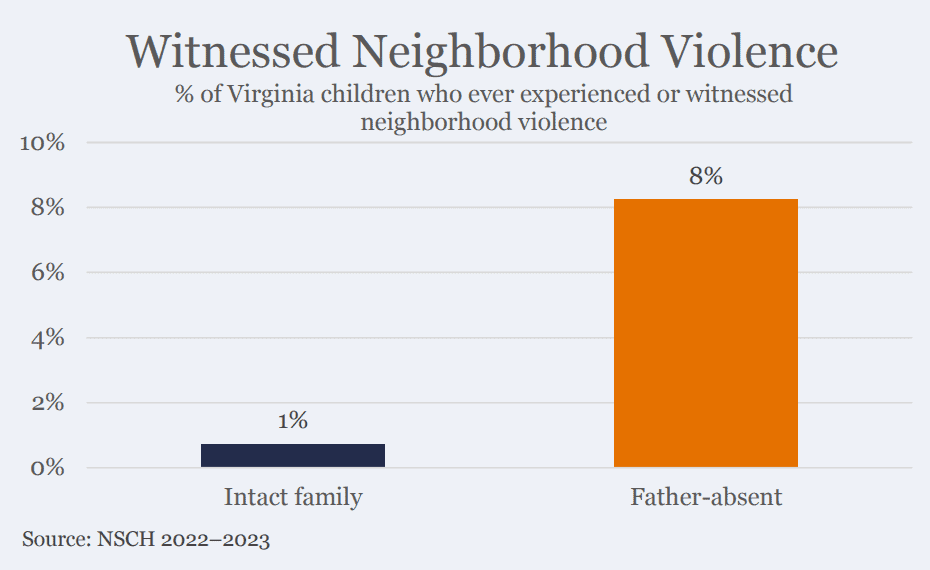
Scholars explain the power of this statistic:

After controlling for parent education, family income, race of child, immigrant status, and sex and age of child, the odds of exposure to violence were 10 times higher for children in father-absent homes, than for children with both parents present in the home.

Policy Recommendations

The report offers six policy recommendations they believe will help serve the promotion of fatherhood involvement and child well-being in the decades to come.

The first is making schools more boy friendly. Boys are falling behind girls in both grade school and college achievement. Correcting this means making all levels of education more appealing to boys’ imaginations, interests and learning styles. It also means seeking out more male teachers, especially in the earlier years. This is particularly important given the share of male K-12 teachers declined nationally from 33% in the early 1980s to 23% today. We must reverse this decline. We should also be more open to single-sex schools where boys can learn together as boys.

Schools should also teach the Success Sequence, a research-supported and relatively simple formula for nearly guaranteeing that no one ever lives poverty. Simply put, the Success Sequence requires three basic steps:

  1. Finish high school.
  2. Maintain a full-time job once you finish school.
  3. Get married before you have children and stay married.

A full 97% of youth who follow these steps will never be poor as adults. It works just as powerfully for minority youth and those from broken and impoverished homes.

Their second recommendation is creating a more positive culture of fatherhood and father involvement. This can be done through policy changes, public service announcements and greater overall education on the essential importance of dads being married to their child’s mother and involved in their kids’ lives.

The third recommendation is limiting access to pornography. The scholars’ reasoning is simple:

The near-universal availability of pornography has deformed countless boys’ conception of healthy relationships. Through pornography, young men are trained to enjoy violence, domination, and the objectification of the opposite sex as part and parcel of relationships and a future marriage and family life.

They are precisely right. We cannot form good fathers and a healthy marriage culture in porn-saturated society.

Their fourth proposal is what they call “reviving civic effort to promote prosocial masculinity.” This means countering the vile and corrosive idea that masculinity is inherently toxic and replacing that with vibrant examples of what healthy, prosocial masculinity looks like, helping more boys and young men become “responsible, respectful, and hard-working family men in the future.”

Their fifth proposal is to help all dads, regardless of racial, economic or educational background, flourish in the lives of their children. The related sixth proposal involves helping previously incarcerated fathers re-enter the lives of their children and maximize their positive influence on their sons and daughters.

Richard V. Reeves, a Brookings Institution scholar, president of the American Institute for Boys and Men and co-author of the report, says of fathers,

Dads matter. Fatherhood is a load-bearing wall—for healthy families, flourishing kids and for strong communities. For too long, the debate over fathers has focused too narrowly on financial issues, as if dads are little more than walking ATMs. But fathers are providers of love, time, energy and laughter as much as of money.

Focus on the Family applauds every effort to educate citizens on the importance of fatherhood. This helpful report furthers that work in important ways.

Related Articles and Resources

The Important Parenting Differences Between Moms and Dads

Married Fatherhood Makes Men Better

Important New Research on How Married Parents Improve Child Well-Being

New Research Shows Married Families Matter More Than Ever

Why Marriage Really Matters – 3 Focus on the Family Reports

Reclaiming the Truth About Marriage

Research Update: The Compelling Health Benefits of Marriage

New Research: Marriage Still Provides Major Happiness Premium

Cohabitation Still Harmful – Even as Stigma Disappears

Don’t Believe the Modern Myth. Marriage Remains Good for Women

Don’t Believe the Modern Myth. Marriage Remains Good for Men.

Married Mothers and Fathers Are Happiest According to Gold-Standard General Social Survey

Image from Shutterstock.

Written by Glenn T. Stanton · Categorized: Culture · Tagged: Random, Study

Jun 04 2025

Christianity Invented Childhood. It’s Time We Defend it Again

From infanticide to gender sterilization, history is repeating itself. The church must once again be the world’s fiercest protector of children.

This tweet sparked many thoughts for me this week.

“Pre-Christian Rome” was a world of child victimization. That’s what the early Christ-following church was born into. Abortion, infanticide, child castration, selling children, and child sexual abuse were common. Infant exposure, the practice of discarding illegitimate, disabled, or simply female babies, was routine. Children from poor families could be sold into labor or sexual exploitation. Eunuchs castrated in childhood, were in demand. Archaeologists often identify ancient brothels by the discovery of mass graves filled with male infants discarded for lacking market value.

Into this darkness came the gospel. Jesus Christ, who entered the world as a vulnerable infant, elevated the value of children. He welcomed them, blessed them, warned against causing them harm, and instructed His followers to become like them. The Apostle Paul even acknowledged the developmental differences of childhood. This was such a radical shift that some historians argue Christianity invented the idea of childhood by recognizing children’s full humanity and worth.

And Christians lived out this new vision. They opposed abortion. They rescued abandoned children. They rejected sexual exploitation and affirmed marriage as a protective sexual boundary. Their treatment of children helped distinguish them from the surrounding culture and fueled the spread of the faith.

But ancient evils are making a comeback.

The Return of Pagan Practices

Our society is not post-Christian. It is pre-Christian. We are watching a return to the same brutal attitudes toward children that defined the ancient pagan world.

Abortion is legal through birth in several states. Infants who survive botched abortions are left to die. Surrogacy allows babies to be conceived, bought, and separated from their mothers at birth. Reproductive technologies often exploit vulnerable women and create children who are intentionally deprived of a parent.

Children are being subjected to chemical castration and irreversible surgeries in the name of gender identity. Medical guidance now exists for minors who identify as eunuchs and seek surgical removal of their sex organs. This is not progress. It is a revival of ancient cruelty.

The Church Must Reclaim Its Role

The church must reclaim its historic role as the world’s foremost protector of children.

Christians already lead in adoption, but that is not enough. We must speak clearly and act boldly in defense of all children. Many pastors avoid these issues because they fear being seen as political. But silence in the face of child harm is not a virtue. It is surrender.

We must oppose abortion and care for both mothers and children. We must speak against surrogacy and donor conception that intentionally rob children of a biological parent. We must work to end the sterilization of minors disguised as medical treatment. We must fight against graphic sex education and sexualized content in schools. We must support laws that protect children’s innocence and dignity.

In the first century, Christians had no political power. Yet they transformed their society by living differently. Today, we have both a platform and a voice. We must use them to protect children from harm.

This Is Gospel Work

Modern society is once again at war with children. As in the days of the early church, Christians must lead in their defense.

This is not a distraction from the gospel. It is the gospel in action. Defending children is one of the clearest signs that the love of Christ is active and alive in His people.

To protect children is to follow in the footsteps of the earliest believers. This is our calling. This is our moment. We must not stay silent.

Let the church be known as the people who protect the little ones.

Written by Katy Faust · Categorized: Culture · Tagged: Katy Faust, Random

May 29 2025

Why the Ascension of Christ Matters

Today is Ascension Day, the day set aside in the church calendar to remember when Christ returned to the Father’s right hand in glory 40 days after His Resurrection. Ascension Day is still a public holiday in several European nations and marks the end of the Easter season. Most American Christians think of Easter as only a day and of Ascension Day as barely a blip on the calendar. 

However, in different times and places, Christians put a high priority on the Ascension. In the first few centuries of the Church, it was celebrated, along with Pentecost, as part of the Easter season. By the late fourth century, some believers observed it on its own with celebrations that included prayer and processions, as well as visual representations and reenactments. 

More importantly, Ascension Day is a pivotal event in the biblical story, foretold throughout Scripture. At the Ascension, Christ completed His work begun at the Incarnation, and promised long before to Adam, Abraham, David and Isaiah. The Ascension wasn’t merely Jesus leaving the Earth, but the God-man sitting in authority and power on His eternal throne. The Ascension is the coronation of Christ as King of heaven and earth. 

The Ascension also fulfilled prophecy, including  Psalm 2 and Psalm 110,  where the Anointed One of God, David’s Greater Son, puts His enemies under His feet. In the Apostle Peter’s Pentecost sermon, recorded in Acts 2, the Ascension is ultimate proof of Christ’s superiority. In Ephesians 4, the Apostle Paul described the Ascension as when Jesus equipped His people for their work. 

All of this makes the Ascension critical to the biblical narrative of how God redeems the world He created. The focus of Genesis 1-11 is the Creation, Fall, flood, and division of this world. Genesis 12 turns the attention of Scripture to one nation through whom redemption comes. Jesus Christ is sent to that nation, and His ministry offers glimpses of His redemption going outside of Israel, for example to the Syrophonecian woman, the Samaritans and the Roman Centurion. Just before He ascended to heaven, Jesus turned the attention of the Apostles and the biblical narrative back to the whole world when He said, “you will be my witnesses in Jerusalem and in all Judea and Samaria, and to the end of the earth.” The books of Acts follows that outline. In his Pentecost sermon, recorded in Acts 2, Peter describes the Ascension as proof of Christ’s reign and the source of His blessing. 

Ascension Day is a wonderful time to remember essential aspects of Christ’s work that are too often neglected. Yes, Jesus came to save people from their sin, and we should never allow the reality of that gift to be lost in our church teaching and practice. We should also remember that Christ’s work is cosmic in scope, with public implications that extend beyond the personal and private. The Christian life is not some kind of extended waiting room for the real action of the End Times. As theologian NT Wright has described: 

The mission of the Church is not about preparing for Jesus to become king. It is implementing the fact that he has become king, even if that new kingship doesn’t look like the sort of thing people had been expecting. … This is why the disciples, faced with Jesus going away, are not sorrowful, but joyful. Jesus is now lord of the world! He is now in charge! That’s the good news! The one whose resurrection has launched the new creation, following his defeat of evil on the cross, is now ruling the world! 

Whatever specifics the End Times entail, there is an already-ness to Jesus’ rule, even as we wait for what is yet-to-come. We’re not waiting for His kingdom to begin. It has begun. He is the King; His rule is in place; and He is making all things new. That’s why the Ascension matters. 

Written by John Stonestreet · Categorized: Culture · Tagged: Evangelism, John Stonestreet, Random

May 19 2025

Are Government Policy and Culture Making Men Weak?

It has long been well-documented how men and male overall well-being is declining in America. Men have been increasingly dropping out of the workforce, dating, school, marriage and family formation, and out of public life in general.

A new article from the Institute for Family Studies (IFS) asks who or what is to blame for the increase in male malaise.

They blame a very culpable culprit: Uncle Sam.

A recent Wall Street Journal article asserts the same.

“Blame government, which showers benefits on able-bodied people who don’t work while at the same time subsidizing college degrees that don’t lead to productive employment. The result is millions of idle men and millions of unfilled jobs – what an economist would call a deadweight loss to society.”

The Journal says this has serious implications for family formation. “Single women might commiserate: A good worker, like a good man, can be hard to find these days.”

IFS states that in 1976, just 5% of young men ages 25 to 40 were not in the workforce. That number has more than doubled in 2024. They explain the problem is even worse for full-time employment among men, saying,

“Over the same period, the share of men in this age range not working full-time rose by 46%, such that now more than 1 in 5 men in this age group are not working full-time. In 2024, 3.8 million men ages 25 to 40 were not in the labor force, and a total of 7.8 million were not working full-time.”

This is an extremely troubling cultural and family indicator.

There is a striking difference for men when it comes to educational status. The increase in flight from work is up 79% among college educated men, but it is up a whopping 165% among less-educated men! IFS explains, “A large minority of young men who are not working, or who are working less than full-time, are collecting food or cash from the government.”

This robs young men of their motivation to branch out and fight to make an independent life for themselves, a key motivator that all young men need to earn their place in the world as an able-bodied contributor to society.

Anthropologist David D. Gilmore, in Manhood in the Making: Cultural Concepts of Masculinity, explains about one of the primary qualities of healthy manhood in society.

“Again and again we find that ‘real’ men are those who give more than they take; they serve others.” They are protectors and providers, not just of themselves, but of others … primarily of a wife and their children.

If a healthy young man is not married, he should put his energy into serving others through hard work and community service, by sacrificing himself through duty in the military, the church, to community volunteering or building a business or institution that creates necessary things and lifts others up.

But when government steps in and does these things for men, males lose their ambitious drive to do hard things, take chances, make their own way in the world and carve out a life for themselves and those who should be able to depend on them.

This motivational robbery is happening to men today on a massive scale. IFS notes that the 2024 Current Population Survey tells us that 31 to 40% of men aged 25-40 who are not employed full-time collected some form of cash or cash-equivalent assistance in the form of unemployment insurance, food stamps, Social Security disability, or Supplemental Security Income in the past year. This is true of a total of nearly 4 million men in America.

You cannot build a strong country and new, healthy families with facts like this.

Culture is to Blame, Too

IFS reports family break-down, video games, porn and cultural messaging are also to blame. Young men who grow up in a divorced or cohabiting family are 36% less likely to hold down a full-time in their mid-twenties compared to their peers in intact, healthy families.

Consumer culture is to blame as well. IFS founder Brad Wilcox explains in The American Conservative:

Many of the nation’s biggest business – from Alphabet (YouTube) to TikTok to Microsoft (Xbox) – are selling products that serve teenage boys and young men one dopamine hit after another. The problem with these products is they make school and work relatively less appealing, inhibiting the ability of many young men to develop the skills, ambition, and work ethic that would enable them to thrive in the twenty-first century economy.

What is more, Princeton economist Mark Aguiar and colleagues document that increased hours of screentime, primarily video games and porn, account for nearly half of the decline in hours of paid work for men in their twenties from 2004 to 2017.

Consider as well, a culture that is regularly telling young men their masculine energy is a “toxic” problem and that it serves society best by being kept in hiding. This has certainly led to the real cancer affecting masculinity today: passivity. Manhood must be publicly active. If it is not demonstrated in making life better, safer and more productive for others, authentic manhood does not exist.

If we hope to build a stronger nation and build new, thriving families, we must solve the motivation and employment problem among men. This is done by lifting boys and young men up, encouraging them to appreciate their strength and natural abilities, helping them find meaningful, contributory and ennobling employment in our society.

Boys grow into good men by working hard, learning essential skills, serving others and gaining a sense of significance and satisfaction in gainful employment that leads to a better future for them and all those around them.

Anything that prevents this is a serious detriment to society and the family.

Image from Shutterstock.

Written by Glenn T. Stanton · Categorized: Culture · Tagged: men, Random

May 08 2025

We’ve Seen the Dire Wolf Movie and it Doesn’t End Well

Recently, Time magazine announced that the biotechnology company Colossal has resurrected the dire wolf, a species that went extinct thousands of years ago. “This is Remus,” read the caption over a photo of a robust-looking white wolf. “He’s a dire wolf. The first to exist in over 10,000 years.” According to Colossal, this is a first step to resurrecting other long-extinct animals, like the woolly mammoth. 

As it turns out, the headline is an exaggeration. Remus, his brother Romulus, and their sister Khaleesi contain no DNA from the dire wolf. Rather, they are modern gray wolves with genes tweaked by the company to mirror the DNA of the dire wolf. And they were more than likely engineered to look like the fictional giant wolves from HBO’s Game of Thrones.

The most common comment on the Time story was some variation of the sentiment, “I’ve seen this movie, and it doesn’t end well.” Most people likely had in mind Jurassic Park, in which a company uses genetic technology to bring back dinosaurs. Spoiler alert, it doesn’t end well. In fact, the seventh installment of the franchise will release this summer, each containing the same message as the 1993 original: Just because we can do something doesn’t mean we should. 

Dozens of movies reflect the dangers of genetic tinkering, human reengineering, and other forms of scientific hubris. From The Island of Dr. Moreau to Gattaca to Planet of the Apes to The Island, not to mention about half of all zombie movies ever made, we’ve been thoroughly warned about the illusion of human control over nature.  

Maybe this is just the story of directors sprucing up a plot, or perhaps a surprising amount of wisdom in the arts has been overlooked or ignored by scientists and tech pioneers. A popular meme from Twitter quotes an imaginary science fiction author saying, “In my book, I invented the Torment Nexus as a cautionary tale,” immediately followed by a tech company exec announcing: “At long last, we have created the Torment Nexus from classic sci-fi novel Don’t Create The Torment Nexus.” Even more, there is a strange disconnect between pop culture’s ability to anticipate the negative consequences of our scientific advances and our overall willingness to volunteer as guinea pigs.  

This is as true for Artificial Intelligence as for medical technology. From 2001: A Space Odyssey to A.I. to Terminator to I, Robot, to Avengers: Age of Ultron, we’ve been warned about AI. Wall-E warned how we’d lose our humanity if we relied on technology to solve all our problems. Ready Player One warned against getting lost in virtual reality. Children of Men depicted what would happen if society stopped having enough babies. Minority Report questioned the justice of a surveillance state.  

What all these movies have in common is that their warning has been ignored in the real world. People will jokingly say, “I’ve seen this movie, and it doesn’t end well,” but we continue to adopt every new technology that promises comfort, convenience, and control without a serious discussion about purpose or boundaries.  

Even when the warnings aren’t exactly accurate or even realistic, these films often raise questions worth asking. And yet, our curiosity wanes once the credits roll. As in the Terminator movies, artificial intelligence continues to gobble up vast areas of life and human creativity without much protest. And despite all the Jurassic Park references, Colossal’s wolves will likely be the first of many bioengineering projects that prioritize profit and publicity over the welfare of animals or humans.  

You won’t hear me say this often, but it’s time to pay closer attention to Hollywood. Despite the garbage that comes from the entertainment industry, there’s a willingness to question “progress” that is lacking at MIT, medical labs, and Silicon Valley. 

C.S. Lewis wrote that reason is the organ of understanding, and imagination is the organ of meaning. We need both, which is why we should listen when someone asks, even in film, “What could go wrong?” Asking whether we should do something is a skill that should not be extinct.

Written by John Stonestreet · Categorized: Culture · Tagged: John Stonestreet, Random

  • « Go to Previous Page
  • Page 1
  • Interim pages omitted …
  • Page 8
  • Page 9
  • Page 10
  • Page 11
  • Page 12
  • Interim pages omitted …
  • Page 17
  • Go to Next Page »

Privacy Policy and Terms of Use | Privacy Policy and Terms of Use | © 2025 Focus on the Family. All rights reserved.

  • Cookie Policy