• Skip to main content
Daily Citizen
  • Subscribe
  • Categories
    • Culture
    • Life
    • Religious Freedom
    • Sexuality
  • Parenting Resources
    • LGBT Pride
    • Homosexuality
    • Sexuality/Marriage
    • Transgender
  • About
    • Contributors
    • Contact
  • Donate

Random

Nov 11 2025

The ‘Times’ Lets Two Conservative Women Critique Modern Feminism

Last week, The New York Times of all places gave two very smart conservative women an open microphone and one hour to passionately debate and critique modern feminism.

The event was hosted by columnist Ross Douthat on his “Interesting Times” podcast,  joined by Helen Andrews and Leah Libresco Sargeant. This discussion was launched because both women have written important new pieces offering distinct critiques of modern feminism.

Helen Andrews, a former senior editor at The American Conservative, caused a much-needed firestorm with her excellent article over at Compact magazine, entitled, “The Great Feminization,” in which she provocatively argues that “the pathology in our institutions known as wokeness is distinctively feminine and feminized.”

Leah Libresco Sargeant has just published a new book, entitled, The Dignity of Dependence, which makes the case for the unique strengths of being unapologetically woman. On the first page of her book, Sargeant posits, “When a woman’s capacity exceeds that of a man through her ability to bear life within her, her fertility is treated as disruptive – a problem to be contained.” She is pressured to become more male-like in her abilities and sensibilities.

Ross Douthat opens the discussion with this obvious statement, “Men and women are really different.”  He follows that with one of the most important questions we must ask, “But what do those differences mean?” What Douthat is overseeing here is a spirited conversation, a debate actually, between what he describes as two “conservative writers, both critics of feminism, but they have very different views of what a right-wing politics of gender should look like.”

The bottom line in this debate between these two women is they are disagreeing on their observations of the very real problems that modern feminism has wrought. They disagree with each other in this exchange, not on principle, per say, but on perspective.

They are both talking about the serious harms feminism has brought to important social institutions. Helen Andrew’s interest is the damage it brought to politics, the workplace, and the softer sciences of academia resulting in wokeness and hypersensitivity. Sargeant’s interest is in the harms feminism brought to family and home and how it encourages women to deny their femininity and act more like men when it comes to sexuality, fertility and labor.

While Andrews is speaking of the pathology of these things, Sargeant is speaking of the virtue of femininity, motherhood and that fact that family demands no small measure of dependence on one another. It also requires the soulful cooperation between husbands and wives, fathers and mothers as sex-distinct partners.

It truly is a strange thing to see an outlet like The New York Times host two conservative women talking about the objective natures and virtues of men and women and how the erasure of these truths and their complementarity has harmed so much that matters.

You can watch the whole interview here:
Written by Glenn T. Stanton · Categorized: Culture · Tagged: Random

Nov 06 2025

‘Glamour’ Awards Men ‘Women of the Year’

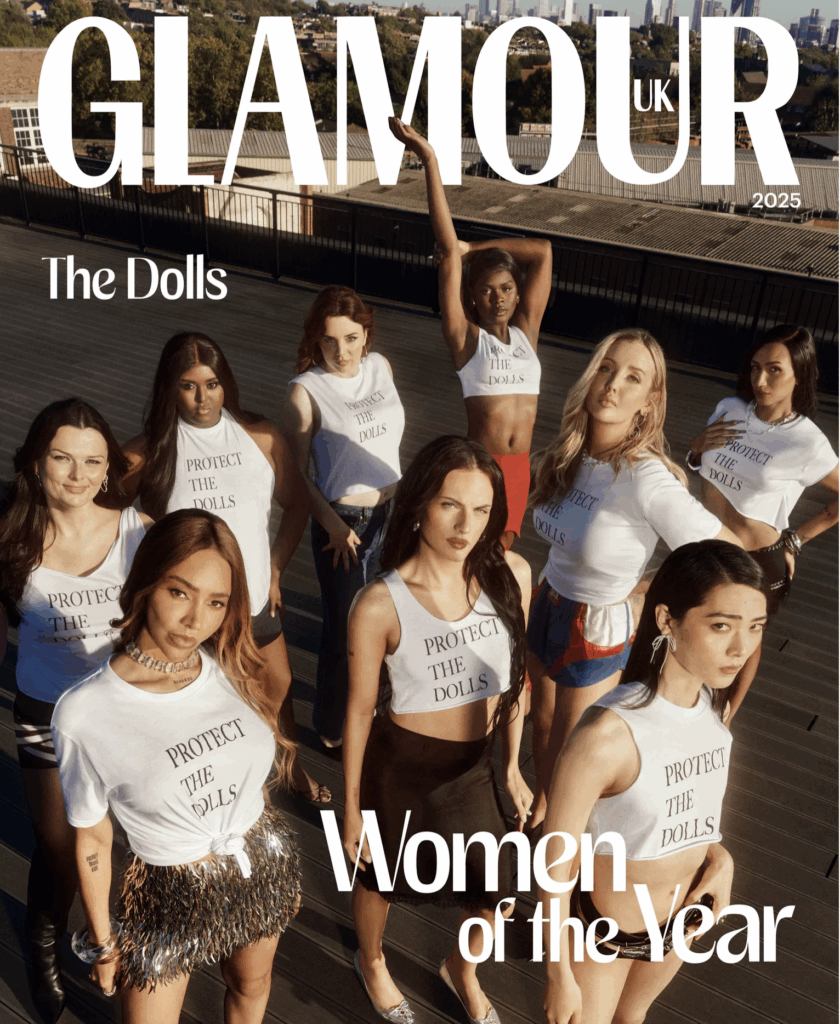
Glamour Magazine UK recently awarded nine men Women of the Year 2025. Not a one of them is an actual woman, but the editors gave them the ridiculous cover title, “The Dolls.”

Yes dolls, as in fake, make believe girls.

Strangely, each of the men are wearing “Protect the Dolls” T-shirts accentuating their skimpy teen girl outfits.

The article announcing Women of the Year informs us, “‘Protect the Dolls’ is a positive sentiment but … we must all ask ourselves what does protection entail?”

They answer it with this mind-blowing question, “What does it look like in a society so utterly consumed with the degradation of a group of women who are often struggling to make ends meet, to get the healthcare they need and to try and pursue lives that contain at least some capacity for happiness and joy?”

Do the Glamour editors not appreciate the vast irony? Glamour is 100% denigrating women by lauding nine biological men, who are seeking praise their so-called bravery in masquerading as women. The “healthcare they need” is medicating and cutting their perfectly healthy male bodies to mimic women.

J.K. Rowling had the best take on this madness, stating on X,

I grew up in an era when mainstream women’s magazines told girls they needed to be thinner and prettier.

Now mainstream women’s magazines tell girls that men are better women than they are. pic.twitter.com/ybEFr8XdSv

— J.K. Rowling (@jk_rowling) October 30, 2025

She is precisely right.

But it’s not the first time a magazine awarded men women of the year. USA Today infamously awarded a man their Woman of the Year in 2022.

Ironically, just six months ago, the UK Supreme Court had the clarity to reject baseless gender ideology, holding a legal definition of woman is determined by biology.

The Glamour feature, however, includes a 14-minute video of men explaining how difficult it is pretend to be a woman. These “girlhood firsts” are intentionally deceptive; instead, we are supposed to act like awarding men a women’s award is perfectly normal and worthy of our admiration.

It is misogynist appropriation, a clear example of erasing womanhood and femininity. There is nothing glamorous about men pretending to be women. Glamour has betrayed the women they claim to empower.

This madness will only stop when every single person refuses to pretend they don’t know biological reality; that a woman is a woman and a man is a man. Here’s the lesson: Do not live by lies.

Written by Glenn T. Stanton · Categorized: Culture · Tagged: Random

Nov 05 2025

Research Shows Marriage Boosts Well Being

Feminists say marriage harms women; men often refer to marriage as the “old ball and chain.” A writer proclaimed in The Guardian, “Marriage is not now and never has been designed with women’s happiness in mind.” Weak-minded influencer Andrew Tate infamously proclaimed, “There is zero advantage to marriage in the Western world for a man. … There is zero statistical advantage.”

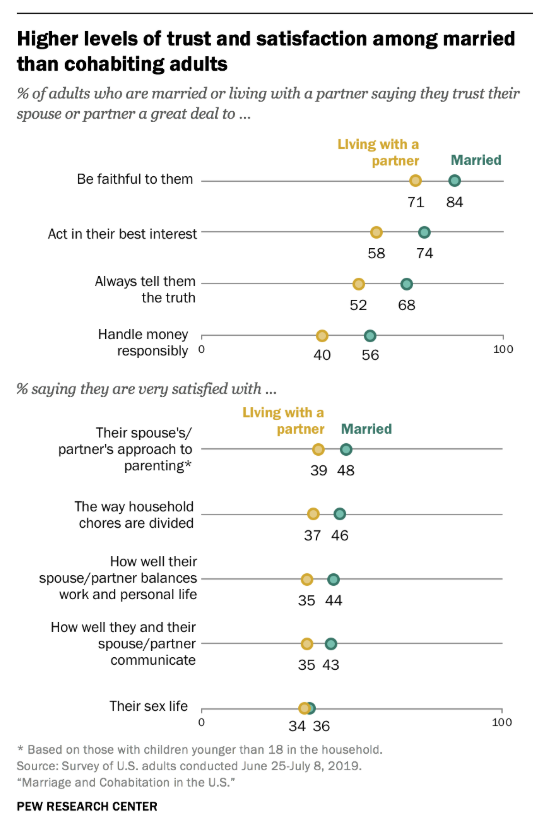
Unsurprisingly, younger adults are less likely to see the personal and societal benefits of marriage, according to Pew Research Center.

The same research, however, also shows marriage significantly boosts both spouses’ well being, especially when comparing marriage to cohabitation.

Social science data has shown for years that marriage is beneficial, both physically and mentally for men and women.

“Robust literature links being married to better physical and mental health outcomes,” a 2022 study published in the Journal of Family Psychology explains. “Studies consistently show long-term rather than short-term benefits to well being of getting married.”

A new joint study from the University of Michigan and Singapore Management University examined 5,000 adults in the United States and Japan. They found that “single adults in both cultures … reported worse physical health and lower life satisfaction than their married counterparts.”

While the study did not directly examine cohabiting couples, one of the lead authors explains, “My sense is that partnered but not married people would fall somewhere in between.” He adds, “They get the benefits of partnership, in terms of social capital, support and companionship, but they might still not get the benefit … that comes with marriage.”

Decades of research have consistently shown the problems of cohabitation and serious dating relationships; neither come close to providing the same benefits as marriage.

Marriage Still Matters

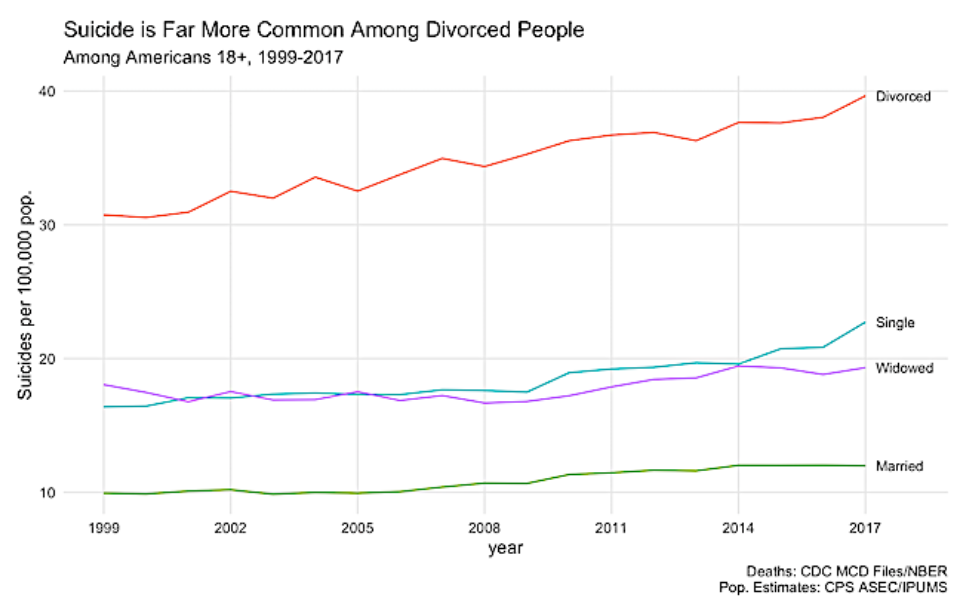
Data consistently shows suicides are dramatically lower among married men and women. This is the case even though deaths of despair, or deaths from suicide, drug overdoses and alcohol abuse, have increased dramatically.

Why? Marriage makes both men and women happier.

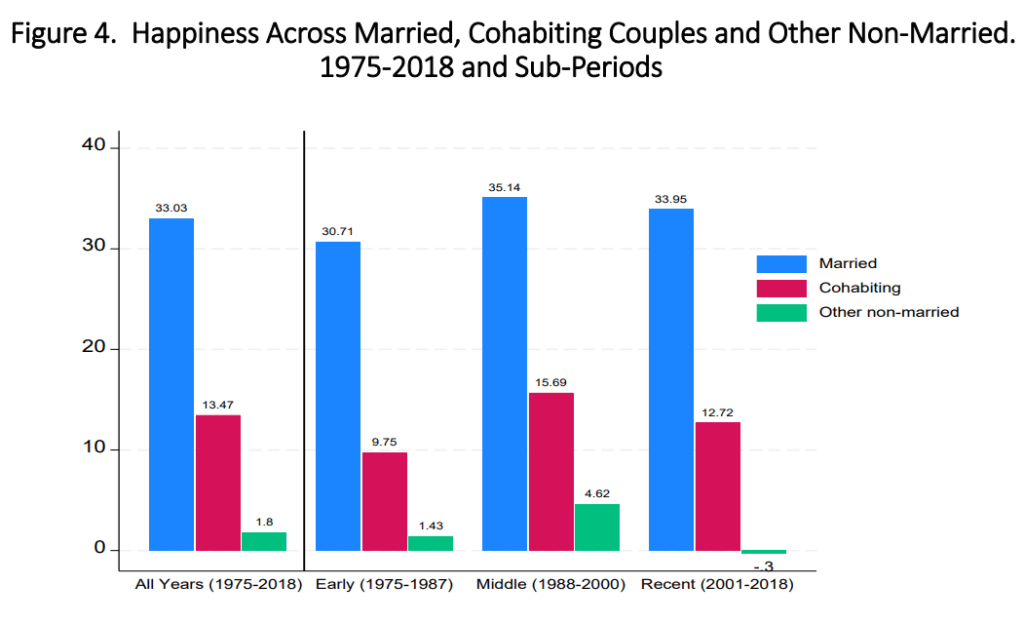
A 2025 University of Chicago study found that married people consistently are more likely to report substantially higher levels of happiness. Such findings have been consistent for decades.

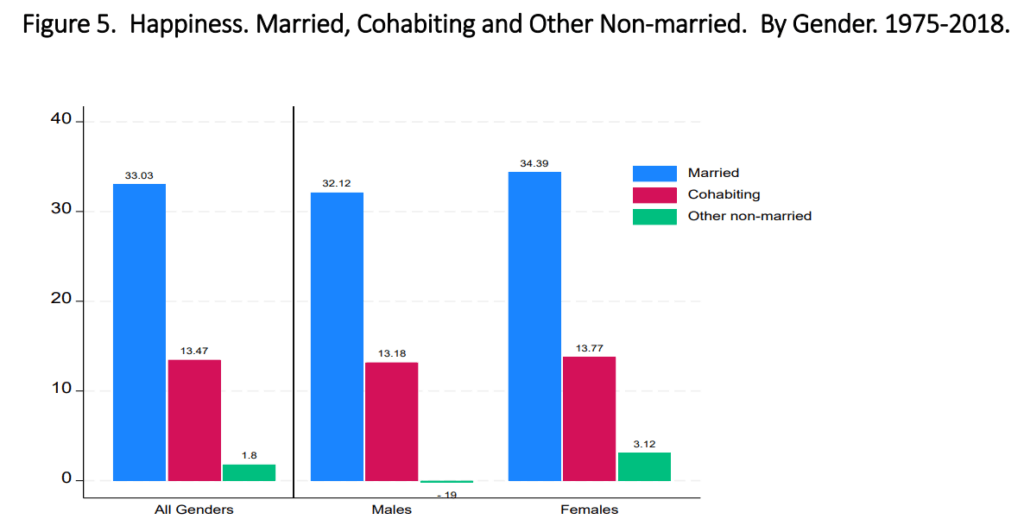
Married women tend to report being happier, compared to their husbands – who are significantly happier than their non-married counterparts. Both are happier than their cohabiting and single peers.

Professor Sam Peltzman, who conducted the study, explains there are two main reasons why married people are happier. According to Pelzmen, happy people are more likely to get married and marriage in and of itself causes couples to be happier.

He notes, “Being married is the most important differentiator with a 30-percentage point happy-unhappy gap over the unmarried.”

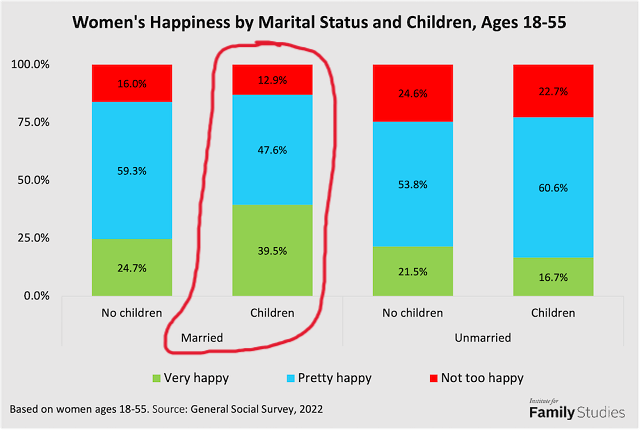
Data from the Institute for Family Studies consistently shows this; married mothers are happier than their unmarried and childless peers by wide margins.

University of Virginia sociologist Brad Wilcox explains this is also the case for married fathers.

“Nearly 60 percent of married fathers report their lives are meaningful ‘most of the time,’ compared to only 38 percent of their single childless peers,” he said.

Improved Physical Health

Marriage also positively impacts physical health, both for men and women.

A meta analysis looking at cancer survival rates, analyzed how much marital status impacted a patient’s recovery, finding that, “compared to unmarried patients, being married was significantly associated with better overall survival and cancer specific survival.” Additionally, the “most vulnerable group found in our study were divorced/separated men.”

Tyler VanderWeele, a medical professor of biostatistics at Harvard, carefully examined life factors that promote human flourishing.

He explains in the Proceedings of the National Academy of Sciences, “The effects of family life, and of marriage, are profound.”

“Evidence moreover suggests that marriage is associated with better mental health, physical health, and longevity, even controlling for baseline health, meaning that marriage promotes better health, rather than healthy people being selected into marriage,” he adds.

“The effects of marriage on health, happiness and life satisfaction, meaning and purpose, character and virtue, close social relationships, and financial stability are thus profound,” Vanderweele continues in his findings.

In a different study, Harvard Medical School found in 2019 that marriage significantly boosts heart health and longevity in men.

They also found married individuals survived cancer by up to 5.75 years, compared with divorced peers and those never married (four years). Earlier research highlighted by Harvard explains the various ways marriage boosts physical health outcomes.

Improved Mental Health

Not only is marital status related to better mental health, but “marriage seems to confer its mental health benefits indiscriminately; that is … [married men and women are] better off from a mental health perspective relative to their unmarried peers,” according to the Institute for Family Studies in 2024.

“Specifically, being married is significantly correlated with better mental health among men and women, young and old, rich and poor, uneducated and educated, religious and secular, white and non-white, liberal and conservative and parents and those without children,” IFS notes.

A 2024 examination between depression and marital status across seven diverse countries “revealed that unmarried individuals had a higher risk of depressive symptoms than their married counterparts across all countries.” A 2025 study found older “married individuals were significantly less likely to report depressive symptoms” compared to their single, divorced or widowed peers.

Decades of Research

Decades of academic research shows just how marriage boosts physical health and mental well being for both women and men.

Walter R. Gove, a Vanderbilt University medical sociologist, started chronicling the health benefits of marriage in the early 1970s.

“It is shown that, controlling for age, the married have lower mortality rates than the single, the widowed, or the divorced” and “these differences are particularly marked among those types of mortality where one’s psychological state would appear to affect one’s life chances,” he said at the time.

Professor Robert H. Coombs from UCLA’s School of Medicine published similar findings in 1991.

Citing more than 130 studies on this connection, Coombs concluded, “There is an intimate link between marital status and personal well-being.”

“Numerous investigations beginning decades ago attest that married people live longer and generally are more emotionally and physically healthy than the unmarried,” he notes.

Linda J. Waite, a social demographer from the University of Chicago, similarly came to the conclusion in 1995 that marriage does matter for both men and women, simply because marriage leads to more healthy behaviors.

“Married men and women exhibit lower levels of negative health behaviors than the unmarried. Perhaps as a result, a good deal of research evidence suggests that married men and women face lower risks of dying at any point than those who have never been married or whose previous marriage has ended,” Waite explained.

Waite was tasked with the question of how marriage reduces the risk of dying.

First, it reduces risky, unhealthy behaviors.

Second, it increases wealth and material well being, meaning that married couples typically have good living conditions, healthier food and better access to medical care.

Finally, marriage provides a larger network of support and encouragement through children and extended family.

Marriage is a strong factor for great good in the lives of men and woman. This is why it’s a shame that marriage rates are declining, while cohabitation is climbing and divorce, while declining, remains at a very high level.

We are increasingly cutting ourselves off from a vital institution that dramatically boosts all important measures of well-being. That is simply not wise.

Related Articles and Resources

Are Men or Women More Likely to Be Married?

New Research Shows Married Families Matter More Than Ever

Why You Should Care About the Growing Positive Power of Marriage

Important New Research on How Married Parents Improve Child Well-Being

New Research: Marriage Still Provides Major Happiness Premium

Cohabitation Still Harmful – Even as Stigma Disappears

Don’t Believe the Modern Myth. Marriage Remains Good for Women

Don’t Believe the Modern Myth. Marriage Remains Good for Men.

Yes, Married Mothers Really Are Happier Than Unmarried and Childless Women

Marriage and the Public Good: A New Manifesto of Policy Proposals

Image from Shutterstock.

Written by Glenn T. Stanton · Categorized: Family · Tagged: Random

Oct 30 2025

One Political Party is Clearly More Proud of America Than the Other

It should come to no one’s surprise that political parties have extremely different takes on whether citizenship in the United States of America is worthy of their pride. A new Gallup poll finally has the all the details.

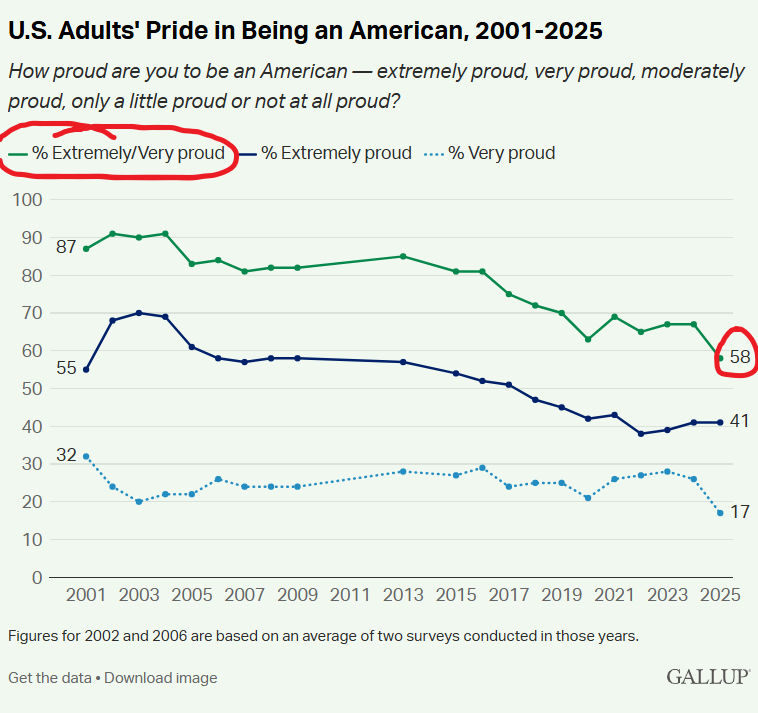
In January 2001, Gallup initially found 87% of Americans were “extremely” or “very proud” to be U.S. citizens. That number rose, hovering around 90 and 91% from 2002 to 2004 and declined yet again in 2005. As of 2025, American pride is the lowest it has been at just 58%.

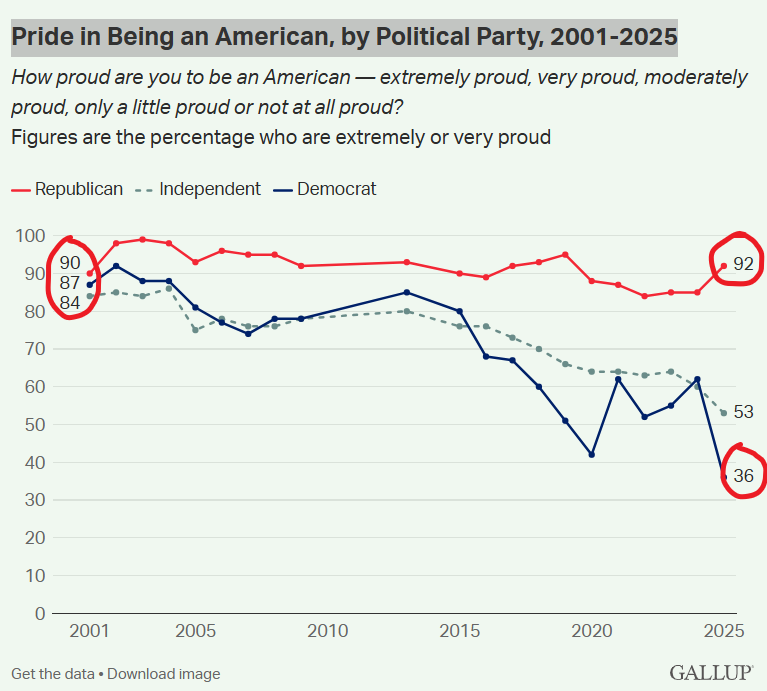
Declining national pride is never good. But the real punch of this finding is the group who national pride is declining among. Gallup tells us it is certainly not declining among everyone. Not even close. It divides starkly along politically partisan lines. Gallup presents the distinction this way.

As we can see, this was not always the case.

Democrats and Republicans were only three percentage points different, and both at very high levels, in 2001. For Democrats it started to dip to 81% in 2005 to a first low of 74% in 2007. It then started to climb to 85% in 2013 and then sink to a stark 42% in 2020. It then rose for Democrats to 62% in 2021, sank exactly ten points in 2022, then began to rise again to 62% in 2024. Then Democrat national pride sank by nearly half to 36% in 2025, an all-time low.

All the while, pride in being American remained relatively stable at a very high level for Republicans, never dipping more than six points.

Curiously, if you look at the more recent years of dramatic rise and fall in national pride among Democrats, these changes correspond closely with who is in the White House. That is clearly not the case with Republicans. Their national pride remained at a relatively high level regardless of who occupied the executive office of our country.

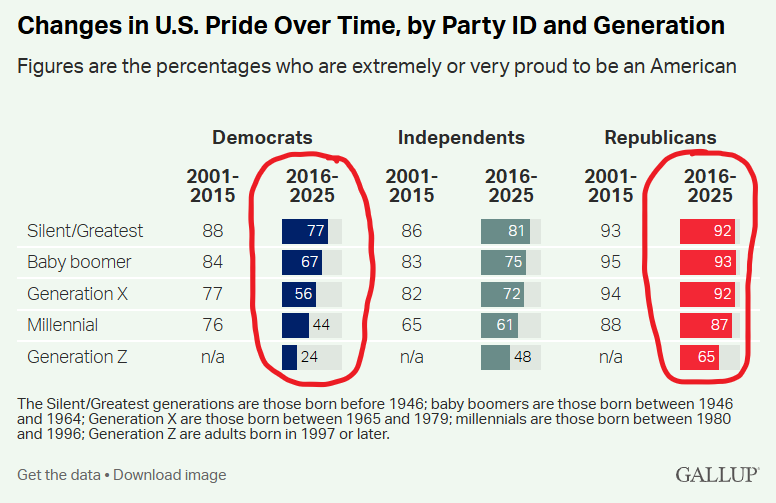
The same dramatic shifts are also shown by age cohort.

Younger Democrats show dramatic declines in being “extremely” or “very proud to be an American.” Republicans show declines as well, but these are far less dramatic for GOP-aligned young people, staying well above the majority. As Gallup reports, “Notably, more Gen Z Democrats say they have little or no pride in being an American (32%) than say they are extremely or very proud” (emphasis added).

Clearly, one of our nation’s two major political parties have stronger and more consistent pride in being American than the other. This also means one party is more aligned with the strong pro-American sentiments of immigrants legally assimilating to the U.S.A. than either Democrats or Independents.

Blind allegiance to a nation is not a virtue, but neither is blind disdain based on who is in the White House. But the flow of families from around the globe coming to American – legally and illegally – risking life and fortune, is a very strong indicator of just how great a nation America is. That is worth taking pride in.

Additional Resources

Data Shows Democrats Are Increasingly Secular

Research Finds Republican Husbands More Faithful; Religious Even More

Image from Shutterstock.

Written by Glenn T. Stanton · Categorized: Culture · Tagged: Random, United States

Oct 29 2025

‘Great American Christmas’ is Here With 17 New Movies

Great American Christmas is back for its fifth year of family-friendly, faith-filled Christmas movies — here’s everything you need to know!

The annual celebration kicked off on Friday, October 10, 2025. The network will present new movies every weekend through Christmas and will have Christmas programming 24/7 until the end of the year.

Viewers will see many familiar faces in this year’s movie line-up including Candance Cameron Bure, Bure’s daughter Natasha, Danica McKellar, Mario Lopez, Cameron Mathison, Paul Greene, Trevor Donovan, Cindy Busby, Marcus Rosner and Christopher Russell.

From cherry orchards and small-town bakeries to hometown bookstores and festive parades, this year’s slate is filled with stories that inspire hope, love, community and faith.

Each week the network will release at least one new original holiday film, making this season the biggest yet for Great American Christmas.

Most premieres air at 8:00 p.m. Eastern Time on Great American Family unless noted otherwise, with additional streaming on Great American Pure Flix.

This year, for the first time in its history, Great American Family will premier one of their holiday movies for a limited time in select theaters. The three-day limited engagement begins the Sunday following Thanksgiving, November 30 through December 2.

The premiere will feature Another Sweet Christmas, a follow-up to last year’s Home Sweet Christmas, starring the “Queen of Christmas” movies Candace Cameron Bure and Cameron Mathison. Tickets can be purchased at Fanthom Entertainment.

Candace Cameron Bure will star along her daughter, Natasha Bure, again this year in a new feature, Timeless Tidings of Joy.

Mario Lopez will be producing Chasing Christmas and his son, Dominic Lopez, will be featured in the movie.

Danika McKellar will star in Have We Met This Christmas airing on December 13.

Here is a printable checklist of this year’s new holiday movies.

Below are the holiday premier dates and trailers.

Great American Christmas 2025 — Movie Lineup & Premiere Dates

Saturday, October 11: A Wisconsin Christmas Pie

Saturday, October 18: A Christmas Prayer

Saturday, October 25: A Royal Icing Christmas

Saturday, November 1: Christmas in Midnight Clear

Saturday, November 8: A Very Curious Christmas 

Sunday, November 9: Christmas of Giving

Saturday, November 15: Timeless Tidings of Joy 

Sunday, November 16: Pencil Me in for Christmas

Saturday, November 22: Christmas on Every Page

Sunday, November 23: Christmas North of Nashville

Friday, November 28: The Christmas Spark

Sunday, November 30: There’s No Place Like Christmas

Saturday, December 6: Cranberries and Carols

Sunday, December 7: Christmas at Mistletoe Manor

Saturday, December 13: Have We Met This Christmas?

Sunday, December 14: A Royal Christmas Tail

Sunday, December 21: Mario Lopez Presents: Chasing Christmas

Written by Nicole Hunt · Categorized: Family · Tagged: Random

  • « Go to Previous Page
  • Page 1
  • Page 2
  • Page 3
  • Page 4
  • Page 5
  • Interim pages omitted …
  • Page 17
  • Go to Next Page »

Privacy Policy and Terms of Use | Privacy Policy and Terms of Use | © 2025 Focus on the Family. All rights reserved.

  • Cookie Policy