
• Skip to main content
Daily Citizen
  • Subscribe
  • Categories
    • Culture
    • Life
    • Religious Freedom
    • Sexuality
  • Parenting Resources
    • LGBT Pride
    • Homosexuality
    • Sexuality/Marriage
    • Transgender
  • About
    • Contributors
    • Contact
  • Donate

Random

Oct 29 2025

Data Shows Democrats Are Increasingly Secular

Democrat voters in America have starkly different views than Republicans on important social issues. New data is demonstrating another dramatic and consequential difference between Red and Blue Americans: Democrats are far more secular and that gap is only increasing.

Ryan Burge, a statistician and professor at Washington University in St. Louis, has posted a new report detailing just how stark this difference is. In fact, Professor Burge was not shy in titling his piece, “The Democrats Have a Religion Problem.” His subtitle is just as damning: “Most Americans are Still Christians – Democrats Seen to Have Forgotten.”

Burge opens his report with what he describes as “a true, simple, and profound fact.” He states that fact in two blunt parts.

  • Eighty percent of the people who voted for Donald Trump identify as some type of Christian. It was 48% for Harris voters in 2024.
  • Just 17% of Trump voters identified as atheist, agnostic, or “nothing in particular.” Nearly half of Democrats in 2024 (45%) were non-religious.

These are stark differences, indeed. The drift toward secularism among Democrats from 2008 to 2024 looks like this.
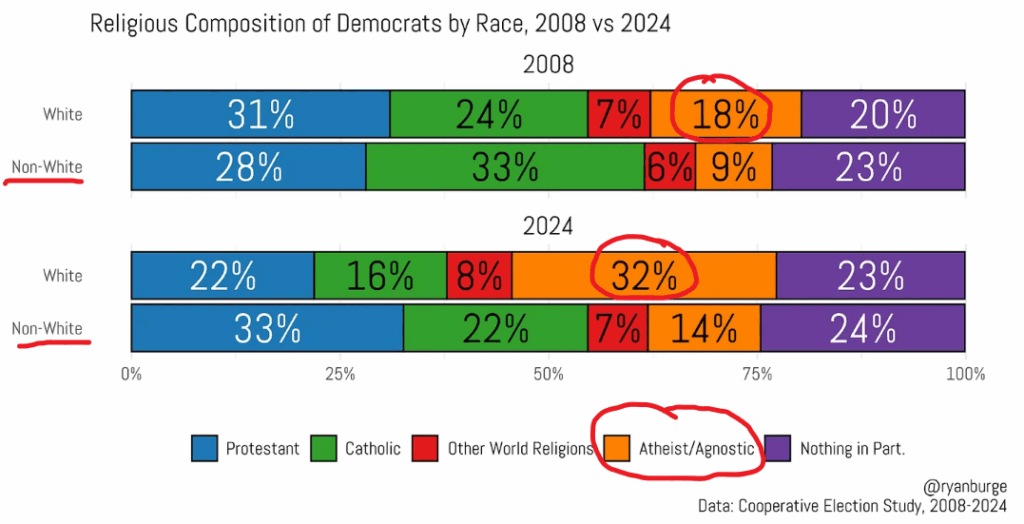
Non-white Democrats have moved toward protestant Christianity since 2008, largely moving away from Catholicism. In terms of church or synagogue attendance, the differences look like this.
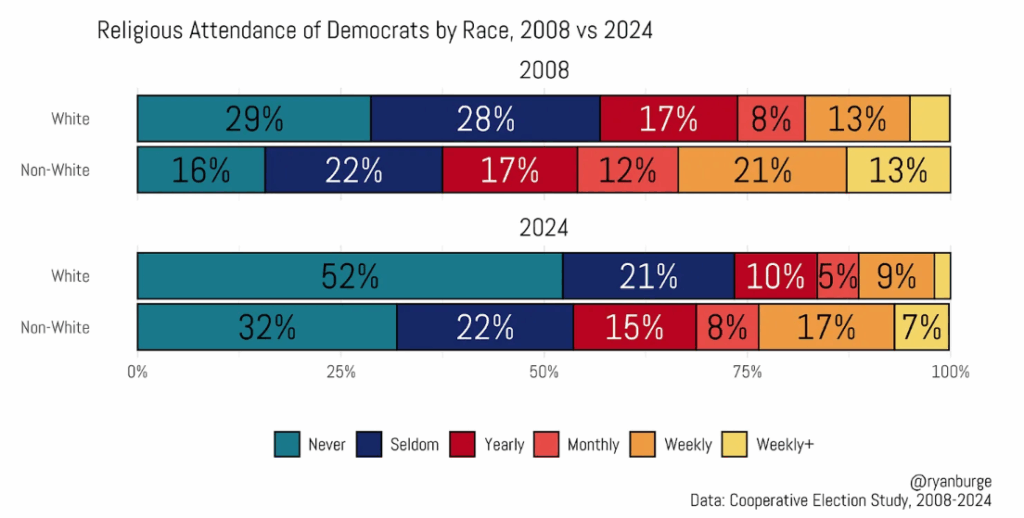
A remarkable 83% of white Democrats either never or very seldom attend any religious weekly meeting. Only 9% attend weekly services and 5% attend monthly. The same never/seldom attending number for non-white Democrats is 69%. However, the corresponding percentages for Republicans are 58% who never or seldom attend, while 32% attend weekly and 10% attend monthly.

This marks a 30% difference between white Democrats and all Republicans who never or seldom attend religious services, a 72% difference of those who attend weekly and a 50% split in those who attend monthly. That is a lot of secularism among white members of the Blue party. In fact, Burge calls it the “racial God gap” among Democrats and the rest of the country.

He also notes that Republican voters are largely unified in their national values.  Burge states, “If you’re working for the GOP, something along the lines of ‘God, Country, and Traditional Family Values’ resonates with nearly all your voters.” He reports a substantial racial and religious divide among Democrat voters. “Essentially, the party now has a large cohort of non-religious white voters alongside a diverse coalition of voters of color who remain deeply religious.”

White and Hispanic Democrats have gotten increasingly more secular, essentially doubling, while their Black and Asian voters have not shifted more secular by much between 2008 and 2024. Burge explains, “In other words, the ‘average American’ looks a lot like the ‘average Democrat of color’ in terms of religious activity.” But their white members are increasingly secular and liberal.

So, among Democrat politicos, Burge believes “a message of faith and values will probably turn off as many voters as it attracts” because “the party now has a large cohort of non-religious white voters alongside a diverse coalition of voters of color who remain deeply religious.”

“Democrats can’t win national elections on the backs of the non-religious alone, but they’ve also ceded large swaths of the Christian vote to Republicans. That leaves them with a coalition that risks alienating either Christians of color or secular whites, depending on how the message is framed,” Burge concludes.

Serious faith is a very important part of political power and appeal because the Christian faith informs so many serious moral issues. Republicans would do well to appreciate how important values voters driven by faith are to their future successes at the ballot box.

Democrats have an increasingly real electoral problem on their hands with their growing white secularist base as they try to hang onto religiously affiliated voters of color. In August, The New York Times documented how serious a problem this is for Democrats who are “hemorrhaging voters long before they even go to the polls.”

Democrats must solve their “racial God gap” fast if they hope to remain a viable party. It is very unlikely that they will, though, as they continue to play to the more extreme parts of their base.

Image from Shutterstock.

Written by Glenn T. Stanton · Categorized: Culture · Tagged: Random

Oct 24 2025

Beauty Queens and Conservatism: A Perfect Match

The conservative movement is full of intelligent, beautiful and ambitious women.

As a former beauty queen, it’s no surprise to me that many of them got their start in beauty pageants; I can tell you firsthand that pageants offer real, substantive life lessons.

I began competing in pageants when I was 18 months old and continued until I was 18.

It was never a full-time job — more like an extracurricular activity. I loved it because it challenged me to engage with my community, represent myself with poise and confidence, develop strong communication skills and grow as a person and leader.

During high school, I had the honor of serving my hometown community as a beauty queen for two years. In my junior year of high school, I served as Teen Miss Hemet and in my senior year as Miss Hemet. In those roles, my love for community service truly deepened. I participated in Chamber of Commerce events, welcomed new businesses into our local economy and used my title to serve men and women in assisted living. Those experiences strengthened my sense of civic responsibility and taught me how powerful it can be to use your platform to make a positive difference in other people’s lives.

There’s a common misconception that pageants are all superficial with no substance. The truth is, they can be powerful tools for personal growth and leadership development.

Some of the most valuable lessons I learned in pageants include,

  • Public speaking and communication — learning to express myself clearly and with confidence.
  • Grace under pressure — performing and thinking on my feet in stressful situations.
  • Personal image and discipline — understanding the value of a first impression and the importance of perseverance.
  • Community engagement — learning to serve, advocate and lead with purpose.
  • Resilience and confidence — handling criticism, setbacks and competition with courage.
  • Maintaining a teachable spirit — staying open to growth and recognizing progression is built on a willingness to keep learning.

Erika Kirk is a shining example of how pageantry can shape a young woman into a poised, articulate and influential leader. Her ability to communicate with grace and strength in the face of adversity has made her a beloved figure among young conservatives today.

Kristi Noem is another example of a conservative leader who developed poise, communication skills and public presence through pageantry. As she rose in political leadership, those foundational experiences helped prepare her for the responsibilities of serving as governor of South Dakota and now Secretary of Homeland Security.

Kirk and Noem illustrate that beauty pageants aren’t just about crowns and sashes — it’s about building the skills, confidence and character to be successful in life.

Pageant alumnae are an excellent fit for the conservative movement because conservatism values ambitious, intelligent and thoughtful women. Conservatives celebrate the talents beauty queens develop and honor marriage and motherhood as powerful, meaningful expressions of womanhood.

For some, pageants can seem shallow because of its emphasis on outward beauty. At the heart of it all is a simple truth: pageantry may celebrate beauty, but true beauty comes from within — and that’s what sets it apart from a superficial display.

Even though I didn’t always walk away with the crown and sash, the most important lesson I learned from beauty pageants was that true beauty was a reflection of inner beauty — and that kind of beauty never fades — it grows more radiant with time.

For many of us who were contestants and followers of Jesus, we understood that we reflected the Light of the World. That foundation of faith, combined with the strength and grace learned through pageantry, is what makes so many pageant alumnae powerful voices in our culture today.

Image from Getty.

Written by Nicole Hunt · Categorized: Culture · Tagged: Random

Oct 22 2025

A Ready Defense of Christian Patriotism

When conservative Christians express their unqualified love and appreciation of America and back it up with involvement in politics and the public square, they easily get tarred as Christian Nationalists. In fact, CNN recently feared Charlie Kirk’s massive memorial service in Phoenix was a demonstration in Christian nationalism.

Patriotism by anyone, much less faithful Christians, should never be assumed a threat.

Daniel Darling, pastor and director of the Land Center for Cultural Engagement at Southwestern Theological Seminary, has given the world a very important book on this topic, entitled In Defense of Christian Patriotism. He asks, “Since when does praying to Jesus, loving America, and saluting the flag make you an extremist?”

Darling contends that standing up and publicly loving one’s country as a patriot is essential for Christians, saying, “A healthy patriotism is not only an acceptable posture for a Christian. I believe it is a necessary posture for a Christian.”

Darling explains, “I wrote this book to show Christians how to fight back against the Left’s false narrative with an upbeat, robust defense of how Christians make America better.

“As I speak to ordinary believers around the country, I meet good people who want to love America but are constantly being told that this passion is in direct conflict with their love for God.”

His book explains why loving one’s country is acting in obedience to God.

In the chapter “You Can’t Obey God and Hate Your Country,” Darling warns against the silly temptations to avoid patriotism because we “fear being confused with [our] flag-waving parents and grandparents” or we “equate any form of patriotism with idolatry.”

Darling approvingly highlights Hillsdale professor Wilfred M. McClay’s definition of patriotism.

Patriotism, in the American context, is an intricate latticework of ideals, sentiments, and overlapping loyalties. Since its founding, America has often been understood as the incarnation of an idea, an abstract and aspirational claim about self-evident truths that apply to all of humanity. There is certainly some truth to this view, but to focus on it exclusively ignores the very natural and concrete aspects of American patriotism: our shared memories of our nation’s singular triumphs, sacrifices, and sufferings, as well as our unique traditions, culture, and land.

These ideals are why millions immigrants risk their lives and meager fortunes to come to America legally. They believe in our ideals and a promise of a better life.

Darling explains, “Loving America is not ignoring her flaws, but recognizing the possibility of positive change is more likely” as much of this is “due to the unique influence of Protestant Christianity on our founding ideals – an influence many want us to forget.”

Darling continues to detail how family decline has harmed many of our nation’s most vulnerable populations, which prevents them from fully realizing the rewards of the American Dream.

Darling rightly observes Christian efforts in the fight for family, saying, “Often it is Christians trying to arrest change who are labeled as the aggressors, backwards, weird and retrograde, while the Left, which made the changes in the first place, is the enlightened, fair-minded, justice-oriented cohort.”

He’s not wrong by recognizing that “some evangelical leaders dismiss fighting for families as mere ‘culture wars’.”

He adds, “The truth is [our patriotism has us] engaged in a fight for what is true and good and beautiful, whether we realize it or not. Some political skirmishes are stupid, but championing the family is not one of them. It’s serious and it matters.”

The book concludes, saying, “For our children, for our neighbors, for the glory of God, let’s love this country,” the essential call of Christian patriotism for Americans as a great beacon of hope and freedom for billions around the world.

You can read Daniel Darling’s motivation for writing his new book here.

Related Articles and Resources

The Importance of Social Responsibility

Christianity and Patriotism

Raise Your Child to be an Engaged Citizen

Making Citizens: The Case for Patriotic Assimilation

A Hopeful View of America’s Future

Learning to Love America Again

96-Year-Old WWII Vet Plays National Anthem on His Harmonica: ‘This is America’

Written by Glenn T. Stanton · Categorized: Culture · Tagged: Random

Oct 09 2025

When Academics Sexualize Children

The world’s scholars are tasked with investigating important and even controversial topics in their pursuit of truth and virtue. A newly published article violates this call in a disturbing way. The manner in which it does is certainly worth our attention and condemnation.

The article, entitled “Childhood Sexualities: On Pleasure and Meaning from the Margins,” was published last month in the American Sociological Association’s journal Sex & Sexualities. It is authored by a scholar from the University of KwaZulu-Natal in South Africa whose stated specialty is childhood sexuality. She employs all the necessary buzz phrases so fashionable in leftist social justice theory, such as this opening line: “This article repositions childhood sexualities within a pleasure-centered, globally oriented, and power-aware frame informed by feminist, queer, and decolonial perspectives.” The article “interrogate[s] dominant narratives of sexual innocence that suppress young people’s desires and show how children negotiate pleasure and meaning amid intersecting hierarchies of age, race, gender, and class.”

This author is deeply concerned that “nowhere is this politics of misrecognition, erasure, and marginalization more acute than in childhood, where preadolescent children’s erotic capacities are routinely pathologized.” Yes, she is deliberately positioning that which is good and protective to appear evil.

The article is just over 3,000 words of this kind of thing. It is certainly not serious scholarship. It is a subversive ramble. But it got published all the same by an otherwise respectable sociological association.

The article’s thesis is predicated on this claim that is as bold as it is false: “What is clear is that the notion of childhood sexual innocence is not a natural construct.” The sexual innocence of every child that has ever been born is among the most natural of things. The very definition of childhood itself is that of innocence and wonder. G. K. Chesterton spoke truth in observing, “For children are innocent and love justice; while most of us are wicked and naturally prefer mercy.”

While one of the domineering virtues of childhood is innocence, a most damning vice of adulthood is the sexualization of children. This article gratuitously trades in the latter, objecting to “a colonial fiction that has long erased the very thought of putting sexuality and childhood together.” It advocates for the linking of the two in the name of everything they deem right and good. Why? Well, as this author explains, “Sexual pleasure and meaning are integral to understanding why children do what they do, and how they can be supported to lead healthier, happier lives.” Thus, “It is time for sexualities research to hone in on the meanings of sexual pleasure for children and young people.”

Every person who possesses any sense of reason and compassion for children and childhood must state that such a time will never come. They should recognize and denounce articles such as these as the latest effort to de-stigmatize sexualizing children and erase protective age-of-consent boundaries.

The author makes her intentions known in the conclusion of the article, stating, “Our focus is more than just an inversion of the usual risk-focused narrative; it is a call to transform how we think about childhood sexuality and whose experiences we value.”

We shudder to think what those valued experiences are. Yes, very bad people posing as serious academics are making real progress toward the further sexualization of our children. Academics and the journals who publish their pedophilic proposals take note:  “It would be better for him if a millstone were hung around his neck and he were cast into the sea than that he should cause one of these little ones to sin” (Luke 17:2, ESV).

Image from Shutterstock.

Written by Glenn T. Stanton · Categorized: Culture · Tagged: Random, Study

Sep 24 2025

Yale Students Vote Against Abortion, Signals Momentum for Pro-Life Cause

In a striking turn of events at one of America’s most elite universities, Lila Rose decisively won a formal debate on abortion at Yale University.

On September 16, Yale Political Union, a student-run debate society hosted a debate on abortion. The topic was “Abortion and Human Rights.” The specific resolution, “Choice over Life,” urged students to consider whether abortion should be defended as a right.

After over two hours of debate and discussion, the audience rejected the resolution by a vote of 60-31, giving Rose and the pro-life community a resounding victory.

Rose posted this on X immediately following the event:

Debate just ended.

We won. The room voted for the pro-life side.

Yale organizer was shocked.

Change is here.

Thank you for praying 🙏 pic.twitter.com/fLWtBO80e6

— Lila Rose (@LilaGraceRose) September 17, 2025

The debate pitted Lila Rose, founder and president of Live Action and Frances Kissling, an abortion rights activist and former head of Catholics for Choice, against each other.

Each side was given time for opening remarks, cross-examination and rebuttals.

As reported by Rose’s organization, Live Action, Kissling “focused her argument on the false claim that preborn children are not as valuable as other human beings.” While Rose contended that preborn children are being “denied their humanity” and drew connections to slavery and the Holocaust to demonstrate what happens when groups of people are stripped of their humanity.

Rose built her argument for life on the principles of science and morality. She emphasized that life begins at conception and that the baby in the womb is fully human with equal value to born people. She stressed the importance of pregnancy help organizations for pregnant women and that the pro-life position cares deeply about protecting women and the vulnerable in society.

Kissling argued that it was important for women to make their own decisions about what is best for their bodies. She tried to frame the abortion issue as a matter of balancing values, and that ultimately, women should balance what is best for them.

Following the debate, National Catholic Register reported on the responses of several Yale students, including a female art history major at Yale who said Rose was the clear winner because “she came in with a sense of humility and also with a deep sense of wanting to do justice….”

A senior reflected that Rose won the debate fair and square “with a secular, logical argument centered on the humanity of the unborn child.” This student was especially moved by Rose’s ability to speak on the topic with eloquence and precision.

After her decisive win, Rose told the National Catholic Register, “I think we’re going to keep doing this….”

She insisted that the prolife movement is going to win on every college campus because it has the truth on its side.

She said, “We can’t be scared, we can’t back down. I think more than ever, we need to stand up and speak out in love. And I think this is a tipping point, or, as Charlie [Kirk] would say, it’s a turning point.”

Rose posted a video on X before the debate explaining that she initially declined to attend the event due to a packed schedule and family commitments, but after Charlie Kirk’s assassination, she felt a sense of calling to go. In the video, she urged people of faith and conscience not to be afraid to speak the truth with love.

Thank you, Lila Rose, for listening to the call of the Holy Spirit to defend truth and God’s design. May we all heed the calling to be light in our spheres of influence for God’s glory.  

Related Articles and Resources

Charlie Kirk Saved Baby Oliver’s Life

Gen Z Women Rejected Pro-Abortion Messaging in 2024, Election Data Shows

Trump Signs Executive Order Limiting Taxpayer Funds for Abortion

BREAKING: Trump Administration Moves to Freeze, Cut Funding to Planned Parenthood

My Choice Network

Counseling Consultation Request Form

Considering Abortion?

Focus on the Family Pro-Life

Written by Nicole Hunt · Categorized: Culture · Tagged: Lila Rose, Random

  • « Go to Previous Page
  • Page 1
  • Page 2
  • Page 3
  • Page 4
  • Page 5
  • Page 6
  • Interim pages omitted …
  • Page 17
  • Go to Next Page »

Privacy Policy and Terms of Use | Privacy Policy and Terms of Use | © 2025 Focus on the Family. All rights reserved.

  • Cookie Policy