One Third of Americans Can’t Name Three Branches of Government, Constitution Day Survey Finds
Today is Constitution Day, an annual federal observance celebrated on September 17. The day commemorates the September 17, 1787, signing of the U.S. Constitution by 39 delegates to the Constitutional Convention in Philadelphia.
The Annenberg Public Policy Center (APPC) of the University of Pennsylvania releases its Constitution Day Civics Survey each year leading up to Constitution Day. The survey examines Americans’ knowledge of their governing institutions and constitutional rights.
Similar to its findings from the last two years, the center reports over one third of U.S. adults (35%) cannot name all three branches of the U.S. government – the legislative, executive and judicial branches.
The survey also found Americans’ knowledge of their First Amendment rights is sorely lacking. The Amendment contains five enumerated rights, including:
- The right to free speech
- The right to freely exercise religion
- The right to peaceably assemble
- The right to freedom of the press
- The right to petition the government for redress of grievances
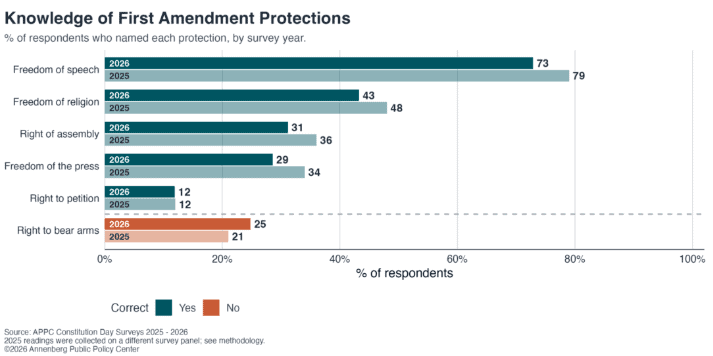
While most Americans (73%) can name the freedom of speech as a right guaranteed by the First Amendment, fewer than half name freedom of religion (43%), freedom of assembly (31%), freedom of the press (29%) and the right to petition the government (12%).
Nine percent of respondents can correctly name all five First Amendment protections, while 24% can name none of them.
“Ignorance is costly,” said Kathleen Hall Jamieson, director emerita of the Annenberg Public Policy Center. “You can’t protect and cherish rights that you don’t know you have.”
This year, the U.S. Department of Education honored Constitution Day and took action to increase American students’ civic knowledge.
Secretary of Education Linda McMahon issued a Dear Colleague letter calling on education leaders and teachers to strengthen civic learning and provide opportunities for students to recite the Pledge of Allegiance.
“To thrive for the next 250 years, we must understand, cherish, and claim the ideals, history, responsibilities, and civic traditions that unite us,” wrote Secretary McMahon. “With 31 simple words, for a minute a day, students connect themselves to this great American story, take ownership of their citizenship, feel pride in their country, and become architects of the nation’s future.”
The letter doesn’t contain any mandate from the federal government. But it does provide a gentle reminder to all educators to consider the important role they serve in fostering civic knowledge in rising generations of young Americans.
This year’s Constitution Day survey shows there’s much work to be done to inform Americans about their rights as U.S. citizens – especially as the 2026 midterm election approaches. While it’s important for Americans to vote, it’s just as crucial Americans cast an informed vote at the ballot box.
“This year’s findings indicate there is still work to be done in strengthening the citizenry’s knowledge of the U.S. Constitution,” said R. Lance Holbert, director of APPC’s Leonore Annenberg Institute for Civics.
“An understanding of our nation’s founding documents remains paramount for the long-term health of the nation’s democracy.”
Related articles and resources:
Teaching Our Children What Makes America Great
Understanding the Importance of Voting
Christians Must Get Out to Vote This November
Most Americans Don’t Know Their First Amendment Rights. Do You?
Many Americans Unaware of Key Facts About U.S. Constitution, Survey Finds
Today is Constitution Day: Let’s Celebrate the Document That Made America
Photo from Shutterstock.


ABOUT THE AUTHOR