Is Religious Faith Gaining Influence in America?
In late October, Pew Research Center reported that “there was a sharp rise in the share of U.S. adults who say religion is gaining influence in American life” since February 2024, when it was only 18%, to 31% today – the highest in 15 years. What is more, the percentage of Americans who say faith is losing influence has declined from an all-time high of 80% in 2024 to 68% today.
Pew adds, “The new survey also finds that in recent years, a growing share of the public takes a positive view of religion’s role in society.” Remarkably, the gain is at least 10% among both Democrats and Republicans, even as Democrats grow increasingly secular. And Democrats were far more likely to have a net negative view of religion’s impact on American life, at 35% for Democrats, compared to just 6% for Republicans.
This present trendline appears encouraging, but the fact is a majority of U.S. adults believe religion is losing influence at 68% and only 31% believe it is gaining influence. But of late, the shifts appear to be moving in a more positive direction, and markedly so as shown here:

It is interesting that the age group showing the largest positive change believing religion is gaining in influence is among 18- to 29-year-olds, at an 18 percentage point increase, while 30- to 40-year-olds saw a 12 percentage point increase; 50- to 64-year-olds saw a 10-point increase; and those aged 65 and older saw a 16-point boost.
The largest increase by faith groups was a 20-point increase among White evangelicals and the highest, at 23 points, was seen among Jewish Americans. Black Protestants saw only a 4-point increase and Catholics saw a 12-point positive improvement.
Pew also reports that the shares of American adults “expressing positive views of religion in 2024 and 2025 are up significantly from 2022 and 2019, indicating an overall shift toward more positive views about religion’s role in American life over the past five years or so” (emphasis in original).
Increasingly, a majority of Americans (58%) feel there is “some” or a “great deal of conflict” between their faith beliefs and those of mainstream American culture. That is up 10 percentage points since 2024 and 16 points since 2020. In terms of political affiliation, Pew states, “62% of Republicans and 55% of Democrats say there is at least some conflict between their religious beliefs and the mainstream.”
Many Religions True?
Finally, a near majority (48%) of Americans believe many different religions may be true, while only 26% believe that only one religion is true. Pew reports, “Clear majorities of White nonevangelical Protestants (69%) and Catholics (65%) say many religions may be true.” They add, “By contrast, most White evangelicals (62%) say only one religion is true.”
Evangelicals were clearly the largest faith group that holds this belief, yet 48% of evangelicals who should know better sadly believe “many faiths may be true.” This is in clear disagreement with Jesus who said, “I am the way, and the truth, and the life. No one comes to the Father except through me” (John 14:6, ESV).
Curiously, 2% of agnostics said that only one religion is true, while 12% of atheists and 38% of agnostics agreed that “many religions may be true.” Only 44% of atheists and 14% of agnostics believe there is “no truth in any religion.” So those who say they hold no faith at all, seem to hold some.
A Faith Revival in America?
It is indeed good that more Americans see faith gaining influence in American life today. But it also remains true that too few Americans have consistent views on faith. In early December, Pew reported, “Our recent polls, along with other high-quality surveys we have analyzed, show no clear evidence” of faith revival among American young people, even while identity with Christianity holds pretty steady.
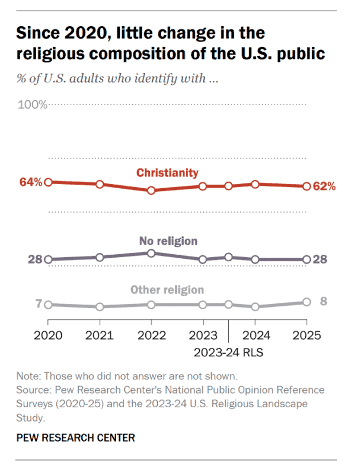
The Daily Signal asked Washington University’s Ryan Burge in late October if there was a “Charlie Kirk Effect” in church attendance. They report, “[Burge] acknowledged the good vibes appearing in popular culture and from the media,” but added, “at the end of the day, he said, there just simply wasn’t much evidence to support the notion of a macro-level nationwide revival currently underway in the U.S.” Yet, Burge is still waiting for more data to come in. Specifically, Burge explained, “[T]he answer, at least as far as we can tell, data-wise is no; there’s no evidence of a massive return to religion.”
We must realize, however, that the same Holy Spirit that worked at Pentecost, and through the ages, is still the same unchangeable, unhindered, powerful God who, just like Jesus, “is the same yesterday and today and forever” (Hebrews 13:8, ESV).
The Holy Spirit is still moving through history and the lives of people in a convincing way. It is His nature to do so; He cannot do otherwise.
We are called to live faithfully today and every day, inviting Him to work through each of us in our various spheres of influence. That is how God’s Kingdom operates.
Additional Resources on the Total Lordship of Christ
How Big is Your View of the Gospel?
The Cultural Paradox of Following Jesus Christ
The Church’s Lane is the Whole Cosmos
Appreciating the Full Scope of the Lordship of Christ – and the Gospel Itself
As Secularists Prep for the Apocalypse, Christians Must Have Strong Kingdom Theology
In Our Troubled World, Take Heart and Remember That Christ is King
Photo from Shutterstock.