• Skip to main content
Daily Citizen
  • Subscribe
  • Categories
    • Culture
    • Life
    • Religious Freedom
    • Sexuality
  • Parenting Resources
    • LGBT Pride
    • Homosexuality
    • Sexuality/Marriage
    • Transgender
  • About
    • Contributors
    • Contact
  • Donate

Courts

Sep 04 2026

Supreme Court Packing: We’ve Seen This Movie Before

When it comes to recent calls to expand the number of justices on the United States Supreme Court, an adaptation of President Reagan’s famous retort seems in order:

“Here we go again.”

On Wednesday, a constitutional amendment introduced by Rep. Andy Biggs (R-Ariz.) to lock the total number of justices on the United States Supreme Court at nine was defeated 212-206, well short of the two-thirds majority needed to pass the House. The amendment would have needed to also pass the U.S. Senate and then be ratified by 38 states.

Speaker Mike Johnson (R-LA), who voted for the amendment, said, “Defending the integrity of the Supreme Court shouldn’t be a controversial vote.”

Speaking in Nashville at the National Urban League’s annual conference earlier this summer, former Vice President Kamala Harris was blunt regarding her support of adding more justices.

“We need to revisit the point of expanding the court to 13 justices like we have 13 district courts,” she said.

Representative James Clyburn (D-SC) wholeheartedly agreed, noting, “A baker’s dozen would be a good number to have on the court.”

Advocating for expanding the High Court in order to dilute its ideologically conservative leanings might sound familiar to students of history.

Speaking to the American people during one of his fireside chats in 1937, President Franklin Roosevelt explained why he wanted to do likewise.

“We cannot yield our constitutional destiny to the personal judgment of a few men who, being fearful of the future, would deny us the necessary means of dealing with the present,” the 32nd president contended. He went on to claim the proposal to “pack the court” was not politically motivated but rather in the best interest of the country.

“This plan of mine is no attack on the Court,” FDR proffered. “It seeks to restore the Court to its rightful and historic place in our system of Constitutional Government and to have it resume its high task of building anew on the Constitution ‘a system of living law.’ The Court itself can best undo what the Court has done.”

For context, President Roosevelt was frustrated that a majority of justices were striking down as unconstitutional some of his signature policies that were part of the suite of “New Deal” government expansion programs. More than a dozen of his initiatives were blocked, including “The National Industrial Recovery Act,” “The Agricultural Adjustment Act,” and the “Bituminous Coal Conservation Act.” The High Court repeatedly found that FDR was overstepping his executive authority.

Rather than waiting for openings and appointing justices more aligned with his judicial philosophy, FDR decided it would be quicker to simply expand the court. Although the High Court has had 9 justices since 1869, it has previously possessed as few as 5 and as many as 10. The Constitution is silent regarding how many should be on the Supreme Court.

Interestingly enough, it was FDR’s fellow Democrats who ultimately killed his court-packing proposal. The Senate Judiciary Committee dismissed the proposal and forcefully stated:

The bill is an invasion of judicial power such as has never before been attempted in this country.” It went on to warn, “It is essential to the continuance of our constitutional democracy that the judiciary be completely independent of both the executive and legislative branches of the government.

Conventional wisdom suggests the fate of the current proposals to expand the Supreme Court rests with the outcome of the November elections.

As Christians, we pray that the nine justices who currently sit on the Court “shall judge the people with righteous judgment” and who won’t “pervert justice” or “show partiality” (Deut. 16:18-19).

Photo Credit: U.S. Supreme Court
Written by Paul Batura · Categorized: Culture · Tagged: court packing, Courts

Aug 07 2026

President Trump Outpacing First Term in Confirmed Judge Picks

President Donald J. Trump’s picks for federal judgeships are being confirmed at a faster clip in his second term compared to his first.

Article III of the Constitution establishes the judicial branch of the federal government, made up of one U.S. Supreme Court and “such inferior Courts as the Congress may from time to time ordain and establish.”

Congress has created 13 federal courts of appeals along with 94 lower district courts. While the Supreme Court has the final word in deciding cases and controversies, our nation’s other courts – particularly the 13 appeals courts – are vitally important to our nation’s judicial system.

The Supreme Court receives roughly 7,000 requests to hear cases each year; it accepts around 1% of them, leaving the other 99% to be decided by the lower courts.

The Constitution’s appointments clause grants the president the power to appoint federal judges. The Senate provides “advice and consent” on each nominee.

Upon confirmation, judges are granted a lifetime appointment to the federal bench, meaning they can serve far longer than a president’s time in office. This makes the president’s job of selecting and nominating federal judges extremely important.

In his first term, President Trump nominated three Supreme Court justices: Neil Gorsuch, Brett Kavanaugh and Amy Coney Barrett. He also nominated 54 judges to serve on our nation’s federal appellate courts and 174 federal district judges.

In his second term, the U.S. Senate has confirmed 10 of the president’s nominees for the 13 federal appellate courts. Two more are awaiting confirmation.

Most recently, on July 23, the Senate confirmed Judge Daniel Traynor, previously a federal district judge, to the U.S. Court of Appeals for the 8th Circuit, one of the nation’s most conservative federal appellate courts.

In announcing his appointment of Traynor to the court in May, President Trump said he “has issued courageous decisions, and blocked illegal Federal Government actions under the previous Administration.”

President Trump also recently gained a chance to fill a vacancy on the U.S. Court of Appeals for the 5th Circuit after Judge Kurt Engelhardt, who has served on the court since 2018, announced his intention to take senior status, a form of semi-retirement, upon the confirmation of his successor. The president has nominated Anna St. John for the seat.

The Senate has also confirmed 42 of President Trump’s district court nominees since January 20, 2025.

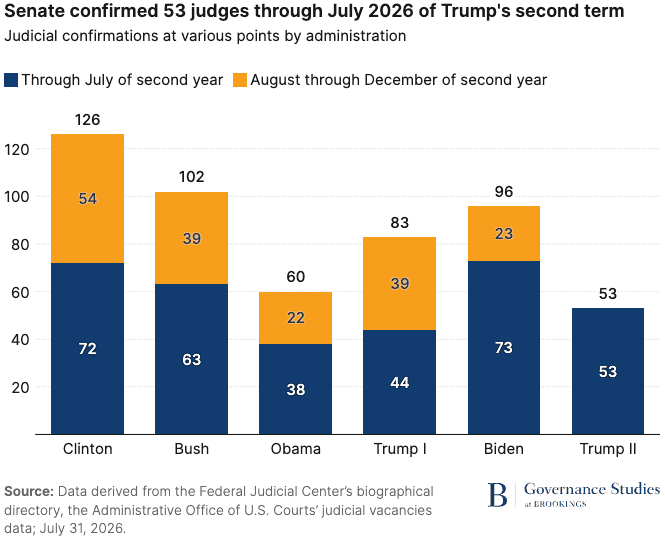
Overall, Senate Republicans have confirmed the president’s judicial picks at a faster clip than Trump’s first term.

“As chairman, I’ve ensured efficient consideration of nominations and under my leadership this Congress we’re processing judicial nominations at a historic pace,” said Senate Judiciary Committee Chairman Chuck Grassley.

“In fact, if you look at the time between nomination and confirmation, we’ve advanced and confirmed Article III judges faster than at any time since Ronald Reagan’s presidency.”

Photo Credit: Brookings Institution

According to the left-leaning Brookings Institution, “Nearly 1 in 3 full-time lower-court federal judges are Trump appointees, due largely to his near-record number of first term confirmations.”

However, given a much lower level of judicial vacancies, Brookings expects the confirmation of new judges to slow. The district and appellate courts now have only 30 vacancies compared to 92 vacancies in July 2018.

Federal judges confirmed today could serve for 30 or 40 years. Each judge’s judicial philosophy matters greatly to how they might rule on issues of life, religious freedom, free speech, parental rights, the protection of girls sports and more.

As we’ve written previously, “Focus on the Family believes that the judicial system plays a vital role in our government, our families and society in general. … The federal judicial system set up by the Founders held up the ideal of limited judicial authority: Judges should stick to offering ‘judgment’ and exercising ‘neither force nor will.’”

Our nation needs more judges today who understand their job is to say what the law is, not what they would like it to be.

As former Justice Antonin Scalia said, “A judge must be, above all else, a servant of the law – and not an enforcer of his personal predilections – about the issues that come before him. The good judge must suppress his personal views and must decide each case as the law dictates, not as he would have resolved the matter if he had drafted the law or the constitutional provision at issue.”

In our constitutional system, the people – not unelected, unaccountable federal judges – get to determine what the law is through their lawfully elected representatives. That’s what it means to have a nation that is of, by and for the people.

Related articles and resources:

US Supreme Court Ends Judicial Tyranny: No More ‘Universal Injunctions’

Judicial Tyranny: Solutions to the Problem of Rogue Federal Judges

Trump Victory Likely Cements Conservative Supreme Court for Decades to Come

Why Elections Matter – The Judicial Impact

Judicial Philosophy

Photo from Getty Images.

Written by Zachary Mettler · Categorized: Government Updates · Tagged: Courts, Trump

Privacy Policy and Terms of Use | Privacy Policy and Terms of Use | © 2026 Focus on the Family. All rights reserved.

  • Cookie Policy