
• Skip to main content
Daily Citizen
  • Subscribe
  • Categories
    • Culture
    • Life
    • Religious Freedom
    • Sexuality
  • Parenting Resources
    • LGBT Pride
    • Homosexuality
    • Sexuality/Marriage
    • Transgender
  • About
    • Contributors
    • Contact
  • Donate

divorce

Aug 20 2025

Could the Divorce Decline Actually Be Bad News?

Daily Citizen has been tracking the long, slow decline in divorce rates in America, here, here, here and here.

But what if that is not actually good news for marriage and the family? It seems like a counter-intuitive thought, but that is what a family scholar at the Institute for Family Studies (IFS) wants us to consider. She makes an interesting and important point.

First, let’s address two big misunderstandings when it comes to divorce.

Most people assume the risk of divorce for couples marrying today is 50%. It is not. It’s actually about 42%. But as research done by Focus on the Family demonstrates, many couples marrying today have a dramatically lower risk of lifetime divorce because they have made life choices and have advantages that dramatically elevate their risk of building a successful marriage.

The other misunderstanding is that almost nine out of ten people assume the divorce rate is rising in the U.S. but it is not. Divorce has steadily declined from its historic high in 1980, to a 50-year low today.

So, why might this remarkable divorce decline not be good news? Leah Libresco Sargeant, the author of the IFS piece, explains “the story of declining divorce isn’t primarily a story of stronger marriages, but of a failure to make matches in the first place.” She is correct on the decline of marriage.

The U.S. Census Bureau reports (May 2024) that married-couple households made up 47% of all U.S. households in 2022, down from 71% in 1970.

The National Center for Family & Marriage Research (NCFMR) at Bowling Green State University notes the U.S. marriage rate has declined 54% from 1900 to today. That rate peaked in 1920 at 92.3%, almost triple today’s rate.

Pew Research Center reports (2023) a dramatic 4-fold increase since 1980 in never married adults in the U.S., a record high. As of 2021, 25% of 40-year-olds in the United States have never married. This is a dramatic increase from 6% in 1980. While many of these unmarried 40-year-olds are living with a romantic partner, most are not. In 2022, 22% of never-married adults aged 40 to 44 were cohabiting. And 80% of marriages taking place today are preceded by some form of cohabitation. Singleness and cohabitation are the relational growth markets.

Sargeant highlights a trend graph by generational birth cohort from a new and important National Bureau of Economics Research working paper addressing why fertility is so low in high income countries. It’s related to declining marriage rates.
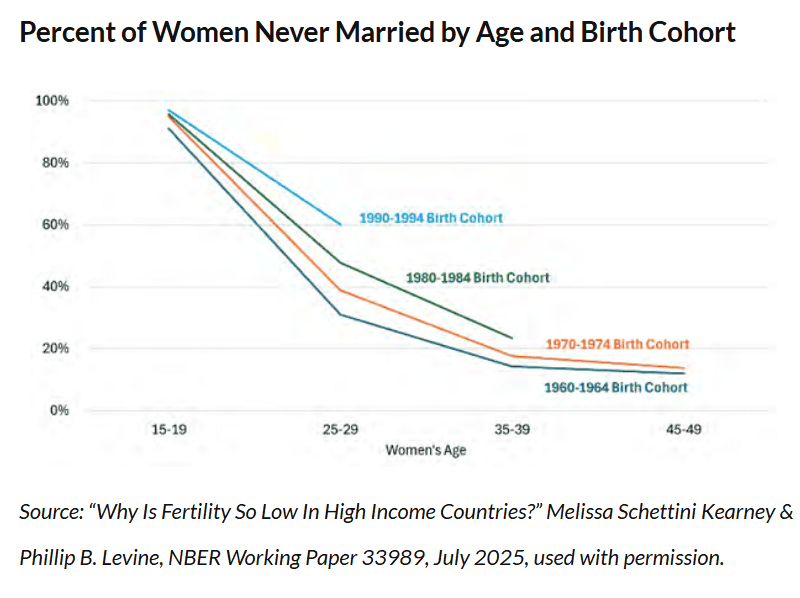
Marriage has been declining sharply for multiple generations. The noted economics paper explains “marriage and fertility remain tightly linked, even in high-income countries today.” The two authors, Melissa Schettini Kearney and Phillip B. Levine, note, “The data reveal that as a descriptive matter, the decline in fertility in high-income countries corresponds to a decline in marriage.”

So, when the population of people marrying declines, so does the pool of people who could possibly get divorced. Sargeant asks, “So, what would represent genuinely encouraging news about marriage in America?”

Her answer, “It would help to see the divorce rate decline while marriage rates rise. Then we might have reason to believe that people were getting better at being married, rather than that our culture was convincing people to give up on marriage.

She adds, “One statistic I’d like to see is how many people of marriageable age can point to strong examples of successful marriages, especially of peers just a few years ahead of them. …When marriage declines, young singles are in a negative feedback loop – they see fewer examples and so marriage becomes more abstract and less achievable.”

We must all lament that growing numbers of men and women are making choices away from marriage and parenthood. Sargeant concludes, “No matter how good that makes the divorce toplines look, that’s still bad news for American families and America’s future.”

As our nation works to recover in so many areas, rebuilding our crumbling marriage and fertility rates must be chief among them. Without families and babies, there is no nation, there is no future.

Related Articles and Resources

If you or someone you know is struggling with marriage issues, Focus on the Family offers a one-time complimentary consultation with our ministry’s professionally trained counseling staff. The consultation is free due to generous donor support.

To reach Focus on the Family’s counseling service by phone, call 1-855-771-HELP (4357) weekdays 6:00 a.m. to 8:00 p.m. (Mountain Time). Please be prepared to leave your contact information for a counselor to return a call to you as soon as possible. Alternatively, you can fill out our Counseling Consultation Request Form.

New Focus on the Family Report: Marriage Health in America

Research Shows New Data on Divorce Risk

Premier Research Documents Long-Term Divorce Harms for Adult Children

Reclaiming the Truth About Marriage

Four Things to Enhance Marital Happiness Among Wives

Research Update: The Compelling Health Benefits of Marriage

Important New Research on How Married Parents Improve Child Well-Being

How Marriage Fights Against Deaths of Despair

New Research: Marriage Still Provides Major Happiness Premium

Don’t Believe the Modern Myth. Marriage Remains Good for Men

Harvard Evolutionary Biologist Brilliantly Explains Necessity of Monogamous Marriage

Image from Shutterstock.

Written by Glenn T. Stanton · Categorized: Marriage · Tagged: divorce, IFS, Random

May 22 2025

Premier Research Documents Long-Term Divorce Harms for Adult Children

A sophisticated new research report published by the National Bureau of Economic Research charts new findings in how divorce is not a temporary bump in the road for children. It has long-term, deleterious effects far into adulthood. This is not a new finding overall. It has long been an established finding in leading academic investigations into the impacts of divorce on children throughout their lives.

However, this important new study does chart some important new ground. Conducted by scholars at the University of Texas at Austin, University of Maryland and the U.S. Census Bureau, these authors examined data on “over 5 million children to examine how divorce affects family arrangements and children’s long-term outcomes.” These children were born between 1988 and 1993.

Because of their sophisticated research methodology, these scholars were able to document the causation of divorce’s harmful impacts on children well into adulthood. This is an important contribution to the literature and this research team did this by looking at children within families to see how the younger children fared after their parents’ divorce, in contrast to their older siblings who spent more of their growing-up years being raised by intact married parents. These scholars explain,

[W]e estimate the effect of divorce on child outcomes including adult earnings, teen birth, mortality, college residency, and incarceration. Our event studies show that divorce represents a significant turning point in children’s outcomes, and our sibling comparisons show that longer exposure to divorce has a lasting impact into adulthood.

Family scholar Patrick T. Brown, a fellow at the Ethics and Public Policy Center, explains the value of this unique research approach: “By comparing siblings from the same family who were different ages when their parents divorced, they can control for a lot (though not all) of the factors that might create concerns about comparing apples to oranges.” It does this by examining 1 million sibling groups whose parents divorced.

Grant Bailey at the Institute for Family Studies adds, “By comparing siblings, the authors can see how divorce affects, say, a 10-year-old versus an 18-year-old within the same family.”

This mitigates selection bias where it could be charged that children of divorce show greater negative outcomes, not because of divorce per se, but because they came from an unhealthy family to start, with parents who had a contentious relationship. This approach shows how outcomes changed at the point of divorce for various siblings within the same family setting. Thus, these scholars assert, “we estimate the causal effects of divorce on children’s adult outcomes.”

So, what did these scholars find?

As economists and not psychologists, they look at three very objective consequences of divorce and their impact on child well-being: changes in financial resources, decline in neighborhood quality due to establishing new housing locations and distance from non-resident parent.

They noted that 95% of children live with their mother after divorce splits their home. Half of parents remarry after 5 years, introducing stepparents and often stepsiblings into kids’ lives, creating greater complications and divided loyalties.

First, income drops considerably for children living in divorced homes. These authors explain,

“When parents divorce, household income drops by half as families divide into separate households. This decline moves the average divorced household from the 57th percentile of the income distribution to the 36th. Households recover about half of their initial income loss over the next decade.”

This means children lose important resources that diminish their housing quality, nutrition, health care and education. They also live further from one of their parents, almost always their father, and this lessens their essential contact with the non-resident father.

“In the year of divorce, the distance between children and their non-resident parent increases to 5 miles at the median and over 100 miles at the mean, and this distance grows significantly over time after the divorce.”

What is most concerning are the measurable impacts they discovered that divorce has on children as they enter their teens and young adult years. They explain, “We find that teen births and child mortality increase following divorce and remain elevated throughout the observation window, suggesting that divorce represents a turning point in the trajectory of children’s outcomes.”

Specifically, children of divorce face the following serious challenges in their teen and early adult years:

  • Teen births increase by 60%. Of course, rates of teen pregnancy will be higher.
  • Child mortality (early death) increases from 35 to 55 percent.
  • 40 to 45% increase in incarceration rates.
  • They earn substantially less (9 to 13%) in adulthood, equal to obtaining one less year of education.
  • Decreased chance of attending college.

Kids who do not experience parental divorce do not suffer these significant setbacks. These scholars found that up to 60 percent of the negative divorce effects on adult children are due to three leading factors: substantial declines in household income, lowered neighborhood quality after divorce due to multiple moves, and obvious distance and disaffection from at least one parent.

To be sure, these scholars only looked at a relatively small set of outcomes from divorce. They did not examine broader psychological outcomes on children experiencing the death of their mother and father’s marriage. Others have examined such things and the outcomes are equally negative.

Data like these further document why it is so important that churches, para-ministries like Focus on the Family, clinicians and extended families do all they can do to help married couples in crisis gain access to marriage-saving insights and resources so that everyone can avoid the measurable damage divorce brings to the lives of children, their parents and society at large.

Focus on the Family’s Hope Restored crisis marriage ministry provides a lifeline to couples who are struggling. Struggling individuals and couples can call 1-855-771-HELP (4357) weekdays from 6:00 a.m. to 8:00 p.m. (Mountain Time), or complete our Counseling Consultation Request Form to be connected with one of our licensed or pastoral counselor.

Related Articles and Resources

Reclaiming the Truth About Marriage

Four Things to Enhance Marital Happiness Among Wives

Research Update: The Compelling Health Benefits of Marriage

Important New Research on How Married Parents Improve Child Well-Being

How Marriage Fights Against Deaths of Despair

New Research: Marriage Still Provides Major Happiness Premium

Family Scholars Explain the Current Marriage Paradox in America

New Research Shows Married Families Matter More Than Ever

Cohabitation Still Harmful – Even as Stigma Disappears

Don’t Believe the Modern Myth. Marriage Remains Good for Women

Don’t Believe the Modern Myth. Marriage Remains Good for Men.

Yes, Married Mothers Really Are Happier Than Unmarried and Childless Women

Married Fatherhood Makes Men Better

Marriage and the Public Good: A New Manifesto of Policy Proposals

Image from Shutterstock.

Written by Glenn T. Stanton · Categorized: Family · Tagged: divorce, parenting

Privacy Policy and Terms of Use | Privacy Policy and Terms of Use | © 2025 Focus on the Family. All rights reserved.

  • Cookie Policy