• Skip to main content
Daily Citizen
  • Subscribe
  • Categories
    • Culture
    • Life
    • Religious Freedom
    • Sexuality
  • Parenting Resources
    • LGBT Pride
    • Homosexuality
    • Sexuality/Marriage
    • Transgender
  • About
    • Contributors
    • Contact
  • Donate

free speech

Dec 09 2025

‘The Babylon Bee’ Fights Hawaii Law Censoring Political Speech

The Babylon Bee went to court to challenge a Hawaii law banning “deceptive media” during the 10 months before an election.

The Hawaiian legislature passed S2687 in July 2024, allegedly to stop the spread of election “disinformation and misinformation,” which, according to the measure, “can increase political tensions and result in electoral-related conflict and violence.”

The law censors the use of “deepfake and generative AI technologies” that could in any way risk harming “the reputation or electoral prospects of a candidate in an election or changing the voting behavior of voters in an election.”

Alliance Defending Freedom (ADF) filed the lawsuit on behalf of the satirical news site and Dawn O’Brien, a Hawaiian podcaster and media personality.

Babylon Bee CEO Seth Dillon said, in an ADF press release, that the ordinance was an unconstitutional muzzling of the outlet’s free speech:

We use comedy to speak about current events in a way others can’t, and Hawaii is robbing us of that voice. The First Amendment protects our right to tell jokes, whether it’s election season or not. We’ll never stop fighting to defend that freedom.

Hawaii’s law specifically targets videos, audio and images that are digitally created or altered, requiring anyone who posts these to include “a disclaimer informing the viewer that the media has been manipulated by technical means and depicts appearance, speech, or conduct that did not occur.”

The state’s Campaign Spending Commission is responsible for enforcing the measure which the Bee refuses to comply with.

As the lawsuit states, Hawaii’s law creates serious consequences for anyone who creates or posts “deceptive media” about political candidates:

Its new law, S2687, threatens jail time, fines, lawsuits, damages, injunctions, attorney’s fees, and even a ten-year disqualification from holding public office. It bans digitally created content, like memes or satirical images, that risks harming a candidate’s reputation or electoral prospects or changing someone’s voting behavior.  

ADF Legal Counsel Matthew Hoffmann explained that the law is unconstitutional because it suppresses free speech:

Hawaii’s war against political memes and satire is censorship, pure and simple. Satire has served as an important vehicle to deliver truth with a smile for centuries, and this kind of speech receives the utmost protection under the Constitution.
The First Amendment doesn’t allow Hawaii to choose what political speech is acceptable, and we are urging the court to stop this unnecessary censorship.

The lawsuit describes The Babylon Bee’s popularity as “a website that exposes foolishness, mocks absurdity, and highlights hypocrisy in faith, politics, and culture through satire, humor, and parody.” It has a huge following on social media:

The Bee currently has nearly five million followers on X, over two million followers on Instagram, over one and a half million followers on Facebook, nearly half a million followers on Rumble, and nearly two million subscribers on YouTube.

The lawsuit included past content from the Bee involving Hawaiian and national politicians that was censored by social media platforms – and could just as easily be targeted by the Campaign Spending Commission.

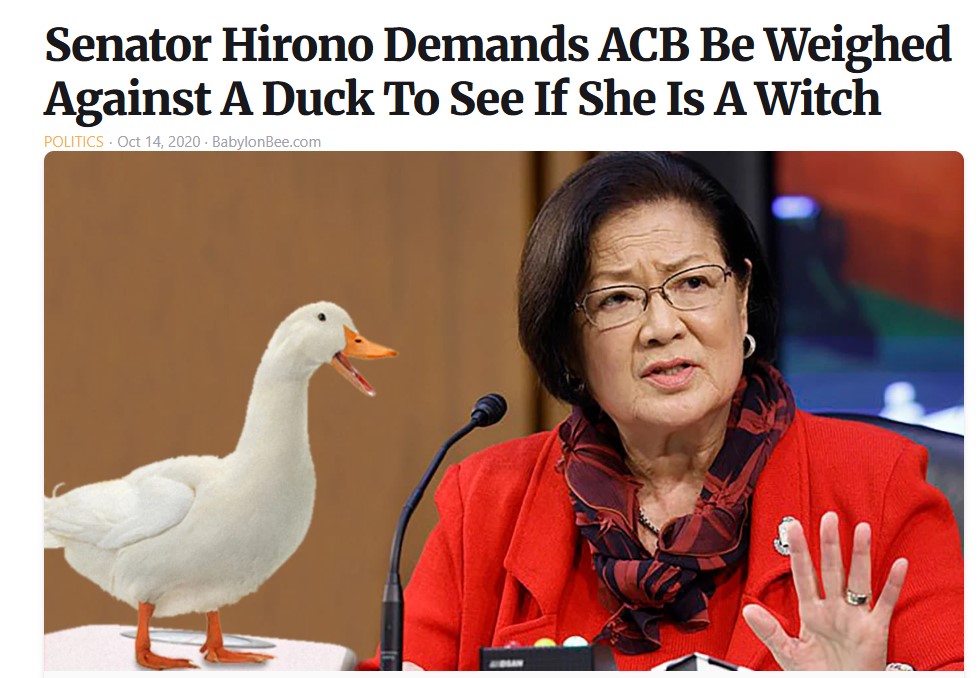
For example, Facebook deleted a Babylon Bee post with a digitally altered image of Hawaii Senator Mazie Hirono, next to a duck, saying the post “incit[ed] violence.”

As the Bee’s CEO Seth Dillon opined:

In what universe does a fictional quote as part of an obvious joke constitute a genuine incitement to violence? How does context not come into play here?

Likewise, the lawsuit listed a post about President Donald Trump dressed as Peanut the Squirrel, an icon of freedom who was unjustly killed by New York officials. Postings like this, about national candidates, could also lead to penalties for the Bee:  

Trump Projected To Win In 50-State Landslide After Appearing In Squirrel Costume https://t.co/QNGlcGERxC pic.twitter.com/tFPgiyfSUO

— The Babylon Bee (@TheBabylonBee) November 2, 2024

While the Bee says it will defy the ban, the law has already stifled free speech for some. O’Brien has said she will avoid posting content because of the harsh penalties.

In  ADF’s press release, she explained that S2687 violates Hawaiian’s natural rights:

Both ‘Hawai’i’ and ‘Aloha’ are rooted in ‘-ha,’ the Hawaiian word for ‘breath of life. It’s the very essence of our identity: to breathe and speak freely, to express our hearts with one another. No ‘ha’ means no aloha and no Hawai’i.
Our governor and lawmakers are trying once again to steal inalienable rights from our Hawai’i ‘ohana’ – our family and community. That is not Aloha nor is it Hawai’i. Let’s stand for our freedoms and families against illegal censorship. I stand for our beloved Aloha State.

We’ll keep you posted on this important First Amendment case, Babylon Bee v. Lopez.

Related articles and resources:

‘Babylon Bee’ Gets Locked Out of Twitter, CEO Says, “Truth Is Not Hate Speech”

The Babylon Bee Is Helping Win the War on Woke

Babylon Bee Makes Triumphant Return to Twitter After Elon Musk Agrees to #FreeTheBee

CEO of Babylon Bee Tells Advocates at Pro-Life Conference ‘Only Thing More Costly Than Standing up to Culture of Death is Not Standing Up to It’

How the Boldness of ‘The Babylon Bee’ Helped Save Free Speech

Is David French Right — Is Our Religious Liberty Secure?

It’s Official: Elon Musk Buys Twitter in Potentially Massive Victory for Free Speech

Twitter Locks Out ‘The Daily Citizen’ Over Factual Reporting on Biden’s Transgender Nominee

Written by Jeff Johnston · Categorized: Culture · Tagged: free speech

Dec 05 2025

Why Self-Censorship is a Real Problem

A trusted colleague recently said to me, playfully, at our morning Daily Citizen editorial meeting, “Glenn, that’s an inside-your-head thought, not a say-it-out-loud thought.” She was right. Not saying everything that passes through our mind is a part of being an adult and good community member.

But things are getting very much out of hand in this regard in American and other countries. Self-censorship – the practice of holding back speaking certain reasonable thoughts and convictions because we fear people’s reactions – is on the rise in concerning ways.

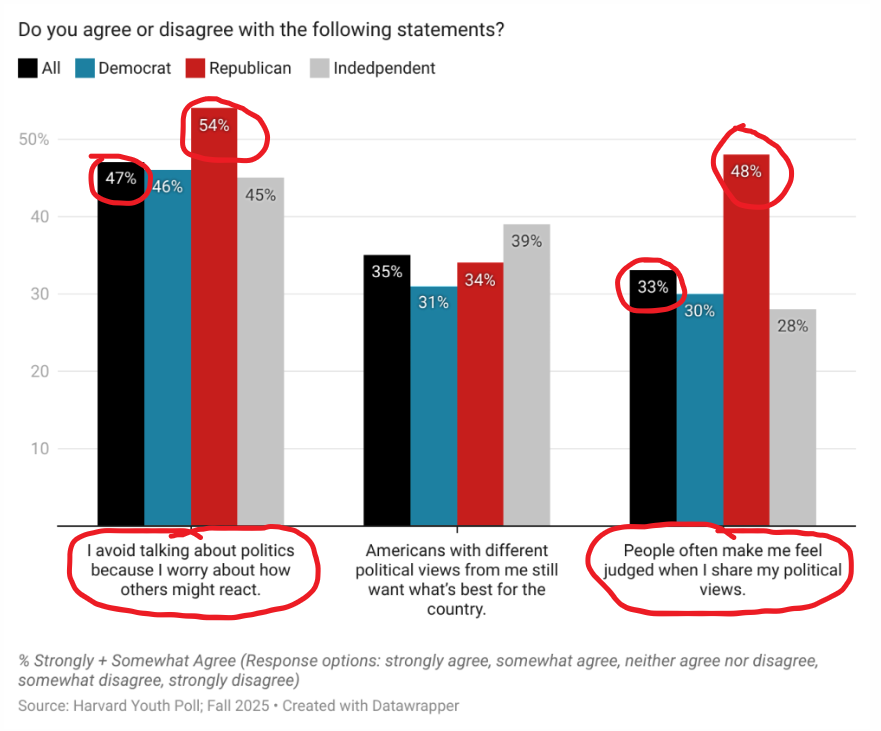
A new Harvard Kennedy School poll of young adults (aged 18-29) demonstrates this.

A dramatic 47% of young Americans say they “avoid talking about politics because I worry about how others might react.” Interestingly, young Republicans are markedly more likely at 54% to say this compared to their democrat and independent peers.

Add to this the fact that young adult republicans are notably more likely than their democrat or independent peers to confess “people often make me feel judged when I share my political views.” The report admitted this, explaining, “These concerns are most pronounced among Republicans: nearly half (48%) agree that they often feel judged, compared with 30% of Democrats and 28% of independents.”

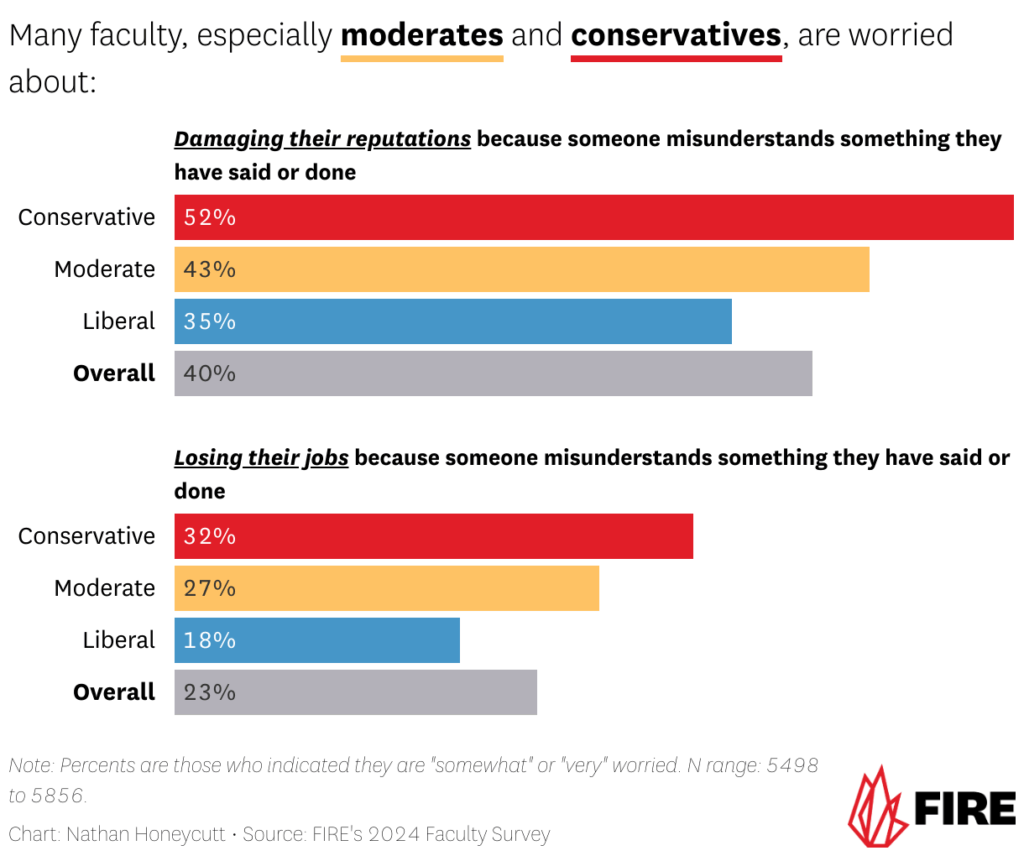
Fear of speaking honestly in public has been happening among college and university faculty as well. The Foundation for Individual Rights and Expression’s (FIRE) most recent report on policing of speech codes on campus details how out of hand this has gotten and the emotional toll it has taken. Of professors that have had their professional communications challenged by student and others, FIRE explains, “Roughly two-thirds (65%) experienced emotional distress, and significant chunks reported facing harrowing social setbacks, such as being shunned at work (40%) or losing professional relationships (47%) and friendships (33%).”  Fifty-three percent report having suffered from loss of sleep.

What makes it worse is that college and university administrators failed to support faculty who were criticized by students or the public for stating certain academic beliefs in their writings and the classroom.

FIRE’s 2024 report states, “35% of faculty say they recently toned down their writing for fear of controversy, compared to 9% of faculty who said the same during the McCarthy era.”  It also reported that conservative faculty felt the most pressure, being more likely to feel something they said could damage their reputation or cause them to lose their job.

And for good reason. Carol Hooven, a classically liberal professor was run out of Harvard by woke students for merely speaking biological truths. Many professors and teachers have taken notice of her experience and are checking what they say. This is a travesty.

A 2022 report carefully documents the problem of self-censorship is not confined to America. It explains how a “chilling effect” is affecting Christians around the world. This report’s number one conclusion is this: “The Church has allowed itself to be self-censored.” This is a tragedy, as Christians are called to speak truth to a hungry and needy world and resist bullying to stay silent. The report’s conclusion added, “Christian leaders must be doubly prepared to defend their positions.” They must, and with unapologetic boldness.

Speaking to his follow academics, American Enterprise Institute Senior Fellow Samuel Abrams strikes the same tone, “The path back to sanity is not complicated. But it requires courage.”

Courage is required of everyone in this age of woke speech policing. Never be intimidated to say what you know to be true, doing so with conviction, utter confidence, gentleness and respect. Refusing to back down is what bullies fear most. And the woke speech police roaming our culture and school halls today are the new bullies.

They must be resisted.

Photo from Shutterstock.

Written by Glenn T. Stanton · Categorized: Culture · Tagged: censorship, free speech

Dec 02 2025

Supreme Court To Hear Evangelist’s Religious Freedom Case

On December 3, the U.S. Supreme Court will hear an important religious freedom case brought by Gabriel Olivier, a Christian evangelist who was arrested for telling others about Jesus at a public park in Brandon, Mississippi.

Six years ago, the city built a new amphitheater in a 250 acre park, The Quarry. As First Liberty, a Christian legal aid group, explained in a summary of the case:

“Gabriel (Gabe) Olivier is a Christian who is passionate about his faith and obliged to tell others about the hope and love he has found in Jesus Christ. He often stands in public places near well-attended events where he can peaceably share the gospel with as many people as possible.”

But the City of Brandon passed an ordinance limiting “protests” or “demonstrations” to a 10-by-10-foot space, 100 yards away from the venue. The city included “oral dialogue, signs, literature, expressive clothing, or one-on-one conversations” – including religious speech – in its definition of “protests.”

Here’s the tiny “free speech zone,” outlined in white, far from the amphitheater.

First Liberty said, “Gabe and his small group walked to the designated ‘protest zone’ where the city would have them stand and evangelize.”

But the group found that “no one could hear or see them while confined to the box, much less converse with or accept literature from them, rendering their outreach efforts useless,” so they moved closer to the amphitheater.

First Liberty explained what happened next:

“But since this practical evangelism ran counter to the ordinance, a police officer soon arrested Gabe for violating the law and took him away in a squad car. He pled “no contest” to the charge – which was not an admission of guilt – and paid the $304 fine.”

Olivier challenged the city’s statute, but “the district court dismissed his constitutional claim without even considering its merits.”

He appealed the case, but he was denied a hearing.

“A Fifth Circuit panel, on appeal, affirmed the lower court, and the entire Fifth Circuit declined to hear the case by a 9 to 8 vote.”

“These courts relied on a U.S. Supreme Court case, Heck v. Humphrey, that held a prisoner could not bring a constitutional claim challenging verdict or sentencing and must instead turn to a form of relief known as habeas corpus – a recourse only available for prisoners – so as not to overturn the guilty verdict of the state criminal court.”

As First Liberty pointed out, Olivier was not a prisoner seeking to overturn a criminal verdict, and he hadn’t been found guilty of a crime.

Still, the courts refused to even consider the City of Brandon’s unconstitutional denial of Olivier’s First Amendment rights, and “Gabe Olivier was effectively denied his day in Court.”

First Liberty and the law firm Gibson Dunn appealed the case to the Supreme Court, which accepted the case in July.

Allyson Ho, a partner at Gibson Dunn and volunteer attorney with First Liberty, will represent Olivier before the court. First Liberty described her as “a seasoned and elite litigator, adding, “She has presented over 100 oral arguments in federal and state courts nationwide, including six high-stakes business cases before the Supreme Court.”

The case is important, as First Liberty explained, because Olivier was denied his First Amendment rights – and then stripped of the ability to defend those freedoms in court.

“Constitutional rights mean little if we cannot assert them in court. We need the Supreme Court to bring clarity to a Heck precedent that is being wrongly applied to keep people from enjoining unconstitutional laws that persist in violating their rights. Everyone deserves their day in court, especially when First Amendment rights are at stake,” the Christian legal aid group explained.

We wish Gabriel Olivier well as he works to protect his religious liberty and free speech.

This is a case where we are definitely not saying, “Let’s go Brandon!”

The case is: Gabriel Olivier v. City of Brandon.

Related Articles and Resources

Court Awards $885,000 in Attorney Fees After Counseling Censorship Victory

Mark Matlock: Making Meaningful Connections with the Spiritually Curious

Oregon School District Pays $650,000 for Firing Teachers Opposed to ‘Trans’ Policy

Photographer Emilee Carpenter Wins Crucial Free Speech Victory Against New York

Pro-Life Activist Arrested for Peaceful Prayer Appeals to Supreme Court

Sidewalk Evangelist Wins Right to Share Good News

Three Ways to Introduce Your Friends to Jesus

U.S. Supreme Court Will Hear Case of Evangelist Banned From Sharing His Faith

Winsome Apologetics Through Questions and Logic

Written by Jeff Johnston · Categorized: Culture · Tagged: free speech

Sep 25 2025

Believers Must Differentiate Free Speech, ‘Hate Speech,’ Censorship and ‘Cancel Culture’ — Here’s How

Late night television host Jimmy Kimmel returned to airwaves on Tuesday, September 23, after a brief suspension.

Disney stopped production of Jimmy Kimmel Live! last week after Kimmel claimed Charlie Kirk’s assassin was one of the “MAGA gang,” which is untrue. Two ABC affiliates, Nexstar and Sinclair, subsequently refused to air Kimmel’s show.  

Neither affiliate broadcast Kimmel’s return, citing ongoing discussions with ABC and Disney.

Kimmel’s brief retirement from late night TV is part of a larger national discussion about free speech, hate speech, cancel culture and censorship in the wake of Kirk’s assassination.

Some, including Kimmel, believe the federal government illegally censored him for saying speech it doesn’t like. They argue Nexstar dropped Kimmel to secure the Federal Communications Commission’s (FCC) approval on an upcoming merger.

FCC Chair Brendon Carr denies getting involved. He and others blame the host’s brief ouster on his show’s poor ratings.

Believers greatly benefit from free speech protections, which allow us to spread the Gospel, practice Christianity and raise families according to the Bible’s instruction. But supporting free speech doesn’t require Christians to support evil speech.

Here are some tips to help identify and differentiate between free speech, “hate speech,” censorship and “cancel culture.”

The First Amendment gives Americans the right to say almost anything they want. It also protects citizens from being forced to speak what they don’t believe.

While broad, the First Amendment does not protect every kind of speech. It does not protect obscenity or speech inciting “imminent lawless action.” Governments can further pass laws curtailing free speech if they prove the law serves a legitimate government interest and limits speech as little as possible.

Recently, local, state and federal governments have tried censoring “misinformation” and “hate speech,” two notoriously nebulous concepts with no consistent legal definition.

Both terms can be weaponized against citizens. Critics frequently tried to prevent Charlie Kirk from speaking at college campuses on the grounds he spread “hate speech.” The Biden administration censored those who claimed COVID-19 leaked from a Chinese viral laboratory for spreading misinformation. The story later proved true.

There’s no direct evidence suggesting the FCC pressured Nexstar to drop Jimmy Kimmel. If it did, however, it should not have. Federal agencies shouldn’t pressure private companies to censor unfavorable speech.

Kimmel’s right to free speech, however, does not exempt him from professional expectations of speech. Entertainment companies closely regulate what talent says on air and on social media. If the controversial host finally fell afoul of Disney’s publication standards, his brief suspension would not constitute a First Amendment violation. No one is constitutionally entitled to a television show.

Similarly, the First Amendment does not immunize Americans from the consequences of their speech.

Social standards of conduct and speech enable people to live in community by incentivizing prosocial behavior and punishing antisocial behavior. Those who say vile things can — and should — face social consequences for doing so.

“Cancel culture” is a disordering of social standards in which a person faces unfair or disproportionate social consequences for their behavior.

“Cancel culture,” like “hate speech” and “misinformation,” is notoriously vague. There will always be some ambiguity about whether a person “deserves” to face social consequences. That being said, I argue “cancellations” fall into three broad categories.

Cancelling those who speak the truth.

Conservative pundit Matt Walsh argues a “cancel culture” punishes people for speaking objective truth, like arguing there are only two sexes.

Cancel culture driven by the government.

The government engages in cancel culture by artificially limiting the speech and reach of citizens. This occurred when the Biden administration pressured Twitter and Facebook to remove and limit posts that questioned government narratives about COVID-19.

Person-specific cancel culture.

Person-driven cancelations occur when a person or group determines someone “deserves” to be canceled before finding evidence to support their conclusion. The cancelers inspire social outrage by digging through the cancel-ees online footprint to find objectionable content or dirty laundry, often from years ago.

Genuine social consequences, unlike “cancel culture,” aren’t person-specific or driven by the government. They are organic reactions to real antisocial behaviors. A good example is those who have been fired from their jobs for celebrating Charlie Kirk’s death.

One of humanity’s longest standing norms is the value of human life. It is prosocial to protect human life and antisocial to take it or celebrate its end.

This norm has eroded in recent years, as evidenced by the normalization of abortion and vigilante violence. But those who celebrated Kirk’s death erroneously assumed this expectation had dissolved entirely.

The First Amendment absolutely protects speech praising Charlie Kirk’s death. But the First Amendment also protects other Americans’ right to call out this vile behavior — and report it to the posters’ respective workplaces.

Proverbs 12:18 reads, “There is one whose rash words are like sword thrusts, but the tongue of the wise brings healing” (ESV). Believers have an obligation to use their speech wisely. The Daily Citizen invites you to use biblical discernment to determine when and how to speak truth online and in person.

When in doubt, always remember — it’s never a good idea to celebrate someone’s death on the internet.

Additional Articles and Resources

‘I Forgive Him’: Three of the Most Impactful Moments from Charlie Kirk’s Memorial

VP Vance: ‘The Most Important Truth’ Charlie Kirk Told is Jesus is Lord

Charlie Kirk: Man of Faith, Family and Fidelity

Transgender Ideology is Inherently Destructive

California State Officials Worked With Big Tech to Censor 2020 Election Posts

Colorado Bills Would Regulate ’Fake News’ in Social Media and Teach Children About ’Misinformation’ in the Media

DHS Threat Advisory Targets ‘False or Misleading Narratives’ that ‘Undermine Trust in U.S. Government Institutions’

Department of Homeland Security Launches Disinformation Governance Board

Government ‘Disinformation’ Board ‘Paused’ After Public Mockery

Written by Emily Washburn · Categorized: Culture · Tagged: cancel culture, free speech

May 19 2025

California Family Wins Early Legal Victory for Parental Rights, Religious Freedom

JUMP TO…
  • Background
  • The Case
  • The Ruling
  • Mahmoud v. Taylor
  • Why It Matters

A California school district must allow parents to opt their children out of some activities pushing gender ideology, the Southern District Court of California ordered in a preliminary injunction issued last week.  

The decision is an encouraging early win for Carlos and Jenny Encinas. The parents of three young kids made the difficult decision to sue Encinitas Union School District last year after their 11-year-old son, a Christian, was forced to teach his kindergarten buddy about gender identity.

“[The preliminary injunction] prevents the school district from teaching [students] about gender ideology in the [kindergarten] buddy class program unless they provide advanced notice and opt out [opportunities],” the Encinas’ lawyer, First Liberty Attorney Kayla Toney, told First Liberty Live.

“That’s exactly what our clients were asking for all along.”

Background

The Daily Citizen interviewed Toney and Carlos shortly before the district court’s ruling. Carlos confirmed he and his wife weren’t itching for a grueling legal battle. They just wanted to opt their sons out of activities teaching gender ideology — or forcing their sons to teach gender ideology to others.

When La Costa Heights Elementary and Encinitas Union School District denied both of the Encinas’ opt-out requests, the couple had nowhere else to turn.

“We are seeking resolution from the court system because we have no other choice,” Carlos told us.

The Encinas family experienced ruthless bullying for trying to exercise their parental rights. Carlos and Jenny received threats and harassment online for being “hateful.” The couple’s two sons became targets of other children — and even adults — at school.

Eventually, the Encinas boys moved schools altogether. But the family remains determined to see their case through.

“I feel like God’s got a plan in this and chose my son and our family for a reason,” Carlos reflected. “I have absolute faith that we are part of a spiritual battle that is going to be part of an ultimate renewal.”

To read more of the Daily Citizen’s interview with Carlos, click here.

The Case

The Encinas’ case alleges Encinitas Union School District infringed on their family’s:

  • Parental rights
  • Right to freely exercise their religion
  • Free speech rights

The district violated Carlos and Jenny’s parental rights by denying their request to opt out of activities teaching gender ideology.

California law requires schools to allow parents to opt out of sex ed lessons. Encinitas Union claims this law only applies to material taught in traditional sex ed units, rather than sexual material in general. The Encinases argue parental opt-out requirements apply to all sexual content, regardless of the curricula it’s rolled into.

Toney sums up:

[The district] is claiming that they don’t have to provide [parental] opt-outs when the exact same material about sexuality and gender identity is taught in other classes, in younger grades, outside the sexual education unit.

The district also violated the Encinas family’s right to freely exercise their religion by denying their request to opt out. A school cannot constitutionally deny religious exemptions while granting other, non-religious exemptions. Toney expands:

The school is able to provide opt-outs, and is required in certain circumstances. It’s very common in a school environment.
[But] the free exercise clause says that, if there’s a system of exemptions for any reason, then religious exemptions have to be provided too. Religion can’t be treated less favorably than other interests.

Encinitas Union School District violated the Encinas’ eldest son’s free speech rights by forcing him to teach gender ideology to his kindergarten buddy. Toney explains:

Our position is that what happened to Carlos’ son was compelled speech, because the government — the school district — was using the children to teach its own message about gender that directly conflicted with [his] religious beliefs.

The Supreme Court has considered “compelled speech” a violation of the free speech clause for nearly a century.

The Ruling

The Southern District Court of California granted the Encinas family’s request for preliminary injunction against the district. The injunction will not only prevent the district from violating parents’ rights while the case is adjudicated, but also require schools like La Costa Heights to notify parents about sexualized lessons.

Until now, Carlos tells the Daily Citizen, these lessons have been shrouded in secrecy.

“In talking to other parents, we discovered a pattern in the way the school and the district suppressed objections to [inappropriate sexual material],” he explained. “It was like they wanted to hide how they were promoting some of this stuff in the classroom.”

The judge largely affirmed the Encinas’ arguments, according to Toney — an encouraging sign for future rulings. He expressed particular concern over the district’s alleged free speech violations.

“The judge here was very focused on the children, and how children have a right to believe in God,” Toney recounted to First Liberty Live. “They have a right to express their faith and they have a right to not be forced to express a message that they disagree with.”

Mahmoud v. Taylor

The U.S. Supreme Court heard arguments in a case similar to the Encinas family’s just last month.

In Mahmoud v. Taylor, families of diverse faith backgrounds argue a Maryland school district violated their right to freely exercise their religion after the district taught LGBT children’s books in elementary school classes — without notice or the chance to opt out.

Like Encinitas Union School District, Montgomery County Public Schools tried to get around parental opt-out requirements by rolling inappropriate sexual material into other subjects. Outside of sex ed, Montgomery County tried to argue, the school district isn’t required to allow parents to opt out.

As the Daily Citizen previously reported, the six conservative justices seemed sympathetic to parents during oral arguments, expressing concern that Montgomery County could be burdening families’ religious exercise.

Carlos felt profound relief after listening to the case.

“It was amazing to hear some of the highest legal authorities in the land ask some of the questions we, ourselves, asked early on.” he told the Daily Citizen.

Like, “Wait a second, why can’t you guys opt us out of this? We just don’t want to participate.” To have a Supreme Court justice ask that same question over and over again, and get the same unclear explanation, and then have that justice come back and say, “Wait hold on, I’m still not understanding the answers” — that’s another kind of inspiration.

To learn more about Mahmoud v. Taylor, click here.

Why It Matters

The Daily Citizen is grateful to the Encinas family for putting themselves on the line to protect the right of all parents to raise their children according to their faith.

We will continue to cover this important case.

To read more about the Encinas’ story, click here.

Additional Articles and Resources

California Family harassed After Trying to Opt-Out of Activities Teaching Gender Ideology

Supreme Court Sympathetic to Opt-Outs for LGBT Curriculum

Common Spirit Denied Teen Body Medical Care After Parents Objected to Doctor’s Bizarre Questions

Three Ways the Media Supports Sexually Explicit, Inappropriate Books for Children

Liberal Father Seeks to Disprove Concerns Over Sexually Explicit Books in Schools, Becomes Convinced These Books Are Not for Children

Sexualizing Schoolchildren: Classroom and Library Books

Written by Emily Washburn · Categorized: Education, Family · Tagged: encinas, free speech, parental rights, religious freedom

  • Page 1
  • Page 2
  • Page 3
  • Go to Next Page »

Privacy Policy and Terms of Use | Privacy Policy and Terms of Use | © 2025 Focus on the Family. All rights reserved.

  • Cookie Policy