• Skip to main content
Daily Citizen
  • Subscribe
  • Categories
    • Culture
    • Life
    • Religious Freedom
    • Sexuality
  • Parenting Resources
    • LGBT Pride
    • Homosexuality
    • Sexuality/Marriage
    • Transgender
  • About
    • Contributors
    • Contact
  • Donate

IFS

Oct 28 2025

Are Men or Women More Likely to Be Married?

Marriage is built on the lifelong union of a man and a woman. So, when sociologists ask “Who is more likely to be married, men or women?,” the answer seems obvious. Both, right?

The truth more complex than it initially seems. Men and women have different likelihoods of being married and at different life stages.

This is a topic the Institute for Family Studies (IFS) has brought much needed understanding to; young men are indeed less likely to be married than young women.

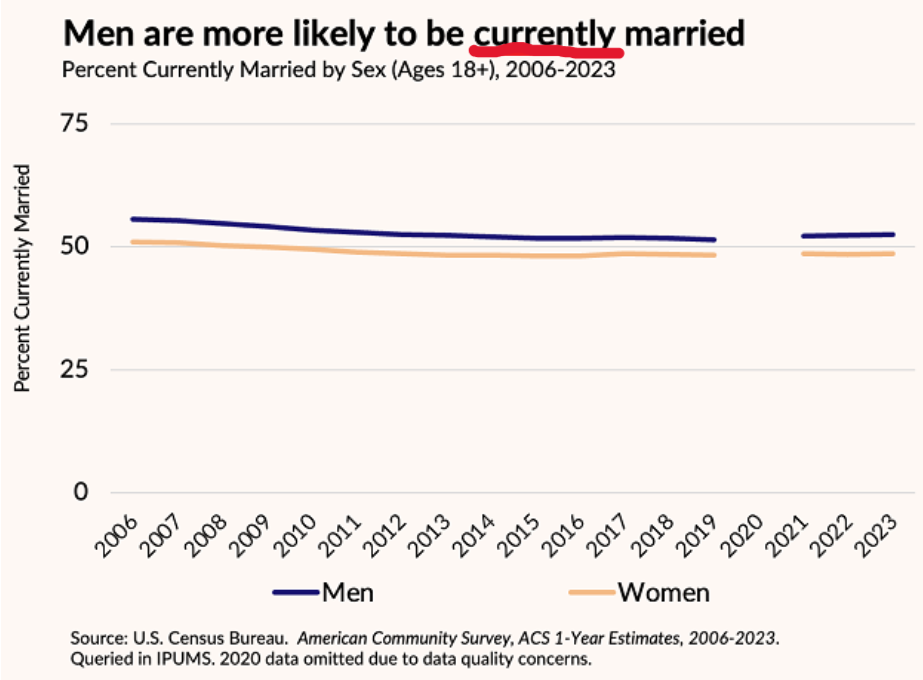
But curiously, they note that “while men are more likely than women to be ‘never married,’ they are also more likely to be currently married.”

 IFS demonstrates this in the following two charts.
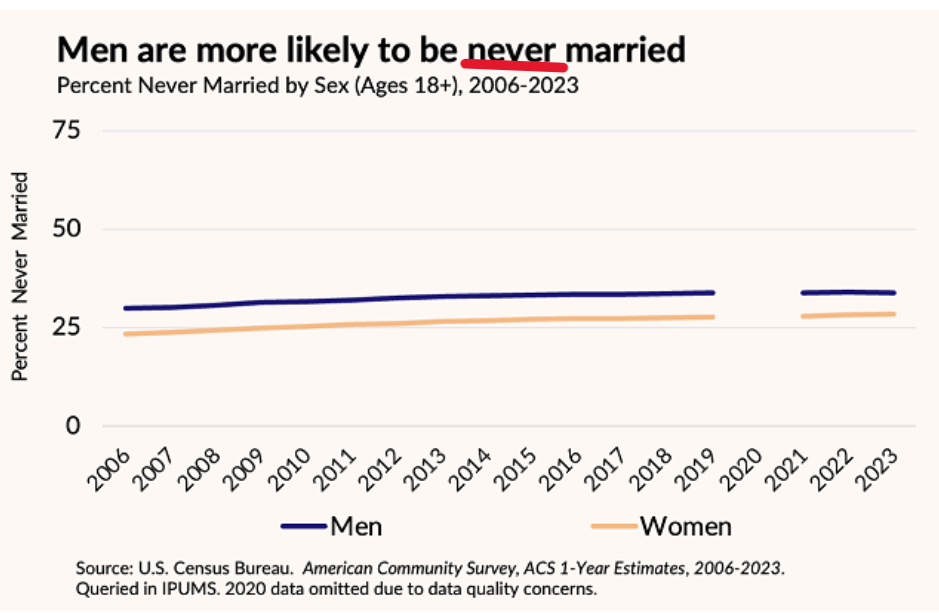
IFS explains these seemingly conflicting facts are not paradoxical, but rather “reflect differences in the timing of marriage, divorce, remarriage, and mortality between the sexes.”

Most of the confusion on this topic is when looking at the data for young adults; young men do marry less than young women. “Among U.S. adults ages 25-34, approximately 42% of women are married compared with only 35% of men in 2023 – a gap of about 7 percentage points.”

Marriage rates for all U.S. adult men and women, however, is completely reversed.

IFS states, “Among all U.S. adults in 2023, approximately 49% of women were currently married compared to 53% of men.” Other family scholars report the same sex-distinct trends.

Women in the United States, like in most countries, marry at younger ages compared to males.

In 2024, the median age of a first marriage was 30.2 (men) and 28.6 (women).

As men and women move into later years, however (ages 34-44), a difference in marital status by sex largely disappears: 60% of men and 61% of women are married.

IFS explains that sex differences in those unmarried also disappear with age (7% in 2023 for both men and women).

The scholars report, “That is, despite differences in when they get married, men and women have similar lifetime likelihoods of ever being married.”

But marriage differences emerge among men and women when we look at other important life factors.

Men are notably more likely to re-marry after divorce compared to women. This consistent fact “leaves the population of those divorced – and not currently married – disproportionately female.”

Therefore, among all divorced U.S. adults (or those who indicate they are divorced), only 73 men for every 100 women report this.

Older men are more likely to be married because women disproportionately populate the widow category; statistically, men more likely to die younger than women, by dramatic margins. Additionally, widowed men are significantly more likely to remarry.

IFS notes there are only 31 widowed men for every 100 widowed women in the United States. And

These are the primary reasons why more men than woman tend to be married in later age categories. 

IFS explains, “Sixty-eight percent of men ages 65 and over are currently married while less than half (47%) of women ages 65 and over are currently married – a gap of about 22 percentage points.”

In essence, it really depends on age. Women marry younger, but men are more likely to be married than their female peers because they are less likely to become widows or remain unmarried after divorce.

These are just a few more examples of how men and women are indeed different. Marriage involves one man and one woman, but men and women live different lives.

Related Articles and Resources

Family Scholars Explain the Current Marriage Paradox in America

New Research Shows Married Families Matter More Than Ever

Why You Should Care About the Growing Positive Power of Marriage

Important New Research on How Married Parents Improve Child Well-Being

New Research: Marriage Still Provides Major Happiness Premium

Cohabitation Still Harmful – Even as Stigma Disappears

Don’t Believe the Modern Myth. Marriage Remains Good for Women

Don’t Believe the Modern Myth. Marriage Remains Good for Men.

Yes, Married Mothers Really Are Happier Than Unmarried and Childless Women

Marriage and the Public Good: A New Manifesto of Policy Proposals

Image from Shutterstock.
Written by Glenn T. Stanton · Categorized: Family · Tagged: IFS

Aug 27 2025

Why Married Mothers are Happier than Single, Childless Peers

Most people assume motherhood and the life of wives is one of drudgery, endless chores and meeting the needs of others. Few believe married motherhood leads to greater happiness. We presume it’s the carefree, single girls – not tied down by children or wedlock – who are having all the fun and fulfillment.

But is this really true? Daily Citizen has addressed this question often, here, here, here and here. The fact is, married moms are the happiest and most contented in life compared to their unmarried and childless peers.

A new report from the great scholars at the Institute for Family Studies, led by San Diego State University’s Jean W. Twenge, further demonstrates how true this fact is. In fielding the Women’s Well-Being Survey (WWS) of 3,000 U.S. women in early March, these family scholars sought to understand why married mothers are the happiest among women.

This team reports, “Consistent with previous surveys, our new survey finds that married mothers are happier than unmarried women or women without children.”

In fact, they found, “Nearly twice as many married mothers say they are ‘very happy’ as unmarried women without children.”

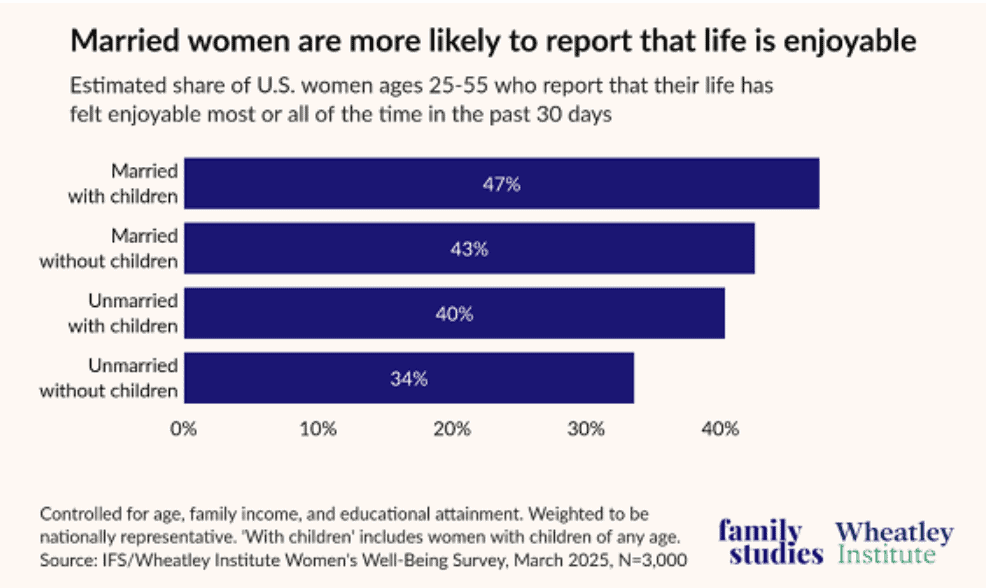
Remarkably, 47% of married mothers report their “life is enjoyable most or all of the time.” Forty-three percent of married women without children indicated this was true. Only 40% of unmarried mothers and 34% of unmarried women without children said their life was highly enjoyable.

This research team then asked: Why are married mothers happier than their peers? They assert, “Both marriage and motherhood appear to play a role, though in different ways.” There are three factors at work here. Married mothers benefit from greater social connection, increased benefit from physical touch and having a greater sense of significant meaning and purpose in life.

Greater Social Connection

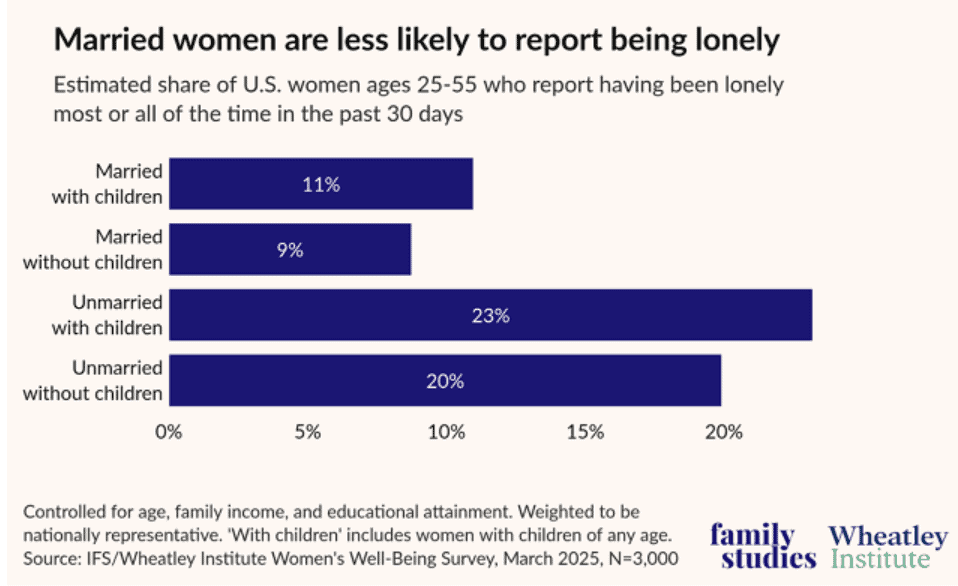
Twenge and her team report “married women are only about half as likely as unmarried women to often feel lonely.”  Specifically, they note, “Our survey finds that married women are markedly less likely to feel lonely: 11% of married mothers and 9% of married women without children feel lonely most or all of the time, compared to 23% of unmarried mothers and 20% of unmarried childless women” [emphasis added].

Their data show married mothers “are just as likely to say they feel satisfied with their number of friends as other women.” Thus, social connection appears to be richer and more rewarding among married moms, compared to their peers in all other relational situations.

Greater Physical Touch

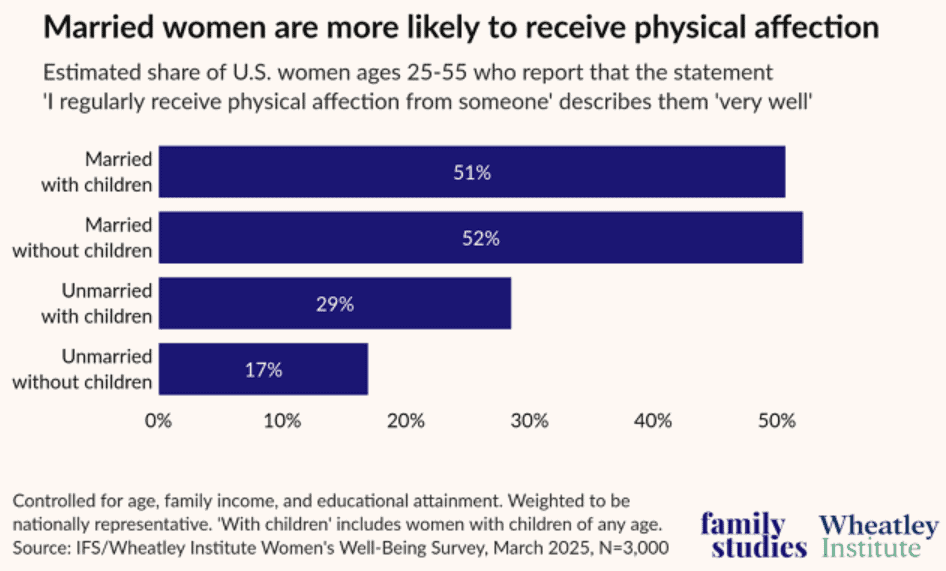
Additionally, this research notes that greater physical intimacy – in terms of hugs, holding hands and welcoming kisses – provided by a husband and children boosts overall happiness and contentedness in life. They state, “In the WWS, married women (both with and without children) report significantly higher levels of touch than unmarried women” [emphasis added]. Fifty-one percent of married mothers received satisfying levels of physical affection while only 17% of unmarried childless women did.

Fifty-eight percent of married mothers report, “Most days I get a hug and a kiss” while only 18% of spouseless and childless women indicate this was true for them. Twenge’s team contends, “Thus, one factor that explains why married women are happier than their unmarried peers is that they have more regular opportunities for kissing, hugging, and snuggling.”

Greater Meaning and Purpose in Life

A final characteristic driving greater happiness in married moms is finding markedly more meaning and purpose in life. WWS survey data shows married women with children are “most likely to report a clear purpose in life” believing that “what I do in life is valuable and worthwhile.” Thirty-three percent of married moms indicate this, while only 20% of unmarried childless women do. Add to this the fact that 49% of married mothers say their “life feels meaningful all or most of the time” while only 32% of unmarried women without kids do.

These researchers also found that yes, motherhood comes with challenges. “Mothers are more likely than non-mothers to feel overwhelmed and exhausted each day.” Married and unmarried mothers also say they have less time for themselves. But this report holds, “Yet, as we have shown, married mothers simultaneously report greater happiness, meaning and purpose.”

Happiness and contentedness are not life goals one runs directly toward. They are the fruit of giving our lives to others, namely a spouse and our children. That is the wonder of family. These scholars end with this strong statement,

Contrary to the common narrative that women who marry and have children are unhappy, the 2025 Women’s Well-Being Survey finds that married mothers are happier than women who are unmarried and women who do not have children. Marriage appears to offer a stabilizing and supportive context that lifts the burdens of motherhood, while strengthening happiness, connection, and meaning.

More young women should know about important, well-documented research findings like this and stop listening to a culture that has it precisely wrong. Happiness and satisfaction are possible and they are more likely to be found in marriage and motherhood.

Related Articles and Resources

Married Mothers and Fathers Are Happiest According to Gold-Standard General Social Survey

Yes, Married Mothers Really Are Happier Than Unmarried and Childless Women

New Research: Marriage Still Provides Major Happiness Premium

Marriage and Family Improves Happiness Far More Than a Pay Raise

Why You Should Care About the Growing Positive Power of Marriage

Family Scholars Explain the Current Marriage Paradox in America

New Research Shows Married Families Matter More Than Ever

Why Marriage Really Matters – 3 Focus on the Family Reports

Research Update: The Compelling Health Benefits of Marriage

Cohabitation Still Harmful – Even as Stigma Disappears

Don’t Believe the Modern Myth. Marriage Remains Good for Women

Don’t Believe the Modern Myth. Marriage Remains Good for Men.

Image from Shutterstock.

Written by Glenn T. Stanton · Categorized: Culture · Tagged: IFS, Random

Aug 20 2025

Could the Divorce Decline Actually Be Bad News?

Daily Citizen has been tracking the long, slow decline in divorce rates in America, here, here, here and here.

But what if that is not actually good news for marriage and the family? It seems like a counter-intuitive thought, but that is what a family scholar at the Institute for Family Studies (IFS) wants us to consider. She makes an interesting and important point.

First, let’s address two big misunderstandings when it comes to divorce.

Most people assume the risk of divorce for couples marrying today is 50%. It is not. It’s actually about 42%. But as research done by Focus on the Family demonstrates, many couples marrying today have a dramatically lower risk of lifetime divorce because they have made life choices and have advantages that dramatically elevate their risk of building a successful marriage.

The other misunderstanding is that almost nine out of ten people assume the divorce rate is rising in the U.S. but it is not. Divorce has steadily declined from its historic high in 1980, to a 50-year low today.

So, why might this remarkable divorce decline not be good news? Leah Libresco Sargeant, the author of the IFS piece, explains “the story of declining divorce isn’t primarily a story of stronger marriages, but of a failure to make matches in the first place.” She is correct on the decline of marriage.

The U.S. Census Bureau reports (May 2024) that married-couple households made up 47% of all U.S. households in 2022, down from 71% in 1970.

The National Center for Family & Marriage Research (NCFMR) at Bowling Green State University notes the U.S. marriage rate has declined 54% from 1900 to today. That rate peaked in 1920 at 92.3%, almost triple today’s rate.

Pew Research Center reports (2023) a dramatic 4-fold increase since 1980 in never married adults in the U.S., a record high. As of 2021, 25% of 40-year-olds in the United States have never married. This is a dramatic increase from 6% in 1980. While many of these unmarried 40-year-olds are living with a romantic partner, most are not. In 2022, 22% of never-married adults aged 40 to 44 were cohabiting. And 80% of marriages taking place today are preceded by some form of cohabitation. Singleness and cohabitation are the relational growth markets.

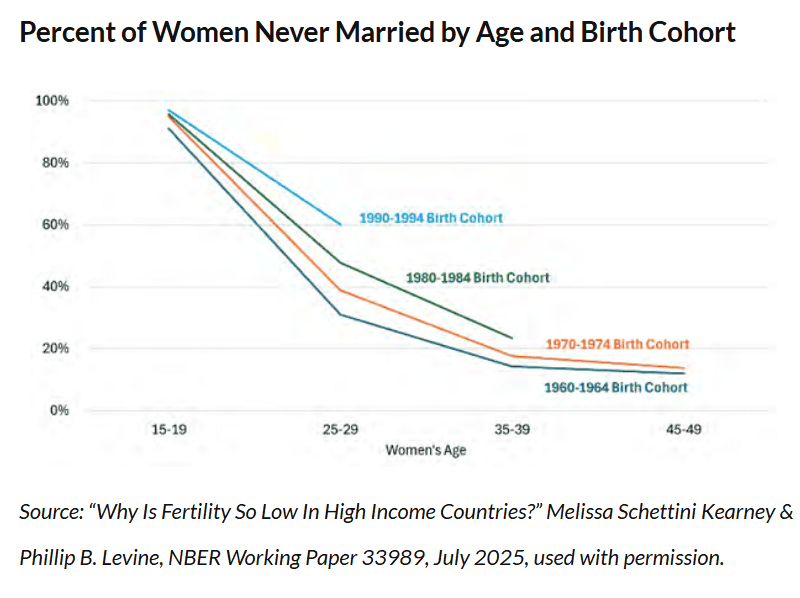
Sargeant highlights a trend graph by generational birth cohort from a new and important National Bureau of Economics Research working paper addressing why fertility is so low in high income countries. It’s related to declining marriage rates.

Marriage has been declining sharply for multiple generations. The noted economics paper explains “marriage and fertility remain tightly linked, even in high-income countries today.” The two authors, Melissa Schettini Kearney and Phillip B. Levine, note, “The data reveal that as a descriptive matter, the decline in fertility in high-income countries corresponds to a decline in marriage.”

So, when the population of people marrying declines, so does the pool of people who could possibly get divorced. Sargeant asks, “So, what would represent genuinely encouraging news about marriage in America?”

Her answer, “It would help to see the divorce rate decline while marriage rates rise. Then we might have reason to believe that people were getting better at being married, rather than that our culture was convincing people to give up on marriage.

She adds, “One statistic I’d like to see is how many people of marriageable age can point to strong examples of successful marriages, especially of peers just a few years ahead of them. …When marriage declines, young singles are in a negative feedback loop – they see fewer examples and so marriage becomes more abstract and less achievable.”

We must all lament that growing numbers of men and women are making choices away from marriage and parenthood. Sargeant concludes, “No matter how good that makes the divorce toplines look, that’s still bad news for American families and America’s future.”

As our nation works to recover in so many areas, rebuilding our crumbling marriage and fertility rates must be chief among them. Without families and babies, there is no nation, there is no future.

Related Articles and Resources

If you or someone you know is struggling with marriage issues, Focus on the Family offers a one-time complimentary consultation with our ministry’s professionally trained counseling staff. The consultation is free due to generous donor support.

To reach Focus on the Family’s counseling service by phone, call 1-855-771-HELP (4357) weekdays 6:00 a.m. to 8:00 p.m. (Mountain Time). Please be prepared to leave your contact information for a counselor to return a call to you as soon as possible. Alternatively, you can fill out our Counseling Consultation Request Form.

New Focus on the Family Report: Marriage Health in America

Research Shows New Data on Divorce Risk

Premier Research Documents Long-Term Divorce Harms for Adult Children

Reclaiming the Truth About Marriage

Four Things to Enhance Marital Happiness Among Wives

Research Update: The Compelling Health Benefits of Marriage

Important New Research on How Married Parents Improve Child Well-Being

How Marriage Fights Against Deaths of Despair

New Research: Marriage Still Provides Major Happiness Premium

Don’t Believe the Modern Myth. Marriage Remains Good for Men

Harvard Evolutionary Biologist Brilliantly Explains Necessity of Monogamous Marriage

Image from Shutterstock.

Written by Glenn T. Stanton · Categorized: Marriage · Tagged: divorce, IFS, Random

Aug 19 2025

Necessities Versus Luxuries When Raising a Family

Writing for our friends at the Institute for Family Studies, Erica Komisar, a psychoanalyst and author, makes an interesting observation about two recent major articles involving motherhood in the New York Times and the Wall Street Journal.

It seems that the pieces, both of which focused on conservative women, spent the vast majority of attention on the mother’s point of view and very little centered on what’s best for their children

Komisar writes, “I’ve spent decades listening to what children tell us — through their behavior, emotional health, and resilience, about what they need most. I’ve witnessed firsthand in the adults that I see in my practice what happens when those needs aren’t met. The research is clear: in the first three years of life, children require consistent, predictable, and emotionally attuned care, ideally from a parent — most often the mother.”

Only Komisar notes most of the talk from the “political left” revolves around personal fulfillment. On the “political right,” she believes there’s too little talk about the economic conditions that “force most mothers into the workforce well before they or their babies are ready.”

There’s no denying that it’s expensive to raise children. Earlier this year, U.S. News and World Report compared current household costs with what the average American home managed back in 1925. A lot can change in a hundred years.

Back in 1925, the average household income was $5,425. In current dollars, that would be the equivalent of $98,968. Not surprisingly, those 1925 dollars went a long way, unlike today’s paychecks. The average new house back in 1925 cost $11,600 – or $211,619 today. In the second quarter of 2025, the average sale price of a house in the United States was $410,800. Back in 1925, a Model T Ford cost $260 or $4,743 in today’s dollars.

It could be argued, though, that relatively speaking, stretching dollars has always been a challenge – though some generations have undoubtedly faced unique circumstances. In recent years, the cost of basic household expenses has soared for a variety of reasons, including a consequence of bad economic policy, inflation and an ever-evolving understanding and expansion of what’s a necessity versus what is a luxury.

Today’s families face a slew of expenses that weren’t even imagined or considered generations ago, including various technologically based costs: Cellphones, cable, computers, and streaming services. Over the years, lifestyle expectations have skyrocketed – juiced by the power of suggestion communicated via those technological mediums. Everything from housecleaning, home maintenance, traveling sports leagues for kids, and dining out are all impacting the bottom line.

Are any or all of those expenses necessities or luxuries?

Financial guru and talk show host Dave Ramsey has long distinguished between what expenses are critical versus what’s optional by defining and prioritizing what he calls the “Four Walls” – food, utilities, shelter, and transportation.

Of course, there can be plenty of luxuries within those walls, too. We need food, but not excessive amounts or costly processed options. Eating out is often a luxury. We need utilities, but does everyone need air conditioning? We need somewhere to live, but the trend to larger homes raises the question of whether as much space as many now enjoy is needed. Transportation is a necessity, but would a used car suffice? Is a massive new truck a critical purchase? Perhaps. Perhaps not.

Vacations are luxuries, as are travel sports teams, stops at Starbucks, and landscaping services – especially when able-bodied young people live in the home. College may or may not be for everyone, but many families are recognizing and appreciating the economic savings that can be found in nearby community or state colleges. Many who feel led to Christian colleges have enthusiastically pursued scholarship opportunities.

It would be wise, helpful and appropriate to acknowledge the impact and influence economic policy has on family economics. But it would also be wise to expand and pivot the conversation and consider what role individual choice and prioritization also has on the economic pressures many families are currently facing.

Image from Shutterstock.

Written by Paul Batura · Categorized: Family · Tagged: IFS, Paul Random

Jul 24 2025

Research Shows New Data on Divorce Risk

The lifetime risk of divorce is not 50%, as so many assume.

This is the finding from a new sophisticated research analysis from the careful scholars at the Institute for Family Studies (IFS). They explain that the hope of a lifelong marriage is “no longer a coin toss.” The analysis was conducted by Yifeng Wan, a postdoctoral research associate at the University of Virginia. He explains, “My best estimate is that about 42% of first marriages today will eventually end in divorce if current patterns persist.”

While a 42% divorce risk is not great news, it is notably lower than the incorrect 50% divorce rate we often hear repeated. It is also important to appreciate that the 42% divorce risk applies to no individual or couple in particular because this is a prediction from overall populations.

As previous research done by Focus on the Family demonstrates, many couples marrying today actually have a dramatically lower risk of lifetime divorce because they have made life choices and have advantages that dramatically elevate their risk of building a successful marriage. This includes things like not cohabiting or engaging in sexual intimacy prior to marriage, sharing a common serious religious faith, growing up in an intact family, and marrying before having children.

This helpful new report from IFS is very beneficial because it explains the demographic complexities of predicting divorce risk in a very concise and straightforward way. Intelligent and quick, it’s valuable reading for all curious students of the family. You can access it here.

Related Articles and Resources

Premier Research Documents Long-Term Divorce Harms for Adult Children

Reclaiming the Truth About Marriage

Four Things to Enhance Marital Happiness Among Wives

Research Update: The Compelling Health Benefits of Marriage

Important New Research on How Married Parents Improve Child Well-Being

How Marriage Fights Against Deaths of Despair

New Research: Marriage Still Provides Major Happiness Premium

Family Scholars Explain the Current Marriage Paradox in America

New Research Shows Married Families Matter More Than Ever

Cohabitation Still Harmful – Even as Stigma Disappears

Don’t Believe the Modern Myth. Marriage Remains Good for Women

Don’t Believe the Modern Myth. Marriage Remains Good for Men.

Yes, Married Mothers Really Are Happier Than Unmarried and Childless Women

Married Fatherhood Makes Men Better

Marriage and the Public Good: A New Manifesto of Policy Proposals

Image from Shutterstock.
Written by Glenn T. Stanton · Categorized: Marriage · Tagged: IFS, Random, Study

  • Page 1
  • Page 2
  • Go to Next Page »

Privacy Policy and Terms of Use | Privacy Policy and Terms of Use | © 2025 Focus on the Family. All rights reserved.

  • Cookie Policy