• Skip to main content
Daily Citizen
  • Subscribe
  • Categories
    • Culture
    • Life
    • Religious Freedom
    • Sexuality
  • Parenting Resources
    • LGBT Pride
    • Homosexuality
    • Sexuality/Marriage
    • Transgender
  • About
    • Contributors
    • Contact
  • Donate

marriage

Sep 03 2025

Will Taylor Swift’s Engagement to Travis Kelce Ignite a Wedding Boom?

Can marriage be contagious?

The news of Taylor Swift’s engagement to Kansas City Chiefs’ star Travis Kelce on August 26 lit up the internet and various social media platforms. Within the first 24 hours of the announcement, the couple’s joint Instagram post generated 30 million likes. It’s currently north of 36 million, a distinction that makes it one of the site’s most popular posts of all time.

One can be forgiven or sometimes even encouraged to ignore celebrity relationship news or gossip. More than half the time it’s likely wrong, tawdry or downright unproductive. But the paparazzi nevertheless still chase and report – and the public often gobbles it up.

There’s no denying the fact that Taylor Swift is a cultural phenomenon. Born and raised on a Christmas tree farm in Reading, Pennsylvania, her first album debuted when she was in the 9th grade. Her latest “Eras Tour” grossed more than two billion dollars – an industry record.

Travis Kelce broke his silence about the engagement earlier this week on his brother Jason’s podcast, telling the retired NFL player that he’s enjoyed communicating the couple’s plans to marry to family and friends.

“It’s been really fun telling everybody who I’m going to be spending the rest of my life with,” he said. Beyond their initial statement, Taylor Swift hasn’t yet spoken publicly about the engagement.

Emily Rella is an editor for People Magazine. A day after the announcement, she published an essay on the site celebrating the news and included these thoughts:

“As a millennial, our current cultural examples of love — true, soulmate-level, real L love — aren’t exactly a dime a dozen. This notion of yearning and desire and all-or-nothing, consuming passion feels less realistic, with the fairy tale ending seemingly out of reach. It’s not so much that millennials stopped believing in love in some jaded, brooding way … I think it’s more so that we’ve become more comfortable with the idea that it might not happen for us in the way we once dreamed of when we were younger. “

Rella is openly expressing what many academics and counselors have been writing, speaking and sharing for years. Focus on the Family has long cautioned about the fanciful idea of finding one’s perfect “soulmate” and have suggested that fairy tale endings are just that – unrealistic and fictitious tales that are likely to lead to disillusionment, disenchantment and disappointment.

But given the volume and energy behind the “Swiftie” brigade, will this one engagement lead to others? Can romance and marriage be contagious?

Sociologists call this phenomenon a “behavioral contagion” – a tendency for someone to imitate what they observe and experience with others, sometimes even subconsciously. While the term may be relatively new, the trend isn’t. There’s a reason most people used to marry young, have lots of children and usually stay married the rest of their lives. They did so because most of the people in their circle lived like this and so deviating from the norm was, well, abnormal.

One could make the argument that simply getting married just because other people are getting married is a recipe for disaster and eventual divorce. To be sure, couples should prayerfully, deliberately, and thoughtfully pursue marriage. There are many things to consider, and none of them should include trying to copy Taylor Swift and Travis Kelce.

Yet it’s a very good thing when young people, especially, are excited about the prospect of marriage. It’s a good thing for them to see others happily married, to recognize that a stable and steady union is healthy and preferable to the chaos of what is often modeled in popular culture.

It’s unclear where Taylor Swift and Travis Kelce are spiritually or how they may view the institution of marriage in a faith context. But if the excitement they’re generating with young fans opens the opportunity for parents and pastors to talk about God’s beautiful gift of marriage with them, that conversation and trend will be time well spent.
Written by Paul Batura · Categorized: Culture · Tagged: marriage, Paul Random, Taylor Swift

Jul 30 2025

Is Marriage Making a Come Back? Scholars Share Some Good News

Nearly all indicators on marriage and married birthrates in America have been moving in the wrong direction over the last few decades. Marriage rates have been declining steadily, 54% overall since 1900. Matrimony has declined markedly among younger adults since 1980. Married births dropped precipitously over this same time compared to growth in births from single and cohabiting mothers. Additionally, cohabitation shot up over the last 40 years, with a shocking 80% of marriages today being preceded by cohabitation.

People are also waiting longer to marry, with age at first marriage increasing to 31 for men and 29 for women. These numbers were 23 for men and 20 for women in 1950.

This bad news seems to be turning round, according to important marriage scholars.

Brad Wilcox, a chaired professor of sociology and director of the National Marriage Project at University of Virginia writes in The Atlantic, saying that marriage “[shows] new signs of resilience.”

Professor Wilcox explains that “reports of marriage’s demise are exaggerated.” Other scholars have noted that it “is not naive optimism to believe that we are on the threshold of a marriage renaissance.”

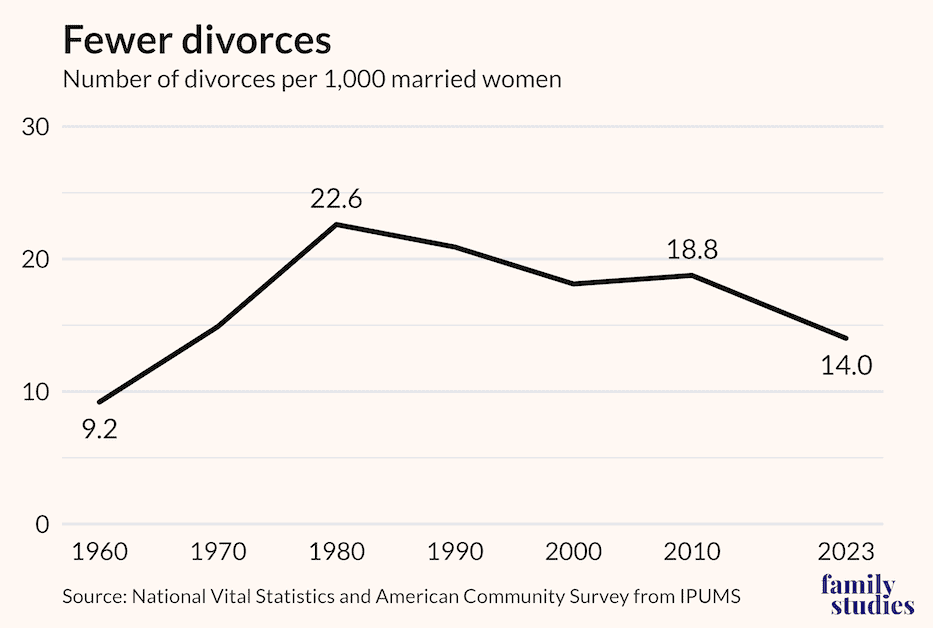
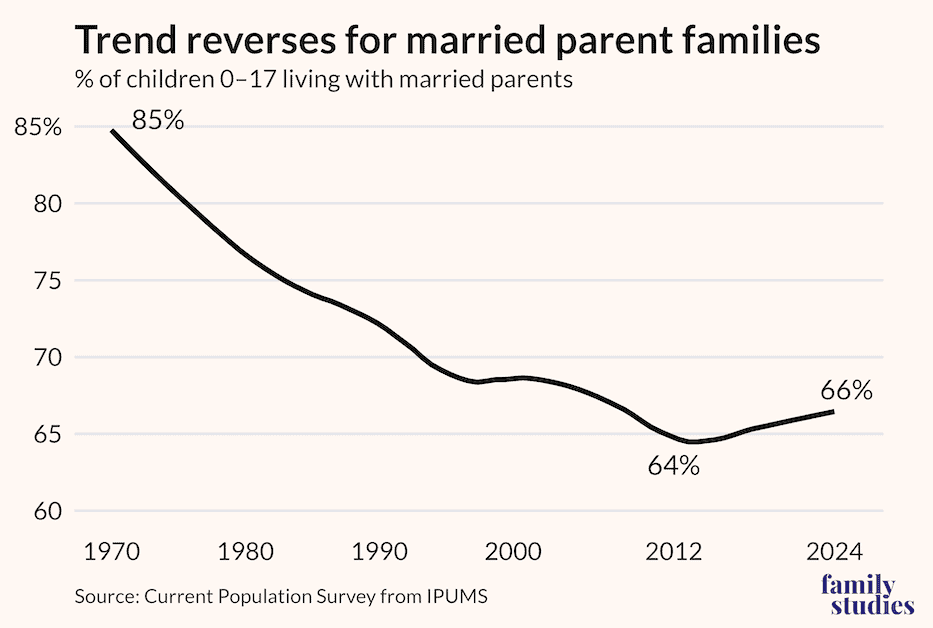
Wilcox explains, “Rather quietly, the post-60s family revolution appears to have ended.” This is most notably indicated by twin facts. Divorce has been declining for some years, and this has been well-established. More recently, the share of children living with two married parents is up.

In a companion story to Wilcox’s Atlantic essay, his Institute for Family Studies demonstrates these trends.

The divorce rate, since the early 1980s, has fallen by nearly 40%. Wilcox remarks much of this improvement “has happened in just the past 15 years.”

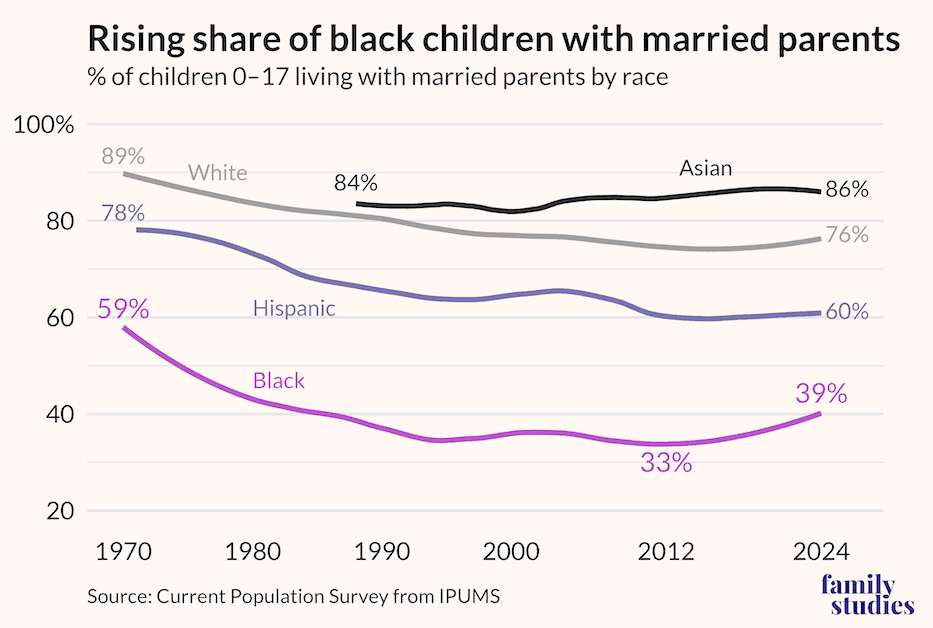
The improving trend in children being born to and living with a married mother and father is more recent to be sure. Wilcox explains, “After falling for more than 40 years beginning in the late 1960s, the share of children living in married families bottomed out at 64% in 2012 before rising to 66% in 2024.”

Married births have also risen among historically challenged racial groups. Wilcox explains “the proportion of black children being raised in a married-parent family rose from 33% in 2012 to 39% in 2024.”

Wilcox explains the crucial benefits, saying,

Marriage’s comeback is good news for society: Children raised in two-parent homes are much more likely to graduate from college than those raised in other families, and less likely to be incarcerated. Kids who don’t live with both of their married parents are far more likely to be depressed than those raised in intact families.

He adds,

After surveying the research on child well-being, the economist Melissa Kearney concluded that the “evidence is clear, even if the punchline is uncomfortable: children are more likely to thrive – behaviorally and academically, and ultimately in the labor market and adult life – if they grow up with the advantages of a two-parent home.”

Parents who are married increase these benefits for adults and children in innumerable ways. These facts explain why it is wise to celebrate notable, positive increases in marriage in our culture today. They result in higher levels of human and societal well-being.

Related Articles and Resources:

If you or someone you know is struggling with marriage issues, Focus on the Family offers a one-time complimentary consultation with our ministry’s professionally trained counseling staff. The consultation is free due to generous donor support.

To reach Focus on the Family’s counseling service by phone, call 1-855-771-HELP (4357) weekdays 6:00 a.m. to 8:00 p.m. (Mountain Time). Please be prepared to leave your contact information for a counselor to return a call to you as soon as possible. Alternatively, you can fill out our Counseling Consultation Request Form.

New Focus on the Family Report: Marriage Health in America

Research Shows New Data on Divorce Risk

Premier Research Documents Long-Term Divorce Harms for Adult Children

Reclaiming the Truth About Marriage

Four Things to Enhance Marital Happiness Among Wives

Research Update: The Compelling Health Benefits of Marriage

Important New Research on How Married Parents Improve Child Well-Being

How Marriage Fights Against Deaths of Despair

New Research: Marriage Still Provides Major Happiness Premium

Don’t Believe the Modern Myth. Marriage Remains Good for Men

Harvard Evolutionary Biologist Brilliantly Explains Necessity of Monogamous Marriage

Written by Glenn T. Stanton · Categorized: Marriage · Tagged: marriage, Study

Jul 15 2025

Legalization of Same-Sex Marriage Harms Children and Society

As June marked the 10th anniversary of the legal de-sexing of marriage through the landmark U.S. Supreme Court Obergefell v. Hodges decision, all citizens of good will should consider how this ruling has impacted humanity through children.

We must recognize that the case for same-sex marriage was always about the same-sex family. No one who advocated for this radical redefinition of marriage and family ever considered this was just about adults. It was always about the kinds of homes children in same-sex families would grow up in and how redefining marriage would change family itself.

The journal First Things has a very helpful, short essay explaining just how de-sexing marriage and family by removing the essential male/female binary has harmed children. It is authored by John Bursch, vice president of appellate advocacy at Alliance Defending Freedom and argued against Obergefell before the U.S. Supreme Court in 2015.

Bursch explains, “Marriage, as I argued, has always served a vital function: binding children to their biological mothers and fathers whenever possible. The government’s interest in marriage has never been about adult companionship.”

This is because “the state’s interest in marriage has always been about creating a stable environment in which children can know and be raised by the two people who co-created them.”

That biological, emotional and societal connection serves as the foundation for all civilizations, as Aristotle long ago explained, is not a private preference, but a public good. Obergefell radically transformed marriage and the family into an adult-centric institution based on peculiar adult sexual desires and feelings, claiming it as a fundamental constitutional right. Bursch holds this “effectively eras[ed] the longstanding understanding of marriage as child-centered.”

An examination of the Latin root of the word matrimony or mātrimōnium establishes this ancient and universal meaning of marriage. Mater-monium is the recognition of and provision for the maternal needs, protection and care of mother and child by the father. This is what marriage has been across human history and diverse cultures for profound reasons.

In contrast, Bursch notes,

Most significantly, children are increasingly being brought into the world through practices that intentionally separate them from one or both biological parents, such as anonymous sperm or egg donation and commercial surrogacy. In other words, the law, influenced by Obergefell’s logic, now often prioritizes the desires of adults over the needs of children to know their mother and father.

Every child that same-sex families include are intentionally, by design, denied the very mother or father whose DNA and maternal or paternal parentage these children share, simply to meet experimental adult wishes. Further, these separations a created through the exchange of money. This is always unjust.

Bursch adds, “A just society must be willing to ask hard questions: not only, ‘What do adults want?’ but, “What do children need?” Modern society frequently focuses on the wrong question. We must confront the reality that children need their mother and father, together, whenever possible.”

Bursch ends his important essay with this essential and prophetic observation: “Obergefell may be the law, but it is not the end of the conversation.”

He compels us “to advocate for an understanding of marriage that serves the common good, one that remembers that every child begins with a mother and a father, and that society has an obligation to support that connection wherever possible.”

This is precisely why Focus on the Family will continue to work hard, and encourage others, to overturn Obergefell v. Hodges – so that marriage and family are returned to the rightful understanding of being about mothers, fathers and their children.

Afterall, there is no tomorrow for humanity without this essential societal good.

Image from Shutterstock.

Written by Glenn T. Stanton · Categorized: Family · Tagged: LGBT, marriage, Random

Jun 27 2025

Why Focus on the Family Believes Obergefell Must Be Struck Down

This week marks the 10th anniversary of the landmark U.S. Supreme Court Obergefell v. Hodges decision that radically redefined marriage and the family by nationalizing the de-sexing of both. That is precisely what happens when that court required every state in the union to accept that same sex couplings are every bit as valuable and important as the ageless and life-producing marital and familial union of the two essential parts of humanity in male and female.

Marriage between a man and a woman is a cross-cultural institution that existed before it was defined in human laws. What the court did in Obergefell was a logical impossibility. It has been hailed as a progressive victory, but the result has been terribly regressive.

There are at least four compelling reasons why Obergefell must be struck down.

First, Obergefell neutered our legal conception of what it means to be human. If male nor female are not essential to the family – and this is precisely the defective logic this landmark decision resulted in — both lose any consequential meaning. This is why it was absolutely no coincidence that the transgender movement was launched when Bruce Jenner infamously appeared as “Caitlyn” on the July 2015 cover of Vanity Fair magazine … within hours of Obergefell being handed down! There was no daylight between these two revolutionary events because one follows from the other.

If male and female have no essential, distinctive meaning for the family, they then have no real meaning for society. People can just assume new “gender identities” at will … and they are.

Second, Obergefell should be overturned because it does a dramatic injustice to children by asserting children have no fundamental right to be loved and cared for by their own mother and father. Every same-sex family, by definition and design, denies every child it contains the maternal and paternal love he or she craves and requires. And does so to fulfill novel adult wishes. Thus, Obergefell establishes the right of adults to form experimental sexless families over any child’s right to his or her own mother and father. This is always immoral, full stop.

Third, Obergefell fails to protect women by casually dismissing the essential power, quality and character of the feminine. It was largely males who argued most persuasively for this redefinition of marriage, demonstrated in numerous early books on the topic, here, here, here, and here. And if the family headed by two males does everything and meets every need that a wife and mother can – and this is, after all, precisely the claim of gay marriage proponents and the reasoning of the Obergefell majority – then the feminine half of humanity becomes meaningless. This created the worst and most dramatic brand of misogyny.

Fourth, Obergefell is based on bad law. As Justice Clarence Thomas correctly explained in his dissent to the razor-thin majority opinion in Obergefell, “The Court’s decision today is at odds not only with the Constitution, but with the principles upon which our Nation was built.” He then noted an indisputable fact:

[T]he majority invokes our Constitution in the name of a ‘liberty’ that the Framers would not have recognized, to the detriment of the liberty they sought to protect.

The Constitution provides no right to so radically change and redefine the essential human institution of marriage and family that predate all human law. Obergefell, just like Roe v. Wade before it, is radically bad law because it is extra-constitutional. It is usurped legislative power.

Obergefell compels all Americans to do the impossible: assent to the radical idea that male and female are merely optional for the noble and essential purposes of marriage and the family which are universal human truths given by God to all of humanity in His wise goodness. That decision put us on a vast, untested experiment with the family and our very understanding of what it means to be human as male and female.

Some warned gay marriage would lead us to slippery slopes. It certainly has. But the wildest imagination never considered it would create this wildly popular cosplay misogyny or this full frontal assault on mothers and fathers. The intentional queering of the family wrought all this and our nation’s Supreme Court enabled it ten years ago this week.


For all these reasons and more, Focus on the Family strongly calls for the overturning of Obergefell v. Hodges and we will work hard to achieve that end.

Written by Glenn T. Stanton · Categorized: Culture, Family · Tagged: family, marriage, Obergefell

May 13 2025

Is the Global Population Decline Linked to Happiness Decline?

It is clearly documented that global population is tanking in most parts of the world. Could this decline be related to declining happiness, worldwide? There is interesting data indicating this could be the case.

In a recent article over at Public Discourse, professor Margarita Mooney Clayton, who teaches practical theology at Princeton Theological Seminary, asks “What are the social implications of a world with fewer children?” It is important to note that we are having fewer children, largely below replacement level, not because of any outside force discouraging us. We are doing so by choice. We are choosing not to marry in greater numbers and increasingly putting education and career before producing the next generation of humanity. This comes with certain substantial costs, namely a threatened human future and declining overall happiness.

Professor Clayton explains,

As it turns out, the freedom to pursue our self-interest without the constraints of marriage and children does not lead to happiness. On average … research shows married people with kids are happier than their single and childless counterparts.

Daily Citizen has documented the research showing this fact over the past few years here, here, and here. There are other research-based indicators that children lead to greater happiness. In the Gallup research group’s 2025 World Happiness Report, they have a whole chapter on how growing families foster greater happiness globally. Their scholars state, “Happiness is nurtured in relational spaces and the family is at the heart of these connections.” They note that “two-parent households are associated with higher levels of life satisfaction among adult members, while adults living in single-person and single-parent households tend to experience lower levels of happiness.”

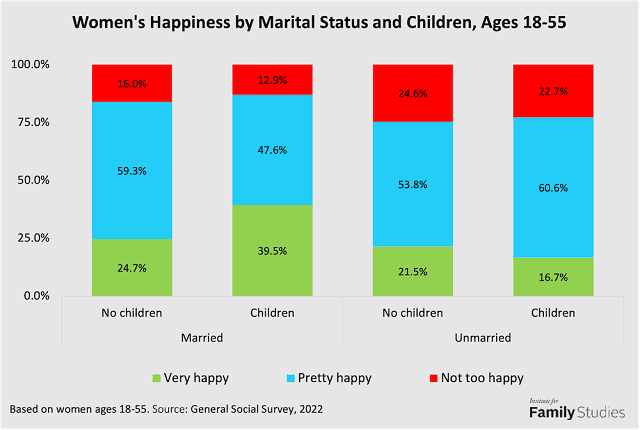
Data from the 2022 edition of the General Social Survey – what the Institute for Family Studies (IFS) calls “the nation’s preeminent social barometer” – shows that “a combination of marriage and parenthood is linked to the biggest happiness dividends for women.”  Leading IFS scholars Brad Wilcox and Wendy Wang add, “Among married women with children between the ages of 18 and 55, 40% reported they are ‘very happy,’ compared to 25% of married childless women, and just 22% of unmarried childless women.”

The happiness differentials for U.S. married mothers looks like this.

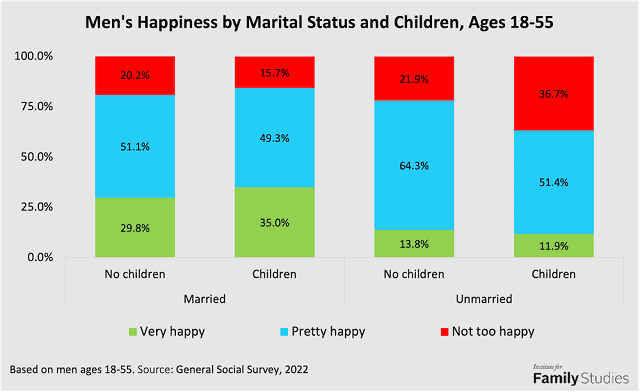
The happiness differentials for married fathers are similarly positive.

Wilcox and Wang explain,

By contrast unmarried childless men, and especially unmarried fathers are the least happy – with less than 15% of these men saying they are “very happy.” In other words, married men (ages 18-55) in America are about twice as likely to be very happy, compared to their unmarried peers.

Professor Clayton correctly observes at Public Discourse,

Children easily pour love into anyone around them, instantly expanding our hearts. If we stop being around children, it’s no wonder the American heart is closing. 

She is absolutely correct, concluding “Happiness is not an achievement; it’s a gift. Children are a blessing.” As the IFS scholars summarize, “As difficult as marriage and parenthood can be, in general, men and women who have the benefit of a spouse and children are the most likely to report that they are ‘very happy’ with their lives.”

Say “Yes!” to having children … and enjoy greater overall happiness.

Related Articles and Resources

Married Mothers and Fathers Are Happiest According to Gold-Standard General Social Survey

Why You Should Care About the Growing Positive Power of Marriage

Married Fatherhood Makes Men Better

Family Scholars Explain the Current Marriage Paradox in America

New Research Shows Married Families Matter More Than Ever

Important New Book Explains Why Marriage Still Matters

Research Update: The Compelling Health Benefits of Marriage

Important New Research on How Married Parents Improve Child Well-Being New Research: Marriage Still Provides Major Happiness Premium

Written by Glenn T. Stanton · Categorized: Family · Tagged: family, happiness, marriage

  • « Go to Previous Page
  • Page 1
  • Page 2
  • Page 3
  • Page 4
  • Go to Next Page »

Privacy Policy and Terms of Use | Privacy Policy and Terms of Use | © 2025 Focus on the Family. All rights reserved.

  • Cookie Policy