• Skip to main content
Daily Citizen
  • Subscribe
  • Categories
    • Culture
    • Life
    • Religious Freedom
    • Sexuality
  • Parenting Resources
    • LGBT Pride
    • Homosexuality
    • Sexuality/Marriage
    • Transgender
  • About
    • Contributors
    • Contact
  • Donate

parental rights

Apr 09 2025

Common Spirit Denied Teen Boy Medical Care After Parents Objected to Doctor’s Bizarre Questions

Multi-state health conglomerate Common Spirit refused to serve a Colorado Springs family after parents objected to a doctor’s inappropriate and ideologically driven questions.

Melissa and her husband, Carlos, are no strangers to the medical system’s disregard for parent’s rights. The devout Christian couple shuttled their four children to doctor’s appointments in several different states during Carlos’ more than 20-year military career.

So, when thirteen-year-old Ricardo needed a physical to play football, the couple gave him a heads up.

“I just asked, ‘Hey, if they ask you if they want us to leave the room, are you comfortable with that?’” Melissa explained.

Years earlier, in Virginia, doctors had asked one of their daughters if she was sexually active or used drugs — after asking Melissa to leave the room.

“She didn’t really know what to say,” she recalled her daughter’s hesitance to answer questions alone. “[But] our children [are used] to respecting their elders, so she just said, ‘Okay.’”

When Ricardo said he would be uncomfortable talking to the doctor alone, Carlos and Melissa helped him prepare to say so. Forewarned and forearmed, they hoped their respectful, shy son would feel free to be honest in a way their daughter had not.  

Melissa and Carlos’ forethought paid off; the doctor, a Common Spirit employee, asked them to leave the room before she’d finished Ricardo’s physical. According to Melissa, it wasn’t much of a question:

She said, “Okay, at this point, I’m going to ask your parents to leave.” She didn’t even give him a choice, give us a choice. She made it sound like, “I’m telling you what to do.”

Ricardo’s parents say they were proud and thankful when he politely declined to speak to the doctor alone, despite her obvious disapproval. 

“You could tell she was annoyed by that,” Melissa remembered. “But she said, ‘Okay, I’m going to proceed with my questions.’”

The doctor asked Ricardo, “What gender do you identify as?”

Melissa says she and her husband locked eyes, baffled:

We just kind of looked at each other like, “Wow, that was not a question we heard a few years ago with our daughter.” Things had clearly evolved.

Ricardo was similarly confused. How did his doctor, who had already begun his exam, not know his sex.

“I’m a boy,” he answered, half giggling.

So far, Melissa told the Daily Citizen, she had kept her cool. But then the doctor asked, “What gender are you attracted to?”

“I felt like this was the proper time to speak up. It’s totally inappropriate,” Melissa said. She asked the doctor what her questions had to do with Ricardo’s appointment.

I said, “I’m his mother and I’ve never even asked him these questions — why do you get to ask them?”

Carlos pressed the issue.

I just asked, “Okay, where is this going? [What’s the point?]”
She said, “Well, we want to know if there is sexual and physical abuse.”
Well, then wouldn’t that be the first question out of your mouth?

He believes the conversation could have proceeded much differently under different circumstances.

“If we weren’t in the room, and [Ricardo] were to say he was a member of the opposite sex, then what?” he argued. “What’s the next line of questioning? Are you going to offer [opposite-sex] hormone therapy?”

Common Spirit’s website does not clearly offer “gender-affirming” care. It does, however, financially support organizations that serve the “LGBTQIA+ community.” The website boasts several other phrases commonly associated with gender ideology, including “Diversity, Equity and Inclusion” and “social justice.”

After Melissa and Carlos’ vociferous objections, the doctor left the room, claiming a nurse would return to finish Ricardo’s physical. She soon reappeared, absent a nurse, and said,

I’m no longer comfortable with this appointment, and I don’t think we [Common Spirit] are the right fit for you.

She didn’t even finish Ricardo’s exam.

Melissa called the appointment violating.

“I just felt so violated as mother,” she said. “She violated my values. It was just so wrong in so many ways.”

She continued, heartfelt,

I didn’t have the luxury of a mom and dad. It’s so disheartening to me that, here I am, able to give that to my children, and it’s frowned upon. It’s really sad.

A Common Spirit patient advocate later told the family that the doctor’s line of questioning was unusual, particularly for a routine exam. After promising to bring their case to the higher-ups, she never contacted Melissa or Carlos again.

As far as Melissa knows, the doctor, a bilingual Spanish speaker, is still practicing. She worries about the power the doctor can exercise over Spanish-speaking Christians and their families.

“We’re Latino. In our culture, we have a high respect for doctors almost immediately,” she explained. “If a non-English speaker were to bring her son to a well check, like me, she would more then likely step out of the room if the doctor asked.”

The couple advises parents to prepare themselves, and their kids, to establish firm boundaries in the doctor’s office — because they may be pushed.

We don’t want parents to walk out of an appointment feeling violated, like we did. I’ve started letting a lot of parents know that if you have a son and are going in for a 12-year-old well check or physical, these are the kinds of questions you are going to be asked.

They suggest parents ask kids whether they feel comfortable talking to a doctor alone before heading to the appointment. Given time to prepare themselves, they are more likely to be honest about wanting parents in the room.

If a child says they don’t mind talking to a doctor alone, Melissa says parents should be ready to begin intentional conversations about sex and gender.

You want to be the one to have those conversations with them, instead of a school or a doctor telling them before you’ve even had the opportunity. It’s unfortunate that we have to have these conversations so young. But I think if you don’t tell them, someone will rob you of that and do it themselves.

Melissa and Carlos’ experience should inspire parents to proactively protect their kids from gender ideology. Focus on the Family and its allies have resources to help you do just that. Click on the links below to learn more.

Additional Articles and Resources

Equipping Parents for Back to School

Enfoque a la Familia

FOTF: Transgender Resources

Parent Resource Guide: Responding to the Transgender Issue

Protect Your Kids from ‘Trans’ Activism — Look for These Red Flags

Child’s Online Medical Records Hidden from Virginia Mom

‘Art Club’ Documentary — One Family’s Escape from Gender Ideology, and the Bigger Trend Sweeping the Nation

Exclusive Interview: Colorado Parents Expose ‘Gender Cult’ at Public School in New Documentary

Written by Emily Washburn · Categorized: Family, Sexuality · Tagged: interview, LGBT, parental rights, transgender

Oct 31 2024

Child’s Online Medical Records Hidden from Virginia Mom

All Patches Johnson Inge wanted was to look up the date of her 12-year-old’s check-up. When Carilion Clinic’s online patient portal no longer showed her son’s information, she assumed it was a glitch.

“I thought I would check it out in a few days, and they’d have it fixed,” she told the Daily Citizen.

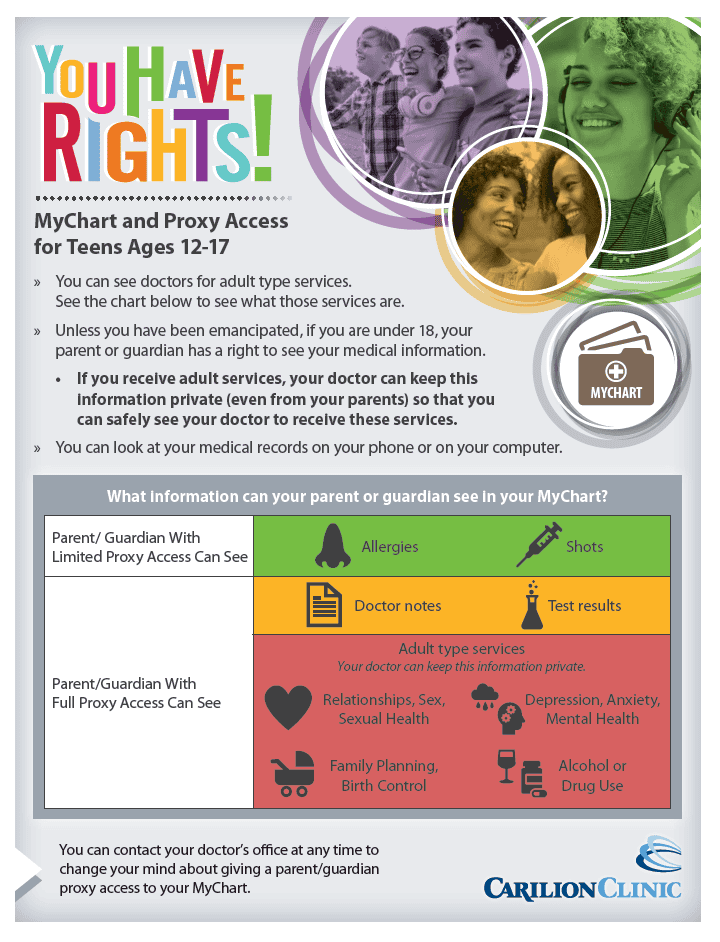
But Johnson Inge’s problem wasn’t a glitch. Carilion Clinic blocks parents’ access to their children’s MyChart account when they turn 12. The policy is spelled out in a colorful pamphlet addressed to children, which the Daily Citizen found buried deep in Carilion’s website. Johnson Inge never saw it.

“Carilion [doesn’t] send you a notification about it,” she explained. “They don’t tell you when you sign up that it’s only good until [your child] turns 12.”

The devoted mother didn’t know anything was wrong until she phoned a friend.

I called one of my girlfriends who takes her daughter to the same pediatrician. I asked, “Are you able to see her records now that she’s turned 12?” I wondered whether you had to renew it or something. She called back and said, “Oh, you’re not going to believe this.”

It was all too real. Carilion had terminated Johnson Inge’s online access to her son’s information. If she wanted it back, they said, her son would have to sign-off in a private meeting with a doctor.

“I told [the employee I was talking to], ‘Over my dead body,’” Johnson Inge recalls. “She was not happy with me when we finished our phone call. But if I allowed that to happen, I don’t know what they would have talked about without me.”

Further communication with a Carilion privacy analyst revealed Johnson Inge and her son would have to visit the doctor in person to restore even limited access to his MyChart account. Carilion’s legal department declined to comment.

Johnson Inge says the bizarre policy violates her parental rights and impedes her ability to care for her son.

Legally, a 12-year-old’s signature means what? Absolutely nothing. They’re not adults. They can’t vote, they can’t drink, they can’t serve in the military. I had to practically sign my life away [at the bank] to let him have his own little kid savings account. Why should he have to give me permission for anything?

She continues,

I pay for him. I drive him everywhere. I mean, he’s my child — my dependent. I feed him. I pay for his school. [My son, my husband and I], we’re a family, and this is just wrong from a pro-family standpoint.

Founding Freedoms Law Center (FFLC), the legal arm of Virginia’s Family Policy Council, tells the Daily Citizen Johnson Inge isn’t alone. Several parents have also reported struggling to access their children’s online medical records at University of Virginia-affiliated clinics.

An FFLC legal fact-sheet for parents like Johnson Inge affirms, “In Virginia, as a general rule, healthcare providers are required to make minors’ medical records available to parents if requested.”

The only exception to this rule is “if the healthcare provider believes that parental review of a minor’s records would be reasonably likely to cause the minor or another person substantial harm.”

So, is Carilion’s treatment of Johnson Inge illegal?

Technically, no. While Virginians have a general right to access their children’s medical records, they don’t have a right to access them online. FFLC is working on a bill that would clarify Virginia parents’ right to access their child’s medical records online and in-person.

Until then, medical groups like Carilion and UVA can continue giving parents the run-around.

But skating by on a legal technicality doesn’t mean hospitals are acting ethically. FFLC’s fact sheet warns that hospitals may not inform parents of all their rights, especially when it comes to online health portals:

Occasionally, parents are told by healthcare providers that they may only have limited access — or perhaps no access at all — to their minor child’s medical records. … Sometimes, parents are even told, inaccurately, that they may not access some or all of their child’s medical records without their teenager’s express authorization.

Carillion’s privacy analyst told Johnson Inge she could still access her son’s information through the hospital’s Medical Records Office. But this right isn’t spelled out anywhere in the PDF laying out Carilion’s MyChart policy.

In fact, the document perpetuates the lie FFLC warns parents against — that kids must consent for parents to see even basic medical information about allergies and vaccinations.

For Johnson Inge, the issue is bigger than medical records or misleading one-pagers. It’s about power.

It’s dangerous [for doctors] to have this level of control over my child and my family. I just think it’s very concerning that they think they can tell me how to run my household or what I have access to for my own child.

Let Johnson Inge’s experience inform the way you interact with the medical system. Consider carefully whether you are okay allowing a physician to talk to your child privately. You can also ask your child if they would feel comfortable talking to a doctor privately, and if not, encourage them to speak up in the doctor’s office. 

Don’t forget to contact your state’s Focus on the Family-allied Family Policy Council to learn about your right to read your child’s medical records online.

Additional Articles and Resources

Selecting a Physician

Doctor Visits and Exam Room Expectations for Parents of Teens

How to Get the Best Care From Your Child’s Doctor

Written by Emily Washburn · Categorized: Culture, Family · Tagged: parental rights, parenting

  • « Go to Previous Page
  • Page 1
  • Page 2
  • Page 3

Privacy Policy and Terms of Use | Privacy Policy and Terms of Use | © 2026 Focus on the Family. All rights reserved.

  • Cookie Policy