• Skip to main content
Daily Citizen
  • Subscribe
  • Categories
    • Culture
    • Life
    • Religious Freedom
    • Sexuality
  • Parenting Resources
    • LGBT Pride
    • Homosexuality
    • Sexuality/Marriage
    • Transgender
  • About
    • Contributors
    • Contact
  • Donate

Random

Sep 16 2025

Evolution is Going Nowhere

According to the “Principle of the Day” posted on August 26 by multibillion dollar hedge fund manager Ray Dalio, “Evolution is the single greatest force in the universe; it is the only thing that is permanent, and it drives everything.”

He went on to declare, “Everything from the smallest subatomic particle to the entire galaxy is evolving. While everything apparently dies or disappears in time, the truth is that it all just gets reconfigured in evolving forms. Remember that energy can’t be destroyed—it can only be reconfigured. So the same stuff is continuously falling apart and coalescing in different forms. The force behind that is evolution.”

If this Psalm to the glory of non-religious materialism sounds religious, it is. Often, those who are most wholeheartedly dedicated to atheism and aimless cosmic progression make proclamations such as “Universe created,” “Nature provided,” or, as Dalio put it, “Evolution drives.” They claim that everything results from a purposeless, pointless series of atomic reactions but then imply this story of the universe is also the storyteller. They talk of evolution as if it is the Mind behind it all, a Mind that may not love us but which, nonetheless, has a plan for our lives. 

In the dramatic opening to his 1980 documentary, Cosmos, Carl Sagan announced, “The cosmos is all that is, or ever was, or ever will be.” Decades later, Neil deGrasse Tyson reincarnated the series by declaring, “A generation ago, the astronomer Carl Sagan … launched hundreds of millions of us on a great adventure.” I doubt he meant to quote Steven Curtis Chapman here, much less to borrow his theistic assumptions, but he saddled up the same horse. 

Even the best attempts to demonstrate that the universe is meaningless tend to smuggle in language of purpose, transcendence, and wonder. And they are every bit as evangelistic as the religions they often despise in their attempts to convince and convert others. As it turns out, the theistic impulse shows up wherever and whenever human beings try to make sense of their world. The same impulse that drove the ancients to explain the world drives all of us today. The same impulse that led pagans to worship something is seen in the reverence for scientific theories and technological innovation.   

Every worldview assumes that there is a plan to life, even those that deny the Planner. If the materialists are right, “all that is, or ever was, or ever will be” amounts to nothing. There is no “great adventure” to be found or had. All of the high-sounding rhetoric is a way to talk about the entropy that will end in the “Heat Death” of the universe, where all life, light, and order ends in darkness. Life is but a much longer version of Samuel Beckett’s short play, “Breath.” Life begins with a gasp, ends with a gasp, and everything that happens between is garbage. 

This worldview, however, is simply not big enough. G.K. Chesterton said, “The worst moment for an atheist is when he is really thankful and has no one to thank.” Dalio may wish to credit evolution for it all, but he’s really just looking for Someone behind it all, even as He denies that anyone is there. 

But there is Someone there. There is a direction in which the universe is heading. Life is an adventure worth exploring. Even better, He has made Himself known in what He has made, what He has said, and ultimately, in Jesus of Nazareth. As He has said to us in Isaiah 43, “But now thus says the Lord, he who created you, O Jacob, he who formed you, O Israel: ‘Fear not, for I have redeemed you; I have called you by name, you are mine.'”
Written by John Stonestreet · Categorized: Culture · Tagged: Evolution, Random

Sep 08 2025

Where Do Human Rights Come from, Senator?

Last week, democratic Senator Tim Kaine made this bold statement during a Senate Foreign Relations Committee hearing:

“The notion that rights don’t come from laws and don’t come from the government but come from the Creator — that’s what the Iranian government believes. It’s a theocratic regime that bases its rule on Sharia law and targets Sunnis, Bahá’ís, Jews, Christians and other religious minorities. And they do it because they believe that they understand what natural rights are from their Creator. So, the statement that our rights do not come from our laws or our governments is extremely troubling.” 

It’s one thing when a progressive media figure says something like this. For example, back in 2024, Politico’s Heidi Przybyla warned that believing human rights “don’t come from Congress, they don’t come from the Supreme Court, they come from God,” makes one a Christian nationalist! Even so, it’s another thing altogether when a sitting U.S. Senator and former vice-presidential candidate claims that this fundamental Christian belief is indistinguishable from Islamic fundamentalists.  

Kaine’s comments were quickly condemned by fellow Senators and religious commentators for, among other things, rejecting the words of the Declaration of Independence. The Senator also failed to realize that his own belief, that rights come from government, is what every communist, fascist, and totalitarian regime in history believed. Still, the first part of the Senator’s claim is not fully wrong.  

The Mullahs in Iran, like all committed Muslims, believe that human rights come from God. So do Christians. But that is where the similarities end. As Ayaan Hirsi Ali, who has lived in cultures rooted in both Islamic and Christian notions of human rights, “You don’t have to imagine how life would be under Islam. … All you have to do is go to any of these places that Western Civilization has barely touched, and the education you’ll get is much better than Harvard.” 

In fact, though Muslims and Christians agree that our rights come from God, they hold widely diverging views about what those rights are, how those rights should be understood, and how the government should recognize and enforce human rights. That’s because Muslims and Christians hold fundamentally different and conflicting ideas about who God is and who humans are. 

As Ayaan Hirsi Ali also says the God of Islam reveals only his will and demands our submission to it. The true God has revealed Himself in Jesus Christ and offers freedom. The Christian God created humans in His own image. He “determined allotted periods and the boundaries of their dwelling place, [so] that they should seek God, and perhaps feel their way toward him and find him.” Not only does God want to be known, He made humans in such a way as to know Him. Islam refers to God as love but then reveals him to be vindictive and cruel.  

According to Islam, humans have not fallen. According to Christianity, humans are sinful, having inherited a fallen nature from our first parents. If humans are inherently ordered toward sin and evil, then a government run by humans will be prone to abuse its citizens. Thus, it must be ordered toward preserving those rights which God has ordained. In an Islamic society, humans are not seen as bearing God’s image and need only be forced into submission by the state, which is inseparable from the religion.

And so, in practice, Islam looks far more like the totalitarian governments that think of human rights like Senator Kaine does. If humans do not have intrinsic dignity as individuals, individuals must be, at times, sacrificed on the altar of the state or the collective. In just the 20th century alone, Joseph Stalin oversaw the executions of 800,000 perceived political opponents in the Soviet Union, and many put the overall death toll of his policies at 20 million. In China under Mao Zedong, 15 to 45 million people were slaughtered. Cambodia under Pol Pot and Germany must also be put on this same list. Whenever and wherever human rights are attributed to the government, they are trampled. As Chuck Colson often said, “If government thinks they can grant rights, then they can also take them away.”  

The very idea that humans have rights that transcend class and sex, tribe and nation, to the very individual, has had a singular source in history. In his book, A Brief History of Thought, the atheist French philosopher Luc Ferry identified that source:  

“Christianity was to introduce the notion that humans were equal in dignity, an unprecedented idea at the time and one to which our world owes its entire democratic inheritance.”

Written by John Stonestreet · Categorized: Culture · Tagged: John Stonestreet, Random

Sep 03 2025

The Quiet Revival of Gen Z

Back in April, The Bible Society of the U.K. issued a report describing a “quiet revival” across England and Wales. “Church decline in England and Wales has not only stopped,” read the subheading, “but the Church is growing, as Gen Z leads an exciting turnaround in church attendance.” Though the report has its fair share of critics, it launched an essential conversation. 

Last Sunday, James Marriott continued that conversation with an article in the U.K. publication The Times entitled “Full-fat faith: the young Christian converts filling our churches.” Marriott, who labels himself “a dry and desiccated materialist,” described what he called “a comeback for Christianity.” At least part of this comeback is, Marriott thinks, due to a widespread and growing disenchantment with atheism. Once, he wrote: 

“[I]t was widely held that the world was soaring ineluctably along an arc of enlightened progress. We were all destined to become richer, more democratic, more just, more rational and more secular. But those optimistic beliefs have been sorely tested in difficult recent years. Anyone tempted to simply dismiss the idea that religion could ever revive may not grasp how dramatically the cultural and economic landscape inhabited by young people has changed.” 

Instead of the utopia that was promised, the post-9/11 reality included economic disruption, Covid, wokeness, and thought police. As a result, many young people are rebelling to a more traditional form of the Christian faith.

According to Marriott, “If you’re young, the establishment is obviously secular. Nowadays, it is precisely Christianity’s marginal status that lends it glamour and charisma, comparable perhaps to the appeal of exotic-seeming eastern religions in the 1960s.” 

Last week, I spoke about the “quiet revival” in the U.K. with podcaster, author, and apologist Justin Brierley. He was among the first to identify what he called “the surprising rebirth of belief in God.” For example, according to a recent poll of non-Christian, Gen-Z students, 75% said they’d consider attending church if invited. And though church attendance is typically higher on Easter, this past Resurrection Sunday broke records all over Europe. According to one poll, the number of 16– to 24-year-olds in the U.K. attending church at least once a month jumped from 4% in 2018 to 16% in 2024.  

There’s still much to learn about this phenomenon, and it remains to be seen how sticky this new-found faith will be for these young people raised in such highly secular environments. It’s fascinating how, merely a decade ago, we were focused on the rise of “the Nones,” who often claimed the church had let them down. Today, we are talking about the rise of the religious who were let down by secularism.  

One more factor worth mentioning, as Marriott put it (perhaps channeling John Calvin) — humans are inescapably religious.

“I suspect the supernatural side of life — not much catered for in secular rationalist democracies—is a constant of human nature, even if only for a minority. It has more room for expression now. If man is a religious animal, God may never really be banished.” 

Indeed, secularism as a worldview is simply not big enough for the God-shaped hole in the human heart. As more young people realize this, the Church has an incredible opportunity to help them find the One who can.

Written by John Stonestreet · Categorized: Culture · Tagged: Random

Sep 02 2025

Chloe Cole Found the One Who is Truth

In his book Begotten or Made?, ethicist and theologian Oliver O’Donovan noted that the vast majority of those who struggle with transgender feelings were middle-aged males. That observation, from 1984, is no longer the case. Today, according to research released last month from UCLA’s Williams Institute, a far greater percentage of teenagers identify as transgender (1.4%) than adults (.5%). Even more, there’s been an explosion of teen and pre-teen females identifying as transgender. 

In her book Irreversible Damage, Abigail Shrier was the first to suggest that the growing rates of transgender confusion among girls was, in fact, a social contagion. Though at the time, she was widely attacked for making this claim, Shrier has been largely vindicated.  

Chloe Cole knows. She was in her early teens when she began to question her identity as female. Voiced from various places immediately chimed in, suggesting she would be happier as a boy. She quickly found a medical community that pushed her to change her body. They saw her, in her words, as “simply being another transition.” 

Chloe’s parents were told if they did not support their daughter’s transition, they would be complicit in her suicide. Backed into a corner, they believed the “live son, dead daughter” myth. Chloe was placed on puberty blockers and testosterone and approved for a double mastectomy, all by the age of 15.  

When she experienced complications from her transition surgeries and drug regimen, her doctors resisted, refusing simple tasks like scheduling regular blood tests or sharing information on her medical charts. A year after she underwent a double mastectomy, Chloe began to realize what had been taken from her.   

Chloe recently told her story on the Strong Women podcast, hosted by my wife Sarah.

“The major turning point of my transition was when I realized just how much of a toll all of this was taking on my body, especially with how sudden the changes were from the surgery and just how grueling the healing process was in every single way. It flipped a switch in my brain.”

“And I had this epiphany that none of this was changing me in any meaningful way. But it was taking away parts of my health and potentially future parts of myself as an adult, as a woman, as somebody who was soon entering adulthood. And I was starting to figure out that one day I wanted to have kids. One day I wanted to get married and actually I was very naturally feminine. I wanted to experience all the great things, all the great trials and tribulations, that come with being a woman, being a girlfriend and then a wife, and all the beautiful things that come with that feminine role. I realized there were a lot of things that I missed about that, and it would break my heart if I never would be able to become a mother.” 

“I really started to reflect on how these changes in my body were actually affecting me. Not only was it a much harder life to live, I also may never be able to reach those milestones of adulthood, of having a traditional marriage, of … having children of my own. And that ended up being the final nail in the coffin of my transition.” 

“All of those feelings, all of the grief that I was going through made me realize I can’t continue this, but I will be able to find a life and personal fulfillment and happiness outside of it.”

REMINDER: Focus on the Family’s Truth Rising debuts this Friday September 5

Written by John Stonestreet · Categorized: Culture · Tagged: John Stonestreet, Random, Truth Rising

Aug 27 2025

Why Married Mothers are Happier than Single, Childless Peers

Most people assume motherhood and the life of wives is one of drudgery, endless chores and meeting the needs of others. Few believe married motherhood leads to greater happiness. We presume it’s the carefree, single girls – not tied down by children or wedlock – who are having all the fun and fulfillment.

But is this really true? Daily Citizen has addressed this question often, here, here, here and here. The fact is, married moms are the happiest and most contented in life compared to their unmarried and childless peers.

A new report from the great scholars at the Institute for Family Studies, led by San Diego State University’s Jean W. Twenge, further demonstrates how true this fact is. In fielding the Women’s Well-Being Survey (WWS) of 3,000 U.S. women in early March, these family scholars sought to understand why married mothers are the happiest among women.

This team reports, “Consistent with previous surveys, our new survey finds that married mothers are happier than unmarried women or women without children.”

In fact, they found, “Nearly twice as many married mothers say they are ‘very happy’ as unmarried women without children.”

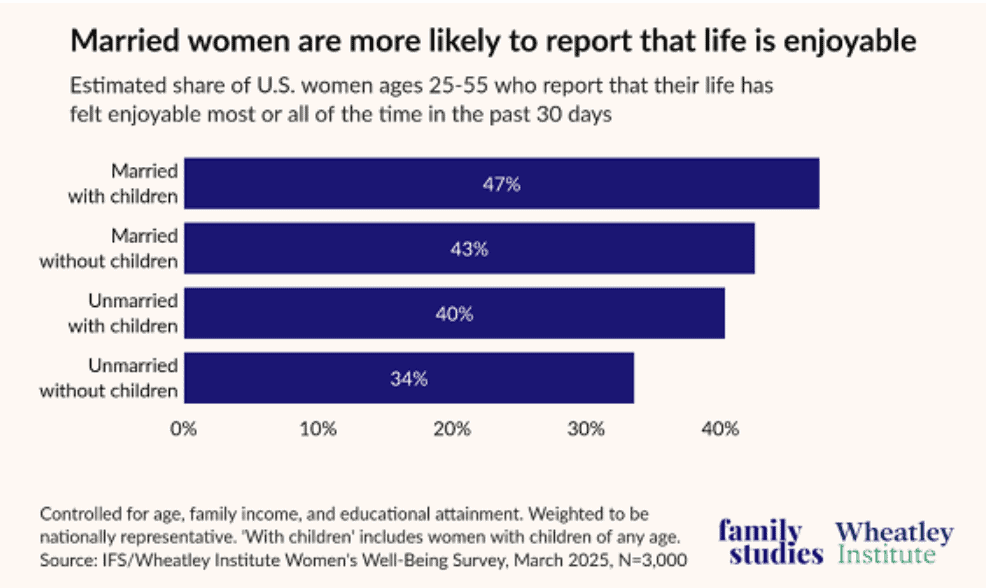
Remarkably, 47% of married mothers report their “life is enjoyable most or all of the time.” Forty-three percent of married women without children indicated this was true. Only 40% of unmarried mothers and 34% of unmarried women without children said their life was highly enjoyable.

This research team then asked: Why are married mothers happier than their peers? They assert, “Both marriage and motherhood appear to play a role, though in different ways.” There are three factors at work here. Married mothers benefit from greater social connection, increased benefit from physical touch and having a greater sense of significant meaning and purpose in life.

Greater Social Connection

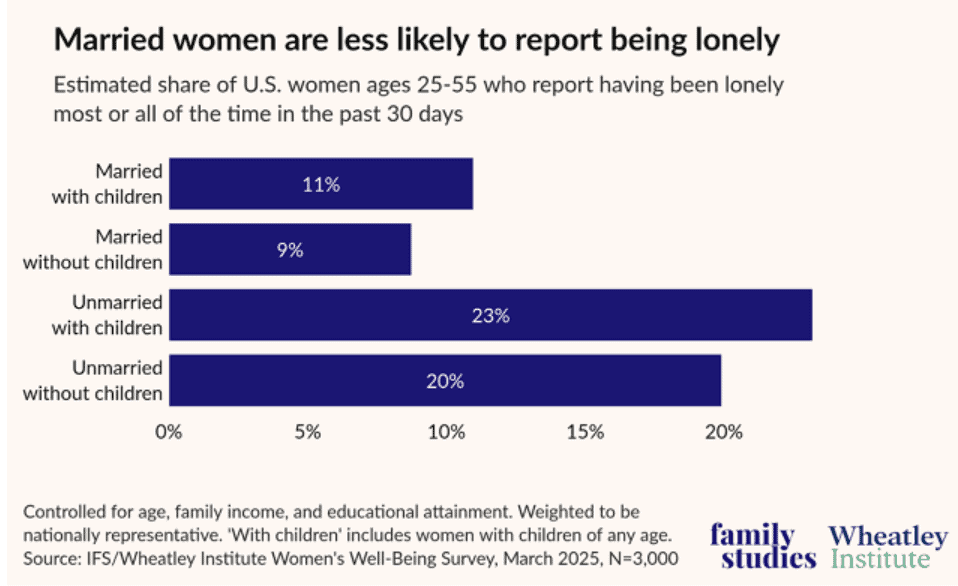
Twenge and her team report “married women are only about half as likely as unmarried women to often feel lonely.”  Specifically, they note, “Our survey finds that married women are markedly less likely to feel lonely: 11% of married mothers and 9% of married women without children feel lonely most or all of the time, compared to 23% of unmarried mothers and 20% of unmarried childless women” [emphasis added].

Their data show married mothers “are just as likely to say they feel satisfied with their number of friends as other women.” Thus, social connection appears to be richer and more rewarding among married moms, compared to their peers in all other relational situations.

Greater Physical Touch

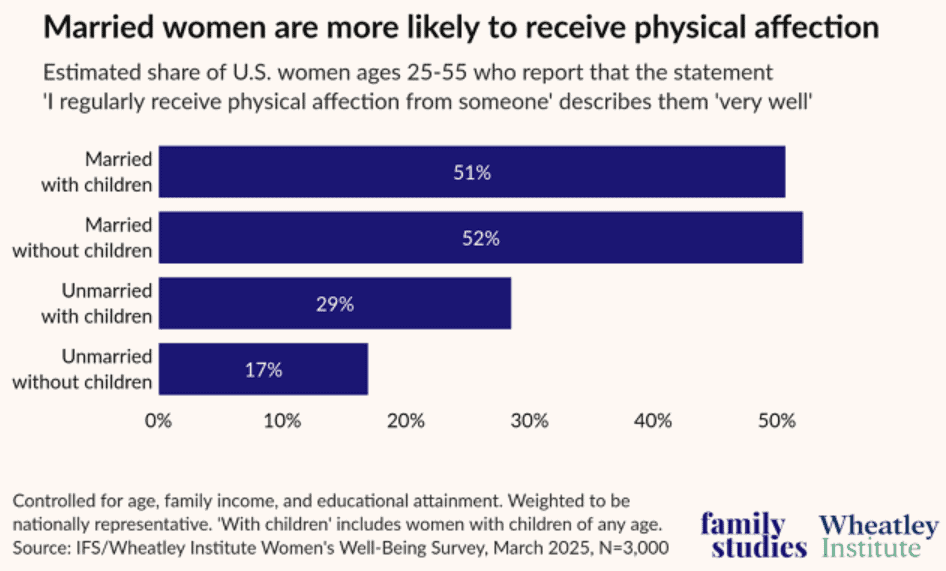
Additionally, this research notes that greater physical intimacy – in terms of hugs, holding hands and welcoming kisses – provided by a husband and children boosts overall happiness and contentedness in life. They state, “In the WWS, married women (both with and without children) report significantly higher levels of touch than unmarried women” [emphasis added]. Fifty-one percent of married mothers received satisfying levels of physical affection while only 17% of unmarried childless women did.

Fifty-eight percent of married mothers report, “Most days I get a hug and a kiss” while only 18% of spouseless and childless women indicate this was true for them. Twenge’s team contends, “Thus, one factor that explains why married women are happier than their unmarried peers is that they have more regular opportunities for kissing, hugging, and snuggling.”

Greater Meaning and Purpose in Life

A final characteristic driving greater happiness in married moms is finding markedly more meaning and purpose in life. WWS survey data shows married women with children are “most likely to report a clear purpose in life” believing that “what I do in life is valuable and worthwhile.” Thirty-three percent of married moms indicate this, while only 20% of unmarried childless women do. Add to this the fact that 49% of married mothers say their “life feels meaningful all or most of the time” while only 32% of unmarried women without kids do.

These researchers also found that yes, motherhood comes with challenges. “Mothers are more likely than non-mothers to feel overwhelmed and exhausted each day.” Married and unmarried mothers also say they have less time for themselves. But this report holds, “Yet, as we have shown, married mothers simultaneously report greater happiness, meaning and purpose.”

Happiness and contentedness are not life goals one runs directly toward. They are the fruit of giving our lives to others, namely a spouse and our children. That is the wonder of family. These scholars end with this strong statement,

Contrary to the common narrative that women who marry and have children are unhappy, the 2025 Women’s Well-Being Survey finds that married mothers are happier than women who are unmarried and women who do not have children. Marriage appears to offer a stabilizing and supportive context that lifts the burdens of motherhood, while strengthening happiness, connection, and meaning.

More young women should know about important, well-documented research findings like this and stop listening to a culture that has it precisely wrong. Happiness and satisfaction are possible and they are more likely to be found in marriage and motherhood.

Related Articles and Resources

Married Mothers and Fathers Are Happiest According to Gold-Standard General Social Survey

Yes, Married Mothers Really Are Happier Than Unmarried and Childless Women

New Research: Marriage Still Provides Major Happiness Premium

Marriage and Family Improves Happiness Far More Than a Pay Raise

Why You Should Care About the Growing Positive Power of Marriage

Family Scholars Explain the Current Marriage Paradox in America

New Research Shows Married Families Matter More Than Ever

Why Marriage Really Matters – 3 Focus on the Family Reports

Research Update: The Compelling Health Benefits of Marriage

Cohabitation Still Harmful – Even as Stigma Disappears

Don’t Believe the Modern Myth. Marriage Remains Good for Women

Don’t Believe the Modern Myth. Marriage Remains Good for Men.

Image from Shutterstock.

Written by Glenn T. Stanton · Categorized: Culture · Tagged: IFS, Random

  • « Go to Previous Page
  • Page 1
  • Interim pages omitted …
  • Page 3
  • Page 4
  • Page 5
  • Page 6
  • Page 7
  • Interim pages omitted …
  • Page 17
  • Go to Next Page »

Privacy Policy and Terms of Use | Privacy Policy and Terms of Use | © 2026 Focus on the Family. All rights reserved.

  • Cookie Policy