• Skip to main content
Daily Citizen
  • Subscribe
  • Categories
    • Culture
    • Life
    • Religious Freedom
    • Sexuality
  • Parenting Resources
    • LGBT Pride
    • Homosexuality
    • Sexuality/Marriage
    • Transgender
  • About
    • Contributors
    • Contact
  • Donate

Random

Aug 20 2025

Could the Divorce Decline Actually Be Bad News?

Daily Citizen has been tracking the long, slow decline in divorce rates in America, here, here, here and here.

But what if that is not actually good news for marriage and the family? It seems like a counter-intuitive thought, but that is what a family scholar at the Institute for Family Studies (IFS) wants us to consider. She makes an interesting and important point.

First, let’s address two big misunderstandings when it comes to divorce.

Most people assume the risk of divorce for couples marrying today is 50%. It is not. It’s actually about 42%. But as research done by Focus on the Family demonstrates, many couples marrying today have a dramatically lower risk of lifetime divorce because they have made life choices and have advantages that dramatically elevate their risk of building a successful marriage.

The other misunderstanding is that almost nine out of ten people assume the divorce rate is rising in the U.S. but it is not. Divorce has steadily declined from its historic high in 1980, to a 50-year low today.

So, why might this remarkable divorce decline not be good news? Leah Libresco Sargeant, the author of the IFS piece, explains “the story of declining divorce isn’t primarily a story of stronger marriages, but of a failure to make matches in the first place.” She is correct on the decline of marriage.

The U.S. Census Bureau reports (May 2024) that married-couple households made up 47% of all U.S. households in 2022, down from 71% in 1970.

The National Center for Family & Marriage Research (NCFMR) at Bowling Green State University notes the U.S. marriage rate has declined 54% from 1900 to today. That rate peaked in 1920 at 92.3%, almost triple today’s rate.

Pew Research Center reports (2023) a dramatic 4-fold increase since 1980 in never married adults in the U.S., a record high. As of 2021, 25% of 40-year-olds in the United States have never married. This is a dramatic increase from 6% in 1980. While many of these unmarried 40-year-olds are living with a romantic partner, most are not. In 2022, 22% of never-married adults aged 40 to 44 were cohabiting. And 80% of marriages taking place today are preceded by some form of cohabitation. Singleness and cohabitation are the relational growth markets.

Sargeant highlights a trend graph by generational birth cohort from a new and important National Bureau of Economics Research working paper addressing why fertility is so low in high income countries. It’s related to declining marriage rates.

Marriage has been declining sharply for multiple generations. The noted economics paper explains “marriage and fertility remain tightly linked, even in high-income countries today.” The two authors, Melissa Schettini Kearney and Phillip B. Levine, note, “The data reveal that as a descriptive matter, the decline in fertility in high-income countries corresponds to a decline in marriage.”

So, when the population of people marrying declines, so does the pool of people who could possibly get divorced. Sargeant asks, “So, what would represent genuinely encouraging news about marriage in America?”

Her answer, “It would help to see the divorce rate decline while marriage rates rise. Then we might have reason to believe that people were getting better at being married, rather than that our culture was convincing people to give up on marriage.

She adds, “One statistic I’d like to see is how many people of marriageable age can point to strong examples of successful marriages, especially of peers just a few years ahead of them. …When marriage declines, young singles are in a negative feedback loop – they see fewer examples and so marriage becomes more abstract and less achievable.”

We must all lament that growing numbers of men and women are making choices away from marriage and parenthood. Sargeant concludes, “No matter how good that makes the divorce toplines look, that’s still bad news for American families and America’s future.”

As our nation works to recover in so many areas, rebuilding our crumbling marriage and fertility rates must be chief among them. Without families and babies, there is no nation, there is no future.

Related Articles and Resources

If you or someone you know is struggling with marriage issues, Focus on the Family offers a one-time complimentary consultation with our ministry’s professionally trained counseling staff. The consultation is free due to generous donor support.

To reach Focus on the Family’s counseling service by phone, call 1-855-771-HELP (4357) weekdays 6:00 a.m. to 8:00 p.m. (Mountain Time). Please be prepared to leave your contact information for a counselor to return a call to you as soon as possible. Alternatively, you can fill out our Counseling Consultation Request Form.

New Focus on the Family Report: Marriage Health in America

Research Shows New Data on Divorce Risk

Premier Research Documents Long-Term Divorce Harms for Adult Children

Reclaiming the Truth About Marriage

Four Things to Enhance Marital Happiness Among Wives

Research Update: The Compelling Health Benefits of Marriage

Important New Research on How Married Parents Improve Child Well-Being

How Marriage Fights Against Deaths of Despair

New Research: Marriage Still Provides Major Happiness Premium

Don’t Believe the Modern Myth. Marriage Remains Good for Men

Harvard Evolutionary Biologist Brilliantly Explains Necessity of Monogamous Marriage

Image from Shutterstock.
Written by Glenn T. Stanton · Categorized: Marriage · Tagged: divorce, IFS, Random

Aug 20 2025

Five Courageous Christians

After his amazing victory on Mount Carmel against the prophets of Baal, Elijah fell into deep depression. Not only had he seen God work in a miraculous way, he had proven before Israel Who was the one true God. And yet, he immediately questioned whether God could protect him from Jezebel and (falsely) believed that he was the only true prophet left in Israel:  

“I have been very jealous for the Lord, the God of hosts. For the people of Israel have forsaken your covenant, thrown down your altars, and killed your prophets with the sword, and I, even I only, am left, and they seek my life, to take it away.”

There’s much to learn in this story, both about the vulnerabilities of humans and the kindness of God. For example, I love that the author of 1 Kings includes the detail that God sent an angel to Elijah to help him sleep and cook him food. Also, by informing Elijah of the 7,000 people in Israel who had not bowed a knee to Baal, God was reminding Elijah that He was still very much at work in the world, and that He primarily works through His people. 

God has His people everywhere. Often, He uses unlikely candidates to be courageous voices of truth. The upcoming film Truth Rising tells the story of five courageous voices in this civilizational moment. 

As a young teenager, Chloe Cole was so completely lost and deceived about who she was, she underwent a double mastectomy attempting to be male. God worked in her life to reveal what was true about who she is, and now, having “detransitioned,” she advocates for the truth that humans are made in God’s image, male and female. She is now a powerful force pushing back against the darkness. 

The story of Seth Dillon and the Babylon Bee is the story of the last decade. First, the popular and funny satirical site was cancelled from one of their most powerful channels of influence for saying what is true. Committed, as Aleksandr Solzhenitsyn put it, “to live not by lies,” the Bee refused to take a short cut around truth. But God was at work, and how the story turned out shocked everyone. 

My friend Katy Faust was a pastor’s wife in the northwest with an anonymous blog. She spoke truth about an ideology that subjects children to the whims of adult desire. Then Katy was outed by someone who threatened her and her entire church community. God used that incident to make Katy a leading champion for the rights and wellbeing of children worldwide.  

Courage is not typically a required qualification for bakers, but it was for Jack Phillips. In one afternoon, Jack took a stand when asked to design a cake with a message that was not true. That stand led to thirteen years of attacks by the state of Colorado, and one of the most consequential First Amendment wins of our lifetime. Again, God was at work. 

Perhaps best known among these stories is Ayaan Hirsi Ali, whose faith journey took her from Islam to atheism to Christ. An activist, political leader, and author, Ayaan has now found what she was looking for and believes deeply that God has placed her as a truth teller in a crucial cultural moment. That’s exactly what she’s doing. 

These five stories of courage are fully told in the upcoming Truth Rising documentary. What is obvious in each is that God is at work through His people as much today as He was on Mount Carmel through Elijah. We are not alone. We’ve been called to this time and place.  

Image from Getty.

Written by John Stonestreet · Categorized: Culture · Tagged: Random, Truth Rising

Aug 18 2025

New Report: Over 400 Attacks on Churches in 2024

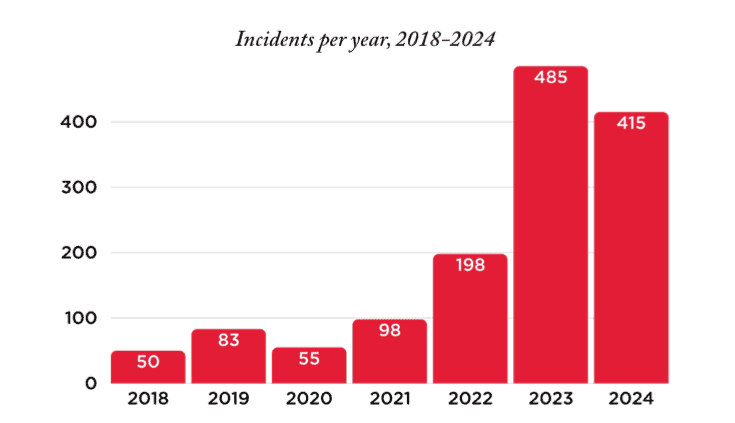
A new report from Family Research Council (FRC) shows that there were 415 attacks on churches in 2024, affecting 383 different churches.  

The report, Hostility Against Churches in the United States: Analyzing Incidents from 2024, explains that these attacks include vandalism, arson, gun-related incidents and bomb threats. Other crimes included “physical assault, disruption of church services, and general threats of harm.”

FRC notes that these are reported attacks, but “many cases likely went unreported to law enforcement or unpublished by news outlets or other publicly available sources,” which the organization relied on as sources for the data.

The organization, which advocates in Washington, D.C., for life, marriage, family, free speech and religious freedom, was founded by Dr. James Dobson in 1983. From 1988 to 1992, FRC was a division under Focus on the Family.

The first report on hostility against churches was published in 2022, but that initial analysis “covered incidents that occurred between January 2018 and September 2022.” While 2023 had the highest number of crimes against churches, at 485, this past year had the second highest number. Overall, there has been a significant increase in attacks on churches since 2018.

The report explains the types of crimes that took place in 2024.

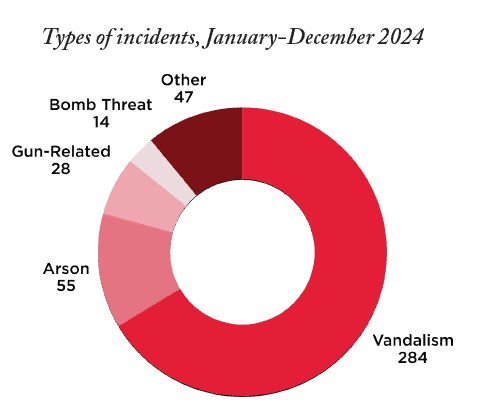
Vandalism was once again the category with the most incidents (284). There were also 55 instances of arson, 14 bomb threats, and 47 “other.” The number of gun-related incidents (28) was more than double the previous year’s total (12). Thirteen incidents fell into more than one category, the most frequent combination being vandalism paired with either gun-related incidents or other forms of physical aggression.

Regarding those acts of vandalism, FRC found,

Some acts of vandalism appear to have been motivated by anger toward a particular church or churches in general. Other incidents seemed to have had political motivations, targeting churches based on their views regarding human sexuality or dignity.

Some perpetrators were juveniles or individuals likely dealing with mental health challenges. A few vandals appeared motivated by financial gain, stealing valuable materials such as copper wiring and air conditioning parts. Several incidents were investigated as hate crimes.

The report indicates our popular culture has become more hostile toward and intolerant of Christianity and “is often treated lightly or outright mocked.”

The report acknowledges that President Trump signed an executive order, Eradicating Anti-Christian Bias to combat animosity toward people of faith. In addition, as the Daily Citizen reported, the president launched a Religious Liberty Commission to safeguard our religious freedom.  

But in a press release, FRC President Tony Perkins spoke about the reality that Christians must continue to battle for the First Amendment guarantee of religious liberty, “Religious freedom is seldom handed to the passive; it is claimed by those who exercise it even when a hostile culture says they may not.” 

This report clearly shows religious freedom faces substantial threats here at home. The American left intentionally spreads its hostility toward the Christian faith throughout every corner of America.

We applaud the efforts of the Trump administration, but efforts must be taken at every level of government to protect and promote this fundamental human right. Christians must expect and demand more from their government leaders when it comes to prosecuting and preventing criminal acts targeting religious freedom.

The report explains, “Not all crimes against churches are motivated by hatred for Christianity,” adding,

“Some vandals appear to be motivated by financial gain through theft, while other culprits are teenagers engaging in a destructive pastime. However, there are still incidents that seem to be targeting churches intentionally and with malicious intent.”

But the overall affect is very harmful to churches and church members.

“Regardless of the perpetrator’s motives, such crimes can leave churches in physical, financial, and emotional disarray. Some churches struggle to cover the costs of repairs and fear future offenses.”

FRC Vice President for Policy and Government Affairs Travis Weber expressed his hope that “Hostility Against Churches” would cause others to “sit up and take notice.”

The fact that hundreds of churches around the United States are denigrated in this manner highlights the broader reality that Christians, Jews, and others are no longer “automatically” safe to live and worship in peace in the United States – a trend that is at work in other Western countries as well.

Government leaders should do their part in ensuring that our laws and constitutional protections for the free exercise of religion are enforced, and our culture and its institutions must do their part in ensuring honor and respect for religious freedom. 

Weber concluded with a warning for believers, saying, “Meanwhile, we must prepare ourselves for how to live amid such hostility, should this trend continue or perhaps get even worse.”

Read the full report, Hostility Against Churches in the United States: 2024.

Related Articles and Resources

300 Attacks on Catholic Churches – In Less Than 3 Years; 82 Attacks on Pregnancy Resource Centers – In Less Than a Year

Global Persecution and Your Faith

Hundreds of Millions of Christians Facing Persecution Worldwide

Is David French Right — Is Our Religious Liberty Secure?

Image from Shutterstock.

Written by Jeff Johnston · Categorized: Culture · Tagged: Random

Aug 06 2025

When Fertility Treatments Don’t Treat Infertility

Last week, a disturbing story broke about the fate of a child acquired through surrogacy. Logan Riley and Brandon Mitchell, “married” men from Pennsylvania, had chronicled their quest for a baby on social media, and that’s how the world learned that Mitchell is a registered child sex-offender due to highly indecent behavior a decade ago. Though forbidden from unsupervised contact with a minor, he was able to buy a baby. 

As Katy Faust of Them Before Us often reminds us, nothing these men did to acquire this baby was illegal. In fact, it’s an extra-legal situation. Unlike the host of regulations and investigations that govern adoption, no such rules apply when it comes to surrogacy. As Faust posted about this incident,  

“This horrifying case of a pedophile acquiring a surrogate boy is opening a lot of eyes. This isn’t adoption. And that’s by design … no part of this process considers the best interest of the child. It is a market-based delivery system for any and every adult to acquire children.”

She later added, “This kind of failing isn’t a bug of the system; it’s a feature.” 

In fact, there are two interrelated systems at work to produce these horrific results. There is the legal system which, as Faust noted in her post, is allergic to any regulation or legal barrier to artificial reproductive technologies, especially those that provide same-sex couples with children. There’s also the artificial reproductive technologies themselves, which are pushing further into uncharted territory day by day. 

For example, L.S. Dugdale recently wrote about eight babies who were made in a lab. Tragically, that kind of thing is not new. Why these particular babies made headlines is that each one carries DNA from three parents, one man and two women.  

As it turns out, the genetic contributions from each adult are not even close to equal. And, as Dugdale put it, “The aim [of this procedure] has not been to create hybrid creatures but to prevent horrific disease linked to mitochondria, the microscopic power generators in the mother’s egg.” That’s noble, until we remember that the aim of IVF and surrogacy was to help infertile couples have children. Now, these ethically fraught practices are being used to help perfectly healthy adults who are not infertile but are naturally sterile, acquire children. Is there any doubt this procedure, known as mitochondrial donation, won’t be used to give polyamorous couples the kind of kids they want, too? 

In another recent piece in The Free Press, Madeleine Kearns described her journey through her own “unexplained infertility.” Multiple doctors recommended IVF as her best and only option, but Kearns instead chose Natural Procreative Technology, a science aimed at treating underlying conditions that affect fertility. As Kearns put it,  

“Revolutionary though it has been, IVF does not restore a would-be mother’s body to optimal health; in fact, IVF is often a profoundly uncomfortable experience for women, not to mention an expensive one. It’s no wonder that many women with “unexplained infertility” are left feeling that mainstream medicine has failed them, subjecting them to stressful, painful interventions, while leaving them in the dark about the mysteries of their own bodies.” 

In other words, what drives most of our artificial reproductive technologies is not the desire to restore health. Rather, these technologies intend to provide adults with what they want, by any means necessary. As medical ethicist C. Ben Mitchell wrote, when “medicine becomes just another consumer good … customers tell the providers what they want, and the providers either respond accordingly or are left behind in the market.”  

The reproductive marketplace is built on twin illusions of consumerism and control. In this world, the almighty “I” should have whatever he or she wants. Those who want sex without children should not be “punished” with a kid. Those who want a child without the trouble of giving birth can rent a incubator for their little accessories. Those who’ve chosen an inherently sterile union can insist, not only that they should be able to have kids, but that others should pay for it. Any future technologies will be utilized accordingly. 

A worldview that insists on absolute autonomy and that “the customer is always right” will corrupt medicine. Christians must offer a better way. In fact, opportunities are ripe for the Bride of Christ to promote healing, become agents of restoration, and advance human dignity … not just by opposing abortion but by ensuring babies aren’t reduced to products to be bought and sold.

Written by John Stonestreet · Categorized: Culture · Tagged: Random

Aug 05 2025

Elite Intellectuals Admit Science Mute on How Human Life Started

An important online forum of leading scientists and intellectuals refreshingly admits science has no real answer and only questions on when and how life began on earth. This is notable because we are often told science is about absolute knowledge while religion is about speculative faith. Of course, this is a false philosophical assumption.  Science must rely on faith and assumption itself.

These authors correctly admit science has uncovered remarkable truths: “Here in our own cosmic backyard, we’ve uncovered a tremendous amount of information about the Universe, discovering many fantastic facts and properties about reality that our long-ago ancestors could scarcely fathom.” This is the profound benefit of science which has a very close relationship with a biblical Christian worldview because both hold to an orderly, systematic universe that can be known and studied. Paganism does not hold such a view.

These scientists correctly admit life is “found only on Earth and not anyplace else we’ve ever looked so far” even as science has confirmed nearly 6,000 exoplanets beyond our solar system. They admit “many burning questions remain unanswered” by science as to how life developed in the first place. Their article presents five of the most pressing unanswered questions science is currently wrestling with.

1. Did life actually originate on Earth?

    They admit life beginning on Earth is the most reasonable conclusion because life has only been found on Earth “and not any place we have ever looked so far.” But since science has no definitive record or explanation for how life arose on Earth, these authors say we must be open to the possibility that life might have originated somewhere else, and was brought to Earth by some means. As this article admits, “the only evidence we have is the presence and record of life on Earth encoded within our own planet, and the lack of signs of life, either related to or independent of Earth-life, elsewhere within our Solar System and our Universe.” This would seem to favor the idea that life started in the only place where it exists, if one takes Occam’s Razor to be true.

    The Judeo-Christian worldview offers an important nuanced explanation that life did originate beyond our earth and was delivered here … by divine orchestrations as we read in Genesis 1. But as far as science can explain, “Whether earth-based life originated on earth or elsewhere in the universe is still an open question.”

    So, science has nothing to say over a biblical perspective regarding this fundamental question of the origins of human existence.

    2. Why is life only found on Earth?

    The second question these authors ask is why Earth is the only planet to win the “life lottery”. Thus, what are the essential qualities that make it unique, and will other planets ever obtain these qualities so that biological life could grow there? They wonder, “What are the minimal sets of ingredients and/or conditions that we need to have a non-zero chance of life coming into existence on such a world?” That is an important scientific question indeed.

    In another article this same science site admits “only our ‘lucky stars’ enabled our existence.” Sounds very similar to a religious or fairy tale answer, doesn’t it?

    Hence, the limits of science.

    They confess, “Here on Earth, all we know is that life came to exist on it, somehow, at some point long ago: as far back as the fossil records can take us, and possibly even earlier than that.”

    They add, “But on all other known worlds, from exoplanets to the planets, moons, and dwarf planets in our Solar System, we have no signatures of life anywhere.”

    The human world is indeed unique.

    3. How do living organisms first arise from non-living ingredients?

    This is related to one of the most vexing questions about our material origins regardless of what philosophy or worldview you hold: How does something arise out of nothing? Science has no credible answer. It cannot speak definitely to origins.

    These authors do show their prejudice to any concept of divine origins, but they thankfully admit that that question is not absolutely rejectable.

    Assuming, as scientists often do, that there’s no “divine intervention” in our Universe – or that the processes that occur in our Universe are purely physical in nature – we’re left with the inescapable conclusion that, at some point, something we would consider “life” arose from what we would consider “non-life.”

    They admit all science has are competing hypotheses on this question. It is unlikely science, as a discipline for understanding things, will ever be able to answer this most important of questions because it lies outside its boundaries of observation and repeatable experience. As they admit, “We have not by any means ever synthesized something that we would classify as a living organism from solely non-biological precursor ingredients.”

    4. Which method of searching for life beyond Earth will be successful?

    Of course, this question largely comes down to a question of technological reach. Will we be able to look far enough to find any existence of life beyond what we have already reached? As NASA has explained, for all the truly profound scientific progress we have made, what we don’t know is exponentially greater than what we do.

    5. Are we actually unique, and alone, as a living planet in the universe?

    This article, as an explanation of the limits of science, was very good until it got to this last question. Here, the authors make this remarkable statement that seems to contradict everything they just said: “In every way that we know how to look at the Universe, there is nothing about Earth, the solar system, or the galaxy and our place in it that appears to be special and unique.” Really?

    How can they conclude that the Earth is not special? Well, they say it right here: “There are no special conditions or properties that we are known to possess, except for the fact that Earth is a living world: the only one known so far.”

    They don’t mean this as sarcasm. But being the only planet in the known cosmos that has life sounds pretty dang unique in anyone’s book.

    And while science has no definitive answer at present to this question, the Judeo-Christian worldview certainly does. It was God who told us that humanity possesses the unique distinction of being created in His very image and likeness. Scripture, in accord with science, does not say life exists anywhere else. It does say human life is unique.

    We should all remember that every belief system has its limits when it comes to human knowledge and our ability to know. Including science.

    For the Christian, faith and science go together. To take one at the exclusion of the other is shortsighted for both scientists and Christians.

    Additional Resources

    No, Science Can’t Answer the Biggest Questions of Life and Existence

    The Limits of Science

    Even Scientists are Warning Scientism is a Problem

    Science and Nature

    Written by Glenn T. Stanton · Categorized: Culture · Tagged: Evolution, Random

    • « Go to Previous Page
    • Page 1
    • Interim pages omitted …
    • Page 4
    • Page 5
    • Page 6
    • Page 7
    • Page 8
    • Interim pages omitted …
    • Page 17
    • Go to Next Page »

    Privacy Policy and Terms of Use | Privacy Policy and Terms of Use | © 2025 Focus on the Family. All rights reserved.

    • Cookie Policy